Snowflake's stock price surges 33%, AI infrastructure expands from chips to the data layer

marsbitPublicado em 2026-05-29Última atualização em 2026-05-29

Resumo

Snowflake's stock surged over 33% after the company raised its full-year revenue forecast and announced a $6 billion, five-year partnership with AWS. This agreement, which secures AWS Graviton chip supply, underscores Snowflake's evolving role in the AI infrastructure landscape. The market's reaction reflects a reassessment of data platforms as critical enablers for enterprise AI adoption. As companies move beyond conceptual AI to building operational, data-integrated AI workflows, demand for robust data storage, processing, and analysis capabilities is increasing. The deal strengthens AWS's custom chip ecosystem while positioning Snowflake not just as a data warehouse, but as a key data layer for deploying and managing AI applications. Analysts have rapidly revised their valuations upwards, signaling a shift in sentiment where proven AI-driven revenue growth is now commanding premium multiples.

Editor's note: The narrative of AI investments is further expanding from chips and models to the data infrastructure layer.

After facing stock price pressure since the beginning of the year, Snowflake saw its stock surge over 33% in a single day after raising its full-year revenue forecast and securing a $6 billion five-year cooperation agreement with AWS. The core of this market reaction isn't just about better-than-expected earnings; it's that investors have started to reassess Snowflake's position in the enterprise AI implementation chain.

Over the past year, enterprise software companies have generally faced a question: Will AI become a growth engine, or will it undermine their existing business models? Snowflake's latest performance and the AWS partnership provide a relatively clear answer—when enterprises start deploying AI applications at scale, the capabilities for data storage, processing, analysis, and model deployment become even more critical.

In this partnership, the supply of AWS Graviton chips addresses the computing power constraint issue, while the deeper integration of the Snowflake platform with AWS AI workloads points to a more profound enterprise need: companies don't simply "use AI"; they need to connect their own data into AI workflows to build operational, manageable, and scalable application systems.

This is also why Snowflake is being re-integrated into the "AI winner" narrative. AI software stocks previously experienced a sell-off, with the market being skeptical about whether "AI can truly contribute to revenue." However, Snowflake's case shows that once AI translates from conceptual demonstrations into real revenue growth, market sentiment can reverse rapidly. The fact that at least 30 analysts raised their price targets illustrates that the capital markets are re-pricing the value of data platforms within the AI infrastructure cycle.

What's even more noteworthy is that this deal also reinforces the presence of AWS's in-house chip ecosystem. From Anthropic, OpenAI, and Meta to Uber, and now Snowflake, Amazon is embedding itself deeper into the AI infrastructure through cloud, chip, and enterprise software partnerships. For Snowflake, this means it is not just an enterprise data warehouse company but is becoming a critical data layer in the process of enterprise AI application implementation.

The original text follows:

May 28—Snowflake's stock surged more than 33% on Thursday. The company previously raised its full-year revenue forecast and announced a $6 billion cooperation agreement with Amazon, bolstering investor confidence in its position as a key beneficiary of the AI boom.

This five-year agreement with Amazon Web Services (AWS) will secure a crucial supply of AWS Graviton chips for Snowflake. Currently, computing resources are becoming increasingly scarce as AI usage grows substantially.

The agreement will also further deepen the integration between Snowflake's data storage, processing, and analytics products and AI workloads on the AWS cloud. As enterprises rapidly scale their AI applications, Snowflake is poised to capture more demand. Currently, most of Snowflake's customers run on AWS.
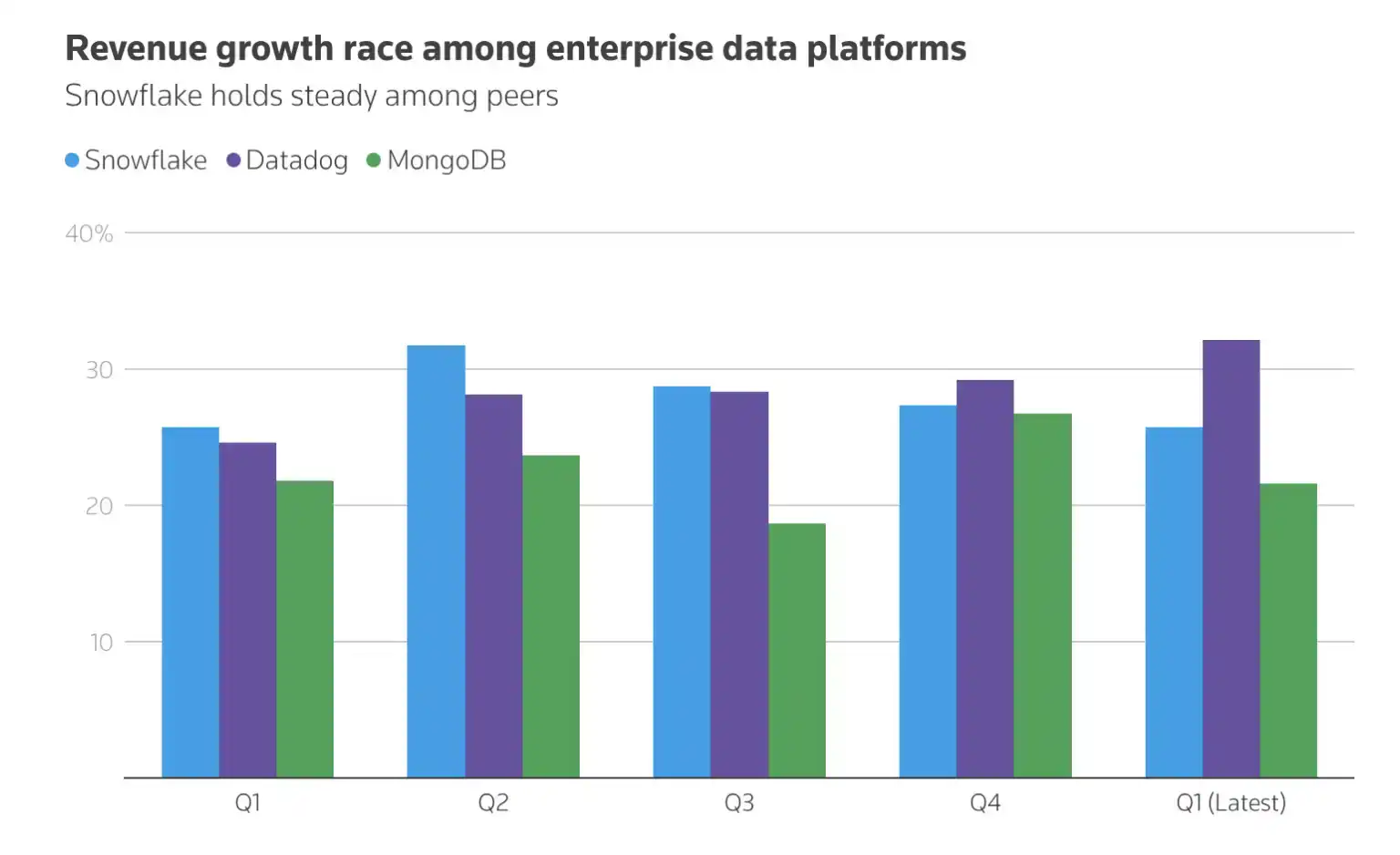
Following the announcement, at least 30 analysts raised their price targets for Snowflake, pushing the median target price from $230 before Wednesday's earnings report to $280. The stock was last trading at $233.50 in early trading.

If the current gains hold, Snowflake's market value would increase by approximately $20 billion from its previous $607.5 billion.

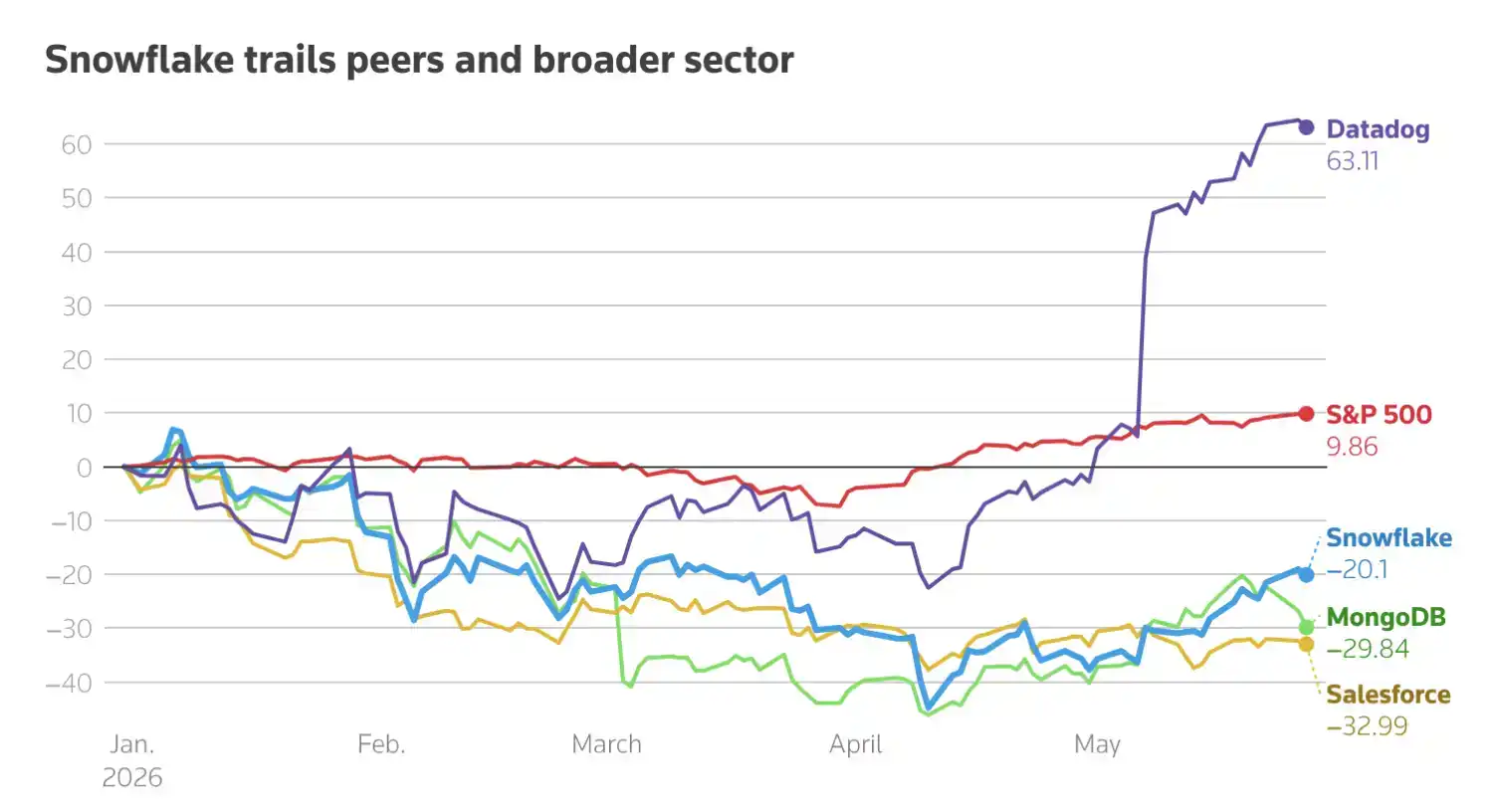
Matt Britzman, a senior equity analyst at Hargreaves Lansdown, stated that Snowflake's sharp stock rise—the stock was down 20% year-to-date before the previous trading day's close—"shows how much skepticism had built up during the wider AI software sell-off that hit data names."

"But it also shows how quickly sentiment can turn once a company proves AI is already driving revenue rather than just being PowerPoint filler."

Currently, Snowflake's forward 12-month price-to-earnings ratio is 85.21 times, compared to 85.19 times for Datadog and 47.17 times for MongoDB. A higher P/E ratio typically indicates investors are betting on stronger future growth.
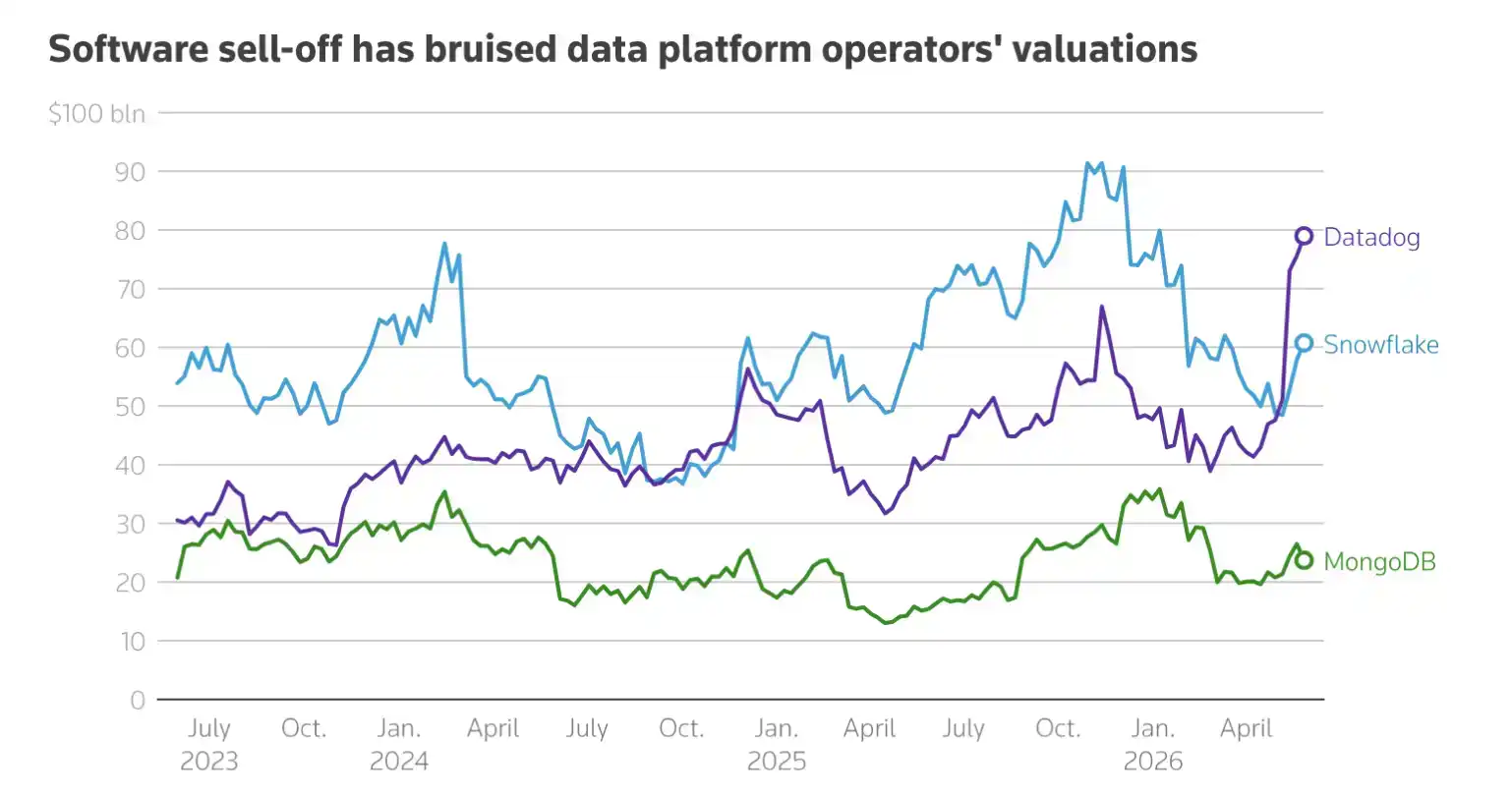
Previously, market concerns that AI would disrupt enterprise software put pressure on Snowflake. Now, the company is embedding AI into its platform, helping businesses integrate data from multiple sources, perform analysis, and build AI tools.

"We believe this set of results puts Snowflake squarely in the 'AI winner' camp and deserves a higher valuation multiple," said Patrick Colville, an equity research analyst at Scotiabank. He added that this clearly indicates Snowflake is benefiting from the growth in enterprise AI adoption.

Snowflake helps businesses store, manage, and analyze all their data on one platform. Its AI tools like Cortex Code and Snowpark are seeing strong adoption. These tools enable enterprises to build generative AI applications based on their own data and deploy machine learning models.

This agreement also serves as another vote of confidence in Amazon's in-house chip business. In recent months, Amazon has secured several significant customers, including Anthropic, OpenAI, Facebook parent Meta, and Uber.
Perguntas relacionadas

QWhat were the two main factors that led to Snowflake's stock price surging over 33%?

ASnowflake's stock price surged over 33% primarily due to two factors: 1) The company raised its full-year revenue guidance. 2) It announced a five-year, $6 billion partnership agreement with Amazon Web Services (AWS).

QWhat does the $6 billion AWS deal specifically provide to Snowflake, and why is it important?

AThe $6 billion deal provides Snowflake with a critical supply of AWS Graviton chips. This is important because as AI usage grows, computing power resources are becoming increasingly scarce and constrained.

QHow does the article describe the shift in the AI investment narrative, and what role does Snowflake now play in it?

AThe article states that the AI investment narrative is shifting from chips and models to the data infrastructure layer. Snowflake is now being re-evaluated as a key data layer, essential for enterprises to integrate their own data into AI workflows and build manageable, scalable AI application systems.

QAccording to the analyst from Hargreaves Lansdown, what does Snowflake's stock surge indicate about market sentiment?

AMatt Britzman from Hargreaves Lansdown stated that the surge indicates how much skepticism had built up during the broader AI software sell-off that dragged down data-related companies. It also shows how quickly market sentiment can reverse once a company proves that AI is driving actual revenue growth, not just being a presentation talking point.

QWhat are some of the specific AI tools offered by Snowflake mentioned in the article, and what is their purpose?

AThe article mentions Snowflake's Cortex Code and Snowpark AI tools. Their purpose is to enable enterprises to build generative AI applications and deploy machine learning models based on their own data.

Leituras Relacionadas

Biology's Paradigm Shift: Zuckerberg's New Open-Source Model Completely Overturns Google's AlphaFold Throne

The AlphaFold era faces a major challenge. A new open-source AI model, ESMFold2, from Meta CEO Mark Zuckerberg's Biohub, has been released alongside a massive database of 11 billion predicted protein structures—surpassing the AlphaFold database by 8 billion entries. Published in Nature, the model is reported to outperform AlphaFold3 in key areas, particularly in predicting protein complexes. Crucially, it is fully open-source with no commercial restrictions. ESMFold2 takes a different technical approach, building on a protein language model trained on billions of sequences, including microbial data from diverse environments like soil and ocean—areas less covered by AlphaFold. The team validated its utility by designing and successfully synthesizing novel functional proteins in the lab. The decision to open-source everything is seen as a strategic move, similar to Meta's approach with its Llama models, aiming to build an ecosystem and accelerate global research. While scientists welcome the resource, some urge caution, noting the need for independent validation of predictions and questioning its performance on entirely novel protein folds. The development signals intensified competition in protein AI, rapidly evolving much like the large language model field, and represents a significant step forward in using AI to decode and engineer the machinery of life.

marsbitHá 9h

Biology's Paradigm Shift: Zuckerberg's New Open-Source Model Completely Overturns Google's AlphaFold Throne

marsbitHá 9h

Trading

Spot
Futuros

Artigos em Destaque

Como comprar LAYER

Bem-vindo à HTX.com!Tornámos a compra de Solayer (LAYER) simples e conveniente.Segue o nosso guia passo a passo para iniciar a tua jornada no mundo das criptos.Passo 1: cria a tua conta HTXUtiliza o teu e-mail ou número de telefone para te inscreveres numa conta gratuita na HTX.Desfruta de um processo de inscrição sem complicações e desbloqueia todas as funcionalidades.Obter a minha contaPasso 2: vai para Comprar Cripto e escolhe o teu método de pagamentoCartão de crédito/débito: usa o teu visa ou mastercard para comprar Solayer (LAYER) instantaneamente.Saldo: usa os fundos da tua conta HTX para transacionar sem problemas.Terceiros: adicionamos métodos de pagamento populares, como Google Pay e Apple Pay, para aumentar a conveniência.P2P: transaciona diretamente com outros utilizadores na HTX.Mercado de balcão (OTC): oferecemos serviços personalizados e taxas de câmbio competitivas para os traders.Passo 3: armazena teu Solayer (LAYER)Depois de comprar o teu Solayer (LAYER), armazena-o na tua conta HTX.Alternativamente, podes enviá-lo para outro lugar através de transferência blockchain ou usá-lo para transacionar outras criptomoedas.Passo 4: transaciona Solayer (LAYER)Transaciona facilmente Solayer (LAYER) no mercado à vista da HTX.Acede simplesmente à tua conta, seleciona o teu par de trading, executa as tuas transações e monitoriza em tempo real.Oferecemos uma experiência de fácil utilização tanto para principiantes como para traders experientes.

304 Visualizações TotaisPublicado em {updateTime}Atualizado em 2025.03.21

Como comprar LAYER

Discussões

Bem-vindo à Comunidade HTX. Aqui, pode manter-se informado sobre os mais recentes desenvolvimentos da plataforma e obter acesso a análises profissionais de mercado. As opiniões dos utilizadores sobre o preço de LAYER (LAYER) são apresentadas abaixo.

活动图片