Coinbase Posts $394 Million Loss In Q1 2026 — And The Worst May Not Be Over

bitcoinistPublicado em 2026-05-08Última atualização em 2026-05-08

Resumo

Coinbase reported a net loss of $394 million for Q1 2026, a sharp reversal from a $65.6 million profit a year ago. This missed analyst expectations as total revenue fell 30.5% to $1.41 billion, largely driven by a 23% decline in transaction revenue due to lower crypto trading volumes and prices. A significant factor was $482 million in unrealized losses on crypto holdings, primarily linked to Bitcoin's price drop. Excluding that, the adjusted net loss was $46 million. While subscription and services revenue remained strong at $584 million and adjusted EBITDA was positive, the results highlight the exchange's continued sensitivity to crypto market cycles. This follows recent workforce reductions and shows operating margin collapsing to -1.5%. The quarter underscores that despite its institutional standing, Coinbase's path to durable profitability remains tied to volatile crypto market conditions.

Coinbase reported a net loss of $394 million for the first quarter of 2026, swinging from a $65.6 million profit in the same period last year and missing Wall Street expectations on both revenue and earnings per share — as a sharp pullback in crypto prices and trading volumes hit the exchange’s core business harder than analysts had anticipated.

The results, reported by Bloomberg after market close on May 7, showed total revenue of $1.41 billion — a 30.5% year-over-year decline and a miss against the analyst consensus of approximately $1.51 billion. On a per-share basis, Coinbase posted a GAAP loss of $1.49 against expectations of a $0.29 profit — a significant miss that sent shares down roughly 4% in after-hours trading.
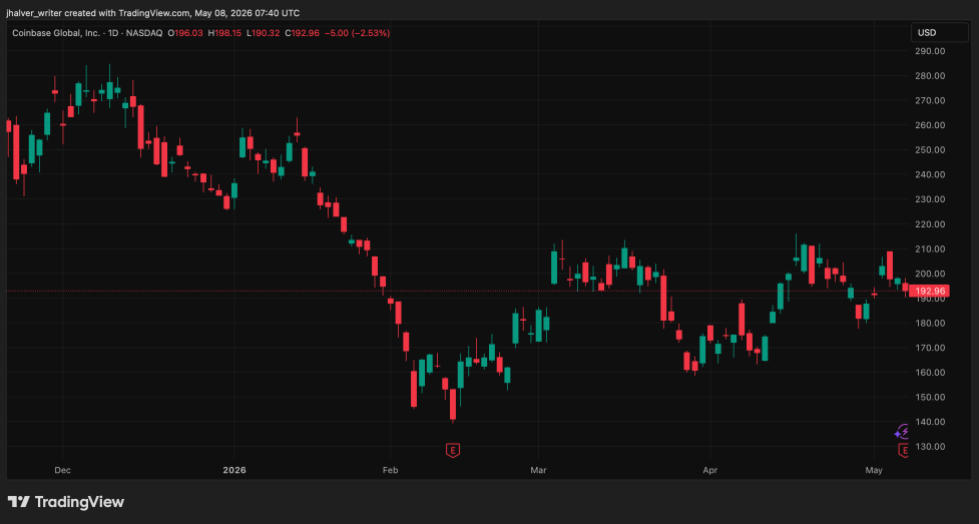
COIN's price records a modest loss following their Q1 earnings report, as seen on the daily chart. Source: COINUSD on Tradingview

What Drove Coinbase To A Loss

The single largest drag on the quarter was $482 million in unrealized losses on crypto assets held for investment, tied primarily to Bitcoin’s roughly 23% decline during Q1, a separate report from TheStreet crypto claims. Strip out that mark-to-market impact and the adjusted net loss narrows to $46 million — a meaningful distinction, but one that still reflects a materially weaker operating environment than the prior year.

Transaction revenue, the exchange’s primary revenue engine, came in at $755.8 million — down 23% quarter-over-quarter and below the $805.2 million analysts had projected. The main driver was straightforward: total crypto market capitalization and spot trading volumes declined more than 20% quarter-over-quarter, per Investing.com, pulling Coinbase’s most volatile revenue line with it.

Not everything was negative. Subscription and services revenue reached $584 million — representing 44% of net revenue — while stablecoin revenue hit $305 million on record average USDC holdings of $19 billion in Coinbase products. Adjusted EBITDA came in at $303 million, marking the company’s 13th consecutive positive quarter on that metric, per CFO Alesia Haas on the earnings call.

A Quarter That Confirms The Pattern

The Q1 loss arrives just days after Coinbase announced a 14% reduction in its workforce — approximately 700 roles — citing the need to restructure around AI-driven operations. Taken together, the layoffs and the earnings miss paint the picture of an exchange managing through a difficult cycle rather than riding one.

Operating margin collapsed to -1.5% from 34.7% in the year-ago quarter, underlining how quickly Coinbase’s profitability profile can shift when crypto markets pull back. The company closed the quarter with over $10 billion in cash and equivalents, per the earnings call transcript, which provides a substantial buffer — but does little to address the structural revenue sensitivity that has defined every down cycle in the exchange’s short public history.

For the nascent sector, Coinbase’s Q1 results serve as a reminder that even the most institutionally established crypto exchange remains tightly tethered to market conditions — and that the road to durable profitability runs directly through the unpredictable terrain of crypto price cycles.

Cover image from Grok, COINUSD chart from Tradingview

Perguntas relacionadas

QWhat were Coinbase's reported Q1 2026 financial results in terms of net loss and revenue?

ACoinbase reported a net loss of $394 million for Q1 2026, swinging from a $65.6 million profit in Q1 2025. Total revenue was $1.41 billion, a 30.5% year-over-year decline.

QWhat was the largest single factor contributing to Coinbase's Q1 2026 loss according to the article?

AThe single largest drag was $482 million in unrealized losses on crypto assets held for investment, primarily tied to Bitcoin's roughly 23% decline during the quarter.

QHow did Coinbase's transaction revenue perform in Q1 2026 compared to analyst expectations?

ATransaction revenue came in at $755.8 million, which was down 23% quarter-over-quarter and below the $805.2 million analysts had projected.

QDespite the overall loss, which areas of Coinbase's business showed positive performance in Q1 2026?

ASubscription and services revenue reached $584 million, representing 44% of net revenue. Stablecoin revenue hit $305 million on record average USDC holdings. Adjusted EBITDA was $303 million, marking the 13th consecutive positive quarter on that metric.

QWhat recent operational decision by Coinbase, mentioned alongside the earnings, highlights its response to a difficult cycle?

AJust days before the earnings report, Coinbase announced a 14% reduction in its workforce (approximately 700 roles), citing a restructuring around AI-driven operations.

Leituras Relacionadas

In a Bull Market, Trade New Coins. Will the 'Hook' Concept Become the Sector That Opens the Bull Market?

In a recent surge of interest, the "Hook" concept on Uniswap v4 has captured significant attention from the retail crypto community, driven by projects like $upeg, $sato, and Slonks. Despite being introduced over a year ago, Hooks—customizable plugins for the Uniswap protocol—gained mainstream traction only recently. The article argues that earlier Uniswap efforts to promote Hooks focused too heavily on technical improvements and liquidity provider (LP) solutions, which failed to capture the imagination of everyday users. The breakthrough came with projects that introduced novel, engaging gameplay. $upeg combines trading with generative art, where each integer purchase creates a unique image, adding a layer of artistic creation and complexity to tokenomics. $sato leverages a bonding curve on Ethereum, appealing to the network's "diamond hands" culture with a decentralized, zero-intervention model that turns into a "belief game." Slonks uses an AI model to redraw CryptoPunks, creating a gamified ecosystem where users can burn or merge NFTs to earn $SLOP tokens based on how much the AI "deviated" from the original. These examples highlight Hooks' potential to transform Uniswap from a simple swap and LP platform into a vibrant ecosystem of innovative applications. While technically possible to build such projects independently, the synergy with Uniswap’s established user base and infrastructure provides mutual benefits. For "Hook" to become a true catalyst for a bull market, the author suggests that projects need compelling, original narratives, and Uniswap must further commit to positioning itself as Ethereum's premier application marketplace for creative on-chain experiences.

marsbitHá 2m

In a Bull Market, Trade New Coins. Will the 'Hook' Concept Become the Sector That Opens the Bull Market?

marsbitHá 2m

Saylor Softens Stance, STRC Weakens, Is BTC Facing a Do-or-Die Battle?

**Summary: Bitcoin (BTC) at a Critical Juncture? Saylor's Hint and STRC Softness Spark Concerns** This article examines two recent developments that could pressure Bitcoin's price: Saylor's hinted willingness to sell some of MicroStrategy's (MSTR) BTC holdings and a significant slowdown in the issuance of its Structured Token Receipt Capital (STRC) product. Previously, STR C was viewed as a powerful new source of ongoing demand for Bitcoin, as the funds raised were used to buy more BTC with leverage. However, MicroStrategy CEO Michael Saylor's recent acknowledgment that the company *might* sell BTC to pay dividends undermines the "never sell" narrative that underpins MSTR's valuation premium and the entire STRC-driven demand thesis. While mathematically sustainable if BTC appreciates, forced selling during a market downturn would severely damage the company's balance sheet and reverse much of its recent buying. Simultaneously, the STRC "flywheel" appears to be stalling. Unlike in previous cycles, the STRC price has failed to return to its $100 par value ahead of the May dividend date, indicating zero new BTC purchases via this channel for the current period. The author attributes this "softness" to a saturated market of arbitrage traders after huge inflows in March and April, whose selling pressure kept prices down, as well as higher opportunity costs in a surging stock market. The combination risks starting a "reverse flywheel": No STRC issuance means no new BTC buying, putting downward pressure on BTC's price. This weakens STRC's collateral backing, potentially raising its required yield and making it even less attractive, which further starves BTC of demand. Saylor's comments may be preemptively pricing in this scenario. The article concludes that the near-term direction of BTC hinges on whether STRC can regain its par value and resume meaningful issuance in the coming week. A small, recent STRC issuance and a brief return of positive Coinbase premiums are noted as faintly optimistic signals. However, failure of the STRC model could lead to a sharp BTC correction by removing a key perceived source of support.

marsbitHá 9m

Saylor Softens Stance, STRC Weakens, Is BTC Facing a Do-or-Die Battle?

marsbitHá 9m

Trading

Spot
Futuros
活动图片