Retail Ecology Dwindles, ZKsync Bets on Bank Pilots for a Breakthrough

Foresight NewsPublicado em 2026-06-12Última atualização em 2026-06-12

Resumo

Amidst declining retail activity, ZKsync is pivoting to target institutional banking as its primary growth strategy. The article explores this shift, contrasting it with the competitive "survival of the fittest" narrative by highlighting a cooperative model inspired by naturalist Peter Kropotkin. ZKsync is developing infrastructure like its private, permissioned Prividium suite for banks (e.g., Deutsche Bank's use case via Memento), enabling private transactions with public verifiability via zero-knowledge proofs. This appeals to institutions needing privacy, compliance, and Ethereum-based settlement security, unlike fully private chains (e.g., JPMorgan's Kinaxis) or consortium models (e.g., R3 Corda). However, this strategic focus has coincided with a steep decline in its public DeFi ecosystem, evidenced by plunging TVL and the departure of major protocols like Aave due to low fees. The network's future now hinges on banking adoption, with upcoming pilots like the Cari Network involving regional banks holding over $600 billion in deposits. A significant challenge is balancing this institutional focus with ZKsync's decentralized governance. Banks must operate on a network where rules and fees (denominated in the volatile ZK token) can be changed via community vote, and where a Security Council holds emergency control—a stark contrast to the predictable, contract-bound environments of traditional finance. The coming 18 months will test whether ZKsync can successfully onboar...


Written by: Thejaswini M A

Compiled by: Saoirse, Foresight News


When we think of competition, the phrase 'survival of the fittest' often comes to mind. Hearing it, I picture a brutal scene of everyone fighting each other: the strongest predator wins by eliminating all rivals.


But I've started to doubt that sustainable ecosystems are built this way. In the early 20th century, naturalist and philosopher Peter Kropotkin challenged this notion in his evolutionary essays on mutual aid. Kropotkin observed that species surviving extreme climate changes relied on sophisticated systems of collective cooperation. From a long-term evolutionary perspective, the power of mutual support far outweighs individual struggle. The true 'fittest' are those who know how to cooperate and build stable, shared frameworks to navigate unpredictable environments.


This principle applies across industries.


Right now, all crypto projects are finding their niche; protocols that weathered the bear market have made crucial choices for their future.


Some development teams are returning to their original core tenets, pursuing absolute censorship resistance and pure decentralization; others are adding centralized controls to maintain basic solvency; a few are building walled-garden ecosystems, funneling internal liquidity into isolated scaling chains.


ZKsync has taken a distinctly different path, centered on mutual aid: it is building infrastructure for banks.


The Boston Consulting Group (BCG) predicts the tokenized asset market will fully migrate to blockchain systems, reaching $10-16 trillion by 2030. Major mainstream banks are already running pilots, with some moving from trials to full-scale operations. The infrastructure solutions being chosen now will determine the flow of trillions in capital and who controls the underlying rails.


ZKsync is now a highly competitive Layer 2 solution for these financial rails. Even if you haven't looked at Layer 2 since the last bull run, its trajectory is worth noting.


Why are banks moving into blockchain? And why specifically ZKsync?


The ZKsync environment used by Deutsche Bank is completely segregated from regular crypto users. The bank relies on ZKsync's Prividium suite, with Memento building a private, permissioned Layer 2 network—Memento ZK Chain.


Prividium is ZKsync's commercial product for institutions, supporting private transactions, tiered access controls, built-in compliance tools, with all transactions ultimately settling on Ethereum. Memento compared and tested five blockchain ecosystems before choosing ZKsync. This solution shortened capital deployment timelines from two-to-three months down to two-to-three weeks.


The core reason banks favor zero-knowledge technology: it can prove a statement is true without revealing the underlying private information. Banks can verify transactions without disclosing sensitive details like counterparty names, amounts, or specific assets to the public. This privacy architecture gives banks full control over data visibility, protecting corporate secrets while providing clear evidence to regulators, perfectly fitting Wall Street's existing operational models.


The Tradable platform already hosts $1.7 billion in private credit products on ZKsync, listing nearly 30 institutional-grade investment vehicles with 8% to 15.5% annual yields. In October 2024, Buenos Aires, the capital of Argentina, quietly migrated its entire city-wide digital identity system to ZKsync Era, giving 3.6 million citizens officially recognized, crypto-protected identity credentials overnight, with local governments unable to trace the data—making it the first city globally to deploy such an application.


By the end of 2025, the global private credit market reached $3.5 trillion, while Tradable's volume represents less than 0.05% of that total. The tokenized credit sector will either capture significant market share or remain niche, but current data shows it's on a growth trajectory. Regardless, a vast gap remains between current on-chain capital and the overall market size.


Consider the decision from a corporate risk team's perspective: they have three options—a completely self-controlled, isolated private network; a contractual enterprise consortium; or a public network governed by an online community.


JPMorgan's Kinexys is an example of a fully internal, private network. Since 2019, this operation has independently built a blockchain system, handling repo trades, cross-border payments, and asset settlement with partners like BlackRock and Siemens. JPMorgan runs its own servers, manages the ledger, and has no interaction with the public crypto community. Fees don't change arbitrarily based on token holder votes, system upgrades follow internal planning, and governance is entirely in JPMorgan's hands.


But the bank's own data reveals this model's weakness: Kinexys processes about $5 billion in daily transaction volume, while JPMorgan's payment division handles $10 trillion daily. Five years after launch, its own blockchain business carries only 0.05% of the bank's payment traffic. The bank with the highest level of infrastructure control has the lowest adoption rate. Full self-control hasn't solved the core problem of scaling.


Another competitor, R3 Corda, has cleared $10 billion in tokenized real-world assets and processes one million transactions daily. It's a consortium of over 200 financial institutions, with all rules agreed upon via contracts before launch; to update features, all members must sign off. Every bank gets a seat at the rule-making table before the first transaction settles.


These platforms are ZKsync's competitors, but ZKsync has unique advantages that dedicated consortium or private chains cannot replicate: publicly verifiable transaction validity without leaking private data, coupled with a settlement layer independent of any single corporate entity's survival. If a firm shuts down its internal blockchain tomorrow, on-chain assets are immediately at operational risk; assets anchored on ZKsync ultimately settle on the Ethereum mainnet, with no corporate executive who can order the network shut down. This underlying isolation is its core differentiating advantage, but balancing this with the risks of open governance remains an ongoing industry debate.


Before pivoting fully to institutional business, ZKsync launched an incentive program called Ignite, subsidizing DeFi protocols to maintain on-chain activity. After the strategic shift, the project terminated Ignite, clearly refocusing on enterprise clients, and on-chain activity declined along with the incentives.


Around the same time, the original network ZKsync Lite, launched in 2020, was permanently shut down. Matter Labs signaled this as early as December 2025 and announced the exact shutdown date in late February the following year. User assets remain withdrawable permanently, and no institutional deployments were built on ZKsync Lite, so they were unaffected.


The leading lending DeFi protocol, Aave, proposed shutting down its lending market on ZKsync Era, citing dismal revenue data: over 30 consecutive days, ZKsync generated only $714 in fee revenue for Aave. In contrast, Base chain brought in $300,000, and Ethereum mainnet a staggering $7.7 million during the same period. The governance forum concluded this Layer 2 chain didn't truly meet retail DeFi market demand and proposed a new rule: Aave would only consider deploying a market on any public chain generating at least $2 million in annual fee revenue.


At the peak of the retail Layer 2 scaling frenzy, ZKsync Era's Total Value Locked (TVL) consistently held at several hundred million dollars; now, its public DeFi ecosystem TVL is only about $15 million. In comparison, top retail-focused Layer 2 networks typically have TVLs in the tens of billions.
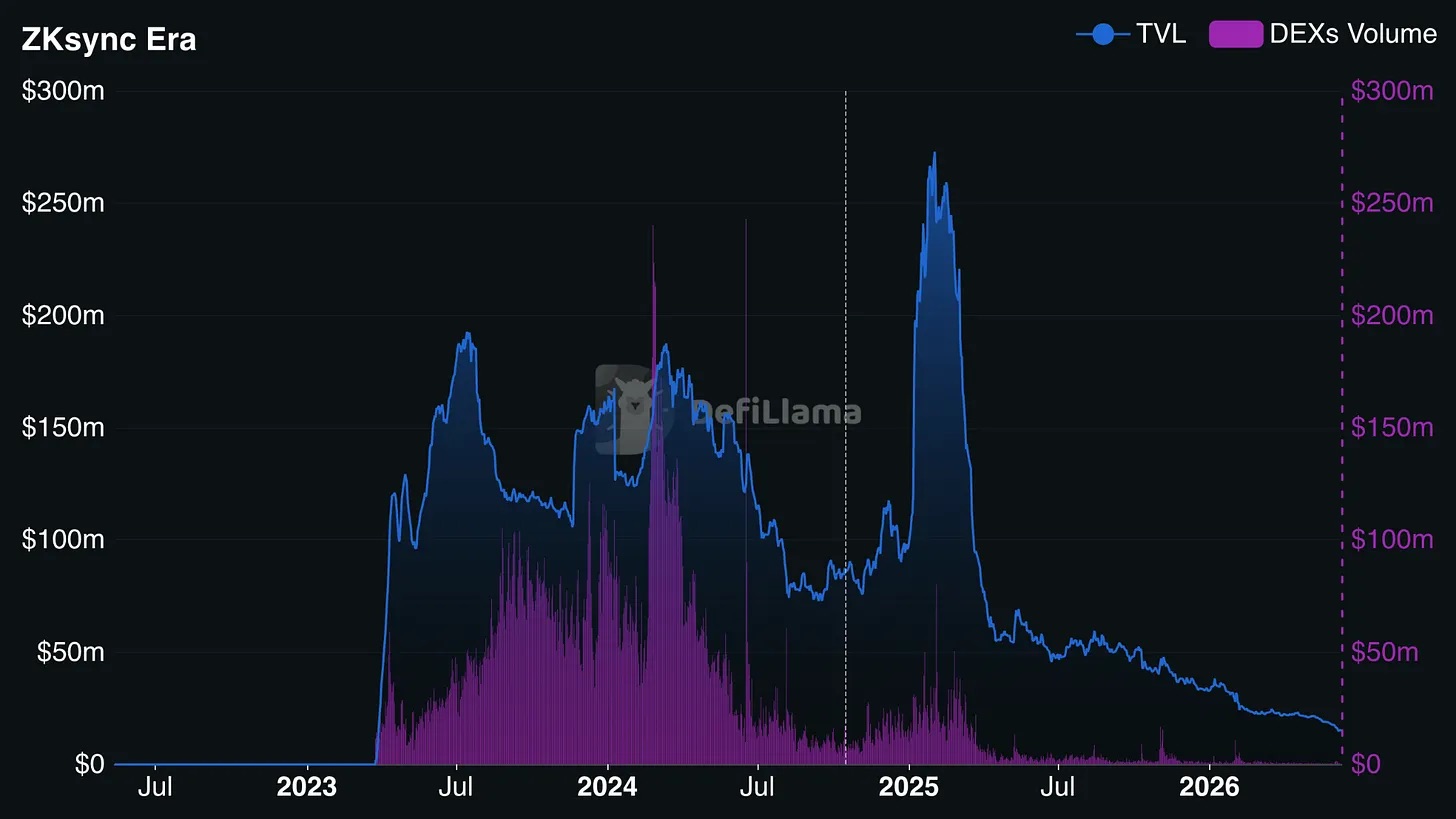

After launching in 2023, ZKsync Era's on-chain TVL (blue line) and DEX volume (purple bars) peaked in early 2025 before sharply and continuously declining, with retail DeFi activity becoming extremely low by 2026. Source: @defillama.com


If the retail ecosystem continues to wither, the chain's entire development will bet solely on the institutional business line. Is a Layer 2 network a retail crypto playground gradually infiltrated by banks, or merely an enterprise financial rail settled on Ethereum? The answer will determine ZKsync's ultimate fate.


Earlier this year, Matter Labs CEO Alex Gluchowski publicly revealed a roadmap clearly refocusing the project on building heavy-duty financial infrastructure for traditional markets.


Product evolution confirms this: the team first launched Prividium, creating segregated environments for banks with non-leaking transaction data; then launched the Bank Stack suite, partnering with institutions like Cari Network to onboard regional banks managing hundreds of billions in traditional deposits. So Aave's departure wasn't a surprise to the development team.


As for Cari Network's rollout plan: led by former US Office of the Comptroller of the Currency officials, it plans to pilot with five regional banks next quarter, which collectively hold over $600 billion in deposits.


If this pilot succeeds, the transaction volume gap left by departing retail DeFi apps will be completely filled by banks' massive flows; but if it fails, ZKsync will become an technologically advanced yet experimental tool with no real mainstream users, hosting only a handful of corporate pilot projects.


The v31 protocol upgrade, passed via ZKsync governance forum vote, officially went live in early May.


ZKsync's official X account posted a reminder: this protocol upgrade was submitted to the governance forum for review. The v31 upgrade includes several core updates, using the ZK token as a universal pricing unit to enable native interoperability across all ZK-based scaling chains.


Key announcement points: This ZKsync Improvement Proposal (ZIP-16) was submitted for forum vote:


  • ZKsync Interoperability Protocol: Enables native cross-chain interaction for all ZK-based scaling chains;
  • Phase 1 supports scaling chains that can settle on Ethereum Layer 1;
  • Expands ZKsync OS compatibility.


Under v31 rules, each cross-chain call between different ZK chains costs a flat fee of 10 ZK tokens, a rate set by DAO vote. Banks already constantly deal with variable costs—like blockchain gas fees, cloud computing costs, foreign exchange spreads—so such fluctuating costs are a normal part of business.


Not just the fee rate, but the entire fee mechanism can be rewritten via the same governance forum, with no obligation for the project to pre-notify institutional partners on the chain.


The ZK Nation governance forum is already discussing next-stage adjustments, currently debating node operator transaction fees, staking rules, and customized pricing for zero-knowledge proof verification. Any topic could trigger a community vote, altering the cost model for all cross-chain operations of institutions like Deutsche Bank and Tradable. All discussions are publicly viewable at forum.zknation.io.


In contrast: JPMorgan's Kinexys system permissions are entirely in its own hands; R3 Corda's rule changes also have formal contracts specifying amendment conditions and processes.


So why would banks choose ZKsync over JPMorgan's private chain? Because ZKsync can provide publicly verifiable proof of transaction validity without leaking private data.


If JPMorgan shuts down its blockchain business tomorrow, all on-chain assets would be frozen; even if Matter Labs, the development company behind ZKsync, goes bankrupt, the network can still run because all assets are ultimately anchored to Ethereum for settlement. But the price for this underlying security is accepting the network belongs to no single entity. An ownerless network's governance belongs to all participating token holders who vote.


The ZK token currently trades around $0.01, having hit an all-time high of $0.3285 in June 2024, a 96% drop from its peak. At a 10 ZK token cross-chain fee, a transaction cost about $3.28 at the bull market peak, now just $0.10. Token price volatility can be managed through hedging, but a community-voted mechanism that can change rules at any time makes long-term, stable budgeting difficult for corporate financial planning.


Layer 2 rating agency L2Beat classifies ZKsync Era as a Stage 0 network: an independent security council can bypass the full DAO voting process to directly pause or modify smart contracts. Mature Stage 1 Layer 2 networks like Arbitrum lack such centralized intervention powers. Enterprise risk managers often favor emergency kill switches to mitigate losses from smart contract bugs; but this control resides with a Web3 security council, completely outside traditional corporate management structures.


Sygnum tokenized $50 million of Matter Labs' corporate treasury assets on ZKsync, connecting to a Fidelity liquidity fund; subsequently, Fidelity also launched an institutional money market fund on the network. The development team injected initial transaction volume by deploying its own capital, creating core enterprise use cases. This asset flow operates smoothly, but the entire business setup directly serves the project's founding team.


The core infrastructure remains subject to an independent security council holding the highest system permissions. In emergencies, the council can bypass normal delay processes entirely, modifying smart contract parameters or freezing functions without prior notice. Actual network control is split between the security council and the active token governance community, meaning partnering banks must operate within a continuously dynamic governance system, not a fixed corporate cooperation agreement.


ZKsync is betting its entire existence on a group that has never led crypto project development—licensed traditional financial institutions. Banks don't care about token prices, nor will they participate in governance forum votes.


But once a bank chooses a core infrastructure to build its business on, it often becomes deeply embedded and difficult to migrate. This adoption path has higher initial barriers, but once established, it's hard to replace.


ZKsync will either become the first crypto project to achieve this, or serve as an expensive case study proving banks ultimately choose to build their own blockchains, then abandon external public chain solutions. The market will deliver its verdict within the next 18 months.


In crypto, many projects boast strong technology but falter on governance mechanisms and long-term sustainability, eventually fading away. ZKsync's grand experiment in governance models is still ongoing.

Perguntas relacionadas

QWhat major strategic shift has ZKsync made to address the decline in its retail user and DeFi ecosystem?

AZKsync has pivoted its strategic focus towards building heavyweight financial infrastructure for traditional institutions, particularly banks, moving away from competing directly in the retail-focused DeFi arena.

QWhat are the key features and advantages of ZKsync's 'Prividium' suite that appeal to banks like Deutsche Bank?

APrividium offers features like private, permissioned Layer 2 networks, confidential transactions, tiered access control, built-in compliance tools, and settlement on Ethereum. Its key advantage is enabling zero-knowledge proofs that allow transaction verification without exposing sensitive data, fitting perfectly with banking confidentiality and regulatory requirements.

QAccording to the article, what is the core dilemma or challenge ZKsync faces in its new institutional-focused strategy?

AZKsync faces a core governance dilemma: its network is governed by a decentralized community of token holders (ZK Nation) and a Security Council, which can dynamically change rules and fees via voting. This introduces significant uncertainty for institutional clients like banks, who are used to stable, contractually-bound agreements and have no control over or interest in participating in crypto governance processes.

QHow does the article contrast ZKsync's approach with that of its competitors like J.P. Morgan's Kinexys and the R3 Corda consortium?

AJ.P. Morgan's Kinexys is a fully private, internally controlled network offering maximum control but suffering from low internal adoption. R3 Corda is a consortium where rules are set by contract among members before launch. ZKsync differs by offering public verifiability via Ethereum settlement without data exposure, providing independence from any single entity, but at the cost of being subject to unpredictable decentralized governance.

QWhat is the significance of the upcoming pilot with Cari Network and regional banks for ZKsync's future, as described in the article?

AThe pilot with Cari Network, involving five regional banks managing over $600 billion in deposits, is a critical test. Its success could flood ZKsync with massive institutional transaction volume, filling the gap left by departed retail DeFi. Its failure, however, could relegate ZKsync to a niche experimental tool with only minor corporate pilots, jeopardizing its entire institutional-focused strategy.

Leituras Relacionadas

Crypto Market Makers Are Collectively Seeking Change as Money Becomes Harder to Earn

**Summary: Crypto Market Makers Adapt as Margins Shrink** Leading crypto market maker GSR exemplifies a broader industry shift, moving beyond traditional market-making to become a full-service "Web3 investment bank." Its recent strategic acquisitions—including an SEC-registered broker-dealer, rebranded as GSR Securities—and purchases of token advisory firms aim to create an integrated platform covering token design, fundraising, listing, liquidity provision, and asset management. This includes launching an ETF and investing in tokenization platforms like Libeara, backed by a strategic investment from Standard Chartered's SC Ventures. This transformation is not unique to GSR. Other major players like Keyrock, B2C2, Wintermute, and DWF Labs are also expanding geographically, pursuing regulatory licenses (especially under frameworks like MiCA in the EU), and diversifying into over-the-counter (OTC) trading, asset management, and real-world asset tokenization. The driving force behind this collective pivot is a rapidly changing market. Profits from traditional altcoin market-making are declining due to fewer viable projects, reduced client budgets, increased competition, and smarter, more demanding clients. Simultaneously, regulatory pressures are mounting, making compliance a baseline cost. Extreme market events further expose teams lacking robust risk controls. Consequently, the crypto market-making business model is evolving from one reliant on information asymmetry and volatility to a more institutionalized, regulated, and service-diverse industry. Survival now depends on building systemic capabilities beyond mere liquidity provision.

marsbitHá 45m

Crypto Market Makers Are Collectively Seeking Change as Money Becomes Harder to Earn

marsbitHá 45m

Market Adjusts Following Google's $84.7 Billion Fundraising, AI Valuations Now Focus on Payback Speed

After Alphabet's announcement of an $84.75 billion equity financing round, market focus for AI investment is shifting from pure growth narratives to capital efficiency and payback periods. The core argument is that AI is being re-priced from a software-like growth story into a heavy-asset infrastructure cycle, requiring massive capital expenditure (CapEx) on chips, data centers, and power grids. While Alphabet's financing itself is not a distress signal—part of it is for administrative purposes like tax obligations on stock compensation—it highlights the enormous capital demands of AI infrastructure. This demand extends beyond tech giants to pure-play AI model companies (like OpenAI, Anthropic), data center REITs, and utilities. Major tech firms are projected to spend heavily on AI data centers in 2026, signaling a broad-based capital cycle the market must absorb. Consequently, valuation logic is changing. Investors are moving away from questions about who has the strongest AI narrative and are now prioritizing clear visibility into orders, stable cash flows, and the cost of capital. This has led to recent pressure on high-multiple AI software and semiconductor stocks, while "picks-and-shovels" hardware, data center, and power assets with firmer near-term demand may see relative support. The key going forward will be monitoring whether rising CapEx guidance across companies is matched by a timely monetization of AI investments into revenue and cash flow. The market's tolerance for high spending depends on demonstrable returns. While the long-term AI thesis remains intact, the valuation framework has fundamentally shifted to emphasize capital discipline and payback speed.

marsbitHá 52m

Market Adjusts Following Google's $84.7 Billion Fundraising, AI Valuations Now Focus on Payback Speed

marsbitHá 52m

Trading

Spot
Futuros

Artigos em Destaque

O que é $BANK

Bank AI: Um Passo Revolucionário no Futuro da Banca Introdução Em uma era marcada por avanços rápidos na tecnologia, o Bank AI está na interseção da inteligência artificial (IA) e dos serviços bancários. Este projeto inovador visa redefinir o panorama financeiro, melhorando a eficiência operacional, as medidas de segurança e as experiências dos clientes através do poder da IA. Ao embarcarmos nesta exploração do Bank AI, iremos aprofundar no que o projeto implica, suas dinâmicas operacionais, seu contexto histórico e marcos significativos. O que é o Bank AI? No seu cerne, o Bank AI representa uma iniciativa transformadora com o objetivo de integrar a inteligência artificial em várias operações bancárias. Este projeto aproveita as capacidades da IA para automatizar processos, melhorar os protocolos de gestão de risco e melhorar a interação com os clientes através de serviços personalizados. Os principais objetivos do Bank AI incluem: Automatização das Funções Bancárias: Ao aproveitar as tecnologias de IA, o Bank AI visa automatizar tarefas rotineiras, reduzindo o peso sobre os recursos humanos e aumentando a eficiência. Gestão de Risco Melhorada: O projeto utiliza algoritmos de IA para prever e identificar riscos, fortalecendo assim as medidas de segurança contra fraudes e outras ameaças. Personalização dos Serviços Bancários: O Bank AI foca em oferecer produtos e serviços financeiros ajustados, analisando dados e comportamentos dos clientes. Melhoria da Experiência do Cliente: A implementação de soluções impulsionadas por IA, como chatbots e assistentes virtuais, visa proporcionar aos usuários interações mais humanizadas, revolucionando a forma como os clientes se envolvem com os bancos. Com esses objetivos, o Bank AI posiciona-se como um ator crucial para tornar a banca mais eficiente, segura e centrada no usuário. Quem é o Criador do Bank AI? Os detalhes sobre o criador do Bank AI permanecem desconhecidos. Assim, nenhuma pessoa ou organização específica foi identificada nas informações disponíveis. O anonimato que cerca a origem do projeto levanta questões, mas não diminui a sua ambiciosa visão e objetivos. Quem são os Investidores do Bank AI? Semelhante ao criador do projeto, informações específicas sobre os investidores ou organizações que apoiam o Bank AI não foram divulgadas. Sem essas informações, é difícil delinear o apoio financeiro e institucional que pode estar impulsionando o projeto para frente. No entanto, a importância de ter uma sólida base de investimento é fundamental para sustentar o desenvolvimento em um campo tão inovador. Como Funciona o Bank AI? O Bank AI opera em várias frentes inovadoras, focando em fatores únicos que o diferenciam das estruturas bancárias tradicionais. Abaixo estão as principais características operacionais: Automatização: Ao aplicar algoritmos de aprendizado de máquina, o Bank AI automatiza vários processos manuais dentro dos bancos. Isso resulta na redução dos custos operacionais e permite que os trabalhadores humanos redirecionem os seus esforços para atividades mais estratégicas. Gestão de Risco Avançada: A integração da IA nas práticas de gestão de risco equipa os bancos com ferramentas para prever com precisão potenciais ameaças, como fraudes, garantindo que as informações e ativos dos clientes permaneçam seguros. Recomendações Financeiras Personalizadas: Através do aprendizado contínuo a partir das interações com os clientes, os sistemas de IA desenvolvem uma compreensão sutil das necessidades dos usuários, permitindo oferecer conselhos adaptados sobre decisões financeiras. Interações Melhoradas com os Clientes: Utilizando chatbots e assistentes virtuais alimentados por IA, o Bank AI permite uma experiência de cliente mais envolvente, permitindo que os usuários tenham suas dúvidas resolvidas rapidamente, reduzindo assim os tempos de espera e melhorando os níveis de satisfação. Juntas, estas características operacionais posicionam o Bank AI como um pioneiro no setor bancário, estabelecendo novos padrões para a prestação de serviços e a excelência operacional. Cronologia do Bank AI Compreender a trajetória do Bank AI requer uma análise do seu contexto histórico. Abaixo está uma cronologia que destaca marcos e desenvolvimentos importantes: Início de 2010: A conceituação da integração da IA nos serviços bancários começou a ganhar atenção à medida que instituições bancárias reconheciam os potenciais benefícios. 2018: Ocorreu um aumento significativo na implementação de tecnologias de IA, quando os bancos começaram a usar ferramentas de IA como chatbots para atendimento ao cliente básico e sistemas de gestão de risco para melhorar o tratamento de segurança. 2023: A sofisticação da IA continuou a avançar, com a introdução de IA generativa para tarefas mais complexas, como processamento de documentos e análise de investimentos em tempo real. Este ano marcou um salto significativo nas capacidades proporcionadas aos bancos pela tecnologia de IA. 2024-Estado Atual: Neste ano, o Bank AI está em uma trajetória ascendente, com pesquisas e desenvolvimentos em andamento prontos para aprimorar ainda mais as capacidades nas operações bancárias. A exploração contínua das aplicações de IA sugere desenvolvimentos emocionantes por vir. Pontos Chave Sobre o Bank AI Integração da IA na Banca: O Bank AI foca na adoção da inteligência artificial para simplificar os processos bancários e melhorar as experiências dos usuários. Automatização e Foco em Gestão de Risco: O projeto enfatiza fortemente essas áreas, visando transferir o peso das tarefas rotineiras enquanto melhora as estruturas de segurança através de análises preditivas. Soluções Bancárias Personalizadas: Ao aproveitar os dados dos clientes, o Bank AI possibilita serviços bancários ajustados que atendem às necessidades individuais dos usuários. Compromisso com o Desenvolvimento: O Bank AI permanece comprometido com contínuas pesquisas e esforços de desenvolvimento, garantindo a sua adaptabilidade e relevância contínua à medida que a tecnologia continua a evoluir. Conclusão Em resumo, o Bank AI exemplifica um passo crucial em frente na indústria bancária, aproveitando a inteligência artificial para remodelar paradigmas operacionais, melhorar a segurança e promover a satisfação do cliente. Apesar das lacunas de informação em torno do criador e dos investidores, os objetivos claros e os mecanismos funcionais do Bank AI fornecem uma base sólida para sua evolução contínua. À medida que a tecnologia de IA continua a avançar e se fundir com o setor bancário, o Bank AI está bem posicionado para impactar significativamente o futuro dos serviços financeiros, aprimorando a maneira como entendemos e interagimos com a banca.

40 Visualizações TotaisPublicado em {updateTime}Atualizado em 2024.12.03

O que é $BANK

Como comprar BANK

Bem-vindo à HTX.com!Tornámos a compra de Lorenzo Protocol (BANK) simples e conveniente.Segue o nosso guia passo a passo para iniciar a tua jornada no mundo das criptos.Passo 1: cria a tua conta HTXUtiliza o teu e-mail ou número de telefone para te inscreveres numa conta gratuita na HTX.Desfruta de um processo de inscrição sem complicações e desbloqueia todas as funcionalidades.Obter a minha contaPasso 2: vai para Comprar Cripto e escolhe o teu método de pagamentoCartão de crédito/débito: usa o teu visa ou mastercard para comprar Lorenzo Protocol (BANK) instantaneamente.Saldo: usa os fundos da tua conta HTX para transacionar sem problemas.Terceiros: adicionamos métodos de pagamento populares, como Google Pay e Apple Pay, para aumentar a conveniência.P2P: transaciona diretamente com outros utilizadores na HTX.Mercado de balcão (OTC): oferecemos serviços personalizados e taxas de câmbio competitivas para os traders.Passo 3: armazena teu Lorenzo Protocol (BANK)Depois de comprar o teu Lorenzo Protocol (BANK), armazena-o na tua conta HTX.Alternativamente, podes enviá-lo para outro lugar através de transferência blockchain ou usá-lo para transacionar outras criptomoedas.Passo 4: transaciona Lorenzo Protocol (BANK)Transaciona facilmente Lorenzo Protocol (BANK) no mercado à vista da HTX.Acede simplesmente à tua conta, seleciona o teu par de trading, executa as tuas transações e monitoriza em tempo real.Oferecemos uma experiência de fácil utilização tanto para principiantes como para traders experientes.

395 Visualizações TotaisPublicado em {updateTime}Atualizado em 2026.06.02

Como comprar BANK

Discussões

Bem-vindo à Comunidade HTX. Aqui, pode manter-se informado sobre os mais recentes desenvolvimentos da plataforma e obter acesso a análises profissionais de mercado. As opiniões dos utilizadores sobre o preço de BANK (BANK) são apresentadas abaixo.

活动图片