Atkins' First Year at the Helm of the SEC: A Comprehensive Shift in Crypto Regulation

marsbitPublicado em 2026-04-21Última atualização em 2026-04-21

Resumo

Paul Atkins marked his one-year anniversary as Chair of the U.S. Securities and Exchange Commission (SEC) on April 21, 2025, overseeing a significant shift in the agency’s approach to cryptocurrency regulation. Under his leadership, the SEC dropped multiple enforcement actions against crypto firms, approved several crypto-linked ETFs, and issued guidance clarifying that most cryptocurrencies are not considered securities under federal law. The SEC also signed a memorandum with the CFTC to improve regulatory coordination. These actions reversed the aggressive enforcement stance of his predecessor, Gary Gensler, and aligned with Trump administration promises to support the crypto industry. However, Atkins has faced criticism from Democratic lawmakers, including Senator Elizabeth Warren, who raised concerns over potential conflicts of interest, particularly regarding dropped cases linked to Trump-affiliated companies. While regulatory clarity has improved, the SEC still awaits congressional action to formally define its jurisdiction over digital assets.

Author: Turner Wright

Compiled by: Deep Tide TechFlow

Deep Tide Guide: On April 21, 2025, Paul Atkins was sworn in as Chairman of the SEC, marking exactly one year today. Over this year, the SEC has dismissed multiple lawsuits against crypto companies, approved several crypto ETFs, and signed a memorandum of understanding with the CFTC on coordinating digital asset regulation. However, allegations of conflicts of interest against Atkins by Democratic lawmakers are heating up, and the SEC is still awaiting Congress to pass a market structure bill to clarify its jurisdiction over crypto assets.

On April 21, 2025, Paul Atkins was sworn in as Chairman of the U.S. Securities and Exchange Commission (SEC). As of today, it has been exactly one year.

This year, the SEC has undergone a fundamental shift in its regulatory and enforcement stance on digital assets, in stark contrast to the approach during the tenure of former Chairman Gary Gensler.

During the 2024 election campaign, Trump made several promises to the crypto industry: replacing Gensler, establishing a national Bitcoin (BTC) reserve, and opposing the issuance of a U.S. central bank digital currency. After winning the election in November 2024, Gensler resigned in January 2025, and SEC Commissioner Mark Uyeda served as acting chairman until the Senate confirmed Atkins' nomination.
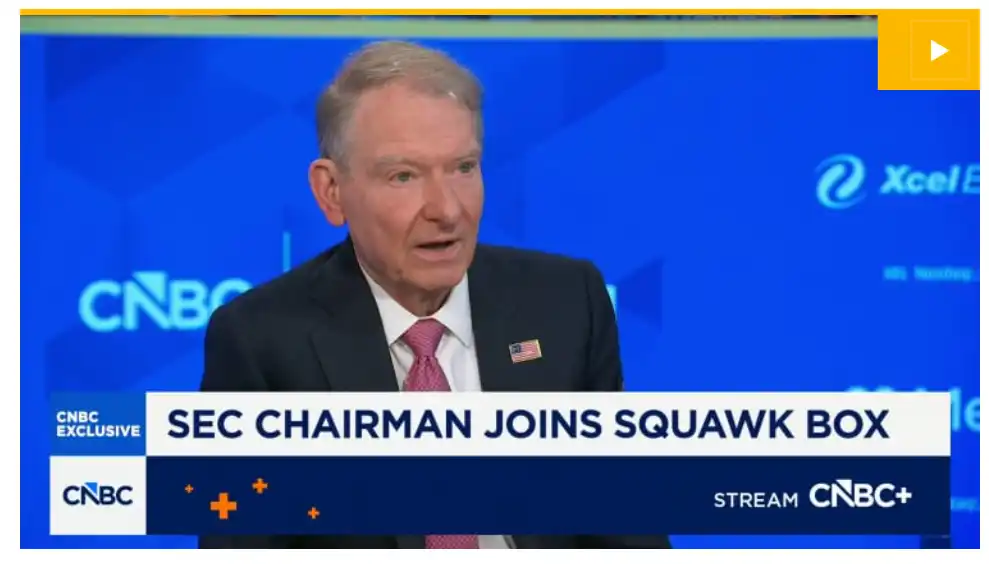
Caption: SEC Chairman Paul Atkins being interviewed on CNBC's Squawk Box on April 20, 2026

Source:CNBC

Even Before Atkins Took Office, the SEC Was Already Shifting

Even before Atkins officially assumed his role, the SEC began sending signals. During Uyeda's acting tenure, the SEC established a crypto working group led by Commissioner Hester Peirce and, starting in February 2025, began dismissing civil enforcement actions and investigations against crypto companies, with Coinbase being the first.

In the 12 months since Atkins officially took office, the SEC has introduced a series of policies widely seen as favorable by the industry:

  • Terminated multiple enforcement actions against crypto companies
  • Approved several exchange-traded funds (ETFs) linked to various crypto assets
  • Signed a memorandum of understanding with the Commodity Futures Trading Commission (CFTC) on coordinating digital asset regulation
  • Issued an interpretive notice clarifying that most cryptocurrencies do not constitute securities under federal law

Atkins himself said in an interview with CNBC on April 21: "The year has passed quickly, but I feel we have made significant progress. When I took office, I promised a new day for the SEC, and we have delivered. We have moved away from the past approach of regulating through enforcement and operating opaquely, and the crypto space is the best example of this."
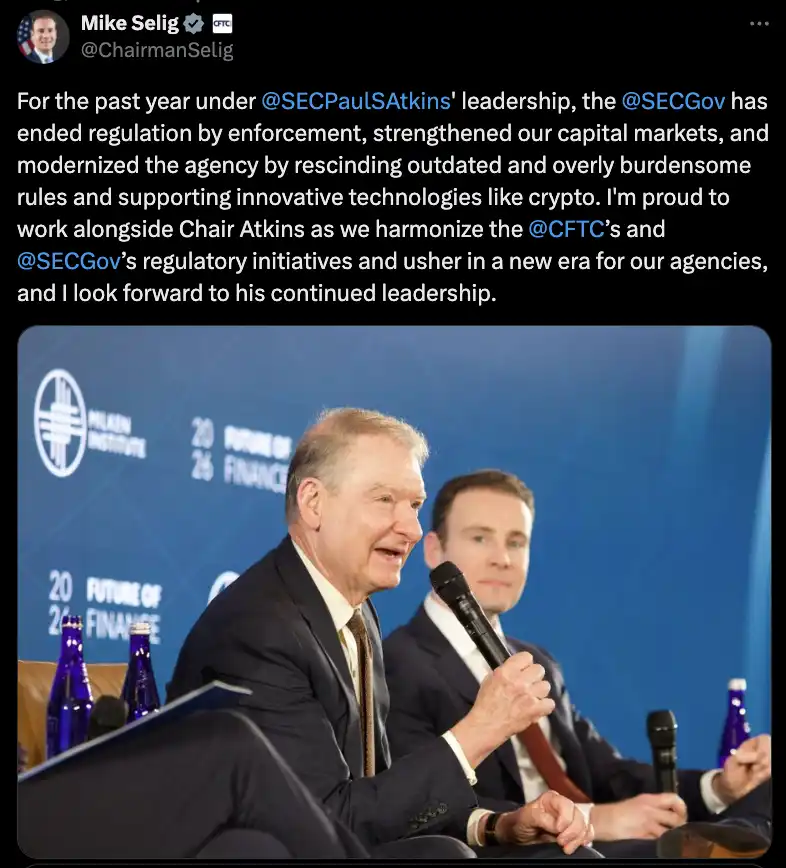
Source:CFTC Chairman Michael Selig

Democratic Lawmakers Focus Fire on Conflicts of Interest

While the crypto industry largely welcomes Atkins' approach, criticism from Congressional Democrats is escalating. The focus is on potential conflicts of interest, as some of the dismissed investigations and enforcement actions involved companies linked to Trump and his family.

Last week, Massachusetts Senator Elizabeth Warren accused Atkins of misleading lawmakers during his Congressional testimony. In a letter dated April 15, Warren pointed out that the SEC's own fiscal year 2025 data shows the number of enforcement actions has dropped to the lowest in a decade.

Despite the clear direction of case dismissals and regulatory relaxation, the SEC is still awaiting Congress to pass a market structure bill to formally clarify the boundaries of its regulatory authority over crypto assets. Until the bill is enacted, the SEC's crypto regulatory framework remains in a transitional state of "administrative guidance + case-by-case handling."

Perguntas relacionadas

QWhat major changes did the SEC undergo under Paul Atkins' leadership in his first year as chairman?

AUnder Paul Atkins' leadership, the SEC underwent a fundamental shift in its regulatory and enforcement stance on digital assets. This included dropping multiple enforcement actions against crypto companies, approving various crypto-linked ETFs, signing a memorandum of understanding with the CFTC for regulatory coordination, and issuing interpretive guidance clarifying that most cryptocurrencies are not securities under federal law.

QWho was the SEC chairman before Paul Atkins and what was the industry's perception of that leadership?

AGary Gensler was the SEC chairman before Paul Atkins. His tenure was characterized by a starkly different approach, which the crypto industry largely viewed as aggressive enforcement and regulatory uncertainty. This contrasted with the more industry-friendly policies implemented under Atkins.

QWhat is the primary criticism from Democratic lawmakers regarding Chairman Atkins' actions?

AThe primary criticism from Democratic lawmakers, such as Senator Elizabeth Warren, focuses on potential conflicts of interest. They allege that the SEC dropped certain investigations and enforcement actions that involved companies linked to former President Trump and his family, and that Chairman Atkins misled Congress in his testimony about these actions.

QWhat significant action did the SEC take regarding crypto ETFs during Atkins' first year?

AA significant action the SEC took was the approval of multiple exchange-traded funds (ETFs) linked to various crypto assets. This was a major policy shift from the previous administration and was widely seen as a positive development for the industry.

QWhat is the current status of the SEC's regulatory framework for crypto assets, according to the article?

AAccording to the article, the SEC's regulatory framework for crypto assets is currently in a transitional state, operating on a basis of 'administrative guidance + case-by-case handling.' The agency is still waiting for Congress to pass a market structure bill to formally clarify the boundaries of its jurisdiction over crypto assets.

Leituras Relacionadas

Where Is the AI Infrastructure Industry Chain Stuck?

The AI infrastructure (AI Infra) industry chain is facing unprecedented systemic bottlenecks, despite the rapid emergence of applications like DeepSeek and Seedance 2.0. The surge in global computing demand has exposed critical constraints across multiple layers of the supply chain—from core manufacturing equipment and data center cabling to specialty materials and cleanroom facilities. Key challenges include four major "walls": - **Memory Wall**: High-bandwidth memory (HBM) and DRAM face structural shortages as AI inference demand outpaces training, with new capacity not expected until 2027. - **Bandwidth Wall**: Data transfer speeds lag behind computing power, causing multi-level bottlenecks in-chip, between chips, and across data centers. - **Compute Wall**: Advanced chip manufacturing, reliant on EUV lithography and monopolized by ASML, remains the fundamental constraint, with supply chain fragility affecting production. - **Power Wall**: While energy demand from data centers is rising, power supply is a solvable near-term challenge through diversified energy infrastructure. Expansion is further hindered by shortages in testing equipment, IC substrates (critical for GPUs and seeing price hikes over 30%), specialty materials like low-CTE glass fiber, and high-end cleanroom facilities. Connection technologies are evolving, with copper cables resurging for short-range links due to cost and latency advantages, while optical solutions dominate long-range scenarios. Innovations like hollow-core fiber and advanced PCB technologies (e.g., glass substrates, mSAP) are emerging to meet bandwidth needs. In summary, AI Infra bottlenecks are multidimensional, spanning compute, memory, bandwidth, power, and supply chain logistics. Advanced chip manufacturing remains the core constraint, while substrate, material, and equipment shortages present immediate challenges. The industry is moving toward hybrid copper-optical solutions and accelerated domestic supply chain development.

marsbitHá 14m

Where Is the AI Infrastructure Industry Chain Stuck?

marsbitHá 14m

Autonomy or Compatibility: The Choice Facing China's AI Ecosystem Behind the Delay of DeepSeek V4

DeepSeek V4's repeated delay in early 2026 has sparked global discussions on "de-CUDA-ization" in AI. The highly anticipated trillion-parameter open-source model is undergoing deep adaptation to Huawei’s Ascend chips using the CANN framework, representing China’s first systematic attempt to run a core AI model outside the CUDA ecosystem. This shift, however, comes with significant engineering challenges. While the model uses a MoE architecture to reduce computational load, it places extreme demands on memory bandwidth, chip interconnects, and system scheduling—areas where NVIDIA’s mature CUDA ecosystem currently excels. Migrating to Ascend introduces complexities in hardware topology, communication latency, and software optimization due to CANN’s relative immaturity compared to CUDA. The move highlights a broader strategic dilemma: short-term compatibility with CUDA offers practical benefits and faster adoption, as seen in CANN’s efforts to emulate CUDA interfaces. Yet, long-term over-reliance on compatibility risks inheriting CUDA’s limitations and stifling native innovation. If global AI shifts away from transformer-based architectures, strict compatibility could lead to technological obsolescence. Despite these challenges, DeepSeek V4’s eventual release could demonstrate the viability of a full domestic AI stack and accelerate CANN’s ecosystem growth. However, true technological independence will require building an original software-hardware paradigm beyond compatibility—a critical task for China’s AI ambitions in the next 3-5 years.

marsbitHá 32m

Autonomy or Compatibility: The Choice Facing China's AI Ecosystem Behind the Delay of DeepSeek V4

marsbitHá 32m

How Blockchain Fills the Identity, Payment, and Trust Gaps for AI Agents?

AI Agents are rapidly evolving into autonomous economic participants, but they face critical gaps in identity, payment, and trust infrastructure. They currently lack standardized ways to prove who they are, what they are authorized to do, and how they should be compensated across different environments. Blockchain technology is emerging as a solution to these challenges by providing a neutral coordination layer. Public ledgers offer auditable credentials, wallets enable portable identities, and stablecoins serve as a programmable settlement layer. A key bottleneck is the absence of a universal identity standard for non-human entities—akin to "Know Your Agent" (KYA)—which would allow Agents to operate with verifiable, cryptographically signed credentials. Without this, Agents remain fragmented and face barriers to interoperability. Additionally, as AI systems take on governance roles, there is a risk that centralized control over models could undermine decentralized governance in practice. Cryptographic guarantees on training data, prompts, and behavior logs are essential to ensure Agents act in users' interests. Stablecoins and crypto-native payment rails are becoming the default for Agent-to-Agent commerce, enabling seamless, low-cost transactions for AI-native services. These systems support permissionless, programmable payments without traditional merchant onboarding. Finally, as AI scales, human oversight becomes impractical. Trust must be built into system architecture through verifiable provenance, on-chain attestations, and decentralized identity systems. The future of Agent economies depends on cryptographically enforced accountability, allowing users to delegate tasks with clearly defined constraints and transparent operation logs.

marsbitHá 1h

How Blockchain Fills the Identity, Payment, and Trust Gaps for AI Agents?

marsbitHá 1h

Trading

Spot
Futuros
活动图片