Original | Odaily Planet Daily (@OdailyChina)
Author | Golem (@web3_golem)

On July 31st, Coinbase announced its Q2 2026 financial report. Coinbase CEO Brian Armstrong posted on platform X, summarizing the quarter: "Despite a very difficult market environment in the second quarter, Coinbase continued to make steady progress amidst various headwinds." He highlighted Q2 achievements, such as over 90% of delegated stablecoin transaction volume concentrated on Base; crypto trading market share reached a new high of 10.3%; and prediction markets revenue doubled, growing 106% quarter-over-quarter, among others.
Overall, it was more about reporting the good news than the bad, which is Coinbase's consistent style. However, the market won't play along. Coinbase's Q2 2026 revenue still fell short of expectations.
The financial report shows that in Q2 2026, Coinbase's total revenue was $1.22 billion, a 19% year-over-year decrease and a 14% quarter-over-quarter decrease, missing market expectations ($1.29 billion); trading revenue was $599 million, also below the market expectation of $628 million; net loss reached $359 million. Coinbase has now achieved net losses for three consecutive quarters (Odaily note: Q4 2025 net loss was $666.7 million, Q1 2026 net loss was $394.1 million).
Affected by this, Coinbase (NASDAQ: COIN) fell over 5% in after-hours trading.
Market Share Hits New High, But Crypto Spot Trading Market Share Continues to Shrink
In the Q2 earnings call, Coinbase didn't even explain the reasons for this quarter's net loss, choosing instead to downplay the negative and focus on answering questions unrelated to its crypto brokerage business. In Q1 2026, Coinbase attributed the losses to weak crypto markets and crypto asset impairments, but Odaily Planet Daily previously analyzed that the essence of its net loss was due to continuous user attrition and a sharp decline in crypto trading revenue.(Related reading:Q1 Net Loss $394.1 Million, Coinbase Can Only Hold Tight to Circle's Leg)
By Q2, the situation had not improved; trading revenue continued to decline. The report shows that Coinbase's Q2 total trading revenue reached $599 million, of which the major contributor, retail trading revenue, was $452 million, down 30% year-over-year and 20% quarter-over-quarter, even falling back to 2023 revenue levels. According to the report, retail crypto spot trading volume has decreased by 24%.
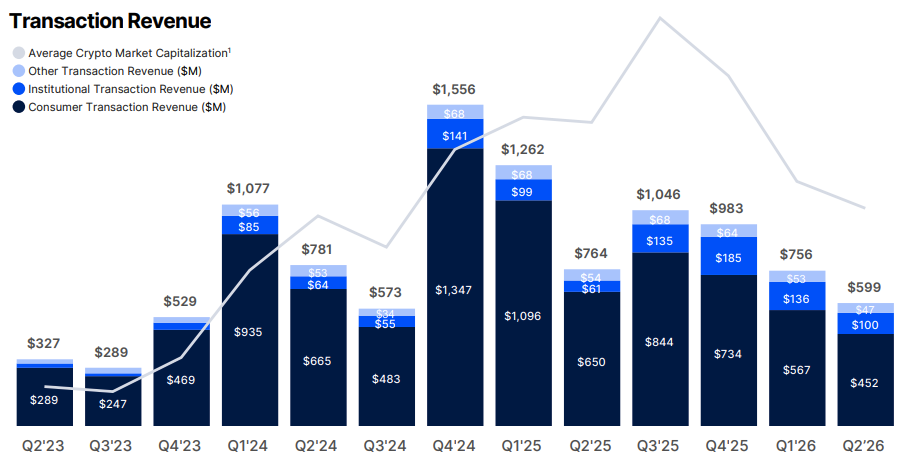
Coinbase 2026 Q2 Trading Revenue
Even with such dismal figures, retail-contributed trading revenue remained the largest single source of revenue in Coinbase's Q2 report. The second-largest source was stablecoin revenue, reaching $292 million. Since the report disclosed that Coinbase's crypto trading market share reached a new high of 10.3% in Q2, why is its trading revenue still declining sharply? Is it, as some analysts say, not due to user loss, but simply because of weak crypto sentiment reducing retail trading desire?
But the truth is that Coinbase played a word game. According to Coinbase's calculation method, this market share includes new products like derivatives trading, prediction markets, and tokenized stocks, not just cryptocurrency spot trading. Therefore, the 1% growth from 9.1% in Q1 to the current 10.3% in crypto trading market share was basically contributed by new business lines.
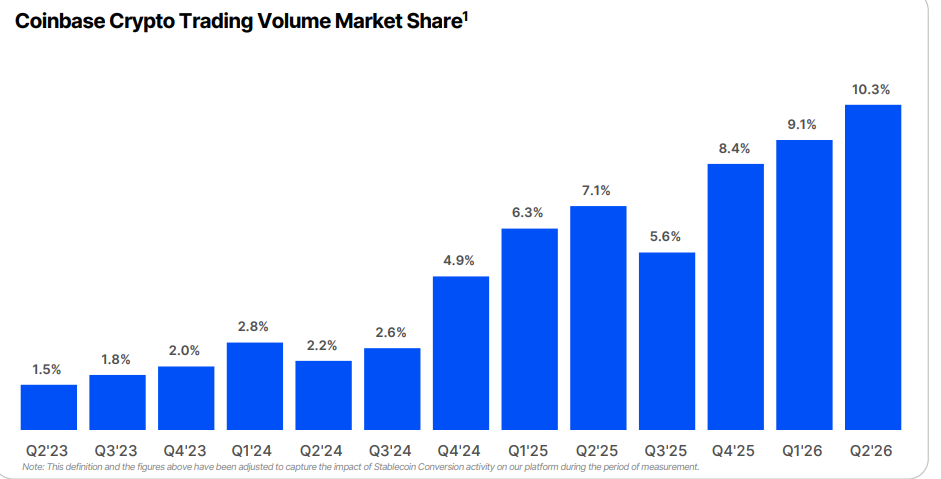
Quarterly Changes in Coinbase Crypto Trading Market Share
According to the report, growth in prediction markets has partially offset the impact of sluggish retail crypto spot trading volume on revenue. But by Coinbase's calculation, although prediction market revenue grew over 2 times quarter-over-quarter compared to Q1, its annualized revenue is only about $100 million, meaning actual revenue might be less than $30 million. Therefore, its offsetting effect on the loss of retail trading revenue can only be described as a drop in the bucket.
In summary, crypto spot trading remains the pillar of Coinbase's revenue. While Coinbase is doing its utmost to develop other businesses to create the so-called "Exchange for Everything," and has achieved growth, its growth rate and revenue levels have not satisfied the market and investors. In established market segments like prediction markets, crypto derivatives, and tokenized stock trading, Coinbase's competitiveness as a new entrant is relatively small. Its prospects for relying on new business lines for substantial growth and financial turnaround do not look optimistic at present.
Cyclical Stock or Growth Stock
However, to be fair, the current valuation of Coinbase depends on whether it is viewed as a cyclical stock or a growth stock.
If viewed as a cyclical stock, Coinbase's revenue is indeed constrained by the current crypto bear market cycle. New businesses have not freed it from cyclical limitations, and user attrition and declining competitiveness among exchanges are also obvious issues on the table.
Therefore, from this perspective, a decline in Coinbase's stock price is reasonable. In fact, everything Coinbase is doing now seems to be about surviving until the bull market cycle returns. Brian Armstrong also stated in the earnings call, "I believe Bitcoin will make a strong comeback; it has always gone through such cycles, and prices always go up and down. But we must have a strategy for diversified revenue; it is core to the exchange's operational strategy." The subtext is: when the bull market comes, everything will be fine.
If Coinbase is viewed as a future growth stock, then it is currently even undervalued.
First, looking at the revenue composition, although Coinbase has not yet achieved revenue diversification and crypto spot trading remains its main revenue source, the sources of revenue show a trend towards diversification. The report shows that Coinbase's current revenue is decoupled from Bitcoin trading fees, with 88% of net revenue coming from non-Bitcoin spot trading. In 2020, Bitcoin trading fees accounted for over 55% of revenue. Meanwhile, Coinbase's subscription and services revenue in this quarter reached $555 million, accounting for 48% of net revenue, almost on par with trading revenue ($599 million).
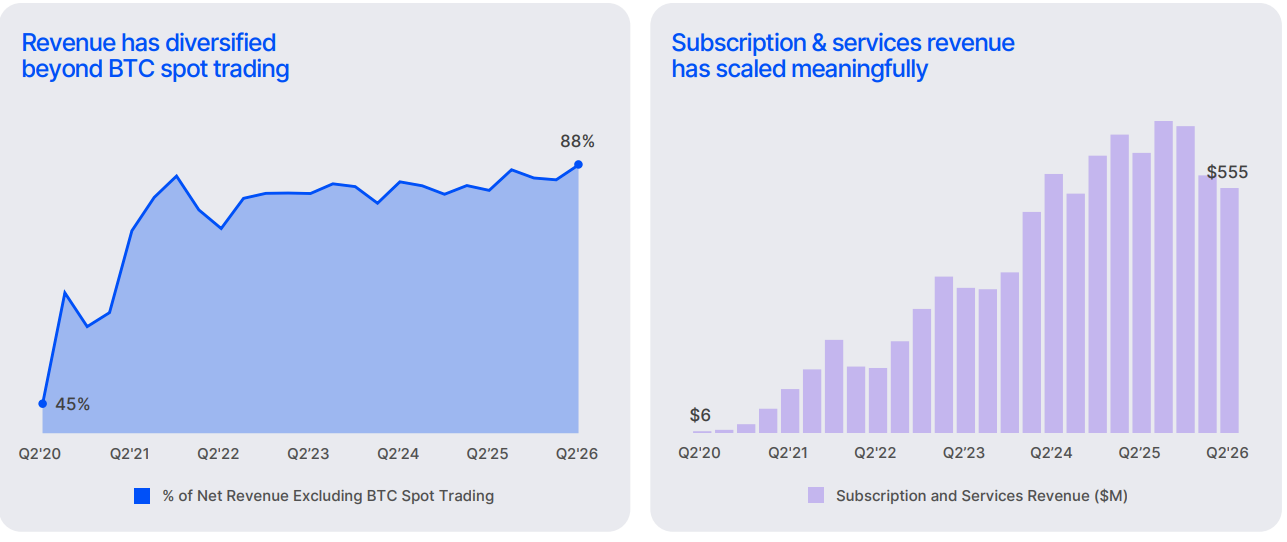
Coinbase Bitcoin Trading Fee Revenue Share & Quarterly Subscription and Services Revenue Growth
Furthermore, the number of paid users for Coinbase One hit a record high this quarter, with subscription fee revenue growing to $114 million. Crypto derivatives trading volume in Q2 did not decrease but remained largely flat with Q1 at $4.221 trillion. Coinbase has acquired Deribit and can now provide crypto derivatives trading for international users, potentially leading to another significant increase in market trading volume.
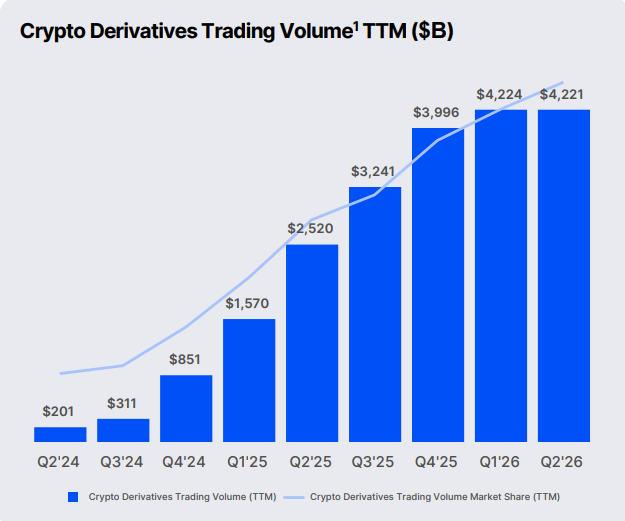
Therefore, from a developmental perspective, perhaps by Q3 2026 or Q1 2027, the total revenue from Coinbase's other businesses will replace the decisive role of crypto spot revenue in its overall revenue. The "Exchange for Everything" concept Coinbase aims to build does not necessarily mean it must excel in every field (like prediction markets, crypto derivatives, and tokenized stocks). Most investors don't have such expectations either; achieving profitability and diversified revenue would already meet expectations.
Because the future potential investors see in Coinbase lies mainly in its stablecoin business and the agent economy.
In the earnings call, CFO Alesia Haas again emphasized that Coinbase's revenue-sharing agreement with Circle will continue. Coinbase's Q2 2026 stablecoin revenue reached $292 million, still its second-largest revenue source. Meanwhile, USDC deposited on Coinbase platforms and products reached a new high, with over 30% of circulating USDC stored on Coinbase. Moreover, Coinbase disclosed in the report that over the past year, Coinbase has captured 50% of the total economic value of USDC, and broader on-chain collaboration and product integration will drive wider adoption of USDC in the future.
Simultaneously, Coinbase doesn't want to rely solely on USDC and is becoming a multi-stablecoin platform. Coinbase is a founding member of OUSD, and the variety of stablecoins supported on its platform is constantly increasing.
In the on-chain agent economy, Coinbase is a leader in the on-chain Agentic Finance (AIFi) field. Currently, according to the report, over 99% of on-chain agent transactions are completed using USDC, and over 90% of delegated stablecoin transactions are completed on Base. In Q2 2026, over 97% of on-chain agent transactions used Coinbase's x402 protocol.
Furthermore, Base's leading position in the agent economy won't be easily shaken by new market entrants competing on price because it is already cheap enough. Brian Armstrong stated in the earnings call, "Base's settlement price is below $0.01, with a settlement time under 1 second. From that perspective, it's highly competitive."
Although Base's leadership in the agent economy has not yet made a significant revenue contribution to Coinbase, this business segment holds immense future commercial value. The agent economy is widely recognized as the best intersection of blockchain and AI. Future agent economies will require payment settlement systems and identity systems, which is precisely where Base and the x402 protocol come into play. According to Coinbase's estimates, by 2030, agents will handle $3-5 trillion in agent transactions. If Base can capture 40% of this market share, even charging a 0.1% fee could generate tens of billions in revenue.
While Coinbase's current business situation is not optimistic, its future is not entirely bleak either. It depends on the perspective and investment horizon of the investor.







