In Order to Buy Investigational Weight-Loss Drugs, a Group of Americans Learn to Use Bitcoin Payments

marsbitPublicado em 2026-07-22Última atualização em 2026-07-22

Resumo

To purchase the experimental weight-loss drug retatrutide, Americans like Zach are turning to Bitcoin despite initial skepticism. Retatrutide, an unapproved triple-agonist from Eli Lilly, offers significant weight loss but is inaccessible through U.S. channels. Buying from domestic resellers costs around $3,600 annually, whereas Zach found a Chinese seller offering a year’s supply for $240—with Bitcoin as the only payment option. This price disparity led him to learn cryptocurrency for the transaction. Online sellers of such “research chemicals” or peptides often use Bitcoin because traditional payment systems avoid the regulatory and legal risks. Chainalysis data shows crypto payments to grey-market peptide sellers reached $32 million in Q1 2026, suggesting an annualized volume exceeding $100 million, though this remains a fraction of the estimated $1-3 billion black market. The trend intersects with communities like DeSciNYC, where events on peptides draw crowds interested in biohacking and longevity, indicating shared interests between crypto and wellness circles. However, potential FDA moves to legalize certain peptides could shift demand away from the black market and reduce the need for crypto payments.

Original: Bloomberg

Compiled & Edited by: angelilu, Foresight News

A 49-year-old American marketing director, who previously considered Bitcoin to have "no underlying value," spent several days this year opening an account, buying cryptocurrency, and making a transfer. His goal was to purchase 20 bottles of an investigational weight-loss drug from a Chinese seller. A Bloomberg report on July 20 revealed that such transactions are forming a crypto payment market, with annual transaction volume projected to exceed $100 million at the current pace—and the buyers are mostly ordinary consumers who had never touched cryptocurrency before.

A Transfer to Save Money

The buyer interviewed by Bloomberg is named Zach (surname withheld for privacy), from the Pacific Northwest region of the US. He wanted retatrutide—an investigational weight-loss drug from Eli Lilly. It is a triple GIP, GLP-1, and glucagon receptor agonist; in simple terms, it targets one more point than current market drugs like semaglutide and tirzepatide. Eli Lilly released its phase 3 clinical data in March this year, showing weight loss of up to 28% at the highest dose over 80 weeks. However, this drug has not yet been approved by the US Food and Drug Administration (FDA) and is unavailable through regular channels.

Zach searched for months and finally found a Chinese seller willing to sell him 20 bottles of what they claimed to be that compound, roughly a year's supply, for a total of $240. In contrast, buying from secondary dealers in the US would cost him $300 a month, or $3,600 a year.

The only condition: Bitcoin only.

According to Bloomberg's description, Zach had previously categorized Bitcoin as a purely speculative asset. But the more than tenfold price difference changed his mind—"The spread is too vast; it felt like a risk worth taking." The seller gave him a webpage teaching him how to buy and transfer cryptocurrency. A few days later, he opened a Coinbase account, bought Bitcoin for the first time in his life, transferred it to the seller, and received the package a week later.

What Peptides Are, and Why They Need Crypto Payments

Peptides are short chains of amino acids that participate in regulating various physiological processes in the human body. They have entered the public spotlight over the past two years alongside the weight-loss drug craze—injectable drugs like semaglutide (Wegovy) and tirzepatide (Zepbound), which have undergone full clinical validation and approval, are themselves peptide drugs.

But beyond these approved drugs, a large number of similar products that have not undergone full human safety and efficacy verification circulate online, often sold under the label of "research chemicals," with packaging clearly stating they are not approved by the FDA and are not for human or animal use. They are shipped directly from overseas laboratories, requiring no prescription and bypassing insurance.

Due to the unproven health claims of these products and the high legal and regulatory risks, banks and credit card networks are often unwilling to provide services to such sellers. Locked out of the traditional payment system, more and more sellers accept only Bitcoin.

style="text-align: left;">It should be noted that crypto payments themselves are stratified: Data cited by Bloomberg shows that among sellers with an average transaction value exceeding $1,000, stablecoins have surpassed Bitcoin as the preferred choice; but on the end catering to small retail customers like Zach, Bitcoin remains mainstream.

Growing in Scale, but Still Small Overall

Data from blockchain analytics firm Chainalysis shows that in Q1 2026, gray-market peptide sellers received $32 million in cryptocurrency payments, a 700% year-on-year increase (a 159% increase from the previous quarter's $12 million). Projecting based on recent months' pace, the annualized scale now exceeds $100 million.
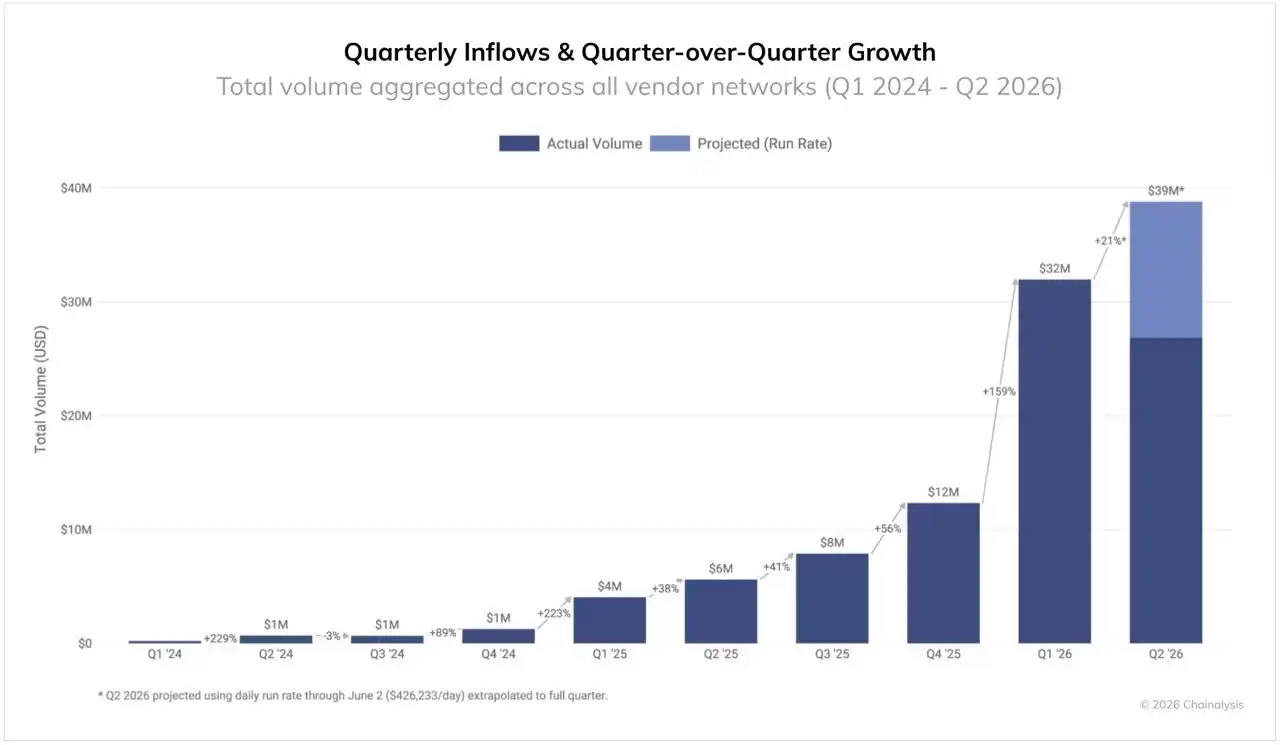
Security firm TRM Labs, using another method—combining on-chain analysis with public information investigations on drug precursor manufacturers—estimated crypto inflows into this sector at $41.4 million in 2025, a 20% year-on-year increase.

Ari Redbord, Global Head of Policy at TRM Labs, believes, "This market is huge and expanding. I'm not sure there's another pharmaceutical market in the world growing as fast as peptides."

This paints a somewhat dramatic scene: regular gym-goers, podcast listeners, middle-aged individuals wanting to lose weight—these demographics are being linked to gray-market buyers.

Despite the growth, industry investors estimate the overall size of the peptide black market to be between $1 billion and $3 billion. The volume using cryptocurrency as a payment method remains very small.

A Bar Adorned with Crypto Memorabilia

The most interesting scene in Bloomberg's report takes place in a corner of a bar in Manhattan—walls covered with crypto memorabilia, over a hundred people crammed into a stuffy room, listening to a lecture on peptides.

The organizer was DeSciNYC, a monthly in-person gathering for science enthusiasts, with the slogan "Science for everyone." Its past themes have included: longevity, CRISPR gene editing, AI & science, microbiome, bioelectricity, tardigrades, cellular metabolism, academic publishing fraud, prediction markets, etc.

This peptide-themed session was called "Peptides 101." The speaker was Julius Ritter, in his twenties, founder of the California Peptide Club, who also runs a longevity-themed meal delivery company and operates a hackathon house in San Francisco. He spent an hour covering peptide chemistry, potential uses, some risks, and several specific products, finally lifting his black T-shirt and injecting himself on the spot, earning a round of applause.

This scene illustrates something more direct than payment data: the connection between crypto and this market is not just a payment channel; it's the same crowd. The DeSci, longevity, biohacking, and fitness self-optimization circles are highly overlapping, with the crypto community being frequent visitors.

Regulation Is Moving, This Use Case Might Disappear

It's worth noting that the US is moving in the direction of "legalization."

The FDA is convening advisory committees to discuss whether to allow the legal domestic production of some popular peptides. US Secretary of Health and Human Services, Robert F. Kennedy Jr., has publicly supported this direction, arguing that legalization "helps shift demand away from the black market." Lee Rosebush, President of the American Peptide Medical Association, which advocates for regulation, used the term "Wild West" to describe the current market state. He believes stricter rules could actually squeeze out "for research only" manufacturers, making it easier for patients to obtain safe medication.

If this path succeeds, crypto payments' position in this market could become awkward—its current share largely occupies the space left by the absence of the traditional payment system.

Zach himself plans to exit. He says he has already reached his target weight.

Criptomoedas em alta

Perguntas relacionadas

QAccording to the article, why is a market for unapproved weight-loss peptides using Bitcoin payments emerging in the United States?

AThe market is emerging because these unapproved peptide products, often sold as 'research chemicals,' face significant legal and regulatory risks. As a result, traditional payment networks like banks and credit cards are often unwilling to process transactions for these sellers. Bitcoin provides a workaround, allowing sellers to receive payments from buyers who cannot access these products through approved channels. Additionally, the large price difference compared to buying from domestic 'gray market' sources is a key driver for consumers to learn and use Bitcoin.

QWhat key difference in payment preference is highlighted between large-scale and small-scale buyers in the peptide crypto market?

AAccording to blockchain data cited in the article, stablecoins have surpassed Bitcoin as the preferred payment method for sellers dealing with large-scale transactions where the average order value exceeds $1,000. However, for small-scale retail buyers making smaller purchases, Bitcoin remains the dominant cryptocurrency used for payment.

QWhat does the scene at the DeSciNYC event in a Manhattan bar illustrate about the connection between the crypto community and the peptide market?

AThe scene illustrates that the connection goes beyond just a payment method. It shows that the communities for decentralized science (DeSci), biohacking, longevity, fitness optimization, and cryptocurrency are highly overlapping. The event, focused on peptide education and featuring a live injection demonstration, attracted a crowd in a crypto-themed bar, indicating shared interests and values between these groups.

QBased on the article, what potential regulatory change in the U.S. could threaten the use of cryptocurrencies in the peptide market?

AThe U.S. Food and Drug Administration (FDA) is considering allowing the legal domestic production of some popular peptide compounds. Key figures like Health and Human Services Secretary RFK Jr. support this move to shift demand away from the black market. If successful, this legalization would likely integrate peptide sales into the traditional financial and pharmaceutical systems, reducing the need for cryptocurrency as a workaround payment method and potentially causing its role in this specific market to diminish.

QWhat was the primary motivation for 'Zach', the 49-year-old marketing director, to use Bitcoin for the first time?

AZach's primary motivation was the massive cost savings. He found a Chinese seller offering a one-year supply (20 bottles) of the unapproved weight-loss drug retatrutide for $240 total. In contrast, purchasing a similar supply from U.S.-based secondary sellers would cost him $300 per month, or $3,600 per year. The enormous price disparity made him decide that the risk and effort of learning to use Bitcoin were 'worth taking.'

Leituras Relacionadas

As Consensus Accelerates, What Are Young Investors Betting On?

Title: As Consensus Forms Faster, What Are Young Investors Betting On? In the rapid evolution of tech investment, a new generation of young investors is navigating a landscape where AI, robotics, commercial aerospace, and quantum computing are advancing simultaneously. Traditional investment logic based on financial models is giving way to a need for deep technical understanding and the ability to act before industry consensus forms. An analysis of trends from the "WAIC FUTURE TECH" list of young investment leaders reveals key shifts in focus. The first major trend is the movement of AI from the digital screen into the physical world. Investment is shifting from large language models and chatbots towards embodied AI, robotics, AI hardware, and edge computing. While demonstrations generate excitement, the real challenge lies in achieving scalable, reliable, and cost-effective delivery in complex real-world environments like factories and logistics. Success depends not just on algorithms but on the integration of sensors, actuators, and control systems. Second, the competitive focus for large models is moving beyond raw capability toward building an "intelligence flywheel." The goal is to create self-reinforcing systems where user interaction generates data, improving the model, which in turn enhances the user experience and attracts more engagement. Companies that successfully embed AI into workflows to create these closed-loop systems can build lasting value that isn't easily erased by the next model upgrade. Third, facing a potential bottleneck in high-quality human-generated data, investors are looking at new underlying technologies. Reinforcement learning and self-play, as demonstrated by AlphaGo Zero, offer paths for AI to generate its own experience. Scientific foundation models, which aim to build general AI capabilities for fields like life sciences and materials discovery, represent a non-consensus direction that could unlock new frontiers of knowledge and data. Finally, in deep-tech areas like quantum computing, commercial aerospace, and space-based infrastructure, patient capital is essential. These fields have long, uncertain development and validation cycles involving complex engineering, supply chains, and regulations. Investment here requires a long-term view, focusing on foundational team capabilities and the eventual emergence of market demand, even if commercial returns are distant. Collectively, these trends illustrate how young investors are adapting to a new era. They are learning to make earlier, technically-informed judgments, balance hype with real-world viability, and provide the patient capital needed to build the deep-tech foundations of the future.

marsbitHá 22m

As Consensus Accelerates, What Are Young Investors Betting On?

marsbitHá 22m

Can Japan Buy Growth with AI? Will the Bond Market Believe It?

Japan's cabinet has introduced the 2026 Basic Policy on Economic and Fiscal Management and Reform, shifting its primary fiscal target. The new framework moves away from the traditional annual primary balance goal and instead prioritizes a stable reduction of the debt-to-GDP ratio. This change is tied to a strategy of increased "responsible proactive fiscal" spending, aiming to boost long-term growth through investments in strategic sectors like AI, semiconductors, energy, and robotics. The government estimates total public and private investment in 62 key technologies could exceed 370 trillion yen by 2040. The market reaction has been mixed and cautious. While equity markets may respond to policy signals, bond markets are focused on fiscal credibility. Concerns center on whether the weakening of the clear primary balance anchor could lead to looser fiscal discipline. If investors doubt that these strategic investments will generate sufficient productivity gains, tax revenue, and nominal growth to outpace rising interest costs, they may demand higher yields on Japanese Government Bonds (JGBs). Recent volatility in the yen and JGB yields, with the 10-year yield briefly reaching 2.9%, reflects this skepticism. The success of this new framework hinges on two factors: whether Japan can achieve a nominal growth rate consistently higher than its long-term interest rates, and whether future budgets demonstrate disciplined control over bond issuance. The government's narrative is that strategic investment is essential to break Japan's cycle of low growth, aging, and labor shortages. However, the bond market will continuously assess the credibility of this plan, pricing the risk that it may represent fiscal expansion rather than a viable growth strategy.

marsbitHá 59m

Can Japan Buy Growth with AI? Will the Bond Market Believe It?

marsbitHá 59m

Misjudged A-Shares: Resilience, Expectations, and Confidence

China's A-share market recently faced selling pressure, especially in tech sectors, initially triggered by a global tech sell-off that began in South Korea. However, the article argues this is a case of "mistaken injury" and highlights the market's underlying resilience. This resilience stems from three main pillars: **1) Tech Sector Fundamentals:** Unlike Korea's market dominated by a few memory chip stocks, China's tech sector is diversified across computing, communications, electronics, and semiconductors, supported by dual narratives of global AI supply chains and domestic substitution. Core areas like optical modules and fiber optics continue to show strong earnings growth. **2) "National Team" Support:** State-backed institutions and large corporations have made significant market purchases and announced buybacks, providing liquidity and signaling confidence. This is seen as a stabilizing policy signal, often associated with market bottoms. **3) Broader Market Pillars:** Other major sectors are showing endogenous recovery momentum. Consumer stocks benefit from stabilizing CPI and signs of sector recovery (e.g., liquor price hikes). Cyclical sectors like aluminum have high earnings, potential price increases due to tight supply, and low valuations. The financial sector offers stable dividends and low valuations. The conclusion is that the sell-off was driven by external contagion, not a collapse in fundamentals. With strong policy support and recovering momentum across key sectors, the A-share market possesses the toughness to regain stability.

marsbitHá 1h

Misjudged A-Shares: Resilience, Expectations, and Confidence

marsbitHá 1h

Trading

Spot

Artigos em Destaque

O que é BITCOIN

Compreender o HarryPotterObamaSonic10Inu (ERC-20) e a Sua Posição no Espaço Cripto Nos últimos anos, o mercado de criptomoedas assistiu a um aumento na popularidade das moedas meme, cativando não apenas os traders, mas também aqueles que procuram envolvimento comunitário e valor de entretenimento. Entre estes tokens únicos está o HarryPotterObamaSonic10Inu (ERC-20), um projeto intrigante que mistura referências culturais no tecido das criptomoedas. Este artigo explora os principais aspetos do HarryPotterObamaSonic10Inu, examinando os seus mecanismos, a sua ética orientada pela comunidade e o seu envolvimento com o vasto panorama cripto. O que é o HarryPotterObamaSonic10Inu (ERC-20)? Como o nome sugere, o HarryPotterObamaSonic10Inu é uma moeda meme construída na blockchain Ethereum, classificada sob o padrão ERC-20. Ao contrário das criptomoedas tradicionais, que podem enfatizar a utilidade prática ou o potencial de investimento, este token prospera no valor de entretenimento e na força da sua comunidade. O projeto visa promover um ambiente onde utilizadores envolvidos possam reunir-se, partilhar ideias e participar em atividades inspiradas por diversos fenómenos culturais. Uma característica notável do HarryPotterObamaSonic10Inu é a zero taxa sobre transações. Este elemento atraente visa encorajar a negociação e o envolvimento da comunidade, isento de encargos adicionais que podem desencorajar os traders de pequena escala. A oferta total da moeda está fixada em mil milhões de tokens, uma cifra que marca a sua intenção de manter uma circulação substancial dentro da comunidade. Criador do HarryPotterObamaSonic10Inu (ERC-20) As origens do HarryPotterObamaSonic10Inu estão um pouco envoltas em mistério; os detalhes sobre o criador permanecem desconhecidos. O desenvolvimento deste token carece de uma equipa identificável ou de um plano explícito, o que não é raro no setor das moedas meme. Em vez disso, o projeto surgiu de forma orgânica, com o seu progresso a depender fortemente do entusiasmo e da participação da sua comunidade. Investidores do HarryPotterObamaSonic10Inu (ERC-20) No que diz respeito a investimentos externos e apoios, o HarryPotterObamaSonic10Inu também permanece ambíguo. O token não lista quaisquer fundações de investimento conhecidas ou apoio organizacional significativo. Em vez disso, o “sangue vital” do projeto é a sua comunidade de base, que informa o seu crescimento e sustentabilidade através da ação coletiva e do envolvimento no espaço cripto. Como Funciona o HarryPotterObamaSonic10Inu (ERC-20)? Como uma moeda meme, o HarryPotterObamaSonic10Inu opera principalmente fora dos quadros tradicionais que muitas vezes governam o valor dos ativos. Existem vários aspetos distintivos que definem como o projeto funciona: Transações Sem Taxas: Sem taxas sobre transações, os utilizadores podem comprar e vender o token livremente, sem a preocupação de custos ocultos. Envolvimento da Comunidade: O projeto prospera na interação da comunidade, aproveitando plataformas de redes sociais para criar entusiasmo e facilitar a participação. Discussões, partilha de conteúdo e envolvimento são elementos cruciais que ajudam a expandir o seu alcance e a fomentar a lealdade entre os apoiantes. Sem Utilidade Prática: Deve ser notado que o HarryPotterObamaSonic10Inu não oferece utilidade concreta dentro do ecossistema financeiro. Em vez disso, é classificado como um token principalmente para entretenimento e atividades comunitárias. Referência Cultural: O token incorpora de forma inteligente elementos da cultura popular para atrair interesse, conectando-se tanto com entusiastas de memes como com seguidores de criptomoedas. HarryPotterObamaSonic10Inu exemplifica como as moedas meme operam de forma diferente de projetos de criptomoedas mais tradicionais, entrando no mercado como construções sociais inovadoras em vez de ativos utilitários. Linha do Tempo do HarryPotterObamaSonic10Inu (ERC-20) A história do HarryPotterObamaSonic10Inu é marcada por vários marcos notáveis: Criação: O token surgiu de um meme viral, capturando a imaginação de muitos entusiastas de criptomoedas. Datas específicas de criação não estão disponíveis, sublinhando a sua ascensão orgânica. Listagem em Exchanges: O HarryPotterObamaSonic10Inu conseguiu entrar em várias exchanges, permitindo um acesso e negociação mais fáceis pela comunidade. Iniciativas de Envolvimento da Comunidade: Atividades contínuas direcionadas a melhorar a interação comunitária, incluindo concursos, campanhas em redes sociais e geração de conteúdo por fãs e defensores. Planos de Expansão Futura: O roteiro do projeto inclui o lançamento de uma coleção de NFTs, mercadorias e um site de eCommerce relacionado aos seus temas culturais, envolvendo ainda mais a comunidade e tentando adicionar mais dimensões ao seu ecossistema. Pontos-Chave sobre o HarryPotterObamaSonic10Inu (ERC-20) Natureza Orientada pela Comunidade: O projeto prioriza a contribuição coletiva e a criatividade, assegurando que o envolvimento dos utilizadores está na vanguarda do seu desenvolvimento. Classificação como Moeda Meme: Representa o epítome da criptomoeda baseada em entretenimento, destacando-se dos veículos de investimento tradicionais. Sem Afiliação Direta com o Bitcoin: Apesar da semelhança no nome do ticker, o HarryPotterObamaSonic10Inu é distinto e não tem qualquer relação com o Bitcoin ou outras criptomoedas estabelecidas. Foco na Colaboração: O HarryPotterObamaSonic10Inu é projetado para criar um espaço de colaboração e partilha de histórias entre os seus detentores, proporcionando uma via para a criatividade e o fortalecimento da comunidade. Perspectivas Futuras: A ambição de expandir além da sua premissa inicial para NFTs e mercadorias delineia um caminho para o projeto potencialmente entrar em avenidas mais mainstream dentro da cultura digital. À medida que as moedas meme continuam a capturar a imaginação da comunidade cripto, HarryPotterObamaSonic10Inu (ERC-20) destaca-se devido aos seus laços culturais e abordagem centrada na comunidade. Embora possa não se encaixar no molde típico de um token orientado para utilidade, a sua essência reside na alegria e camaradagem fomentadas entre os seus apoiantes, destacando a natureza em evolução das criptomoedas em uma era cada vez mais digital. À medida que o projeto continua a desenvolver-se, será importante observar como as dinâmicas comunitárias influenciam a sua trajetória no panorama em constante mudança da tecnologia blockchain.

1.7k Visualizações TotaisPublicado em {updateTime}Atualizado em 2024.12.03

O que é BITCOIN

Como comprar BTC

Bem-vindo à HTX.com!Tornámos a compra de Bitcoin (BTC) simples e conveniente.Segue o nosso guia passo a passo para iniciar a tua jornada no mundo das criptos.Passo 1: cria a tua conta HTXUtiliza o teu e-mail ou número de telefone para te inscreveres numa conta gratuita na HTX.Desfruta de um processo de inscrição sem complicações e desbloqueia todas as funcionalidades.Obter a minha contaPasso 2: vai para Comprar Cripto e escolhe o teu método de pagamentoCartão de crédito/débito: usa o teu visa ou mastercard para comprar Bitcoin (BTC) instantaneamente.Saldo: usa os fundos da tua conta HTX para transacionar sem problemas.Terceiros: adicionamos métodos de pagamento populares, como Google Pay e Apple Pay, para aumentar a conveniência.P2P: transaciona diretamente com outros utilizadores na HTX.Mercado de balcão (OTC): oferecemos serviços personalizados e taxas de câmbio competitivas para os traders.Passo 3: armazena teu Bitcoin (BTC)Depois de comprar o teu Bitcoin (BTC), armazena-o na tua conta HTX.Alternativamente, podes enviá-lo para outro lugar através de transferência blockchain ou usá-lo para transacionar outras criptomoedas.Passo 4: transaciona Bitcoin (BTC)Transaciona facilmente Bitcoin (BTC) no mercado à vista da HTX.Acede simplesmente à tua conta, seleciona o teu par de trading, executa as tuas transações e monitoriza em tempo real.Oferecemos uma experiência de fácil utilização tanto para principiantes como para traders experientes.

4.3k Visualizações TotaisPublicado em {updateTime}Atualizado em 2026.06.02

Como comprar BTC

O que é $BITCOIN

OURO DIGITAL ($BITCOIN): Uma Análise Abrangente Introdução ao OURO DIGITAL ($BITCOIN) OURO DIGITAL ($BITCOIN) é um projeto baseado em blockchain que opera na rede Solana, com o objetivo de combinar as características dos metais preciosos tradicionais com a inovação das tecnologias descentralizadas. Embora partilhe um nome com o Bitcoin, frequentemente referido como “ouro digital” devido à sua percepção como uma reserva de valor, o OURO DIGITAL é um token separado projetado para criar um ecossistema único dentro da paisagem Web3. O seu objetivo é posicionar-se como um ativo digital alternativo viável, embora os detalhes sobre as suas aplicações e funcionalidades ainda estejam em desenvolvimento. O que é o OURO DIGITAL ($BITCOIN)? OURO DIGITAL ($BITCOIN) é um token de criptomoeda explicitamente projetado para uso na blockchain Solana. Em contraste com o Bitcoin, que fornece um papel amplamente reconhecido como armazenamento de valor, este token parece focar em aplicações e características mais amplas. Aspectos notáveis incluem: Infraestrutura Blockchain: O token é construído na blockchain Solana, conhecida pela sua capacidade de lidar com transações de alta velocidade e baixo custo. Dinâmicas de Oferta: O OURO DIGITAL tem um fornecimento máximo limitado a 100 quatrilhões de tokens (100P $BITCOIN), embora os detalhes sobre o seu fornecimento circulante ainda não tenham sido divulgados. Utilidade: Embora as funcionalidades precisas não estejam explicitamente delineadas, existem indicações de que o token poderia ser utilizado para várias aplicações, potencialmente envolvendo aplicações descentralizadas (dApps) ou estratégias de tokenização de ativos. Quem é o Criador do OURO DIGITAL ($BITCOIN)? Neste momento, a identidade dos criadores e da equipa de desenvolvimento por trás do OURO DIGITAL ($BITCOIN) permanece desconhecida. Esta situação é típica entre muitos projetos inovadores no espaço da blockchain, particularmente aqueles alinhados com finanças descentralizadas e fenómenos de moedas meme. Embora tal anonimato possa fomentar uma cultura orientada pela comunidade, intensifica as preocupações sobre governança e responsabilidade. Quem são os Investidores do OURO DIGITAL ($BITCOIN)? As informações disponíveis indicam que o OURO DIGITAL ($BITCOIN) não tem apoiantes institucionais conhecidos ou investimentos proeminentes de capital de risco. O projeto parece operar num modelo peer-to-peer focado no apoio e adoção da comunidade, em vez de rotas de financiamento tradicionais. A sua atividade e liquidez estão principalmente situadas em exchanges descentralizadas (DEXs), como a PumpSwap, em vez de plataformas de negociação centralizadas estabelecidas, destacando ainda mais a sua abordagem de base. Como Funciona o OURO DIGITAL ($BITCOIN) A mecânica operacional do OURO DIGITAL ($BITCOIN) pode ser elaborada com base no seu design de blockchain e nas características da rede: Mecanismo de Consenso: Ao aproveitar o exclusivo proof-of-history (PoH) da Solana combinado com um modelo de proof-of-stake (PoS), o projeto assegura uma validação eficiente das transações, contribuindo para o alto desempenho da rede. Tokenomics: Embora mecanismos deflacionários específicos não tenham sido extensivamente detalhados, o vasto fornecimento máximo de tokens implica que pode atender a microtransações ou casos de uso de nicho que ainda estão por definir. Interoperabilidade: Existe o potencial para integração com o ecossistema mais amplo da Solana, incluindo várias plataformas de finanças descentralizadas (DeFi). No entanto, os detalhes sobre integrações específicas permanecem não especificados. Cronologia de Eventos Chave Aqui está uma cronologia que destaca marcos significativos relacionados ao OURO DIGITAL ($BITCOIN): 2023: O lançamento inicial do token ocorre na blockchain Solana, marcado pelo seu endereço de contrato. 2024: O OURO DIGITAL ganha visibilidade ao tornar-se disponível para negociação em exchanges descentralizadas como a PumpSwap, permitindo que os utilizadores o negociem contra SOL. 2025: O projeto testemunha atividade de negociação esporádica e potencial interesse em envolvimentos liderados pela comunidade, embora não tenham sido documentadas parcerias ou avanços técnicos notáveis até ao momento. Análise Crítica Forças Escalabilidade: A infraestrutura subjacente da Solana suporta altos volumes de transações, o que pode aumentar a utilidade do $BITCOIN em vários cenários de transação. Acessibilidade: O potencial preço de negociação baixo por token pode atrair investidores de retalho, facilitando uma participação mais ampla devido a oportunidades de propriedade fracionada. Riscos Falta de Transparência: A ausência de apoiantes, desenvolvedores ou um processo de auditoria publicamente conhecidos pode gerar ceticismo em relação à sustentabilidade e confiabilidade do projeto. Volatilidade do Mercado: A atividade de negociação depende fortemente do comportamento especulativo, o que pode resultar em volatilidade significativa dos preços e incerteza para os investidores. Conclusão O OURO DIGITAL ($BITCOIN) surge como um projeto intrigante, mas ambíguo, dentro do ecossistema em rápida evolução da Solana. Embora tente aproveitar a narrativa do “ouro digital”, a sua divergência do papel estabelecido do Bitcoin como reserva de valor sublinha a necessidade de uma diferenciação mais clara da sua utilidade pretendida e estrutura de governança. A aceitação e adoção futuras dependerão provavelmente da abordagem da atual opacidade e da definição mais explícita das suas estratégias operacionais e económicas. Nota: Este relatório abrange informações sintetizadas disponíveis até outubro de 2023, e desenvolvimentos podem ter ocorrido além do período de pesquisa.

142 Visualizações TotaisPublicado em {updateTime}Atualizado em 2025.05.13

O que é $BITCOIN

Discussões

Bem-vindo à Comunidade HTX. Aqui, pode manter-se informado sobre os mais recentes desenvolvimentos da plataforma e obter acesso a análises profissionais de mercado. As opiniões dos utilizadores sobre o preço de BTC (BTC) são apresentadas abaixo.

活动图片














