Bitcoin firm Twenty One Capital drops 20% on first day of trading

cointelegraphPublicado em 2025-12-10Última atualização em 2025-12-10

Resumo

Twenty One Capital, a new Bitcoin-focused company, saw its shares drop 20% on its first day of trading after merging with a SPAC. The stock opened at $10.74 and closed at $11.42, later rising slightly after-hours. Backed by Tether, Bitfinex, and SoftBank, the company holds over 43,500 BTC worth around $4 billion. CEO Jack Mallers stated it is "not a treasury company" and plans to build a business around Bitcoin products in brokerage, exchange, and lending, though no specific plans were revealed. The debut reflects broader challenges for crypto-related stocks amid market declines.

Shares in Twenty One Capital (XXI), the newest crypto treasury company in the US, slid 20% on its trading debut after merging with the blank-check company Cantor Equity Partners.

Twenty One Capital opened trading on Tuesday at $10.74, below the closing price of $14.27 on Monday for Cantor’s special purpose acquisition company that it merged with.

The new Bitcoin (BTC)-focused company’s stock closed trading on Wednesday at $11.42, down 19.97% over 24 hours.

However, it later saw a slight 2.2% lift after-hours to $11.67, giving it a market capitalization of around $4 billion based on its outstanding shares.

Twenty One was among the most anticipated crypto public debuts this year, with the company backed by major stablecoin issuer Tether, crypto exchange Bitfinex Japan’s SoftBank Group. Jack Mallers, the founder and CEO of the Bitcoin platform Strike, was also named Twenty One’s CEO.

The company holds over 43,500 Bitcoin worth over $4 billion, boasting the third-largest holdings among public companies behind Bitcoin miner MARA Holdings, according to BitcoinTreasuries.NET.

Twenty One has no public plan, but it’s “not a treasury”

Twenty One has not publicly said what exactly its operating business will be or when it plans to launch one, but Mallers told CNBC that it’s “not a treasury company.”

“We don’t want the market to think of us and price us as just a treasury asset,” he added. “We do have a lot of Bitcoin, but we’re also building a business.”
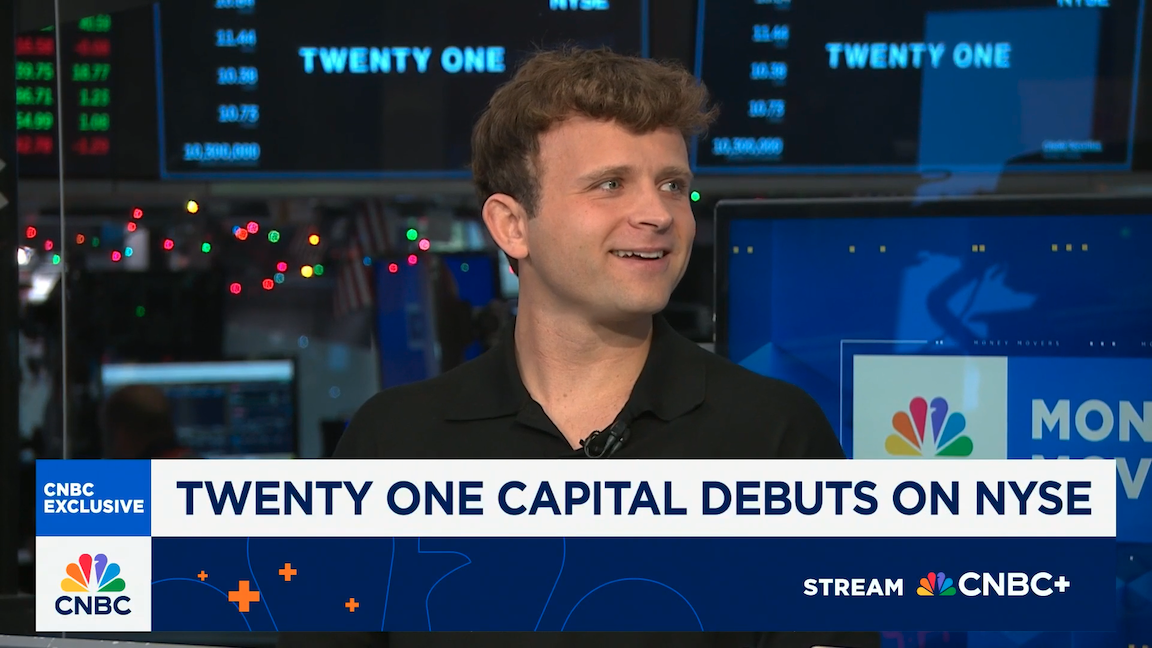
Jack Mallers appearing on CNBC’s “Money Movers” on Tuesday. Source: CNBC

“We’re building an operating company, we’re bringing a lot of Bitcoin products to market with the intent to have cash flow,” Mallers said, adding he sees “many opportunities in brokerage, exchange, credit and lending.”

Mallers deflected when pressed on what exactly Twenty One is planning, saying, “These things, we’ll come out with them sooner rather than later.”

Related: Vivek Ramaswamy's Strive to raise $500M to buy Bitcoin

The US has seen a deluge of so-called crypto treasury companies come to market this year, copying a model popularized by Strategy, where they buy and hold crypto and raise money to continue purchases.

Such crypto holding companies saw investor interest earlier this year as Bitcoin climbed to a high in October, but a decline in the crypto market since has dragged down shares in companies exposed to the sector.

Mallers is seemingly hoping his and Tether’s track record, and his conviction in Bitcoin, will buoy Twenty One in the meantime.

“We see Bitcoin as the forest through the trees,” he told CNBC. “It is the opportunity, and no one is seemingly focused on it. The story of this equity is to focus solely on Bitcoin and deliver value to shareholders primarily through Bitcoin.”

Magazine: Mysterious Mr Nakamoto author — Finding Satoshi would hurt Bitcoin
Leituras Relacionadas

"The Market in Russia is Only Just Emerging": Anton Popov on Sber's Crypto Strategy

Sberbank is increasing its activity in the digital finance sector, offering clients investment products linked to crypto assets and developing its own blockchain platform. In an interview, Deputy Chairman Anatoly Popov discussed the bank's strategy, which is focused on expanding its range of digital financial assets (DFAs), participating in the development of regulations for decentralized finance (DeFi), and integrating with public blockchains. Sber is in constant dialogue with Russian regulators to build a secure infrastructure. It currently offers qualified investors products like structured bonds and DFAs that provide exposure to cryptocurrencies like Bitcoin and Ethereum within the Russian legal framework, with a total issuance volume of 1.5 billion rubles. The bank sees these regulated, ruble-based products as a safer alternative to direct purchases on unregulated crypto exchanges. While Sber plans to be an active player and liquidity provider on future regulated crypto platforms, it will act conservatively, prioritizing client interests and financial system stability. It does not view crypto as a vehicle for its own speculative investments. Looking forward, Sber believes a key trend is the convergence of traditional finance and DeFi. Its in-house blockchain lab has evolved into a full product unit, and its proprietary platform for issuing DFAs is already operational. The bank is exploring tokenization of real-world assets like movable property and shares in LLCs, pending new legislation. For the future, Sber anticipates the institutionalization of blockchain technology. Bitcoin will likely remain a core asset, while networks like Ethereum will form the technological base for tokenization and smart contracts. A crucial step is the legalization of a broad range of blockchain-based digital assets, starting with pilot projects to demonstrate utility and manage risks. The bank is interested in stablecoins and their potential future use in the Russian legal field, emphasizing the need for collaborative work with the central bank.

RBK-cryptoHá 1m

"The Market in Russia is Only Just Emerging": Anton Popov on Sber's Crypto Strategy

RBK-cryptoHá 1m

Trading

Spot
Futuros
活动图片