When Crypto Traders Start Simultaneously Watching Crypto Assets, US Stocks, Gold, and Silver, What Are Trading Platforms Becoming?

marsbitPublicado em 2026-08-25Última atualização em 2026-08-25

Resumo

When crypto traders start tracking not just digital assets like BTC and ETH, but also traditional assets such as Nvidia (NVDA), Microsoft (MSFT), Apple (AAPL), gold, and silver within the same watchlist, it signals a fundamental shift in how markets are perceived. This convergence reflects a growing recognition that macroeconomic forces—like Federal Reserve policy, AI investment trends, or geopolitical tensions—simultaneously influence asset prices across boundaries. Traders are increasingly focused on capital flows between markets rather than isolated price movements. This evolving perspective explains why platforms like WEEX are integrating TradFi offerings—including stocks, commodities, and indices—alongside crypto. Using USDT as unified margin, these platforms cater to users who seek a consolidated view of global opportunities without switching between accounts. The integration highlights a broader trend: as traders adopt a multi-asset, macro-driven approach, platforms are transforming from niche venues into hubs for cross-market exposure, bridging the once-distinct worlds of crypto and traditional finance.

If you have friends who have been involved in Crypto trading for a long time, you can take a look at their watchlists.

In the past, it was most likely BTC, ETH, SOL, plus a few popular tokens they followed. Now it's different: NVIDIA (NVDA), Microsoft (MSFT), Apple (AAPL), Tesla (TSLA), Micron (MU), SanDisk (SNDK), gold, silver, even forex assets, are starting to appear alongside crypto assets in the same trader's field of view.
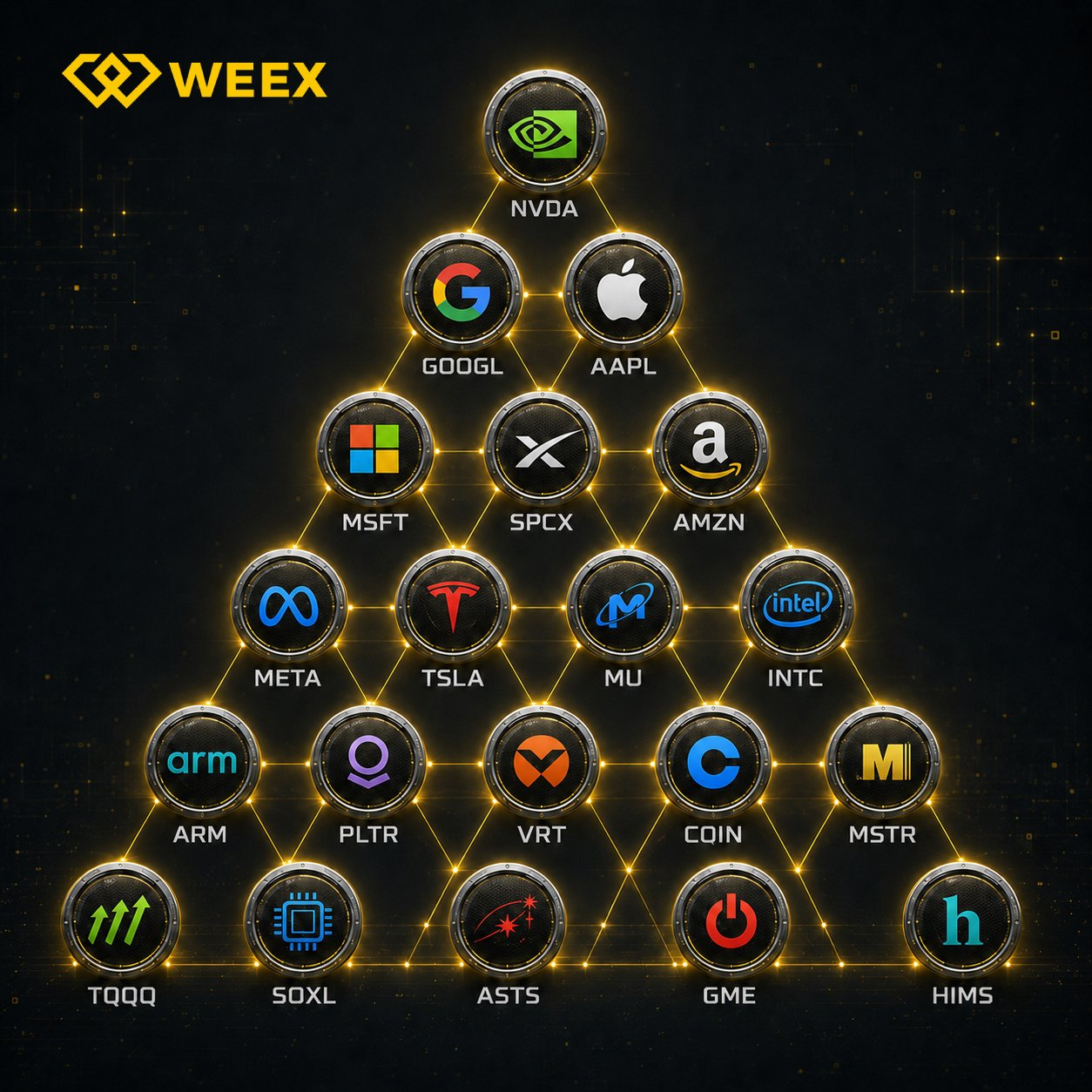
This change is actually quite interesting. People aren't suddenly switching from "crypto trading" to traditional investments. Instead, they are starting to realize that many of the things that truly impact market trends don't have clear market boundaries. When the Fed changes its interest rate expectations, it can simultaneously affect Bitcoin, US stocks, and gold; increased AI investment benefits NVIDIA and Micron, and also changes overall market risk appetite; when geopolitical tensions rise, gold, crude oil, and risk assets can react in completely different ways.

In other words, traders are no longer just focusing on "which market will go up," but on how the same pool of capital moves between different markets.

This also explains why traditional financial assets are appearing more and more frequently on Crypto trading platforms. For traders already accustomed to USDT, perpetual contracts, and 24/7 markets, reopening another account and switching to a different fund system isn't necessarily the answer they want. What they might truly be interested in is a simpler question: since BTC, NVIDIA, and gold are all influenced by the same set of macro factors, why can't we look at them together?

What's truly changing is not the assets, but how traders view the market

In the past, there was a clear dividing line between stock investors and Crypto traders. The former looked at earnings reports, valuations, and macroeconomic data, while the latter researched on-chain capital flows, market sentiment, and industry narratives. But today, the trading logic from both sides is increasingly overlapping.

AI is a typical example.

When NVIDIA rises, many Crypto traders don't treat it as unrelated news. AI computing demand, data center capital expenditures, and changes in tech stock valuations directly impact overall market risk appetite, and this same risk appetite can also be reflected in digital assets like BTC. Conversely, changes in dollar liquidity and interest rate expectations are hard to confine to just one market.

Thus, a trader might study BTC in the morning, watch NVDA's price action in the afternoon, and then look at gold in the evening. It might seem like they are trading three completely different markets, but in reality, they are focusing on the same question: where is the money flowing right now?

This might be the most significant change worth observing after TradFi enters crypto trading platforms.

Previously, what assets a platform offered largely determined what users could see; now, users first form their own market judgments and then look for platforms that can cover those assets. The boundaries between assets still exist, but traders' own perspectives are becoming increasingly difficult to confine by such boundaries.

Why are gold, silver, and US stocks appearing together in the same trading account?

The first time many people see gold, silver, US stocks, and Crypto appearing in the same trading environment, they might find it somewhat incongruous. But think carefully—they are fundamentally several important markets that global capital observes simultaneously every day.
Gold corresponds to safe-haven sentiment, interest rates, and the US dollar; silver, besides its financial attributes, has obvious industrial demand; US stocks more reflect corporate earnings and economic growth expectations. Each has its own pricing logic, yet they become interconnected during major macroeconomic events.

Recently, market interest in "digitizing traditional assets" has also increased noticeably. The US market is discussing enabling extended stock trading hours through blockchain infrastructure, and financial institutions and trading platforms are also exploring products like Tokenized Stocks. In other words, some of the asset trading functions previously carried by stock exchanges, brokerages, and banks separately are finding new digital entry points.

This doesn't mean traditional financial markets will be replaced by Crypto. A more realistic change is that the two market systems are gradually finding ways to connect, and traders happen to be the group that feels this change the earliest.

For WEEX, TradFi is more like an extension of trading boundaries

WEEX's launch of TradFi isn't simply placing a few stock tickers next to the original Crypto products.
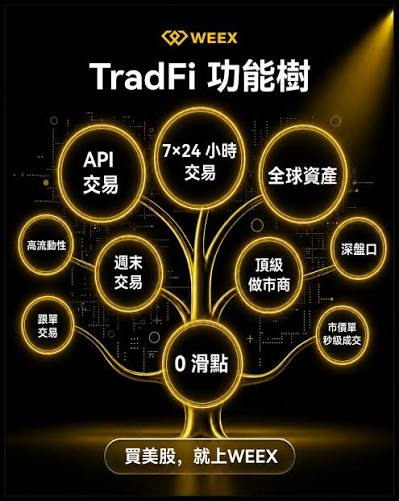
Currently, WEEX TradFi covers various types of traditional financial assets including stocks, gold, silver, crude oil, commodities, and global stock indices. It uses USDT as margin and does not require opening a separate TradFi account. Users can directly participate in related trades using USDT from their spot or contract accounts. The official page also provides a 7×24-hour TradFi trading mechanism, with clear prompts that liquidity might be lower during traditional market closure periods.

This design is quite easy to understand: WEEX is facing a user base already accustomed to digital asset trading. For them, USDT is not just an asset in their wallet, but also a familiar trading medium. Now, when they start paying attention to NVIDIA, Apple, Tesla, gold, or crude oil, the platform is naturally expected to provide broader market access.

Of course, this doesn't mean one account makes all markets completely identical. Stocks, precious metals, and Crypto each have different price formation mechanisms, trading hours, and risk characteristics. TradFi products themselves represent price exposure trades, not traditional ownership of the underlying assets.

But from a trader's perspective, the change is already evident.

A trader's perspective can extend from BTC to NVDA, from NVDA to QQQ, and from QQQ to gold and silver. The market observation that previously required opening several platforms is now gradually being integrated into a single trading environment.
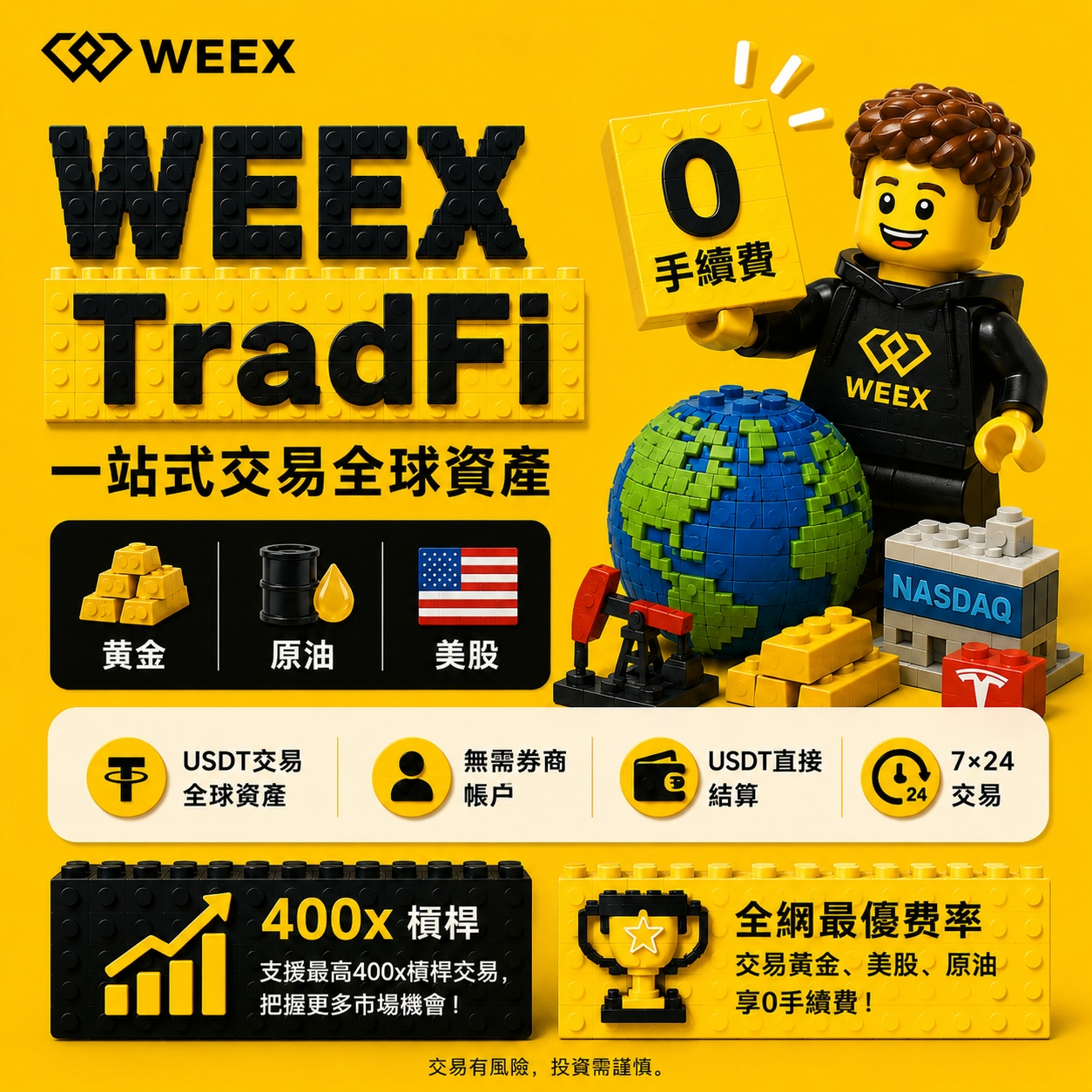
Therefore, what's truly worth paying attention to might not be "why Crypto trading platforms are starting to do TradFi," but another more specific question: When traders no longer see themselves as participants in just one single market, how can trading platforms continue to serve only one type of asset?

Perhaps this is what TradFi is truly changing.

Perguntas relacionadas

QWhat key change in trader behavior is highlighted in the article regarding modern trading platforms?

AThe article highlights a shift from traders focusing on a single asset class (like crypto) to analyzing and trading across multiple markets (crypto, US stocks, gold, silver, forex) within a single platform. Traders are now driven by understanding how capital flows across these interconnected markets under shared macroeconomic influences, rather than viewing each market in isolation.

QAccording to the article, what common factor is driving crypto traders to also monitor traditional assets like Nvidia and gold?

AThe common factor is shared macroeconomic and global risk drivers. For example, changes in Federal Reserve interest rate expectations, AI-related investment trends, and geopolitical tensions simultaneously impact Bitcoin, US tech stocks, and precious metals. Traders want to see how money moves between these assets in reaction to the same events.

QHow is WEEX's approach to integrating TradFi assets different from simply listing new symbols?

AWEEX integrates TradFi as an extension of the crypto trading experience. It allows users to trade stocks, gold, and other assets directly using their existing USDT balance from their spot or contract accounts, without needing a separate account. The platform maintains 24/7 trading for these assets and provides a unified interface, acknowledging the different market characteristics while simplifying access for users accustomed to crypto trading mechanics.

QWhat does the article suggest is the main reason for the blurring boundaries between crypto and traditional finance for traders?

AThe main reason is the increasing overlap in trading logic and market drivers. Events that impact tech stocks (like AI developments) also affect market risk appetite, which in turn influences crypto. Similarly, monetary policy and liquidity concerns impact both markets. Traders now form market views based on these global capital flows, which inherently span multiple asset classes, forcing platforms to adapt to this holistic perspective.

QWhat is the fundamental change the article identifies for trading platforms in the age of TradFi integration?

AThe fundamental change is that platforms are evolving from being defined by a single asset class to becoming unified gateways for multi-asset trading. They are no longer just 'crypto platforms' but are transforming to serve traders whose vision and strategy encompass the interconnected worlds of crypto, equities, commodities, and forex, all within a single environment.

Leituras Relacionadas

Analog Chip Giants TI and ADI Are Stepping Up

Analog chip giants Texas Instruments (TI) and Analog Devices (ADI) have both reported strong quarterly results, signaling an industry recovery. TI's Q2 2026 revenue reached $5.463 billion, a 23% year-over-year (YoY) increase. ADI's Q3 FY2026 revenue hit $4.022 billion, up 40% YoY, marking a new quarterly record. Both companies benefited from rising demand in industrial and data center markets, though their growth paths differed. TI experienced broad-based strength across its segments. Industrial revenue (33% of total) grew approximately 30% YoY, while data center revenue (9%) doubled. The automotive segment (33%) also showed a strong rebound, attributed to demand from China's EV/hybrid market and low inventory levels at automakers. ADI's growth was led by its industrial (49% of revenue, +53% YoY) and communications (16%, +84% YoY) segments, with data center products constituting 80% of the latter. Management highlighted a significant "AI exposure," with data center and ATE-related businesses now accounting for 20% of total revenue. Key differences emerged in their strategies and supply chain dynamics. ADI attributed a larger portion of its growth to AI infrastructure demand and has built "strategic inventory" to a record high of ~$1.93 billion to support future growth, despite channel inventory being below target levels. Its product lead times have extended to up to six months, and price increases are contributing to margin expansion. TI's inventory remained high at $4.6 billion but saw improved turnover. The company emphasized that its growth is primarily volume-driven, with minimal contribution from recent price hikes. TI maintains a competitive lead time below 13 weeks and expressed confidence in its capacity sufficiency for the next three years. In summary, both companies are riding a recovery wave fueled by industrial and AI/data center demand. TI's approach leverages its broad market presence and prepared capacity, while ADI is more focused on AI-driven growth and strategic inventory buildup. Their differing paths highlight the evolving structure of demand within the analog semiconductor market's rebound.

marsbitHá 6m

Analog Chip Giants TI and ADI Are Stepping Up

marsbitHá 6m

Bernstein Research Report Analysis: Circle Benefits from USDC Expansion Cycle, Maintains Outperform Rating with $140 Price Target

Bernstein Report Analysis: Circle Benefits from USDC Expansion Cycle, Maintains Outperform Rating with $140 Target Stablecoin markets are reversing. After nearly six months of stagnation and decline, the supply of USDC suddenly increased by $1.7 billion in the final week of August. Circle's stock price has rebounded 42% from its slump driven by concerns over OUSD competition. On August 24, Bernstein published a report stating this is not a temporary technical rebound. Four key factors are driving a new stablecoin expansion cycle: the macro interest rate environment, expansion of the on-chain capital market, proliferation of stablecoin payments, and the emerging use of AI agent payments. Circle, as the largest compliant stablecoin issuer, is positioned to benefit significantly. Bernstein maintains its "Outperform" rating for Circle with a $140 price target, implying a 59% upside from the current price. The recovery in USDC supply validates the macro logic. The US Treasury's long-end bond buyback plan is reshaping the macro narrative for stablecoins, with stablecoins absorbing incremental short-term Treasury supply. Both Bitcoin and stablecoins benefit from this macro shift. AI agent payments represent a new growth frontier. Stablecoin payments are extending from "person-to-person" to "machine-to-machine." Bernstein highlights the x402 payment protocol, designed for AI agents to autonomously hold wallets, discover services, and make instant micropayments using USDC. While current volumes are small, this signals stablecoins' evolution towards becoming a native currency for the digital economy. USDC accounts for over 99% of x402 transaction volume. Circle benefits from two structural trends. First, the expansion of the on-chain capital market: its ARC blockchain, with validators like BlackRock and DTCC, supports asset tokenization. USDC has also been used as collateral for regulated derivatives. Second, the continued adoption of stablecoin payments: USDC's share of adjusted transaction volume has risen from ~40% in 2025 to over 60% year-to-date in 2026. Bernstein's $140 valuation is based on a long-term discounted cash flow model, corresponding to ~23x 2028 adjusted EBITDA. Key risks include digital asset volatility, increased competition, and Circle's reliance on interest income for 99% of its revenue. The stablecoin expansion is a structural story, and Circle sits at the confluence of these driving trends.

marsbitHá 18m

Bernstein Research Report Analysis: Circle Benefits from USDC Expansion Cycle, Maintains Outperform Rating with $140 Price Target

marsbitHá 18m

Trading

Spot
活动图片