Bitcoin retail inflows to Binance ‘collapse’ to 400 BTC record low in 2025

cointelegraphPublicado em 2025-12-09Última atualização em 2025-12-09

Resumo

Bitcoin retail inflows to Binance have collapsed to a record low of around 411 BTC per day in 2025, down significantly from 2,675 BTC during the 2022 bear market. This "structural decline" in activity from small holders, known as "shrimps" (entities holding ≤1 BTC), suggests a major shift in retail participation. Analysts attribute this trend partly to the rise of U.S. spot Bitcoin ETFs, which offer a more accessible and secure way to gain exposure without direct crypto exchange use. Despite the retail pullback, on-chain data indicates whale positioning remains heavily long, potentially signaling a local price bottom formation.

Bitcoin (BTC) retail investors are setting new records as “structural decline” sets in this bull market.

Key points:

  • Bitcoin entities holding up to 1 BTC are sending less per day to Binance than ever before.

  • A tale of “structural decline” comes in the era of spot Bitcoin ETFs.

  • Whale positioning hints at a new BTC price bottom.


”Shrimp” Binance BTC inflows set all-time lows

Data from onchain analytics platform CryptoQuant shows BTC inflows to largest crypto exchange Binance collapsing in 2025.

Bitcoin retail investors — entities holding up to 1 BTC ($90,000) — have largely withdrawn from the trading scene.

According to CryptoQuant, even compared to the 2022 bear market, the activity of these “shrimp” investors is a fraction of what it was.

“The activity of shrimps, meaning small Bitcoin holders (<1 BTC), has dropped to one of the lowest levels ever recorded,” contributor Darkfost confirmed in a QuickTake blog post on Monday.
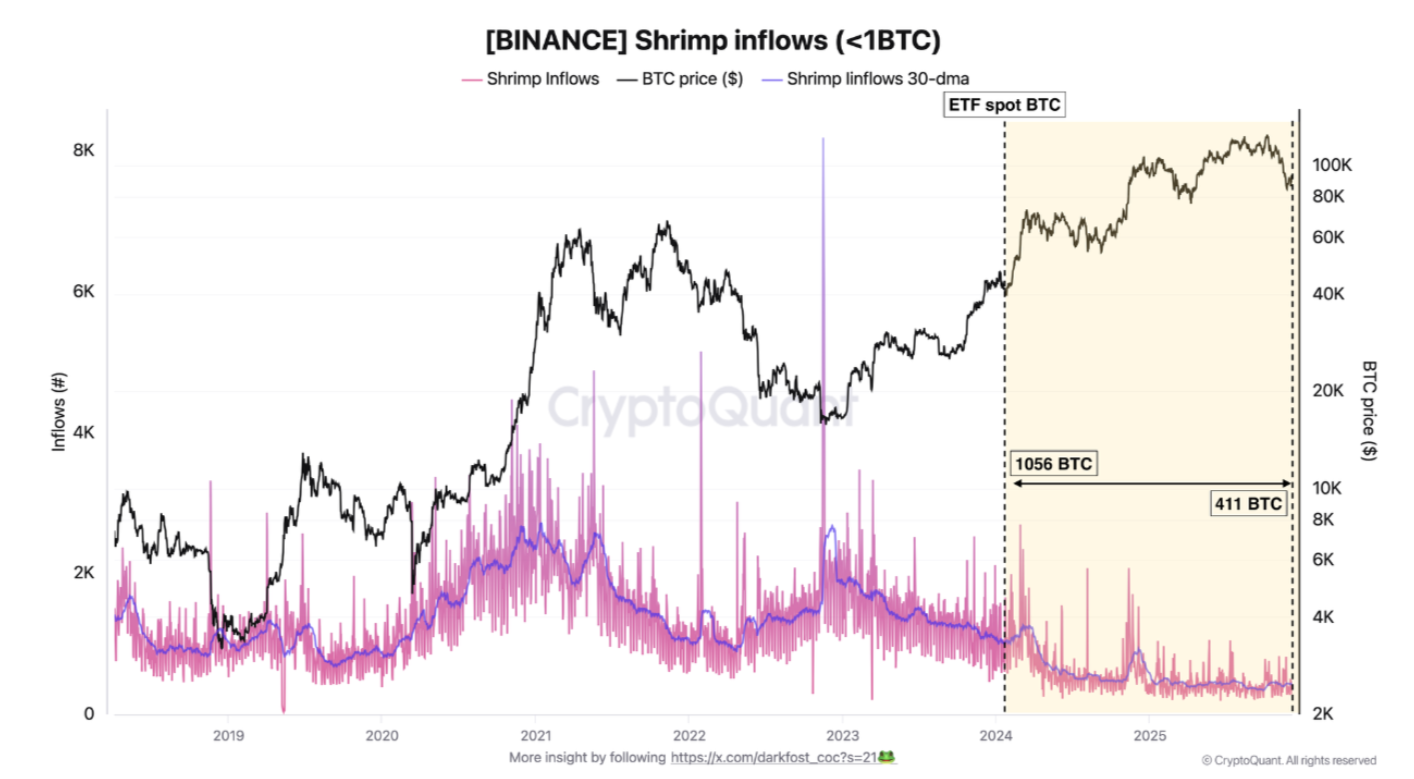
Bitcoin shrimp inflows (screenshot). Source: CryptoQuant


In December 2022, daily inflows from shrimps to Binance alone totaled around 2,675 BTC ($242 million) per day, as measured using a 30-day simple moving average (SMA).

“Today, those inflows have collapsed to just 411 BTC, marking one of the lowest levels ever observed,” Darkfost continued.

“It’s not a simple pullback, it’s a structural decline.”
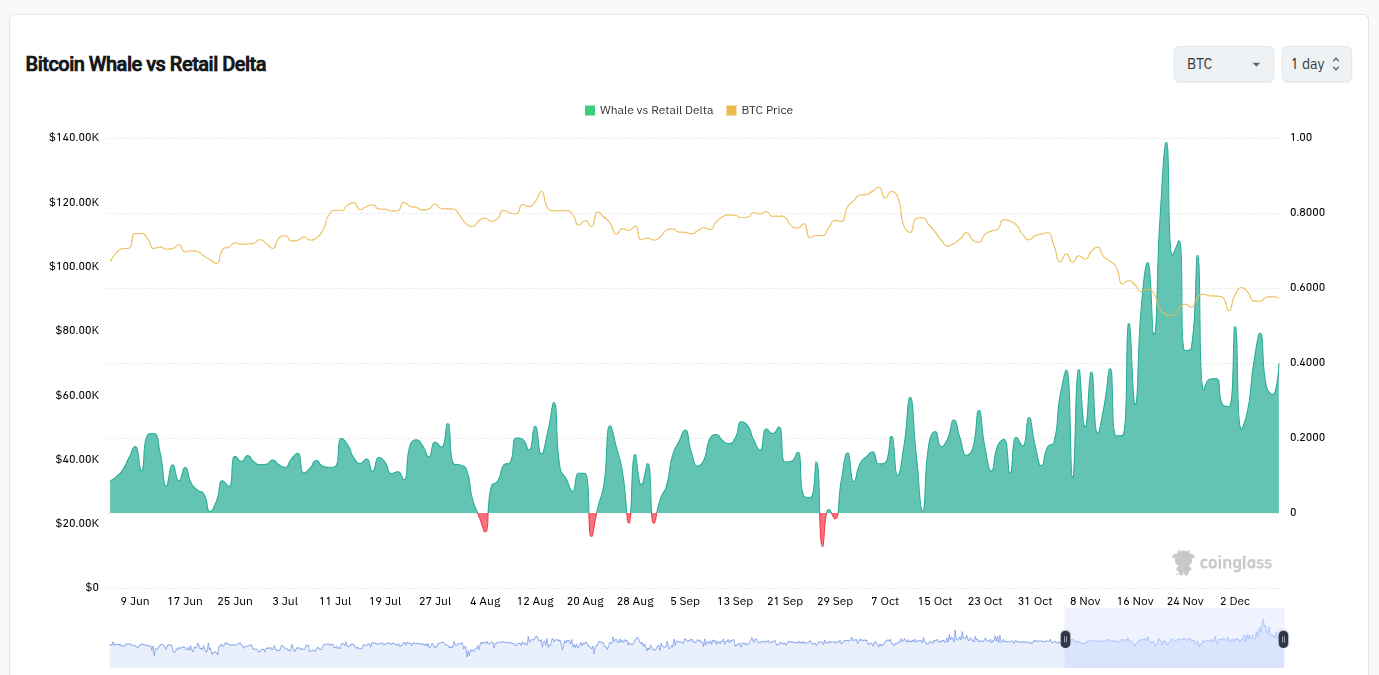
Bitcoin whales vs. retail delta (screenshot). Source: CoinGlass


Retail’s seeming lack of interest has characterized recent Bitcoin history, even as prices reach unprecedented new heights.

Meanwhile, during the drawdown over the past two months, one indicator comparing retail investors to whales has remained bullish.

Whale versus retail delta, which contrasts long positioning across both cohorts, is teasing a BTC price bottom signal.

“Whale vs. Retail Delta shows that, for the first time in Bitcoin’s history, whales are this heavily positioned in longs compared to retail traders,” Joao Wedson, founder and CEO of crypto analytics platform Alphractal, told X followers in late November.

“Whenever these levels got this high in the past, we saw local bottoms forming — but also large positions getting liquidated.”

Bitcoin ETFs “clearly contribute” to retail shifts

CryptoQuant, meanwhile, explained the retail downtrend within the context of the emergence of more suitable Bitcoin investment vehicles, namely the US spot Bitcoin exchange-traded funds (ETFs).

Related: Did BTC's Santa rally start at $89K? 5 things to know in Bitcoin this week

“ETFs have provided a frictionless way to gain exposure to Bitcoin without dealing with private keys, wallet security, exchange accounts or the risk of mismanaging custody,” Darkfost wrote.

“Of course, ETFs are not the only explanation, but they clearly contribute to a profound change in how retail participates in the market.”

As Cointelegraph reported, November was a testing time for the ETFs, with the largest, BlackRock’s iShares Bitcoin Trust (IBIT), seeing net outflows of $2.3 billion.

This article does not contain investment advice or recommendations. Every investment and trading move involves risk, and readers should conduct their own research when making a decision.


Leituras Relacionadas

Champion! Huobi HTX Tops the Industry with $583.7M Net Asset Inflow Over the Past 30 Days

In the competitive crypto industry, fund flows reveal true user trust. According to Defillama data on December 5, Huobi HTX recorded a net inflow of $583.7M over the past 30 days, ranking first among all centralized exchanges (CEXs). This reflects growing user confidence in the platform’s security, transparency, and product offerings. Huobi HTX has maintained steady growth in total assets and spot trading volume, forming a positive cycle of asset safety, user growth, and capital inflow. Key factors behind this performance include enhanced asset proof mechanisms—with 38 consecutive months of published Merkle Tree Proof of Reserves (PoR) and 100%+ reserve ratios for major assets—alongside improved C2C trading features such as a "100% compensation" policy and a streamlined user experience. The platform’s earn products, including Huobi Earn, also saw significant growth, with increases in both user participation and asset deposits for tokens like USDD, ETH, and TRX. Users are increasingly choosing Huobi HTX for its reliable yields, ease of use, and strong security measures during market volatility. As a long-established exchange founded in 2013, Huobi HTX has strengthened its compliance and risk management frameworks, reinforcing its reputation for safety and transparency. The net inflow milestone underscores its position as a trusted platform where users choose to securely store and grow their digital assets.

深潮Há 2m

Champion! Huobi HTX Tops the Industry with $583.7M Net Asset Inflow Over the Past 30 Days

深潮Há 2m

From 'Stablecoin First Stock' to 'Ankle Cut' in Stock Price: Why Circle Quickly Fell from the Spotlight into a Revaluation Cycle

From "Stablecoin Unicorn" to "Ankle-Cut" Stock Price: Why Circle Quickly Fell from Its Peak into a Revaluation Cycle Circle, the issuer of the USDC stablecoin, experienced a dramatic stock price decline shortly after its IPO in June, dropping from an initial peak of around $260 to approximately $88. This reflects a broader market shift from hype-driven optimism to a more rational reassessment of the stablecoin industry. Multiple factors contributed to this sharp correction. Initially, the stock was significantly overvalued due to market enthusiasm for the "first stablecoin stock" and the high-interest environment that boosted the appeal of its reserve-backed revenue model. As early investors took profits and sentiment cooled, a price correction was inevitable. Increased competition is also pressuring Circle. While USDC is the world's second-largest dollar stablecoin, it faces growing challenges from new stablecoin projects and digital dollar initiatives from traditional financial institutions. The sector is shifting from an oligopoly to intense competition, raising investor concerns about USDC's future growth certainty. Furthermore, macroeconomic interest rate trends pose a fundamental risk to Circle's business model. Its core revenue comes from interest earned on the cash and short-term U.S. Treasuries backing USDC. Expectations that the Federal Reserve may begin a rate-cutting cycle could directly compress this income. Rising operational and distribution costs further squeeze profitability. Analysts hold divergent views on Circle's future. Firms like Mizuho have turned bullish, upgrading the stock and suggesting the sell-off related to its post-IPO lockup expiration may have created a buying opportunity. They point to USDC's continued adoption by mainstream financial institutions. Conversely, analysts at firms like Susquehanna remain pessimistic, maintaining an "Underperform" rating. They warn that lower future interest rates and potential underperformance in USDC growth could continue to pressure the stock price and have lowered their price target. The upcoming end of the post-IPO lockup period, which restricts insiders from selling shares, has added near-term selling pressure, but this is viewed by some as a temporary overhang. Circle's recent Q3 earnings report, which beat expectations for both revenue and profit, shows that these fundamental concerns have not yet materialized, leaving the company's trajectory highly dependent on future interest rates and its ability to maintain and grow USDC's market share amidst fierce competition.

cointelegraph_中文Há 4m

From 'Stablecoin First Stock' to 'Ankle Cut' in Stock Price: Why Circle Quickly Fell from the Spotlight into a Revaluation Cycle

cointelegraph_中文Há 4m

Trading

Spot
Futuros
活动图片