Bitcoin's Weak Rebound Fails to Mask Adjustment Trend, HYPE's Top Signal Warns of Short-Term Risks | Invited Analysis

marsbitPublicado em 2026-06-01Última atualização em 2026-06-01

Resumo

**Title:** Bitcoin's Weak Rebound Fails to Mask Downtrend; HYPE Top Signal Alerts of Short-Term Risks | Exclusive Analysis **Abstract:** This weekly market analysis examines the current technical structures of Bitcoin and HYPE, outlining key trading strategies. Bitcoin's daily chart shows it has broken below the median line of its primary ascending channel, indicating structural weakness. It is currently experiencing a weak rebound within a short-term descending channel, targeting resistance at $75,000-$76,000. Failure to break above this zone could lead to a resumption of the downtrend, testing support at $69,500-$70,500. Trading strategies include positioning for a rebound rejection (Plan A) or a breakdown below key support (Plan B) with controlled short positions. For HYPE, the 4-hour chart reveals a potential seven-wave advance from the May 14 low, now showing signs of exhaustion. A bearish divergence (momentum weakening) has been observed, coupled with a top signal from the proprietary "Spread Trading Model" at potential endpoint 47. The key this week is to monitor if a confirmed top forms here, especially upon a breach of the $62.5-$64.57 support area. If broken, a larger corrective move towards $54-$56.30 is anticipated. The short-term strategy for HYPE focuses on cautious long entries only upon confirmed stabilization within the support zone. The report also details a successful short BTC trade from the previous week, yielding a ~5.07% profit, executed based on mod...

This Week's Core: Has Bitcoin's daily structure weakened? Can the short-term rebound effectively break through the upper boundary of the descending channel? Has the HYPE's seven-segment rise reached its end? The following sections analyze the current market structure from multiple timeframes, systematically sort out the current market pattern, and formulate this week's medium- and short-term trading strategies for reference.

Summary of This Week's Core Trading Views:

• Analysis of BTC's multi-timeframe trend structure. (Detailed in Part 1)

• BTC's market outlook and medium/short-term trading strategies for this week. (Detailed in Part 2)

• Analysis of HYPE's hourly chart structure. (Detailed in Part 3)

• HYPE's market outlook and short-term trading strategies for this week. (Detailed in Part 4)

Market Validation of Last Week's Trading Strategies and Core Views:

• Effectiveness of BTC short-term trades: Bitcoin completed one short-term short trade last week (1x leverage), achieving a profit of approximately 5.07%. (Detailed in Table 1)

• Market validation of BTC trend forecast: Last week's article pointed out that Bitcoin was continuing its adjustment pattern with a volatile downtrend, with the short-term strategy focusing on "selling on rallies." The current market movement has validated our previous forecast.

一、Analysis of Bitcoin's Multi-Timeframe Trend Structure

1、BTC Daily Chart Structure Analysis

Bitcoin _ Daily Candlestick Chart:
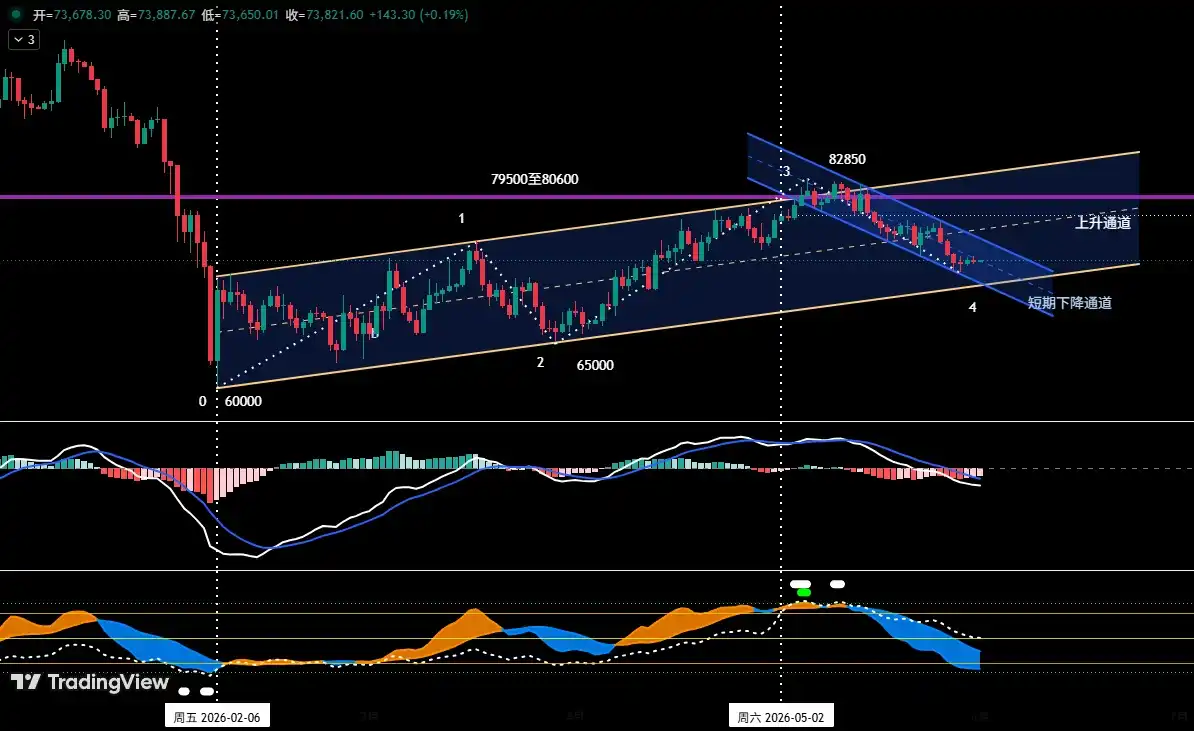
Figure 1

Ascending Channel (Yellow): As shown in (Figure 1), since the low on February 6, 2026, Bitcoin has maintained a volatile uptrend within an ascending channel. (Lower boundary: connecting the lows of Feb 6 and Mar 29; Upper boundary: a line drawn parallel to the lower boundary through the high of Mar 17)

Short-Term Descending Channel (Blue): After touching the high of $82,850 on May 6, Bitcoin has been operating within a short-term descending channel. (Upper boundary: connecting the two rebound highs on May 14 and May 26; Lower boundary: connecting the two adjustment lows on May 7 and May 23)

Based on the Ascending Channel (Yellow), the price has broken below the channel's median line and is seeking stronger support near the lower boundary.

Based on the Short-Term Descending Channel (Blue), the price found brief support after falling to the channel's lower boundary (around $72,500) and is currently in a period of weak rebound towards the channel's upper boundary.

Comprehensive Judgment: Technically, Bitcoin is facing dual influences from both long-term and short-term channels. The current rebound is mainly a correction for short-term oversold conditions, targeting the upper boundary of the short-term descending channel (Blue). However, as the price has broken below the median line of the ascending channel (Yellow), the overall technical structure has weakened. It is expected that after the rebound ends, the price will likely resume the previous downtrend and further test the support strength of the ascending channel's lower boundary.

2、In-Depth Analysis of BTC's Hourly Chart Structure: (Using the 4-hour chart as the analysis period)

Bitcoin _ 4-Hour Candlestick Chart
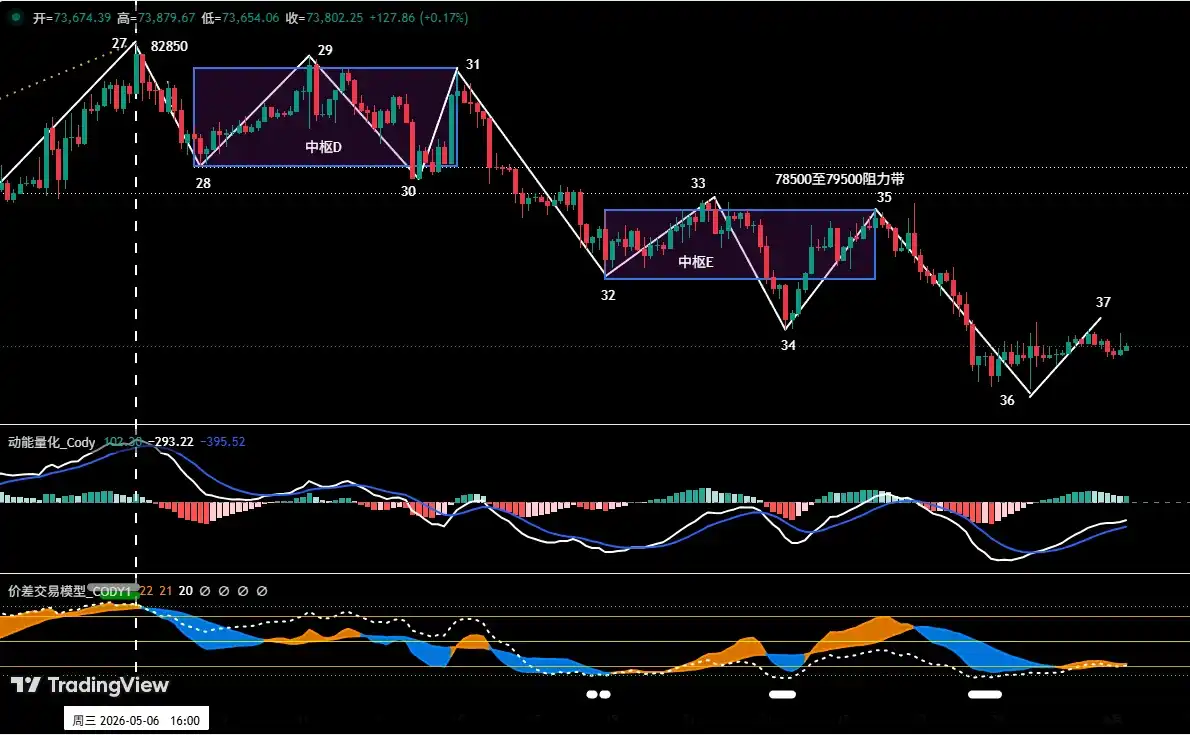
Figure 2

1、As shown in (Figure 2), from the high of $82,850 on May 6 to the present adjustment, the 4-hour chart reveals a detailed structure that can be subdivided into a 10-segment adjustment pattern from "Segment 27-28" to "Segment 36-37." This includes two descending pivot zones:

• Pivot Zone D: Formed by the overlapping of segments 28-29, 29-30, and 30-31.

• Pivot Zone E: Formed by the overlapping of segments 32-33, 33-34, and 34-35.

2、From the 4-hour structure, the current rebound is segment 36-37. If the price rebounds to the $75,000~$76,000 area and faces resistance, unable to form an effective breakout, the market is likely to continue its previous volatile downtrend and test the support level around $69,500~$70,500.

二、Bitcoin Market Outlook and Trading Strategy for This Week

1、BTC Market Outlook for This Week:

Core view for this week: Monitor the results of the test by both bulls and bears on the resistance zone of $75,000~$76,000 and the support zone of $69,500~$70,500.

2、Key Resistance Levels:

• First Resistance Zone: $75,000~$76,000 area (near the lower boundary of Pivot Zone E)

• Second Resistance Zone: $78,500~$79,500 area (near the boundaries of the two pivot zones)

3、Key Support Levels:

• First Support Level: $69,500~$70,500 area (previous important support level)

• Second Support Level: Around $65,000 (previous important support level)

4、This Week's Trading Strategy (Excluding the impact of sudden news)

1、Medium-Term Strategy:

Bitcoin _ Daily Candlestick Chart: (Position Monitoring Model)
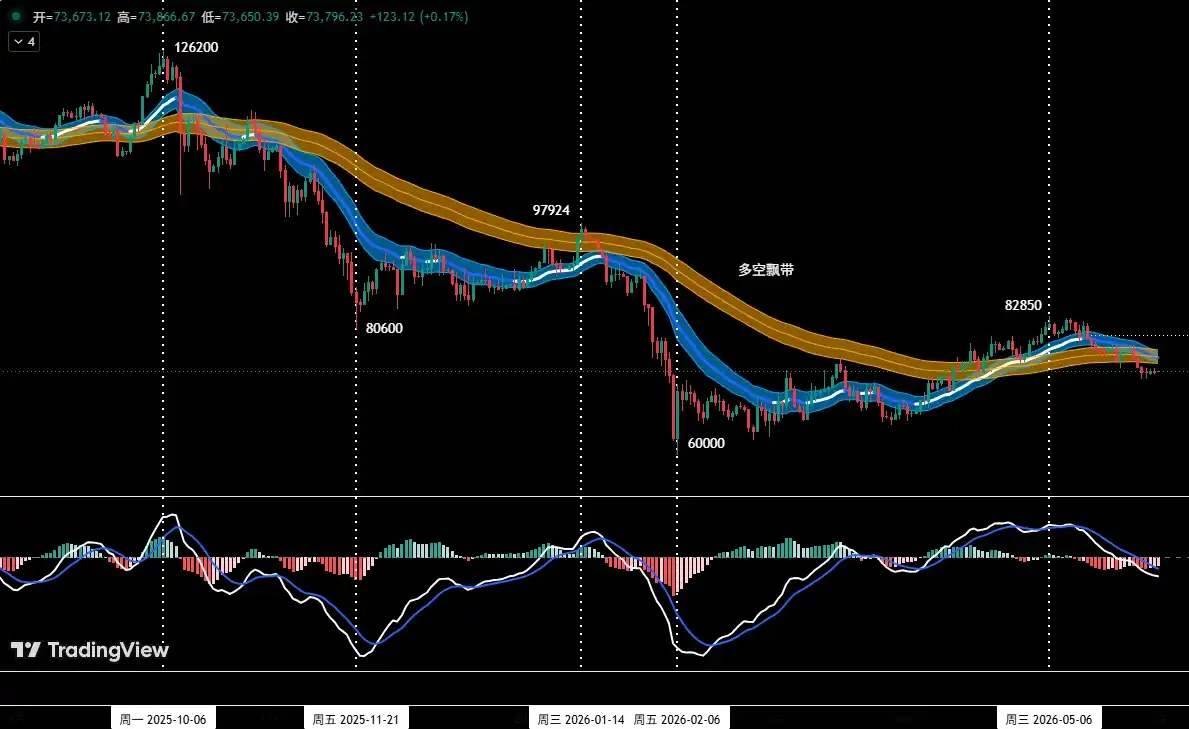
Figure 3

Position Monitoring Model: As shown in (Figure 3), the price has fallen below the "Bull-Bear Channel," entering a technically weak area. This week, monitor its retest result of the Bull-Bear Channel (around $75,000~$76,000). If the price rebounds to this level and shows signs of stagnation, resistance, or a pullback, it will signal the start of medium-term short position allocation. To control risk, the initial position can be kept below 30% of total capital; subsequently, if the price breaks below the lower boundary of the ascending channel (Yellow), increase the medium-term position to around 60%.

2、Short-Term Strategy: Utilize 30% of the position, set stop-loss points, and look for "spread" trading opportunities based on support and resistance levels. (Use the 30-minute/60-minute chart as the operation cycle).

3、To dynamically respond to the complex evolution of the market during short-term operations, we have prepared two specific operational plans in advance: A/B.

Plan A:Rebound Meets Resistance, Sell on Rallies.

• Entry: When the price rebounds and meets resistance in the $75,000~$76,000 area, combined with a top signal from the quantitative model, a short position below 30% can be established.

• Risk Control: Initial stop-loss set above $77,000.

• Exit: Gradually close the position to take profits when the price adjusts near important support levels combined with model signals.

Plan B: Effectively Breaks Support, Follow the Trend Short.

• Entry: When the price effectively breaks below the support zone of $69,500~$70,500 combined with a model top signal, a short position below 30% can be established.

• Risk Control: Initial stop-loss set above $72,000.

• Exit: Gradually close the position to take profits when the price falls to important support levels combined with model signals.

三、Analysis of HYPE's Hourly Chart Structure:

HYPE_4-Hour Candlestick Chart
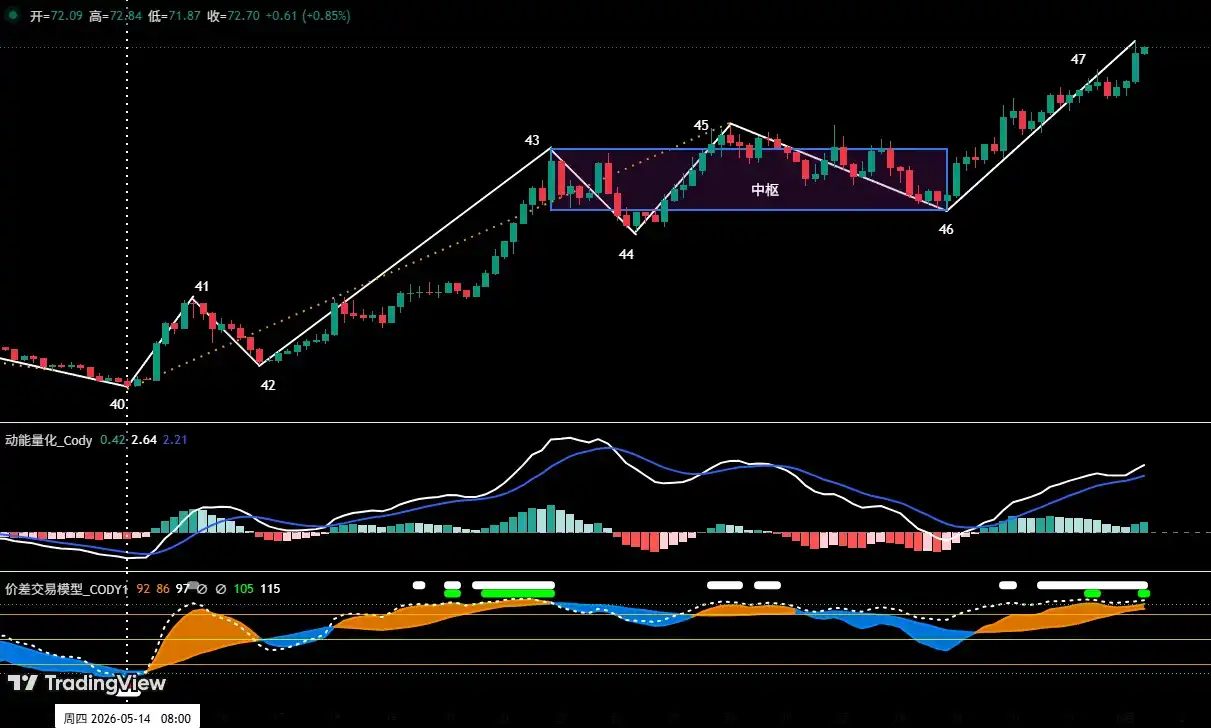
Figure 4

1、As shown in (Figure 4), on the 4-hour chart, since the low of $38.14 on May 14, HYPE has clearly constructed a seven-segment structure (segments 40-41 to 46-47) including a "rising pivot zone." Segments 43-44, 44-45, and 45-46 overlap, forming the "rising pivot zone."

2、The previous weekly review warned: Due to a momentum top divergence state at "Endpoint 45," combined with a top warning signal from the "Spread Trading Model," the two resonated. Therefore, the probability of forming a short-term high here was significant. Market movements confirmed this judgment: the price adjusted from "Endpoint 45" ($64.75) to "Endpoint 46" ($56.30), with a maximum decline of 13.05%.

3、Currently, comparing the pivot exit segment (46-47) with the entry segment (42-43), its upward momentum appears weak, forming a potential "momentum divergence."

4、Analysis from our self-built "Spread Trading Model" shows that "Endpoint 47" has triggered a strong top warning signal (red dot + white dot).

5、In summary, if the price forms a topping signal at "Endpoint 47" and the "momentum divergence" signal remains valid, the probability of this point becoming the terminal point of the rise since "Endpoint 40" will significantly increase. Subsequent price movements require close attention to the test results of the key area between $62.5 and $64.57.

四、HYPE Market Outlook and Short-Term Trading Strategy for This Week

1、HYPE Market Outlook for This Week:

Core view for HYPE this week:

• Observe whether "momentum divergence" is established when "Endpoint 47" issues a clear topping signal.

• If this phenomenon occurs, and the price subsequently effectively breaks below the support zone of $62.5 to $64.57, it can be considered that "Endpoint 47" has become the terminal point of the rally since the May 14 low.

2、HYPE Short-Term Trading Strategy for This Week: (Buy on Support)

This week's HYPE short-term trading should follow the strategy of "buying on dips, avoiding chasing rallies." The core is to observe the test results of the price pullback to the $62.5 to $64.75 area:

Strategy One:Test Long on Support Zone Stabilization

If the price pulls back to this zone, shows signs of stopping the decline and stabilizing, and combines with bottom signals triggered by the two major models, consider a light long position trial. The position must be controlled below 30%, strictly adhering to stop-loss discipline.

Strategy Two: Support Fails, Transitioning to a Larger Correction

If the price effectively breaks below this zone, the short-term correction will escalate into a larger-scale (e.g., daily level) adjustment, prolonging its duration and extending the downside target to the $54 to $56.3 area first.

五、Bitcoin Trade Review

1、Short-Term Trade Review:(See Table 1)

Strictly following the operational plan and based on trading signals issued by our self-built "Spread Trading Model" and "Momentum Quantification Model," we completed one short-term (short) trade last week, achieving a profit of 5.07%.

1、Bitcoin Short-Term Trade Details Summary:(Leverage *1)
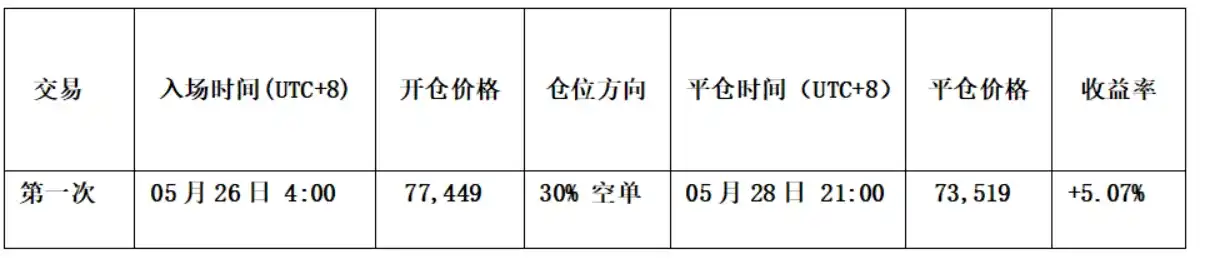
Table 1

2、Short-Term Trade Review:(See Figure 5)

• Entry Strategy:

a、When the price rebounded near $78,000, it showed resistance signals, and the candlestick formed a "top reversal" bearish pattern;

b、The "Spread Trading Model" triggered a top warning signal (white dot);

c、The "Momentum Quantification Model" issued a momentum top divergence signal.

Therefore, we established a 30% short position at $77,449.

• Exit Strategy:

a、When the price fell near $73,000, it showed signs of stopping the decline, and the candlestick formed a "bottom reversal";

b、The "Spread Trading Model" triggered a strong bottom warning signal (red dot + white dot), forming a bottom resonance signal with the "Momentum Quantification Model."

Therefore, we closed all positions near $73,519.

• Summary: This trade successfully achieved a profit of approximately 5.07%.

BTC_60-Minute Candlestick Chart: (Momentum Quantification Model + Spread Trading Model)
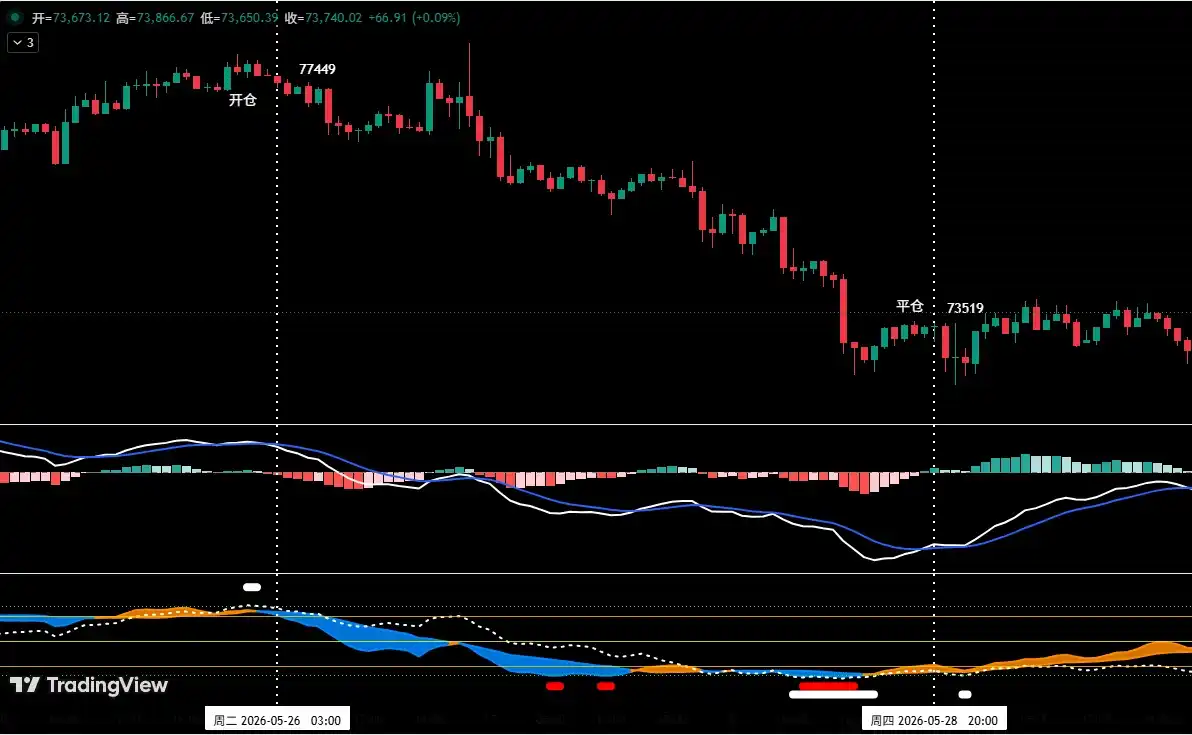
Figure 5 (Short-Term Trade Illustration)

六、Special Reminders:​​

1. Upon Entry: Immediately set the initial stop-loss.

2. When Profit Reaches 1%: Move the stop-loss to the entry price (breakeven point) to ensure capital safety.

3. When Profit Reaches 2%:​​ Move the stop-loss to the 1% profit level.

4. Continuous Tracking: Thereafter, for every additional 1% profit, move the stop-loss up by 1% accordingly to dynamically protect and lock in profits.

Financial markets are constantly changing. All market analysis and trading strategies require dynamic adjustments. All views, analytical models, and operational strategies mentioned in this article are derived from personal technical analysis, intended solely for personal trading log purposes, and do not constitute any investment advice or basis for operation. The market carries risks; investing requires caution. Please do not make decisions based on this.


Perguntas relacionadas

QWhat is the main concern for Bitcoin (BTC) according to the article's analysis?

AThe main concern is that Bitcoin's technical structure has weakened, evidenced by it falling below the median line of its long-term rising channel. The current rebound is seen as weak and likely just a correction from oversold conditions. The article expects the price to resume its downtrend after testing resistance near the $75,000-$76,000 zone, potentially seeking stronger support near the lower boundary of the long-term rising channel.

QBased on the article, what are the two primary scenarios (A and B) proposed for BTC short-term trading strategies this week?

AScenario A (反弹承压,逢高做空): Enter a short position if the price rebounds and faces resistance in the $75,000-$76,000 area, confirmed by top signals from the quantitative model. Stop loss is set above $77,000. Scenario B (有效跌破支撑,顺势做空): Enter a short position if the price effectively breaks below the $69,500-$70,500 support zone, confirmed by model signals. Stop loss is set above $72,000. Both strategies suggest using less than 30% of capital initially.

QWhat key technical phenomenon is highlighted for HYPE that suggests a potential local top?

AThe article highlights that HYPE's current uptrend, structured as a seven-segment pattern on the 4-hour chart, shows signs of a potential 'kinetic divergence' (动能背驰). This means the upward momentum in the segment leaving the central pivot (46-47) appears weaker compared to the segment entering it (42-43). This potential divergence is coupled with strong top warning signals from the author's proprietary 'Price Difference Trading Model' at the 'endpoint 47'.

QWhat is the core condition for HYPE's short-term Strategy 1 (支撑区域企稳试多)?

AStrategy 1 suggests a potential long position if the price retraces to the $62.5-$64.75 support area, shows signs of stabilization and a rebound there, and this is confirmed by bottom signals from the two proprietary trading models (likely the 'Price Difference Trading Model' and the 'Momentum Quantification Model'). The position must be kept under 30% of capital with strict stop-loss discipline.

QHow does the article describe the trade management rules, specifically regarding stop-loss movement?

AThe article outlines a dynamic stop-loss trailing process: 1. Set an initial stop-loss immediately upon opening a position. 2. When profit reaches 1%, move the stop-loss to the entry price (breakeven point). 3. When profit reaches 2%, move the stop-loss to lock in a 1% profit. 4. Thereafter, for every additional 1% of profit gained, move the stop-loss up by 1% to dynamically protect and lock in profits.

Leituras Relacionadas

Trading Reflection: Why Does Trading Cryptocurrencies Become More Miserable the Longer You Do It? In Fact, Your Brain Has Been 'Damaged' by Stress.

Trading Reflection: Why Does Trading Cryptocurrency Become More Miserable Over Time? Your Brain Might Be Damaged by Stress This article explores the often-overlooked yet crucial psychological aspect of trading. It argues that long-term success depends less on intellect and more on the survival capacity of one's nervous system. The core issue is that sustained trading pressure disrupts normal brain chemistry. While initial hope and occasional wins provide dopamine-driven pleasure, repeated losses and constant market exposure trigger chronic cortisol release. This stress hormone, meant for short-term survival, keeps the trader in a perpetual "fight-or-flight" mode. Over time, this erodes sleep quality, depletes patience, and fuels emotional, impulsive decision-making. The author describes a dangerous cycle: fear of missing out leads to overtrading and lowered standards. As losses mount (30%, 50%), trading shifts from a pursuit of profit to a psychological battle for survival. The brain begins to associate prolonged stress with the occasional reward, trapping the trader in an addictive loop. Anxiety becomes a baseline state, and trading turns into a compulsive need to feel something—where green candles offer relief and red ones spark self-loathing. The most powerful move a trader can make, the article concludes, is sometimes to stop entirely—to avoid revenge trading, chasing losses, or seeking dopamine fixes. The key is to step back long enough to ask: is this still about passion, or is it a cage of stress hormones? The market and its opportunities will always return, but a trader who is mentally broken will have nothing left to capitalize on them. The best traders are not necessarily the smartest, but those who preserve their mental well-being long enough to stay in the game. Ultimately, the chase may not be for money, but for relief from the very pressure the game creates.

marsbitHá 1h

Trading Reflection: Why Does Trading Cryptocurrencies Become More Miserable the Longer You Do It? In Fact, Your Brain Has Been 'Damaged' by Stress.

marsbitHá 1h

Issued Two Work Badges to Unitree

At the keynote of his speech at the Taipei Music Center, Jensen Huang introduced a humanoid robot named Isaac GR00T. This robot, described as a 'reference design,' is a collaboration: its body comes from Unitree Robotics' H2 Plus, its hands from Singapore's Sharpa, and its 'brain'—the chip and full software stack—is from Nvidia, powered by the Jetson Thor. Huang positioned it as a turnkey solution for universities and researchers, aimed at drastically reducing setup time for experiments. On the same day as this reveal, Unitree Robotics passed its IPO review in Shanghai, seeking to raise 4.2 billion yuan, with a significant portion earmarked for developing its own embodied AI model—its own 'brain.' The article draws a parallel to the smartphone industry, where Qualcomm's 'reference design' led to homogenized hardware and concentrated profits in chips and software. It suggests Nvidia's GR00T initiative follows a similar playbook: by open-sourcing the model and framework, it aims to establish the industry standard, potentially relegating hardware makers to low-margin roles. While currently a body supplier for Nvidia's project, Unitree is actively pursuing its own AI brain, having open-sourced initial models and tested a more advanced one. The company faces a critical window to develop a competitive proprietary system before GR00T becomes the default. The article contrasts this with Tesla's vertically integrated approach for its Optimus robot, which uses in-house chips and benefits from its automotive data and manufacturing scale. It concludes that while the robot body still holds technical value and differentiation, the race for the 'brain' will ultimately define the industry's profit centers and power dynamics.

marsbitHá 1h

Issued Two Work Badges to Unitree

marsbitHá 1h

Trading

Spot
Futuros

Artigos em Destaque

O que é $S$

Compreender o SPERO: Uma Visão Abrangente Introdução ao SPERO À medida que o panorama da inovação continua a evoluir, o surgimento de tecnologias web3 e projetos de criptomoeda desempenha um papel fundamental na formação do futuro digital. Um projeto que tem atraído atenção neste campo dinâmico é o SPERO, denotado como SPERO,$$s$. Este artigo tem como objetivo reunir e apresentar informações detalhadas sobre o SPERO, para ajudar entusiastas e investidores a compreender as suas bases, objetivos e inovações nos domínios web3 e cripto. O que é o SPERO,$$s$? O SPERO,$$s$ é um projeto único dentro do espaço cripto que procura aproveitar os princípios da descentralização e da tecnologia blockchain para criar um ecossistema que promove o envolvimento, a utilidade e a inclusão financeira. O projeto é concebido para facilitar interações peer-to-peer de novas maneiras, proporcionando aos utilizadores soluções e serviços financeiros inovadores. No seu núcleo, o SPERO,$$s$ visa capacitar indivíduos ao fornecer ferramentas e plataformas que melhoram a experiência do utilizador no espaço das criptomoedas. Isso inclui a possibilidade de métodos de transação mais flexíveis, a promoção de iniciativas impulsionadas pela comunidade e a criação de caminhos para oportunidades financeiras através de aplicações descentralizadas (dApps). A visão subjacente do SPERO,$$s$ gira em torno da inclusão, visando fechar lacunas dentro das finanças tradicionais enquanto aproveita os benefícios da tecnologia blockchain. Quem é o Criador do SPERO,$$s$? A identidade do criador do SPERO,$$s$ permanece algo obscura, uma vez que existem recursos publicamente disponíveis limitados que fornecem informações detalhadas sobre o(s) seu(s) fundador(es). Esta falta de transparência pode resultar do compromisso do projeto com a descentralização—uma ética que muitos projetos web3 partilham, priorizando contribuições coletivas em vez de reconhecimento individual. Ao centrar as discussões em torno da comunidade e dos seus objetivos coletivos, o SPERO,$$s$ incorpora a essência do empoderamento sem destacar indivíduos específicos. Assim, compreender a ética e a missão do SPERO é mais importante do que identificar um criador singular. Quem são os Investidores do SPERO,$$s$? O SPERO,$$s$ é apoiado por uma diversidade de investidores que vão desde capitalistas de risco a investidores-anjo dedicados a promover a inovação no setor cripto. O foco desses investidores geralmente alinha-se com a missão do SPERO—priorizando projetos que prometem avanço tecnológico social, inclusão financeira e governança descentralizada. Essas fundações de investidores estão tipicamente interessadas em projetos que não apenas oferecem produtos inovadores, mas que também contribuem positivamente para a comunidade blockchain e os seus ecossistemas. O apoio desses investidores reforça o SPERO,$$s$ como um concorrente notável no domínio em rápida evolução dos projetos cripto. Como Funciona o SPERO,$$s$? O SPERO,$$s$ emprega uma estrutura multifacetada que o distingue de projetos de criptomoeda convencionais. Aqui estão algumas das características-chave que sublinham a sua singularidade e inovação: Governança Descentralizada: O SPERO,$$s$ integra modelos de governança descentralizada, capacitando os utilizadores a participar ativamente nos processos de tomada de decisão sobre o futuro do projeto. Esta abordagem promove um sentido de propriedade e responsabilidade entre os membros da comunidade. Utilidade do Token: O SPERO,$$s$ utiliza o seu próprio token de criptomoeda, concebido para servir várias funções dentro do ecossistema. Esses tokens permitem transações, recompensas e a facilitação de serviços oferecidos na plataforma, melhorando o envolvimento e a utilidade gerais. Arquitetura em Camadas: A arquitetura técnica do SPERO,$$s$ suporta modularidade e escalabilidade, permitindo a integração contínua de funcionalidades e aplicações adicionais à medida que o projeto evolui. Esta adaptabilidade é fundamental para manter a relevância no panorama cripto em constante mudança. Envolvimento da Comunidade: O projeto enfatiza iniciativas impulsionadas pela comunidade, empregando mecanismos que incentivam a colaboração e o feedback. Ao nutrir uma comunidade forte, o SPERO,$$s$ pode melhor atender às necessidades dos utilizadores e adaptar-se às tendências do mercado. Foco na Inclusão: Ao oferecer taxas de transação baixas e interfaces amigáveis, o SPERO,$$s$ visa atrair uma base de utilizadores diversificada, incluindo indivíduos que anteriormente podem não ter participado no espaço cripto. Este compromisso com a inclusão alinha-se com a sua missão abrangente de empoderamento através da acessibilidade. Cronologia do SPERO,$$s$ Compreender a história de um projeto fornece insights cruciais sobre a sua trajetória de desenvolvimento e marcos. Abaixo está uma cronologia sugerida que mapeia eventos significativos na evolução do SPERO,$$s$: Fase de Conceituação e Ideação: As ideias iniciais que formam a base do SPERO,$$s$ foram concebidas, alinhando-se de perto com os princípios de descentralização e foco na comunidade dentro da indústria blockchain. Lançamento do Whitepaper do Projeto: Após a fase conceitual, um whitepaper abrangente detalhando a visão, os objetivos e a infraestrutura tecnológica do SPERO,$$s$ foi lançado para atrair o interesse e o feedback da comunidade. Construção da Comunidade e Primeiros Envolvimentos: Esforços ativos de divulgação foram feitos para construir uma comunidade de primeiros adotantes e investidores potenciais, facilitando discussões em torno dos objetivos do projeto e angariando apoio. Evento de Geração de Tokens: O SPERO,$$s$ realizou um evento de geração de tokens (TGE) para distribuir os seus tokens nativos a apoiantes iniciais e estabelecer liquidez inicial dentro do ecossistema. Lançamento da dApp Inicial: A primeira aplicação descentralizada (dApp) associada ao SPERO,$$s$ foi lançada, permitindo que os utilizadores interagissem com as funcionalidades principais da plataforma. Desenvolvimento Contínuo e Parcerias: Atualizações e melhorias contínuas nas ofertas do projeto, incluindo parcerias estratégicas com outros players no espaço blockchain, moldaram o SPERO,$$s$ em um jogador competitivo e em evolução no mercado cripto. Conclusão O SPERO,$$s$ é um testemunho do potencial do web3 e das criptomoedas para revolucionar os sistemas financeiros e capacitar indivíduos. Com um compromisso com a governança descentralizada, o envolvimento da comunidade e funcionalidades inovadoras, abre caminho para um panorama financeiro mais inclusivo. Como em qualquer investimento no espaço cripto em rápida evolução, potenciais investidores e utilizadores são incentivados a pesquisar minuciosamente e a envolver-se de forma ponderada com os desenvolvimentos em curso dentro do SPERO,$$s$. O projeto demonstra o espírito inovador da indústria cripto, convidando a uma exploração mais aprofundada das suas inúmeras possibilidades. Embora a jornada do SPERO,$$s$ ainda esteja a desenrolar-se, os seus princípios fundamentais podem, de facto, influenciar o futuro de como interagimos com a tecnologia, as finanças e uns com os outros em ecossistemas digitais interconectados.

69 Visualizações TotaisPublicado em {updateTime}Atualizado em 2024.12.17

O que é $S$

O que é AGENT S

Agent S: O Futuro da Interação Autónoma no Web3 Introdução No panorama em constante evolução do Web3 e das criptomoedas, as inovações estão constantemente a redefinir a forma como os indivíduos interagem com plataformas digitais. Um projeto pioneiro, o Agent S, promete revolucionar a interação humano-computador através do seu framework aberto e agente. Ao abrir caminho para interações autónomas, o Agent S visa simplificar tarefas complexas, oferecendo aplicações transformadoras em inteligência artificial (IA). Esta exploração detalhada irá aprofundar-se nas complexidades do projeto, nas suas características únicas e nas implicações para o domínio das criptomoedas. O que é o Agent S? O Agent S é um framework aberto e agente, especificamente concebido para abordar três desafios fundamentais na automação de tarefas computacionais: Aquisição de Conhecimento Específico de Domínio: O framework aprende inteligentemente a partir de várias fontes de conhecimento externas e experiências internas. Esta abordagem dupla capacita-o a construir um rico repositório de conhecimento específico de domínio, melhorando o seu desempenho na execução de tarefas. Planeamento ao Longo de Longos Horizontes de Tarefas: O Agent S emprega planeamento hierárquico aumentado por experiência, uma abordagem estratégica que facilita a decomposição e execução eficientes de tarefas intrincadas. Esta característica melhora significativamente a sua capacidade de gerir múltiplas subtarefas de forma eficiente e eficaz. Gestão de Interfaces Dinâmicas e Não Uniformes: O projeto introduz a Interface Agente-Computador (ACI), uma solução inovadora que melhora a interação entre agentes e utilizadores. Utilizando Modelos de Linguagem Multimodais de Grande Escala (MLLMs), o Agent S pode navegar e manipular diversas interfaces gráficas de utilizador de forma fluida. Através destas características pioneiras, o Agent S fornece um framework robusto que aborda as complexidades envolvidas na automação da interação humana com máquinas, preparando o terreno para uma infinidade de aplicações em IA e além. Quem é o Criador do Agent S? Embora o conceito de Agent S seja fundamentalmente inovador, informações específicas sobre o seu criador permanecem elusivas. O criador é atualmente desconhecido, o que destaca ou o estágio nascente do projeto ou a escolha estratégica de manter os membros fundadores em anonimato. Independentemente da anonimidade, o foco permanece nas capacidades e no potencial do framework. Quem são os Investidores do Agent S? Como o Agent S é relativamente novo no ecossistema criptográfico, informações detalhadas sobre os seus investidores e financiadores não estão explicitamente documentadas. A falta de informações disponíveis publicamente sobre as fundações de investimento ou organizações que apoiam o projeto levanta questões sobre a sua estrutura de financiamento e roteiro de desenvolvimento. Compreender o apoio é crucial para avaliar a sustentabilidade do projeto e o seu impacto potencial no mercado. Como Funciona o Agent S? No núcleo do Agent S reside uma tecnologia de ponta que lhe permite funcionar eficazmente em diversos ambientes. O seu modelo operacional é construído em torno de várias características-chave: Interação Humano-Computador Semelhante: O framework oferece planeamento avançado em IA, esforçando-se para tornar as interações com computadores mais intuitivas. Ao imitar o comportamento humano na execução de tarefas, promete elevar as experiências dos utilizadores. Memória Narrativa: Utilizada para aproveitar experiências de alto nível, o Agent S utiliza memória narrativa para acompanhar os históricos de tarefas, melhorando assim os seus processos de tomada de decisão. Memória Episódica: Esta característica fornece aos utilizadores orientações passo a passo, permitindo que o framework ofereça suporte contextual à medida que as tarefas se desenrolam. Suporte para OpenACI: Com a capacidade de funcionar localmente, o Agent S permite que os utilizadores mantenham o controlo sobre as suas interações e fluxos de trabalho, alinhando-se com a ética descentralizada do Web3. Fácil Integração com APIs Externas: A sua versatilidade e compatibilidade com várias plataformas de IA garantem que o Agent S possa integrar-se perfeitamente em ecossistemas tecnológicos existentes, tornando-o uma escolha apelativa para desenvolvedores e organizações. Estas funcionalidades contribuem coletivamente para a posição única do Agent S no espaço cripto, à medida que automatiza tarefas complexas e em múltiplos passos com mínima intervenção humana. À medida que o projeto evolui, as suas potenciais aplicações no Web3 podem redefinir a forma como as interações digitais se desenrolam. Cronologia do Agent S O desenvolvimento e os marcos do Agent S podem ser encapsulados numa cronologia que destaca os seus eventos significativos: 27 de Setembro de 2024: O conceito de Agent S foi lançado num artigo de pesquisa abrangente intitulado “Um Framework Agente Aberto que Usa Computadores como um Humano”, mostrando a base para o projeto. 10 de Outubro de 2024: O artigo de pesquisa foi disponibilizado publicamente no arXiv, oferecendo uma exploração aprofundada do framework e da sua avaliação de desempenho com base no benchmark OSWorld. 12 de Outubro de 2024: Uma apresentação em vídeo foi lançada, proporcionando uma visão visual das capacidades e características do Agent S, envolvendo ainda mais potenciais utilizadores e investidores. Estes marcos na cronologia não apenas ilustram o progresso do Agent S, mas também indicam o seu compromisso com a transparência e o envolvimento da comunidade. Pontos-Chave Sobre o Agent S À medida que o framework Agent S continua a evoluir, várias características-chave destacam-se, sublinhando a sua natureza inovadora e potencial: Framework Inovador: Concebido para proporcionar um uso intuitivo de computadores semelhante à interação humana, o Agent S traz uma abordagem nova à automação de tarefas. Interação Autónoma: A capacidade de interagir autonomamente com computadores através de GUI significa um avanço em direção a soluções computacionais mais inteligentes e eficientes. Automação de Tarefas Complexas: Com a sua metodologia robusta, pode automatizar tarefas complexas e em múltiplos passos, tornando os processos mais rápidos e menos propensos a erros. Melhoria Contínua: Os mecanismos de aprendizagem permitem que o Agent S melhore a partir de experiências passadas, aprimorando continuamente o seu desempenho e eficácia. Versatilidade: A sua adaptabilidade em diferentes ambientes operacionais, como OSWorld e WindowsAgentArena, garante que pode servir uma ampla gama de aplicações. À medida que o Agent S se posiciona no panorama do Web3 e das criptomoedas, o seu potencial para melhorar as capacidades de interação e automatizar processos significa um avanço significativo nas tecnologias de IA. Através do seu framework inovador, o Agent S exemplifica o futuro das interações digitais, prometendo uma experiência mais fluida e eficiente para os utilizadores em diversas indústrias. Conclusão O Agent S representa um ousado avanço na união da IA e do Web3, com a capacidade de redefinir a forma como interagimos com a tecnologia. Embora ainda esteja nas suas fases iniciais, as possibilidades para a sua aplicação são vastas e cativantes. Através do seu framework abrangente que aborda desafios críticos, o Agent S visa trazer interações autónomas para o primeiro plano da experiência digital. À medida que avançamos mais profundamente nos domínios das criptomoedas e da descentralização, projetos como o Agent S desempenharão, sem dúvida, um papel crucial na formação do futuro da tecnologia e da colaboração humano-computador.

652 Visualizações TotaisPublicado em {updateTime}Atualizado em 2025.01.14

O que é AGENT S

Como comprar S

Bem-vindo à HTX.com!Tornámos a compra de Sonic (S) simples e conveniente.Segue o nosso guia passo a passo para iniciar a tua jornada no mundo das criptos.Passo 1: cria a tua conta HTXUtiliza o teu e-mail ou número de telefone para te inscreveres numa conta gratuita na HTX.Desfruta de um processo de inscrição sem complicações e desbloqueia todas as funcionalidades.Obter a minha contaPasso 2: vai para Comprar Cripto e escolhe o teu método de pagamentoCartão de crédito/débito: usa o teu visa ou mastercard para comprar Sonic (S) instantaneamente.Saldo: usa os fundos da tua conta HTX para transacionar sem problemas.Terceiros: adicionamos métodos de pagamento populares, como Google Pay e Apple Pay, para aumentar a conveniência.P2P: transaciona diretamente com outros utilizadores na HTX.Mercado de balcão (OTC): oferecemos serviços personalizados e taxas de câmbio competitivas para os traders.Passo 3: armazena teu Sonic (S)Depois de comprar o teu Sonic (S), armazena-o na tua conta HTX.Alternativamente, podes enviá-lo para outro lugar através de transferência blockchain ou usá-lo para transacionar outras criptomoedas.Passo 4: transaciona Sonic (S)Transaciona facilmente Sonic (S) no mercado à vista da HTX.Acede simplesmente à tua conta, seleciona o teu par de trading, executa as tuas transações e monitoriza em tempo real.Oferecemos uma experiência de fácil utilização tanto para principiantes como para traders experientes.

1.2k Visualizações TotaisPublicado em {updateTime}Atualizado em 2026.06.02

Como comprar S

Discussões

Bem-vindo à Comunidade HTX. Aqui, pode manter-se informado sobre os mais recentes desenvolvimentos da plataforma e obter acesso a análises profissionais de mercado. As opiniões dos utilizadores sobre o preço de S (S) são apresentadas abaixo.

活动图片