After the close of trading on Tuesday Eastern Time, U.S. AI cloud services giant CoreWeave released its financial results for the second quarter of fiscal year 2026.
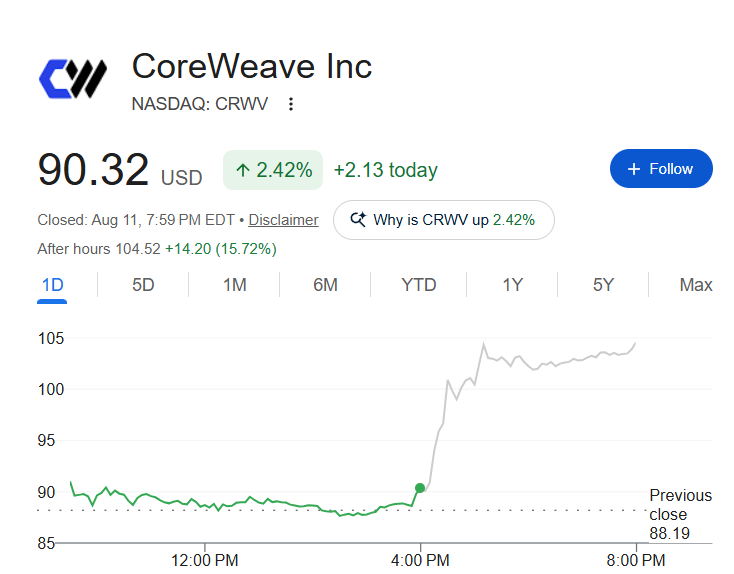
Benefiting from the sustained explosion in global generative AI computing power demand, the company's quarterly revenue doubled year-on-year, with multiple core operating metrics significantly beating Wall Street expectations, driving its stock price up over 15% in after-hours trading.
As a rapidly rising AI computing power service provider, CoreWeave is continuously catching up with traditional cloud giants like Amazon, Google, and Microsoft, achieving rapid expansion through substantial customer contracts. However, it also faces multiple challenges including continuous losses, high debt, intensifying industry competition, and tightening U.S. domestic data center regulations.
Core Financial Metrics Show Strong Performance Across the Board
According to the financial report data, compared to the LSEG consensus estimates, CoreWeave's second quarter (ended June 30) results are as follows:
Total Revenue: $2.58 billion, a 112% surge year-on-year from $1.21 billion in the same period last year, slightly better than the market expectation of $2.56 billion.
Net Loss: $626 million, widening from $290 million in the same period last year. The core reason for the significantly increased loss is the sharp rise in interest expenses due to the company's infrastructure expansion.
Loss Per Share (Adjusted): $1.03, significantly better than the market expectation of a loss per share of $1.20.
On the cost side, the company's technology and infrastructure expenses climbed to $1.51 billion from $670 million in the same period last year, primarily due to the large-scale expansion of computing power capacity.
By the end of Q2, the company added nearly 500 megawatts of effective power capacity, bringing total installed capacity to 1.5 gigawatts. For this quarter, the company's Adjusted EBITDA was $1.51 billion, corresponding to a margin of 59%, slightly down from 62% in the same period last year; Adjusted Operating Profit reached $128 million, significantly exceeding the market expectation of $66 million, highlighting its profit resilience.
Ample Order Backlog, Full-Year Performance Expectations Raised
Relying on strong market demand, CoreWeave holds a substantial order backlog, ensuring performance certainty.
As of June 30, the company's backlog size stood at $104 billion. This figure does not yet include over $25 billion in new customer contracts landed in the initial weeks of the third quarter.
In terms of business signings, the company secured several major partnerships in the second quarter: it finalized a $21 billion AI cloud computing supply agreement with Meta, effective until 2032, expanding upon a previous $14 billion partnership; it also entered into a multi-year collaboration with AI company Anthropic to provide dedicated computing power for its Claude series of large models; and it received a $6 billion investment commitment from quantitative trading firm Jane Street.
Additionally, the company was successfully included in the Nasdaq-100 index during the second quarter and completed the initial deployment and validation of the NVIDIA Vera Rubin NVL72 chip system, marking continuous breakthroughs in technological strength.
Regarding future performance guidance, CoreWeave raised several core expectations.
The company expects revenue for the third quarter of 2026 to reach between $3.4 billion and $3.6 billion, with the midpoint of the range representing a year-on-year growth rate of up to 158%, slightly above the market consensus of $3.43 billion.
For the full year, the company raised its 2026 revenue expectation from the previous range of $12-$13 billion to $12.4-$13.2 billion, roughly in line with the market expectation of $12.63 billion; the Adjusted Operating Profit expectation was raised from $900 million-$1.1 billion to $960 million-$1.15 billion.
Simultaneously, the company increased its capital expenditure plan, expecting full-year capital expenditures to be $35-$39 billion, higher than the previous expectation of $31-$35 billion, and plans to increase effective power capacity to over 1.85 gigawatts by the end of 2026.
CoreWeave co-founder and CEO Michael Intrator stated that the company reached a key inflection point this quarter:
"CoreWeave reached an important inflection point this quarter as our scale began to translate into expanding operating leverage."
Regarding the core computing power leasing business, Intrator revealed that CoreWeave is seeing positive trends in leasing NVIDIA chips.
"Our Blackwell and Vera Rubin series products are achieving record-high prices and margins, while prices for previous-generation products are flat or higher compared to levels seen a few years ago," he said.
Company CFO Nitin Agrawal added that facing pressure from rising hardware component costs, the company has successfully passed these increases on to downstream customers, effectively protecting its own profit margins.
"Even as competition intensifies, we see demand, pricing, and profitability growing, indicating that CoreWeave's products will grow and that we overall will grow in what is already a very large total addressable market."
Local Resistance in Some U.S. Regions Affects Project Implementation
Addressing market concerns about tightening U.S. data center regulations, Intrator responded that the company's current performance guidance and operational projections are all based on the current business situation, and regulatory headwinds have not yet had a material impact on core data or development plans.
However, he also admitted that the growing reluctance in some parts of the United States to build new data centers, unwilling to even engage in dialogue, does present challenges for project implementation.
"Without a doubt, it becomes more challenging when parts of the U.S. aren't even willing to engage in these conversations."
As of the close of U.S. markets on Tuesday, the company's stock price has accumulated a year-to-date gain of 26%, significantly outperforming the S&P 500 index's nearly 13% gain over the same period.