Hong Kong Consensus Binance Voice: In the Era of Regulation-Friendly, Why Are Institutions Increasing Their Bitcoin Holdings?

marsbitPublicado em 2026-02-15Última atualização em 2026-02-15

Resumo

Hong Kong Consensus: Binance's Voice - Why Institutions Are Accumulating Bitcoin in a Regulation-Friendly Era At the 2026 Hong Kong Consensus conference, Binance Co-CEO Richard Teng highlighted key market shifts. Regulatory clarity is now a foundation for innovation, not a barrier, with recent U.S. legislative progress boosting stablecoin adoption. The line between Web2 and Web3 is blurring, evidenced by Binance's collaboration with Franklin Templeton on tokenized money market funds, integrating traditional finance into crypto. While retail investors remain cautious, institutions are accumulating—buying ~43,000 BTC in January alone. Binance's strategic move to convert $1 billion of its SAFU fund from stablecoins to Bitcoin signals strong long-term confidence, reducing circulating supply and providing market support. Institutional buying is driven by Bitcoin's role as a strategic asset, with spot ETFs, corporate treasuries, and even governments like El Salvador increasing holdings. Unlike MicroStrategy's corporate asset allocation or passive ETF inflows, Binance's SAFU conversion is a risk management move, using a dynamic purchasing mechanism to ensure fund security. This action, while having a modest direct price impact (estimated 2-5% upside), reinforces Bitcoin's credibility and sets a psychological support level. For retail investors, survival in the bear market means focusing on defensive strategies, such as low-risk earning opportunities like Binance's booster program...

Author: Viee | Biteye Content Team

In early February 2026, the winter in Hong Kong's Victoria Harbour was livelier than usual, as the Hong Kong Consensus Conference, a focal point of Asia's crypto narrative, was held once again.

Recently, the price of Bitcoin once fell below the $70,000 mark, trading volume was sluggish, and investors were panicked. In this bear market, what choices will these behemoth exchanges make to cope with the cold wave? For ordinary retail investors, perhaps the question is not when the bull market will come, but whether they can survive this bear market. Platforms are adjusting their positions, institutions are building their bases, and how should we allocate funds and protect our principal?

This article will start with Binance's statements at the Consensus Conference, analyze the underlying logic behind institutions' purchases of Bitcoin, and discuss how retail and institutional investors can prepare together for the industry's cold winter by combining recent exchange wealth management activities.

I. Binance's Voice at the Consensus Conference

Amid price volatility and low sentiment, the speeches at this Consensus Conference were different from the passionate expressions during the bull market of previous years, and more like conveying a structural change in the market. Among them, the speech by Binance's co-CEO Richard Teng was quite representative, and several very clear signals could be captured throughout the presentation, regarding regulation, institutions, and infrastructure.
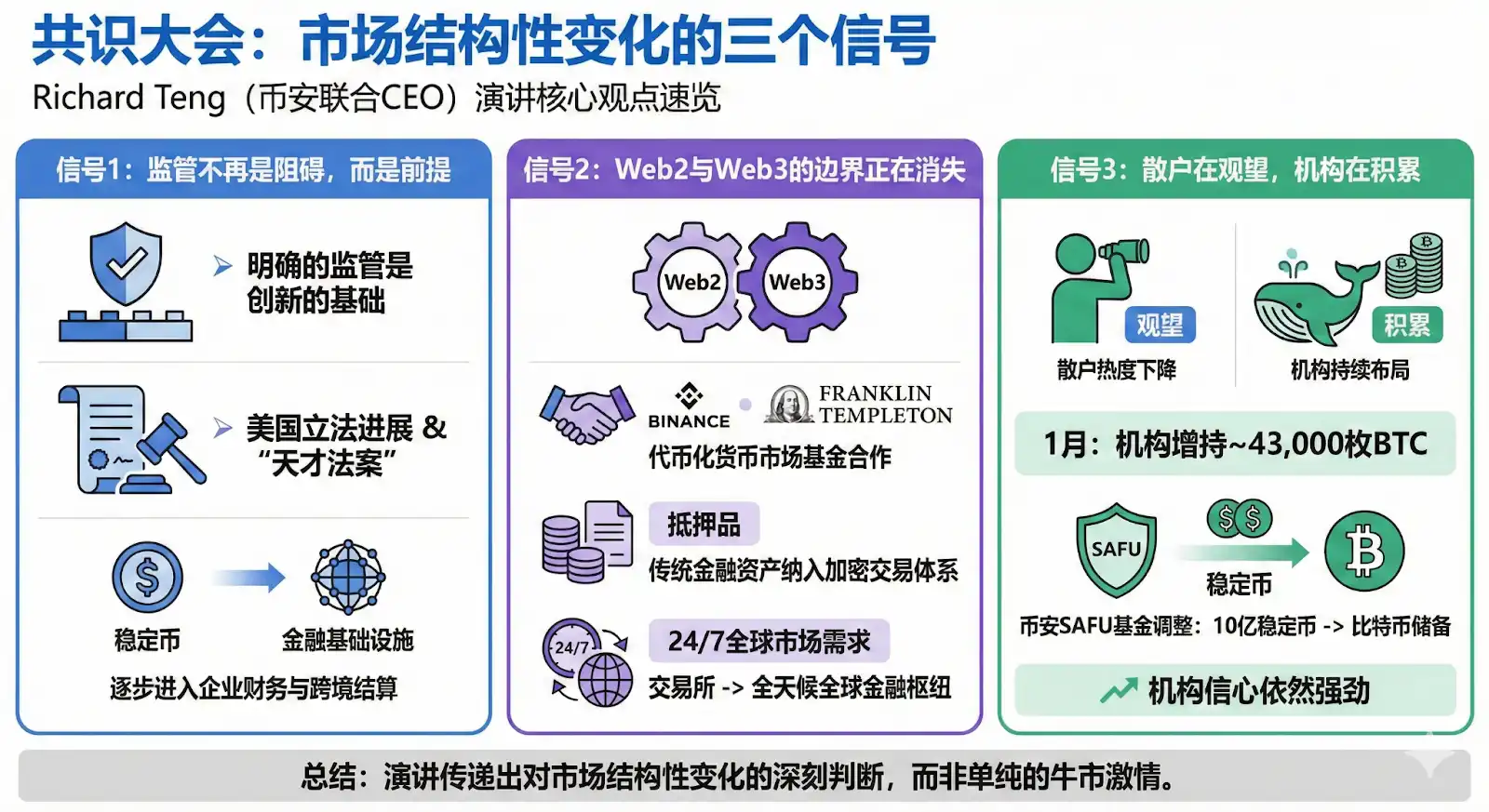
First, regulation is no longer an obstacle but a prerequisite.

Richard emphasized that "clear regulation is the foundation of innovation." He specifically mentioned recent legislative progress in the United States and the confidence boost brought to the stablecoin industry by the "Genius Act." Stablecoins, once a liquidity tool within crypto, are gradually entering corporate finance and cross-border settlement systems, which means crypto assets are migrating towards financial infrastructure.

Second, the boundary between Web2 and Web3 is disappearing.

Another noteworthy part of the speech was Binance's cooperation with Franklin Templeton on tokenized money market funds. Using tokenized funds as institutional collateral also means that traditional financial assets are being incorporated into the crypto trading system.

At the same time, the growth in trading volume of precious metal derivatives reflects the real demand of institutions for 24/7 global markets. When money market funds, gold derivatives, and stablecoins begin to form a closed loop on the same platform, the role of exchanges is no longer just about facilitating trades but more like an all-weather global financial hub.

Third, retail investors are watching, while institutions are accumulating.

A key number given by Richard is that institutional investors increased their holdings by approximately 43,000 Bitcoins in January.

The meaning behind this number is not that prices will rise immediately, but that the market structure is changing. Retail users in Asia-Pacific and Latin America are still active, but overall trading enthusiasm is indeed lower than in a bull market. In contrast, institutional funds are continuously positioning themselves in low-volatility intervals. Combined with Binance's announcement on January 29, 2026, regarding the strategic adjustment of the SAFU fund, which will convert $1 billion of stablecoin reserves in the SAFU fund into Bitcoin reserves within 30 days, it shows that institutional confidence remains strong.

In other words, while retail investors are waiting for clear bottom signals, institutions are already making allocation decisions. Smart money may not have left the market.

So the question is, when institutions are buying and platforms are adjusting their asset structures, how can retail investors gain a deeper understanding of the meaning behind these actions?

II. The Market Is Still Sluggish, Why Are Institutions Already Acting?

Regarding the institutional buying mentioned earlier, let's first review how Bitcoin has attracted a large amount of institutional capital allocation in recent years, especially since the approval of spot Bitcoin ETFs in 2024, which has significantly increased institutional buying.

1. Analysis of Institutional Buying Trends

Today, institutional buying enters the market mainly through ETFs, investment funds, corporations, governments, and other forms. The following points reflect the current institutional layout trends:

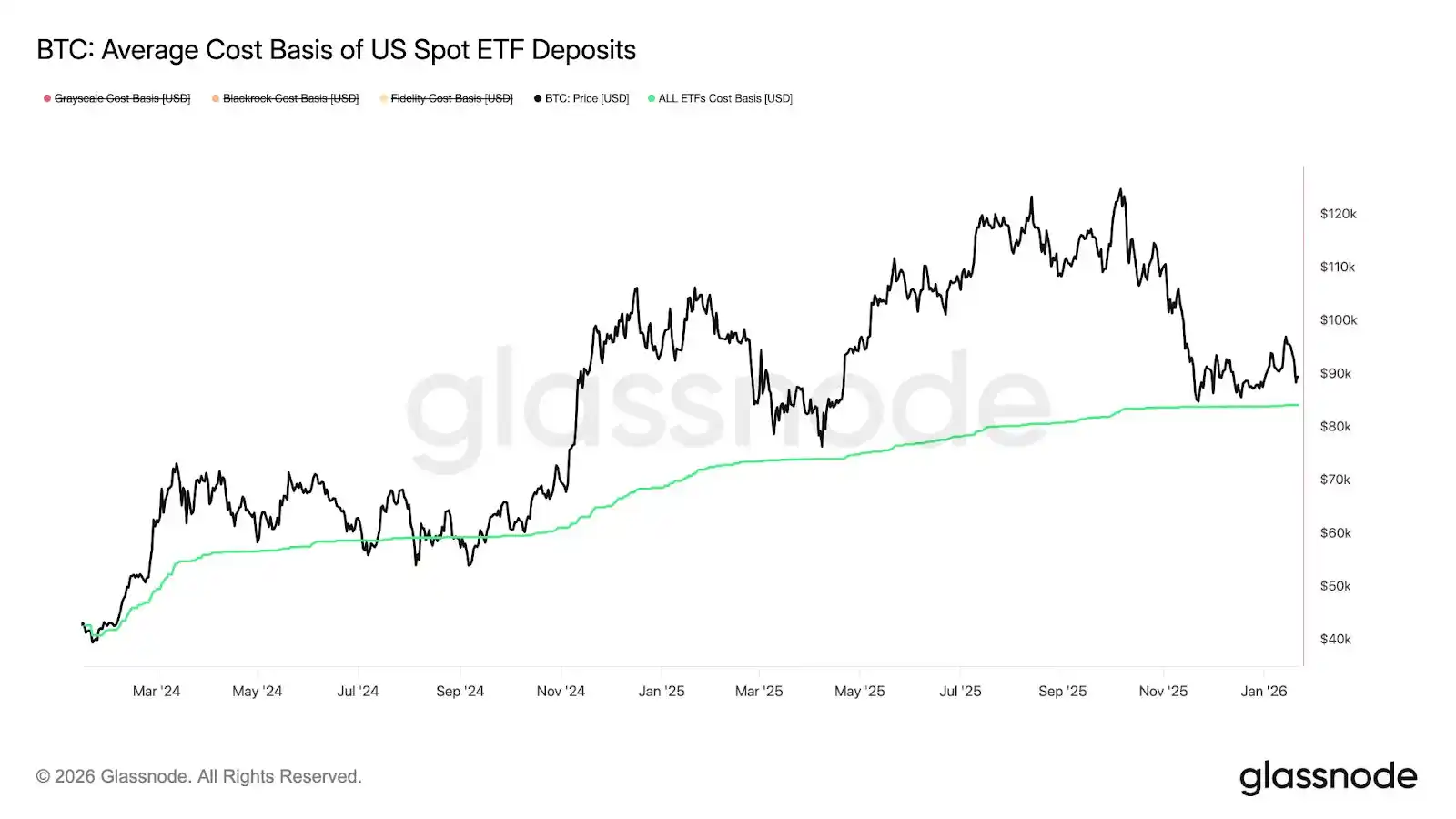
  • Spot ETFs Attract Massive Inflows: Institutions accessing the Bitcoin market through spot ETFs has become a primary method, and ETF data is also a means to gauge market heat. For example, according to SoSoValue data, U.S. spot Bitcoin ETFs saw their largest weekly outflow since last November in late January (approximately $1.22 billion). Historical experience shows that large-scale redemptions often occur near阶段性 bottoms in prices, so Bitcoin may be接近 a local low. The data in the chart below indicates that the average holding cost of ETF investors is about $84,099, a price range that has formed key support levels multiple times in the past. If historical patterns repeat, this round of capital outflows may mean that short-term downward momentum is nearing its end, and a market rebound is possible.
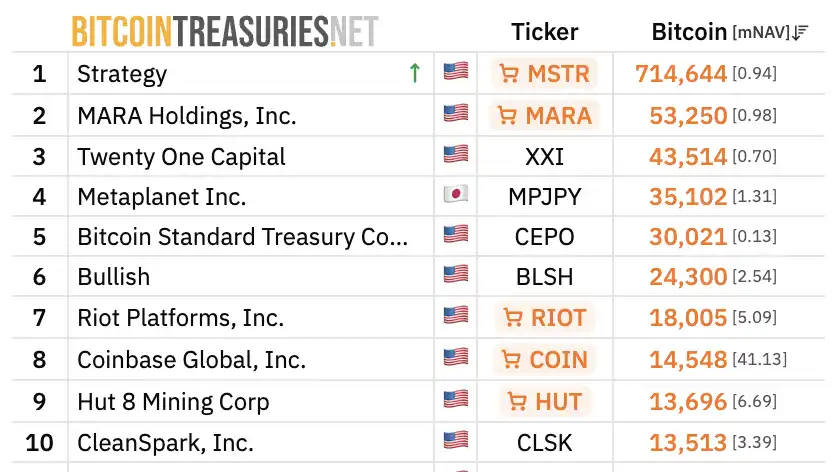
  • Surge in Total Holdings by Listed Companies: It is reported that in Q4 2025, the total Bitcoin held by global listed companies reached approximately 1.1 million (about $94 billion), with 19 new listed companies purchasing Bitcoin. This indicates that Bitcoin is increasingly being regarded as a strategic asset by enterprises. In addition to the well-known strategic treasury companies, several newly listed companies have also joined the buying camp, further validating the trend of institutional capital inflow. The chart below shows the top 10 Bitcoin treasury data.
  • National Level Initiatives: Some countries are also publicly buying Bitcoin. The government of El Salvador announced in November 2025 that it spent $100 million in a single day to buy approximately 1,090 BTC, bringing its cumulative holdings to over 7,000 coins.

In summary, from 2024 to the present, institutional buying has shown characteristics of explosive ETF inflows and密集建仓 by enterprises and investment funds. As Richard Teng said, this trend is expected to continue in 2026 and continue to provide upward momentum for the market.

2. What Are the Historically Representative Public Bitcoin Purchases?

As of early 2026, historically public purchases of Bitcoin for the purpose of "building the market, stabilizing the ecosystem, or reserve assets" can be divided into 5 major categories. Here are a few representative cases:
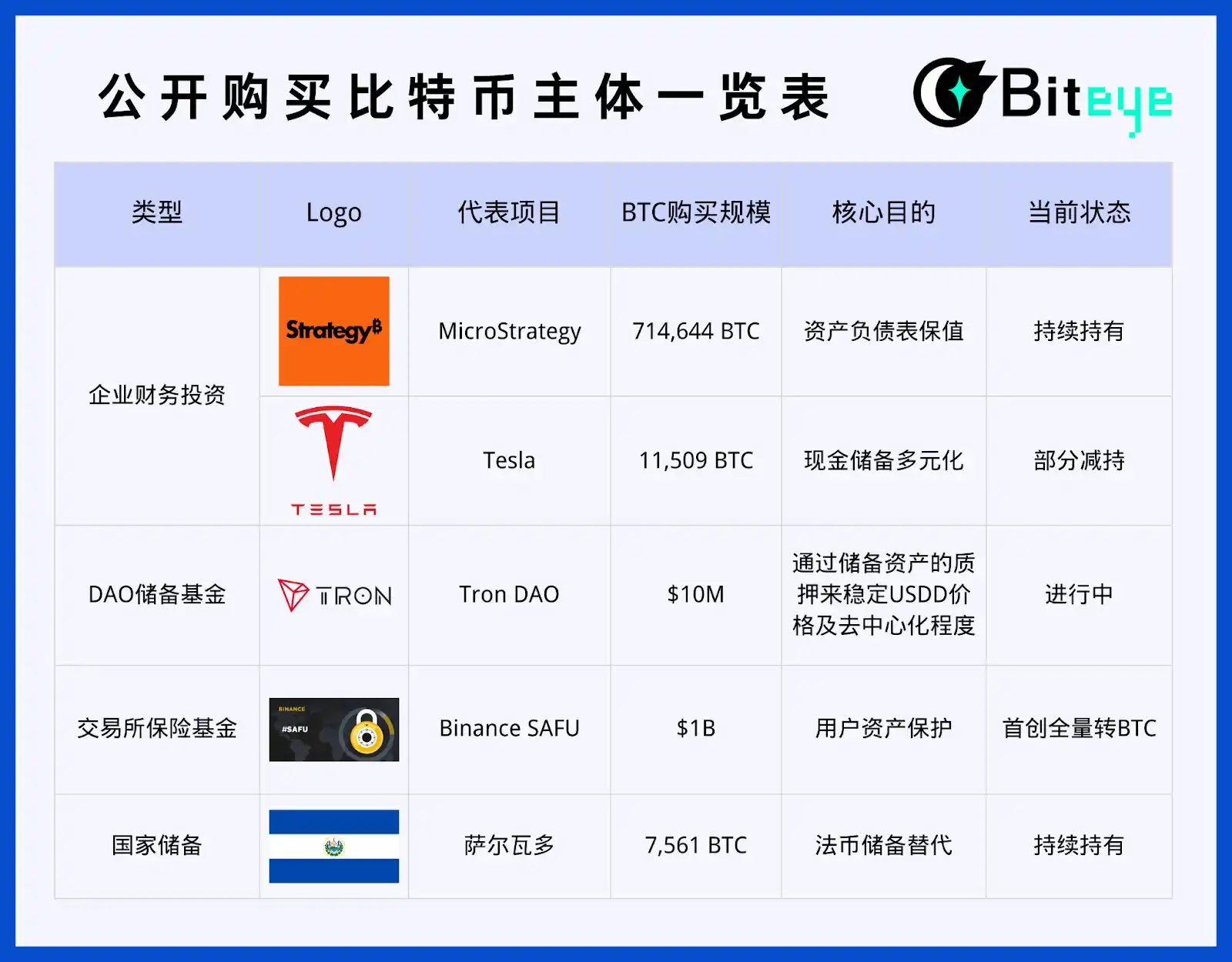
From the table above, it can be seen that institutions buying Bitcoin for market building can be roughly divided into three categories. The first is corporate asset allocation, such as MicroStrategy. These companies use shareholder assets as a basis and treat BTC as a long-term value storage tool. The second category is national/DAO purchases and holdings as reserve alternatives. The third category is exchange buying behavior, such as Binance's current SAFU conversion. This approach shifts reserves from stablecoins to Bitcoin, which is more resistant to inflation and censorship and allows for self-custody. In the event of potential future geopolitical systemic shocks, this can enhance asset independence.

The difference lies here: the starting point for the vast majority of enterprises buying BTC is corporate financial decision-making. Binance, however, is using a user protection fund, meaning this is a purchase for risk structure重构.

3. How Does Binance's Approach Differ Fundamentally from Other Institutions?

First, the asset属性 is different.

MicroStrategy uses company assets; ETF institutions' purchases are passive allocations from user subscription funds and do not bear corporate responsibility for price fluctuations. El Salvador's national purchase is more of a policy strategic行为, and its decision-making logic is difficult to replicate. In contrast, Binance is using a user protection fund. Converting the protection fund to BTC本质上 regards Bitcoin as the most reliable long-term asset.

Second, the execution method is different.

The模式 of MicroStrategy, ETFs, and other institutions is closer to trend/bottom adding. Binance, however, buys in phases and has set up a rebalancing mechanism. If the SAFU market value falls below the既定 safety line, it will continue to add positions. This dynamic replenishment mechanism means this is long-term asset structure management.

Third, the market role is different.

Corporate coin buying mainly affects the company's investment structure. The continuous subscription of ETFs represents the持续放量 of institutional compliance channels. Exchange coin buying affects the entire market liquidity and sentiment structure. When the world's largest exchange locks $1 billion worth of BTC as long-term reserves, it can strengthen the expectation that leading platforms are bullish. This is a demonstration effect.

4. What Retail Investors Need to Care About: What Does This Mean for the Market and BTC Price?

In the short term, large-scale public purchases have not caused剧烈上涨, indicating the market may be in a rational digestion stage. But from a structural analysis, we believe there may be several medium to long-term impacts.

First, $1 billion worth of BTC is locked long-term in the insurance fund, equivalent to reducing circulating supply, although the proportion of total circulation is not high (about 0.1%). According to relevant research data, spreading $1 billion over 30 days means buying about $33.33 million daily. In Bitcoin's全网 daily trading volume of $30-50 billion, this only accounts for 0.1%-0.2%, making it difficult to form a significant impact. After using the TWAP algorithm, the buying volume per minute is only about $23,000, which is hardly noticeable in daily fluctuations. Based on this estimate, the price boost is expected to be within 0.5%-1.5%.

Second, as a strategic purchase by the world's largest exchange, it is seen as an endorsement of Bitcoin by an authoritative institution, which may trigger additional confidence premiums. Therefore,综合考虑, under the叠加 of direct buying and market sentiment, the potential price increase for Bitcoin may exceed around 1%, reaching the 2%-5% level.

Finally, the support mechanism. Since Binance承诺 to replenish if it falls below $800 million, this mechanism effectively sets a strong support level. When prices fall significantly, the market will expect Binance to step in and buy, helping to curb the decline.

In summary, Binance's $1 billion phased purchase is expected to only have a mild boosting effect on Bitcoin. It will not violently pump the price in the short term but provides an invisible layer of support for market sentiment and prices, reflecting more long-term bullish confidence in Bitcoin rather than short-term speculation.

III. Retail Investors' Bear Market Survival Rules: Seeking Defensive Yield

When institutions are allocating underlying assets, how should retail investors respond? Since they cannot change the market like large funds, the best way is not to waste bullets.
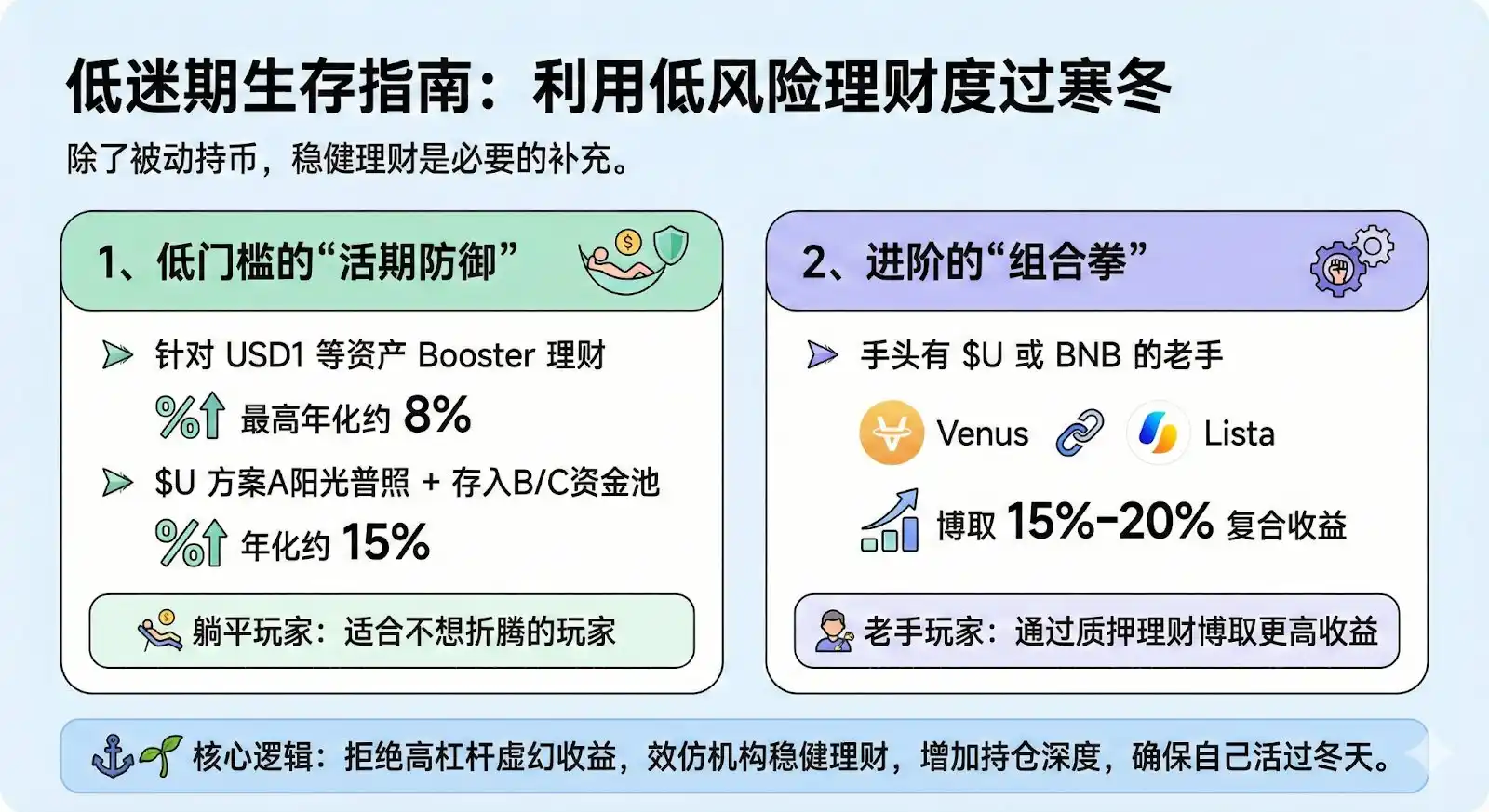
During the current downturn, besides holding coins passively, using platform activities for low-risk wealth management is a necessary supplement to survive the winter. Looking at Binance's recent wealth management actions, the logic is very clear:

1. Low-threshold "Current Defense": Booster wealth management for USD1, with a maximum annualized yield of about 8%. Plan A for $U is sunshine普照 + depositing into pools B/C, with an annualized yield of about 15%.

Suitable for those躺平 players who don't want to折腾.

2. Advanced "Combination Punch": For veterans with $U or BNB, staking for wealth management (such as through Venus or Lista protocols) can aim for复合收益 of 15%-20%.

In short, the core logic is not to chase虚幻收益 with high leverage at this stage but to emulate institutions by increasing holding depth through稳健 wealth management methods to ensure survival through the winter.

IV. Conclusion: Companions in the Winter

The bear market will eventually pass, but only those who survive will be qualified to welcome spring.

At present, this long crypto winter is still testing the patience and will of every market participant. Through the window of the Hong Kong Consensus Conference, we have seen the real choices of leading exchanges.

As the old saying goes, "If winter comes, can spring be far behind?" In a bear market, some are preparing for the worst, which also means the dawn will eventually come. Until then, all we can do is maintain rationality and patience, manage risks well, and cherish the chips in hand.

Perguntas relacionadas

QWhat were the key signals from Binance's speech at the Hong Kong Consensus Conference regarding market structure?

AThe key signals were: 1) Regulation is no longer a barrier but a prerequisite for innovation, with specific mention of U.S. legislative progress. 2) The boundary between Web2 and Web3 is disappearing, exemplified by Binance and Franklin Templeton's tokenized money market fund collaboration. 3) Retail investors are观望 (waiting and seeing), while institutions are accumulating assets, with institutions purchasing approximately 43,000 BTC in January.

QHow did the approval of spot Bitcoin ETFs in 2024 impact institutional investment, and what is a key indicator of market sentiment from this data?

AThe approval significantly enhanced institutional buying power. A key sentiment indicator is that large-scale redemptions from U.S. spot Bitcoin ETFs (e.g., ~$1.22 billion in late January) have historically occurred near阶段性底部 (phase bottoms), suggesting the market might be near a local low and a rebound is possible.

QWhat are the three main categories of historical, market-building Bitcoin purchases, and how does Binance's SAFU conversion differ from a company like MicroStrategy?

AThe three categories are: 1) Corporate asset allocation (e.g., MicroStrategy). 2) National/DAO reserve replacement. 3) Exchange purchases (e.g., Binance's SAFU conversion). Binance's purchase differs fundamentally: it uses a user protection fund for risk structure重构 (restructuring), views BTC as the most reliable long-term asset, employs a phased buying mechanism with rebalancing, and its role as a major exchange creates a示范效应 (demonstration effect) on market liquidity and sentiment.

QWhat is the estimated direct and indirect impact of Binance's $1 billion BTC purchase for its SAFU fund on the Bitcoin price, according to the article?

AThe direct price impact is estimated to be mild, around 0.5%-1.5%, as the daily buying volume is a small fraction (0.1%-0.2%) of total market volume. However, the indirect effect from the authoritative endorsement and confidence boost could push the potential price increase to a range of 2%-5%. The purchase also establishes a psychological support level for the market.

QWhat defensive strategies does the article suggest for retail investor survival during the bear market?

AThe article suggests avoiding high-leverage speculation and instead focusing on low-risk earning opportunities through platform activities, similar to institutional strategies. Examples given include: 1) '活期防御' (current account defense) like Booster理财 (Booster wealth management) offering ~8% APY. 2) '组合拳' (combination punch) for advanced users, using质押理财 (staking wealth management) on protocols like Venus or Lista to pursue 15%-20% compound yields, thereby increasing holdings to survive the winter.

Leituras Relacionadas

a16z Crypto Founder on Stablecoins: The 'WhatsApp Moment' in Money Has Arrived

Chris Dixon, general partner at a16z Crypto, argues that stablecoins are bringing about a "WhatsApp moment" for money—dramatically reducing the cost and increasing the speed of global payments, much like messaging apps did for communication. Last year, stablecoin transaction volume reached over $12 trillion, nearing Visa’s $17 trillion, but at a fraction of the cost. Stablecoins, which are pegged to assets like the U.S. dollar, are becoming mainstream for online and international payments. They offer near-instant settlement, high reliability, and programmability, effectively turning money into software. While adoption is still largely within crypto-native and global business contexts, integration with traditional finance is accelerating. U.S. policy developments, such as the proposed Clarity Act, could provide the regulatory framework needed for stablecoins to scale as part of global financial infrastructure. Major companies like Stripe, Fidelity, and SpaceX are already using or issuing stablecoins to cut costs, streamline cross-border payroll, and operate in regions with weak banking systems. A significant secondary effect is the strengthening of the U.S. dollar’s dominance. Stablecoin issuers like Circle and Tether now hold nearly $140 billion in short-term U.S. Treasury bonds, making them top holders. If growth continues, they could rank among the top 10 Treasury holders by next year. Ultimately, stablecoins are reshaping global finance by enabling borderless value transfer, much as the internet enabled borderless communication—provided clear rules and market structures support their growth.

marsbitHá 30m

a16z Crypto Founder on Stablecoins: The 'WhatsApp Moment' in Money Has Arrived

marsbitHá 30m

Trading

Spot
Futuros

Artigos em Destaque

O que é BITCOIN

Compreender o HarryPotterObamaSonic10Inu (ERC-20) e a Sua Posição no Espaço Cripto Nos últimos anos, o mercado de criptomoedas assistiu a um aumento na popularidade das moedas meme, cativando não apenas os traders, mas também aqueles que procuram envolvimento comunitário e valor de entretenimento. Entre estes tokens únicos está o HarryPotterObamaSonic10Inu (ERC-20), um projeto intrigante que mistura referências culturais no tecido das criptomoedas. Este artigo explora os principais aspetos do HarryPotterObamaSonic10Inu, examinando os seus mecanismos, a sua ética orientada pela comunidade e o seu envolvimento com o vasto panorama cripto. O que é o HarryPotterObamaSonic10Inu (ERC-20)? Como o nome sugere, o HarryPotterObamaSonic10Inu é uma moeda meme construída na blockchain Ethereum, classificada sob o padrão ERC-20. Ao contrário das criptomoedas tradicionais, que podem enfatizar a utilidade prática ou o potencial de investimento, este token prospera no valor de entretenimento e na força da sua comunidade. O projeto visa promover um ambiente onde utilizadores envolvidos possam reunir-se, partilhar ideias e participar em atividades inspiradas por diversos fenómenos culturais. Uma característica notável do HarryPotterObamaSonic10Inu é a zero taxa sobre transações. Este elemento atraente visa encorajar a negociação e o envolvimento da comunidade, isento de encargos adicionais que podem desencorajar os traders de pequena escala. A oferta total da moeda está fixada em mil milhões de tokens, uma cifra que marca a sua intenção de manter uma circulação substancial dentro da comunidade. Criador do HarryPotterObamaSonic10Inu (ERC-20) As origens do HarryPotterObamaSonic10Inu estão um pouco envoltas em mistério; os detalhes sobre o criador permanecem desconhecidos. O desenvolvimento deste token carece de uma equipa identificável ou de um plano explícito, o que não é raro no setor das moedas meme. Em vez disso, o projeto surgiu de forma orgânica, com o seu progresso a depender fortemente do entusiasmo e da participação da sua comunidade. Investidores do HarryPotterObamaSonic10Inu (ERC-20) No que diz respeito a investimentos externos e apoios, o HarryPotterObamaSonic10Inu também permanece ambíguo. O token não lista quaisquer fundações de investimento conhecidas ou apoio organizacional significativo. Em vez disso, o “sangue vital” do projeto é a sua comunidade de base, que informa o seu crescimento e sustentabilidade através da ação coletiva e do envolvimento no espaço cripto. Como Funciona o HarryPotterObamaSonic10Inu (ERC-20)? Como uma moeda meme, o HarryPotterObamaSonic10Inu opera principalmente fora dos quadros tradicionais que muitas vezes governam o valor dos ativos. Existem vários aspetos distintivos que definem como o projeto funciona: Transações Sem Taxas: Sem taxas sobre transações, os utilizadores podem comprar e vender o token livremente, sem a preocupação de custos ocultos. Envolvimento da Comunidade: O projeto prospera na interação da comunidade, aproveitando plataformas de redes sociais para criar entusiasmo e facilitar a participação. Discussões, partilha de conteúdo e envolvimento são elementos cruciais que ajudam a expandir o seu alcance e a fomentar a lealdade entre os apoiantes. Sem Utilidade Prática: Deve ser notado que o HarryPotterObamaSonic10Inu não oferece utilidade concreta dentro do ecossistema financeiro. Em vez disso, é classificado como um token principalmente para entretenimento e atividades comunitárias. Referência Cultural: O token incorpora de forma inteligente elementos da cultura popular para atrair interesse, conectando-se tanto com entusiastas de memes como com seguidores de criptomoedas. HarryPotterObamaSonic10Inu exemplifica como as moedas meme operam de forma diferente de projetos de criptomoedas mais tradicionais, entrando no mercado como construções sociais inovadoras em vez de ativos utilitários. Linha do Tempo do HarryPotterObamaSonic10Inu (ERC-20) A história do HarryPotterObamaSonic10Inu é marcada por vários marcos notáveis: Criação: O token surgiu de um meme viral, capturando a imaginação de muitos entusiastas de criptomoedas. Datas específicas de criação não estão disponíveis, sublinhando a sua ascensão orgânica. Listagem em Exchanges: O HarryPotterObamaSonic10Inu conseguiu entrar em várias exchanges, permitindo um acesso e negociação mais fáceis pela comunidade. Iniciativas de Envolvimento da Comunidade: Atividades contínuas direcionadas a melhorar a interação comunitária, incluindo concursos, campanhas em redes sociais e geração de conteúdo por fãs e defensores. Planos de Expansão Futura: O roteiro do projeto inclui o lançamento de uma coleção de NFTs, mercadorias e um site de eCommerce relacionado aos seus temas culturais, envolvendo ainda mais a comunidade e tentando adicionar mais dimensões ao seu ecossistema. Pontos-Chave sobre o HarryPotterObamaSonic10Inu (ERC-20) Natureza Orientada pela Comunidade: O projeto prioriza a contribuição coletiva e a criatividade, assegurando que o envolvimento dos utilizadores está na vanguarda do seu desenvolvimento. Classificação como Moeda Meme: Representa o epítome da criptomoeda baseada em entretenimento, destacando-se dos veículos de investimento tradicionais. Sem Afiliação Direta com o Bitcoin: Apesar da semelhança no nome do ticker, o HarryPotterObamaSonic10Inu é distinto e não tem qualquer relação com o Bitcoin ou outras criptomoedas estabelecidas. Foco na Colaboração: O HarryPotterObamaSonic10Inu é projetado para criar um espaço de colaboração e partilha de histórias entre os seus detentores, proporcionando uma via para a criatividade e o fortalecimento da comunidade. Perspectivas Futuras: A ambição de expandir além da sua premissa inicial para NFTs e mercadorias delineia um caminho para o projeto potencialmente entrar em avenidas mais mainstream dentro da cultura digital. À medida que as moedas meme continuam a capturar a imaginação da comunidade cripto, HarryPotterObamaSonic10Inu (ERC-20) destaca-se devido aos seus laços culturais e abordagem centrada na comunidade. Embora possa não se encaixar no molde típico de um token orientado para utilidade, a sua essência reside na alegria e camaradagem fomentadas entre os seus apoiantes, destacando a natureza em evolução das criptomoedas em uma era cada vez mais digital. À medida que o projeto continua a desenvolver-se, será importante observar como as dinâmicas comunitárias influenciam a sua trajetória no panorama em constante mudança da tecnologia blockchain.

346 Visualizações TotaisPublicado em {updateTime}Atualizado em 2024.12.03

Como comprar BTC

Bem-vindo à HTX.com!Tornámos a compra de Bitcoin (BTC) simples e conveniente.Segue o nosso guia passo a passo para iniciar a tua jornada no mundo das criptos.Passo 1: cria a tua conta HTXUtiliza o teu e-mail ou número de telefone para te inscreveres numa conta gratuita na HTX.Desfruta de um processo de inscrição sem complicações e desbloqueia todas as funcionalidades.Obter a minha contaPasso 2: vai para Comprar Cripto e escolhe o teu método de pagamentoCartão de crédito/débito: usa o teu visa ou mastercard para comprar Bitcoin (BTC) instantaneamente.Saldo: usa os fundos da tua conta HTX para transacionar sem problemas.Terceiros: adicionamos métodos de pagamento populares, como Google Pay e Apple Pay, para aumentar a conveniência.P2P: transaciona diretamente com outros utilizadores na HTX.Mercado de balcão (OTC): oferecemos serviços personalizados e taxas de câmbio competitivas para os traders.Passo 3: armazena teu Bitcoin (BTC)Depois de comprar o teu Bitcoin (BTC), armazena-o na tua conta HTX.Alternativamente, podes enviá-lo para outro lugar através de transferência blockchain ou usá-lo para transacionar outras criptomoedas.Passo 4: transaciona Bitcoin (BTC)Transaciona facilmente Bitcoin (BTC) no mercado à vista da HTX.Acede simplesmente à tua conta, seleciona o teu par de trading, executa as tuas transações e monitoriza em tempo real.Oferecemos uma experiência de fácil utilização tanto para principiantes como para traders experientes.

2.9k Visualizações TotaisPublicado em {updateTime}Atualizado em 2025.03.21

O que é $BITCOIN

OURO DIGITAL ($BITCOIN): Uma Análise Abrangente Introdução ao OURO DIGITAL ($BITCOIN) OURO DIGITAL ($BITCOIN) é um projeto baseado em blockchain que opera na rede Solana, com o objetivo de combinar as características dos metais preciosos tradicionais com a inovação das tecnologias descentralizadas. Embora partilhe um nome com o Bitcoin, frequentemente referido como “ouro digital” devido à sua percepção como uma reserva de valor, o OURO DIGITAL é um token separado projetado para criar um ecossistema único dentro da paisagem Web3. O seu objetivo é posicionar-se como um ativo digital alternativo viável, embora os detalhes sobre as suas aplicações e funcionalidades ainda estejam em desenvolvimento. O que é o OURO DIGITAL ($BITCOIN)? OURO DIGITAL ($BITCOIN) é um token de criptomoeda explicitamente projetado para uso na blockchain Solana. Em contraste com o Bitcoin, que fornece um papel amplamente reconhecido como armazenamento de valor, este token parece focar em aplicações e características mais amplas. Aspectos notáveis incluem: Infraestrutura Blockchain: O token é construído na blockchain Solana, conhecida pela sua capacidade de lidar com transações de alta velocidade e baixo custo. Dinâmicas de Oferta: O OURO DIGITAL tem um fornecimento máximo limitado a 100 quatrilhões de tokens (100P $BITCOIN), embora os detalhes sobre o seu fornecimento circulante ainda não tenham sido divulgados. Utilidade: Embora as funcionalidades precisas não estejam explicitamente delineadas, existem indicações de que o token poderia ser utilizado para várias aplicações, potencialmente envolvendo aplicações descentralizadas (dApps) ou estratégias de tokenização de ativos. Quem é o Criador do OURO DIGITAL ($BITCOIN)? Neste momento, a identidade dos criadores e da equipa de desenvolvimento por trás do OURO DIGITAL ($BITCOIN) permanece desconhecida. Esta situação é típica entre muitos projetos inovadores no espaço da blockchain, particularmente aqueles alinhados com finanças descentralizadas e fenómenos de moedas meme. Embora tal anonimato possa fomentar uma cultura orientada pela comunidade, intensifica as preocupações sobre governança e responsabilidade. Quem são os Investidores do OURO DIGITAL ($BITCOIN)? As informações disponíveis indicam que o OURO DIGITAL ($BITCOIN) não tem apoiantes institucionais conhecidos ou investimentos proeminentes de capital de risco. O projeto parece operar num modelo peer-to-peer focado no apoio e adoção da comunidade, em vez de rotas de financiamento tradicionais. A sua atividade e liquidez estão principalmente situadas em exchanges descentralizadas (DEXs), como a PumpSwap, em vez de plataformas de negociação centralizadas estabelecidas, destacando ainda mais a sua abordagem de base. Como Funciona o OURO DIGITAL ($BITCOIN) A mecânica operacional do OURO DIGITAL ($BITCOIN) pode ser elaborada com base no seu design de blockchain e nas características da rede: Mecanismo de Consenso: Ao aproveitar o exclusivo proof-of-history (PoH) da Solana combinado com um modelo de proof-of-stake (PoS), o projeto assegura uma validação eficiente das transações, contribuindo para o alto desempenho da rede. Tokenomics: Embora mecanismos deflacionários específicos não tenham sido extensivamente detalhados, o vasto fornecimento máximo de tokens implica que pode atender a microtransações ou casos de uso de nicho que ainda estão por definir. Interoperabilidade: Existe o potencial para integração com o ecossistema mais amplo da Solana, incluindo várias plataformas de finanças descentralizadas (DeFi). No entanto, os detalhes sobre integrações específicas permanecem não especificados. Cronologia de Eventos Chave Aqui está uma cronologia que destaca marcos significativos relacionados ao OURO DIGITAL ($BITCOIN): 2023: O lançamento inicial do token ocorre na blockchain Solana, marcado pelo seu endereço de contrato. 2024: O OURO DIGITAL ganha visibilidade ao tornar-se disponível para negociação em exchanges descentralizadas como a PumpSwap, permitindo que os utilizadores o negociem contra SOL. 2025: O projeto testemunha atividade de negociação esporádica e potencial interesse em envolvimentos liderados pela comunidade, embora não tenham sido documentadas parcerias ou avanços técnicos notáveis até ao momento. Análise Crítica Forças Escalabilidade: A infraestrutura subjacente da Solana suporta altos volumes de transações, o que pode aumentar a utilidade do $BITCOIN em vários cenários de transação. Acessibilidade: O potencial preço de negociação baixo por token pode atrair investidores de retalho, facilitando uma participação mais ampla devido a oportunidades de propriedade fracionada. Riscos Falta de Transparência: A ausência de apoiantes, desenvolvedores ou um processo de auditoria publicamente conhecidos pode gerar ceticismo em relação à sustentabilidade e confiabilidade do projeto. Volatilidade do Mercado: A atividade de negociação depende fortemente do comportamento especulativo, o que pode resultar em volatilidade significativa dos preços e incerteza para os investidores. Conclusão O OURO DIGITAL ($BITCOIN) surge como um projeto intrigante, mas ambíguo, dentro do ecossistema em rápida evolução da Solana. Embora tente aproveitar a narrativa do “ouro digital”, a sua divergência do papel estabelecido do Bitcoin como reserva de valor sublinha a necessidade de uma diferenciação mais clara da sua utilidade pretendida e estrutura de governança. A aceitação e adoção futuras dependerão provavelmente da abordagem da atual opacidade e da definição mais explícita das suas estratégias operacionais e económicas. Nota: Este relatório abrange informações sintetizadas disponíveis até outubro de 2023, e desenvolvimentos podem ter ocorrido além do período de pesquisa.

92 Visualizações TotaisPublicado em {updateTime}Atualizado em 2025.05.13

Discussões

Bem-vindo à Comunidade HTX. Aqui, pode manter-se informado sobre os mais recentes desenvolvimentos da plataforma e obter acesso a análises profissionais de mercado. As opiniões dos utilizadores sobre o preço de BTC (BTC) são apresentadas abaixo.

活动图片