Bitcoin: This Crypto Strategist Foresees A BTC Price Reversal Soon

newsbtcPublicado em 2023-01-06Última atualização em 2023-01-11

Resumo

Bitcoin analysts are following up on BTC price trends as the 2022 bear market drags into the beginning of 2023.

Bitcoin analysts are following up on BTC price trends as the 2022 bear market drags into the beginning of 2023. The crypto market is slightly recovering from the FTX fiasco that caused most of the crypto assets to plunge. According to a famous crypto analyst, Kelvin Svenson, one technical indicator could end Bitcoin’s bear market.

In a video update, Svenson noted that BTC’s weekly relative strength index (RSI) is about to break out from its diagonal resistance. The RSI measures the ratio of ups and downs movements in the crypto market.

As per Svenson, this movement suggests that BTC bulls have started to gather momentum. Furthermore, he noted that the two-year-long market downtrend could end if an RSI breakout occurs.

Svenson explained the importance of a potential RSI breakout in his video update. Following his prediction, there could be a significant trend shift for BTC if the RSI breakout occurs in the next couple of weeks.
Svenson’s Prediction And Bitcoin Price Outlook

Svenson cited a weekly RSI breakout towards the end of the BTC bear market in 2018. Pointing at the BTC diagonal resistance line, he added that the market gets bullish once the RSI pops above the resistance level.

Given the momentum with which the weekly RSI is coming up, the crypto analyst says BTC is heading toward a significant bull run.

Bitcoin is currently trading at $16,831, but Svenson predicts that BTC may rally to $21,000 if the RSI exceeds its long-term resistance. Bitcoin’s current price indicates a potential rise of 25% if it reaches $21,000, which Svenson predicted.
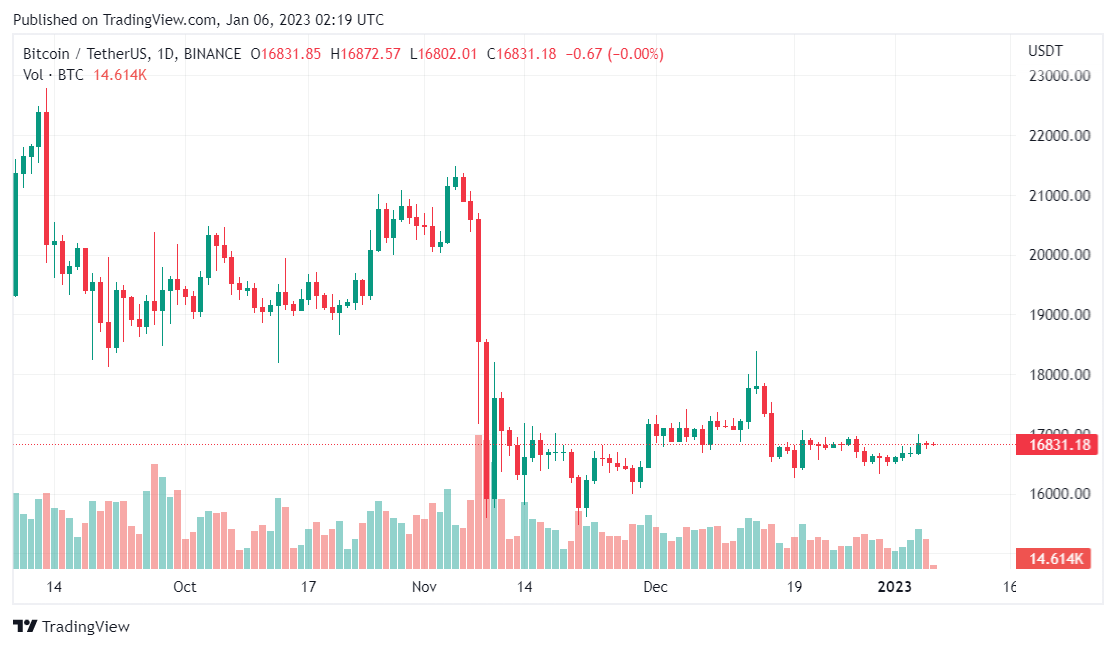
The year 2022 marked the beginning of a new bear market for Bitcoin and the entire cryptocurrencies. Bitcoin declined nearly 75% since its all-time high of $69,000 in 2021.

Many analysts made different predictions for Bitcoin prices in 2022. For example, at a tech conference in Amsterdam in 2018, Tim Draper predicted that Bitcoin would reach $250,000 by the end of 2022. However, when 2022 finally came, Bitcoin price turned opposite Draper’s prediction.

The asset plunged below the $20k mark and hit $16,441 in November after the FTX crisis, but it is now moving toward the $17,000 mark and will likely cross it if the bulls stay intact.

Michael Van De Poppe Releases Bullish BTC Price Prediction For 2023

As the new year unfolds, other analysts besides Svesons have projected a new outlook for BTC in 2023. For example, Michael van de Poppe has made a new prediction for BTC prices in 2023. According to the analyst, BTC will experience a massive price surge in the coming months.

De Poppe predicts a rally between $30,000 and $35,000 as the U.S. Federal Reserve pauses interest rate hikes and reduce inflation. He also made peak high predictions for BTC’s 2023 bull cycle between $275,000 and $350,000.


Leituras Relacionadas

IOSG Founder: Ethereum Doesn't Need Another Leap of Technical Faith, It Needs a Musk-style Compromise

Jocy, founder of IOSG Ventures, argues that Ethereum does not need renewed technological faith but a "Musk-like compromise." The recent formation of ETHLabs—funded by major ETH holders like BitMine and Lubin—highlights a market-driven move to fill a gap left by the Ethereum Foundation (EF), signaling a loss of confidence in its decentralized, hands-off approach. The core critique contrasts Vitalik Buterin's (V) idealistic, technology-first vision with Elon Musk's pragmatic, business-driven execution. The author asserts Ethereum's current shortage is not another technical roadmap but a clear, real-world application narrative and a leader willing to engage directly with commercial realities—like Musk. Internal issues are emphasized, citing EF's management problems and talent drain. While the new decentralized model with independent nodes like ETHLabs addresses the single foundation's limitations, it risks fragmentation without cohesive direction. True cohesion, the author suggests, must come from a shared, compelling narrative around ETH's value, not just from aligned financial interests. Independence claims for new entities are seen as aspirational, needing years of transparency to build trust. The ultimate threat is not competitors like Solana, but the broader shift of attention and talent toward AI. Ethereum has a limited window—12 to 18 months—to recapture focus by delivering tangible, real-world applications. The conclusion urges V to shift from abstract ideals to grounded, pragmatic leadership. The time for this crucial pivot is running out.

marsbitHá 1h

IOSG Founder: Ethereum Doesn't Need Another Leap of Technical Faith, It Needs a Musk-style Compromise

marsbitHá 1h

Google Starts Selling TPUs, Big Tech Aims to Produce "Low-Cost Tokens" with AI Chips

Google has begun selling its proprietary TPU chips and AI computing hardware directly to third-party data centers and clients, marking a strategic shift. Previously only accessible via cloud rentals, TPUs are specialized processors designed for the matrix and tensor operations central to AI models. By combining thousands into supercomputing clusters managed by CPUs, Google achieves high-efficiency AI processing. This move enables Google’s Gemini AI to offer competitive token pricing, challenging rivals like OpenAI. It also signals a broader industry trend where AI compute is becoming a commoditized resource like electricity. While NVIDIA remains dominant with its CUDA ecosystem and high-performance GPUs, the focus is shifting from raw power to cost efficiency and system integration. Google’s approach mirrors NVIDIA’s by selling an entire ecosystem—hardware, software, and data center expertise—rather than just chips. This threatens NVIDIA’s grip on the mid-range inference market, where lower-cost, efficient solutions are increasingly demanded. Similarly, cloud providers like Huawei Cloud and Alibaba Cloud in China are developing their own AI chip ecosystems (e.g., Ascend, Zhenwu), packaging chips, clusters, and tools into full-stack solutions. They aim to reduce token costs and capture market share through integrated systems. In summary, the AI infrastructure race is evolving from a competition for the strongest chips to a contest for the most efficient and cost-effective systems. Google’s TPU sales highlight this transition, emphasizing that future success lies in delivering affordable, scalable AI compute as a foundational service.

marsbitHá 1h

Google Starts Selling TPUs, Big Tech Aims to Produce "Low-Cost Tokens" with AI Chips

marsbitHá 1h

Trading

Spot
Futuros
活动图片