![Tempus Review [2022] | Lend, Stake & Earn Crypto | Pros, Cons](https://finbold.com/wp-content/uploads/2022/03/Tempus-Review-2022-Lend-Stake-Earn-Crypto-Pros-Cons-1024x683.jpg)
In this review, we will analyze Tempus (TEMP), a multi-chain fixed income protocol for crypto users. In particular, we will focus on Tempus lending and staking protocols, its yield aggregators, as well as its governance token and security, among other features.
About Tempus
Tempus is a decentralized finance (DeFi) protocol located in London that was established by David Garai, a Hungarian entrepreneur, and financial specialist.
Launched on the Ethereum mainnet in December 2021, Tempus is a future yield tokenization and multi-chain fixed income protocol that enables crypto traders to obtain a set yield on a reward.
In particular, Tempus avoids the risk of unforeseen variations in returns, in contrast to standard yield farming techniques, for depositors.
Furthermore, Tempus combines with loan protocols, staking protocols, and yield aggregators, while allowing its users to fix or speculate on the yield provided by each of them.
Users of the Tempus protocol can benefit from the following features:
- Native token: Tempus has its own cryptocurrency token (TEMP) which is the core governance and utility token powering the protocol;
- Fix future yield: On Tempus you use a yield-bearing token (YBT), the token on top of which a variable yield accrues over time (i.e. cDAI) to lock in your yield for the future;
- Speculate: Users can make predictions about the pace at which any supported YBT will grow in the future;
- Provide liquidity: Tempus has a unique value proposition that provides liquidity on any supported yield-bearing token pool and earns trading fees on top of the current variable yield.
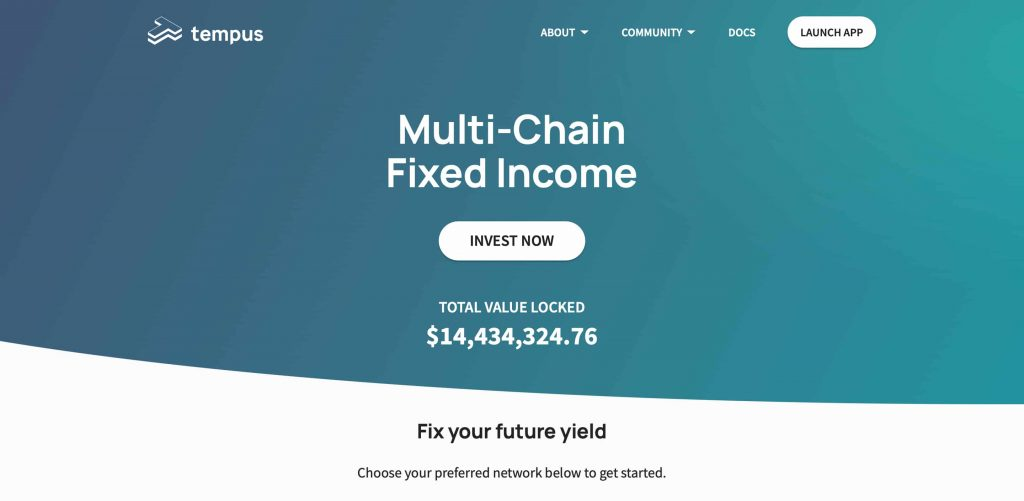
Tempus homepage. Source: Tempus Why do crypto traders use Tempus?
Tempus is building technologies to make future yield tokenization more accessible by enhancing the user experience.
The majority of yield farming techniques that are currently in the crypto space provide a variable rate of production. As a result, depositors are vulnerable to unpredictably high and low variations in their yields.
As things stand, there is no clear capital-efficient strategy for receiving a fixed return or speculating on yields; this is where Tempus comes in. Tempus allows users on its protocol to lock in a fixed-rate yield on their YBT.
More benefits of using Tempus:
- The aim of Tempus is to provide a straightforward and trustless solution for people all around the globe to attain predictable fixed yields using DeFi;
DeFi users with the ability to completely remove interest rate volatility from their portfolios;
- More experienced DeFi users will have the ability to increase exposure to interest rate volatility;
- User exposure to variable yield may also be optimized by using on-chain derivatives on the Tempus marketplace, which is tailored to each user’s risk profile;
- Tempus enables dynamic risk adjustment and the conversion of variable yield rates to fixed yield rates;
- Users may also earn additional yield from Tempus as liquidity providers if they want. Since Tempus enables users to deposit multiple yield-bearing tokens on its platform.

What does Tempus do? Source: Tempus Tempus key features
1. Fixed yields
Tempus offers fixed-yields on a variety of yield-bearing tokens on both the Ethereum and Fantom (FTM) blockchains.
Depositing YBT into an electronic smart contract with the TempusAMM secures a certain rate of return over a predetermined period of time. As a result, you won’t have to worry about your investments losing value due to lowering interest rates and returns.
- The yield-bearing token (YBT) or base asset should be deposited into the Tempus Smart Contract with a certain maturity date in mind.
- Next, the Tempus contract subsequently divides the deposited asset into tokenized Capital and Yield tokens.
- Lastly, in order to ensure future yield, the Tempus contract converts all yield-bearing tokens to Capital tokens.
Redeeming at maturity
It is possible for users to keep Capital tokens until they reach maturity, at which time the principal is completely redeemable at a 1:1 ratio—redeeming at maturity guarantees that the user receives the highest fixed yield possible.
2. Provide liquidity
In order to better fit their risk profile, users may improve their current exposure to variable yield using the Tempus platform.
Users may deposit yield-bearing tokens such as stETH (Lido Staked ETH) into contracts with a variety of maturities, allowing them to earn interest.
In order to facilitate trading on the Tempus custom AMM (automated market makers), these yield-bearing tokens are divided into tokenized Capital tokens and Yield tokens.
The four-step Tempus liquidity provision process:
- The user deposits ETH into Tempus (optional).
- Tempus deposits ETH into Lido and gets stETH as a result.
- The TempusPool contract is responsible for the creation of Tempus Capital and Tempus Yield tokens.
- Capital and Yield tokens are transferred to Tempus’ bespoke TempusAMM in order to serve as a liquidity provider.
- 3. Tempus use-cases for Yield-bearing tokens
For investors, there are three possible outcomes when they own an asset with a yield-bearing token (YBT).

Yield expectation strategies. Source: Tempus 1. Swap Yield for Capital tokens
This technique locks in a set yield to be collected at maturity. Fixing a return upfront reduces risk to possibly greater variable yield.
Choosing how many Yield tokens to trade for Capital tokens requires users to strike a balance between the fixed return they want to lock in and the variable yield income they are prepared to accrue in exchange for their locked-in fixed return. This method works effectively in turbulent markets with decreasing variable yields.
2. Provide liquidity
This method enables users to earn swap fees from all TempusAMM trading activities. People will exchange Capital for Yield tokens when yields rise and vice versa. As long as people trade, liquidity providers will earn fees.
The danger of temporary loss for liquidity providers increases as yields change over time. This strategy performs well when yields are projected to remain stable until maturity.
3. Swap Capital for Yield tokens
Swapping Capital for Yield tokens allows users to enhance their exposure to variable yields and earn much more than the underlying yield-bearing token annual percentage rate (APR).
By giving up Capital tokens to improve their exposure to variable returns, users risk losing capital if rates decline. Thus, this method is suitable for turbulent markets with growing variable yields.

Strategy comparison. Source: Tempus Tempus Governance
Tempus is a Decentralized Autonomous Organization (DAO) governed by the holders of the TEMP cryptocurrency token.
Since Tempus is a DAO, anybody in the Tempus community may submit updates and enhancements to the Tempus protocol, on top of process improvements.
TempusPool
The TempusPool smart contract is the primary smart contract on the Tempus Protocol.
Each Tempus Pool is distinguished by two fundamental tenets:
- A Yield Bearing Token (such as Lido’s stETH or Compound’s cDai).
A maturity date.
The Tempus Pool is in charge of handling deposits and redemptions. By maintaining track of the exchange rate of the underlying Yield Bearing Token, it mints Capitals and Yields on deposit and burns them at redemption in return for Yield Bearing Tokens.
TEMP Token
TEMP tokenholders govern the Tempus protocol on Ethereum; thus, TEMP is the core governance and utility token powering the protocol.
- The ERC-20 native token performs three functions: governance, staking in order to obtain a part of network fees, and paying protocol fees;

Tempus tokenomics. Source: Tempus
- One billion TEMP tokens were produced at the moment of the project’s start, and these tokens will be made available over the course of three years;
- In particular, the TEMP token enables members of the Tempus community to suggest and vote on significant improvements to the Tempus protocol.

TEMP Token. Source: Tempus Available tokens on Tempus
Tempus will initially integrate with the services Lido, Aave, Compound, Yearn, and Rari, but the protocol is constantly working on new integrations with other tokens.
Tempus app
After launching the Tempus app, you will be able to connect to either MetaMask, a cryptocurrency wallet for holding ERC-20 tokens and interacting with decentralized apps (dApps) on the Ethereum and Binance Smart Chain network.
Alternatively to WalletConnect, an open-source protocol for integrating decentralized apps with mobile wallets through QR code scanning or deep linking.

empus app. Source: Tempus Tempus fees
Tempus does not collect any protocol fees; nonetheless, there are two types of costs that users must pay.
- Swap fees will be paid to liquidity providers (LPs), who will supply liquidity to each TempusAMM.
- Gas fees that you pay when you use the networks that are supported by Tempus.
Rates on Tempus
The market indicated annual percentage yield (APY) for each pool is determined by the exchange rate (ratio of reserves on both sides) between the Capitals and the Yields in each TempusAMM.
Is Tempus safe?
Tempus is built on Ethereum network utilizing the Proof-of-Work (PoW) consensus mechanism that is required for miners to mine new Ether. This makes Ethereum one of the safest blockchains in the crypto space, which enhances the security of Tempus as a result of its implementation.
In order to safeguard the Ethereum blockchain, a network of decentralized nodes verifies transactions.
Unit and integration tests
Tempus takes security and protection of users’ funds very seriously; thus, as part of the development process, any new code must be tested using both unit and integration tests to ensure that it meets the requirements.
Pull Requests that include failed tests, or test coverage that falls below a specific level are not eligible for merging.
Smart contract audits
So far, Tempus has conducted three audits of the protocol, by the following firms:
Coinspect;
Bug Bounty
Not to mention that the protocol has two active bug bounties:
Immunefi – For reporting a bug, you may earn up to $1,000,000 (depending on threat level);
- Hats – Presently, you may earn up to 1 million TEMP for reporting a bug (depending on threat level)
Smart Contract Exploit Protection
Sherlock has also agreed to provide Tempus with $10 million of protocol-level exploit coverage on all pools that are available on the Ethereum network on Tempus.
Due to the partnership with Sherlock, users will no longer need to secure their own insurance and will be able to depend on Sherlock to guarantee that they are compensated in the case of a smart contract breach.

Tempus security. Source: Tempus Customer support
Users can stay up to date and get notified about major developments in Tempus on the following social media platforms:
You can also get in touch with the team by sending an email to [email protected].
Pros & Cons
Pros
- Tempus is a highly secure protocol given that it is fully audited, offers rewarding Bug Bounty’s, exploit coverage as well as strict unit and integrations tests;
- Completely remove interest rate volatility;
Variable yield accrues over time which can be locked in;
- Dynamic risk adjustment on top of the conversion of variable yield rates to fixed yield rates;
- Simple solution to obtaining fixed yield rates.
Cons
- Only a small amount of tokens currently integrated;
- The protocol plans to introduce new fees in the future.
Final thoughts
Since is audited and provides rewarded Bug Bounties and exploit coverage as well as a unit and integration tests, we consider Tempus is a secure protocol.
By improving the user experience, Tempus is making future yield tokenization more accessible. People throughout the world may use Tempus to get reliable fixed yields via DeFi, which is the goal of the company.
Ultimately, the protocol, allows for dynamic risk management and the conversion of variable yield rates to fixed yield rates.
What is Tempus?
Tempus is a multi-chain fixed income protocol that allows users to fix or speculate on the yield created through lending protocols, staking protocols, and yield aggregators.
What is TEMP token?
TEMP is the ERC-20 native token for the Tempus protocol. This cryptocurrency performs three functions: governance, staking in order to obtain a part of network fees, and paying protocol fees. At the time of inception, one billion TEMP tokens were created and will be made accessible over the period of three years.
Is Tempus safe?
Yes, Tempus has been audited by three auditors thus far, including Coinspect, Code4rena, and Sherlock. In addition, it carries out unit and integration tests on top of offering a Bug Bounty reward and smart contract exploit protection up to $10 million.
What are Yield-Bearing Tokens (YBT)?
Yield bearing tokens (YBT), are derivatives whose value increases as a byproduct of their participation in a sort of yield farming. One type of YBT is the stETH token (Lido staked ETH), which is a form of yield farming.