【研报精选】2022年终总结与2023年展望:SBT 将引导我们进入去中心化社会

Foresight NewsPublicado em 2022-12-29Última atualização em 2023-01-03

Resumo

2022 年对加密行业来说是一段奇妙旅程。本报告整理了 2022 年十大加密货币事件和趋势,其次是对 2023 年的展望。

2022 年对加密行业来说是一段旅程。在本报告中,我们整理了 2022 年十大加密货币事件和趋势,其次是我们对 2023 年的展望。

2022 年回顾

2022 年,全球经济在宏观和地缘政治逆风下举步维艰,包括世界各国央行为打击通货膨胀而采取的货币紧缩政策、欧洲的冲突、供应链中断以及 COVID-19 流行病挥之不去的影响。因此,预计 2022 年的全球 GDP 增长率为 3.2%,比 2021 年的~6% 大幅下降。同时,通货膨胀增长率继续飙升,达到年均 8.8%。
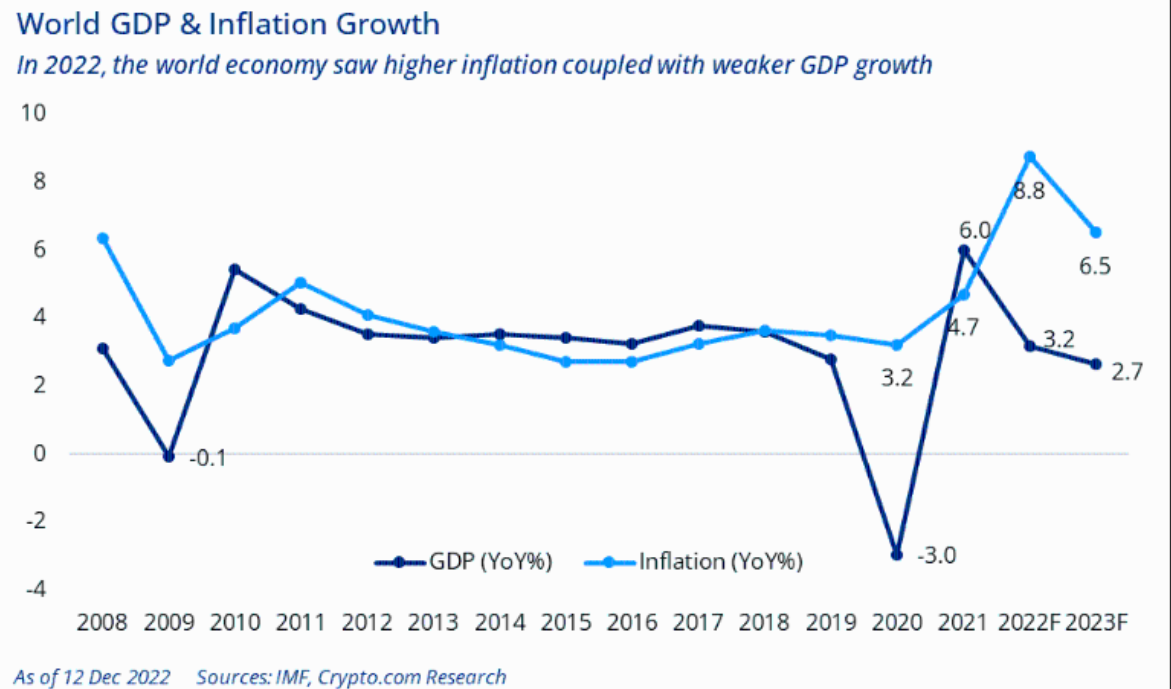
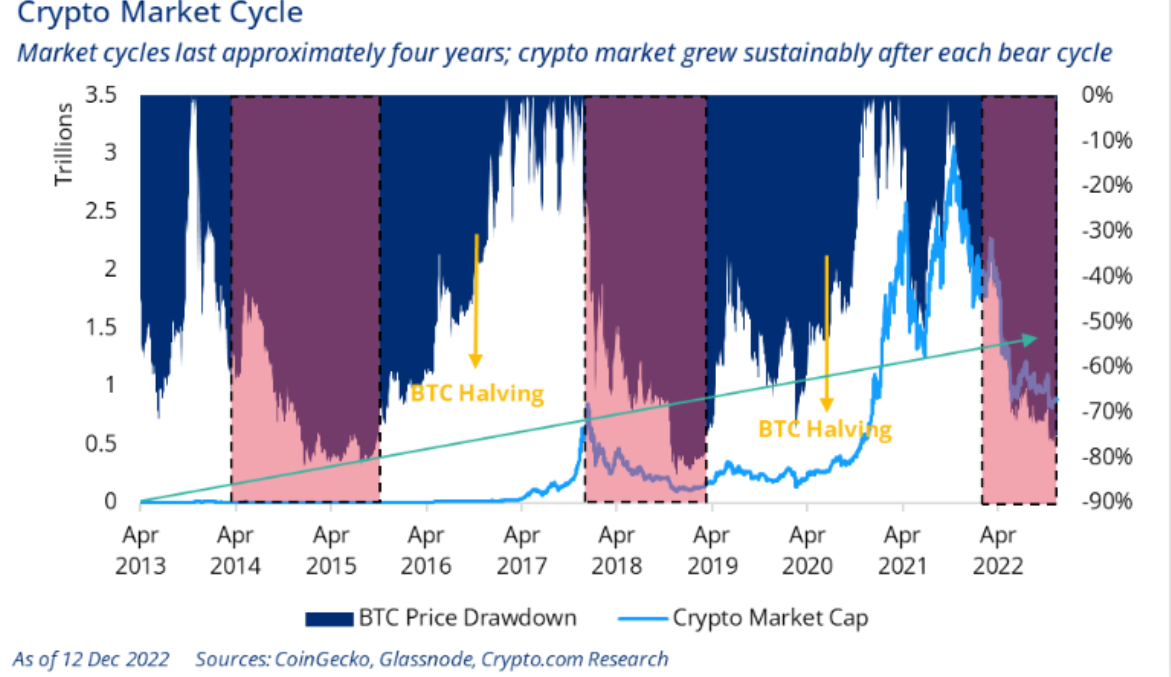
除了宏观逆风外,加密货币市场也受到了一些事件的负面影响,特别是 5 月 Terra 稳定币(UST)的崩溃和 11 月 FTX 的破产。这两个事件和随后的影响产生了连锁反应,影响了生态系统中的其他参与者,并抑制了其对该行业的信心。在写这篇文章的时候,可以说这仍然是「加密货币的冬天」。话虽这么说,市场周期在熊市和牛市之间波动是自然的,如下图所示。
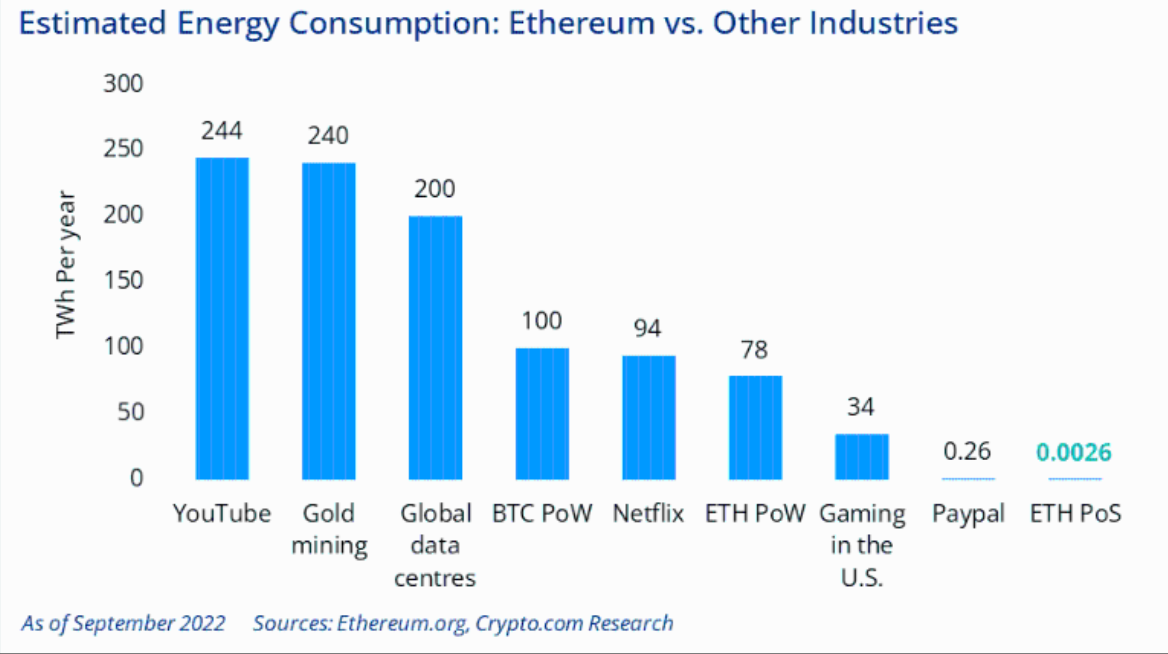
以太坊 2022 年 9 月 15 日的合并被广泛认为是今年最值得期待的加密货币事件之一。合并的积极影响之一是,以太坊的能源消耗下降了 99.95%,因为 PoS 不需要 PoW 那样的能源密集型采矿机。相反,PoS 区块链依靠验证者来验证交易。据估计,PoS 以太坊区块链的能耗大约是 PayPal 的 1%,比 PoW 网络小几个数量级。
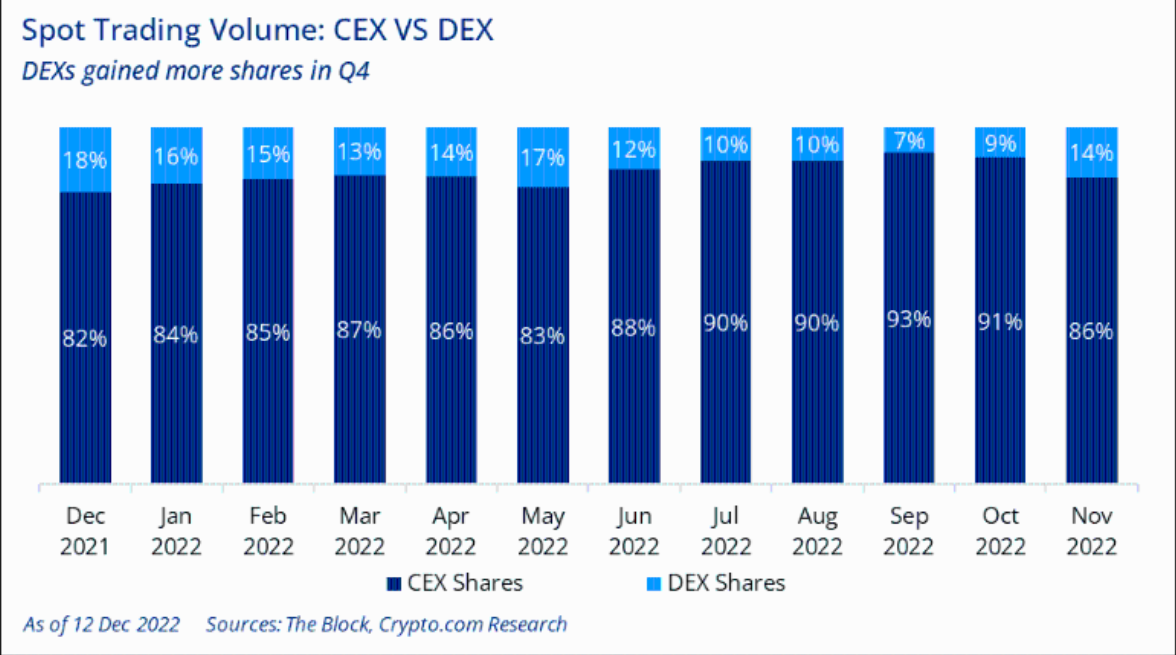
在 FTX 于 2022 年底破产后,我们看到去中心化的交易所(DEX)在加密货币现货交易总量中占据了更高的份额。截至 2022 年 11 月,DEXs 占据了现货交易量的 14%,而 10 月份为 9%。
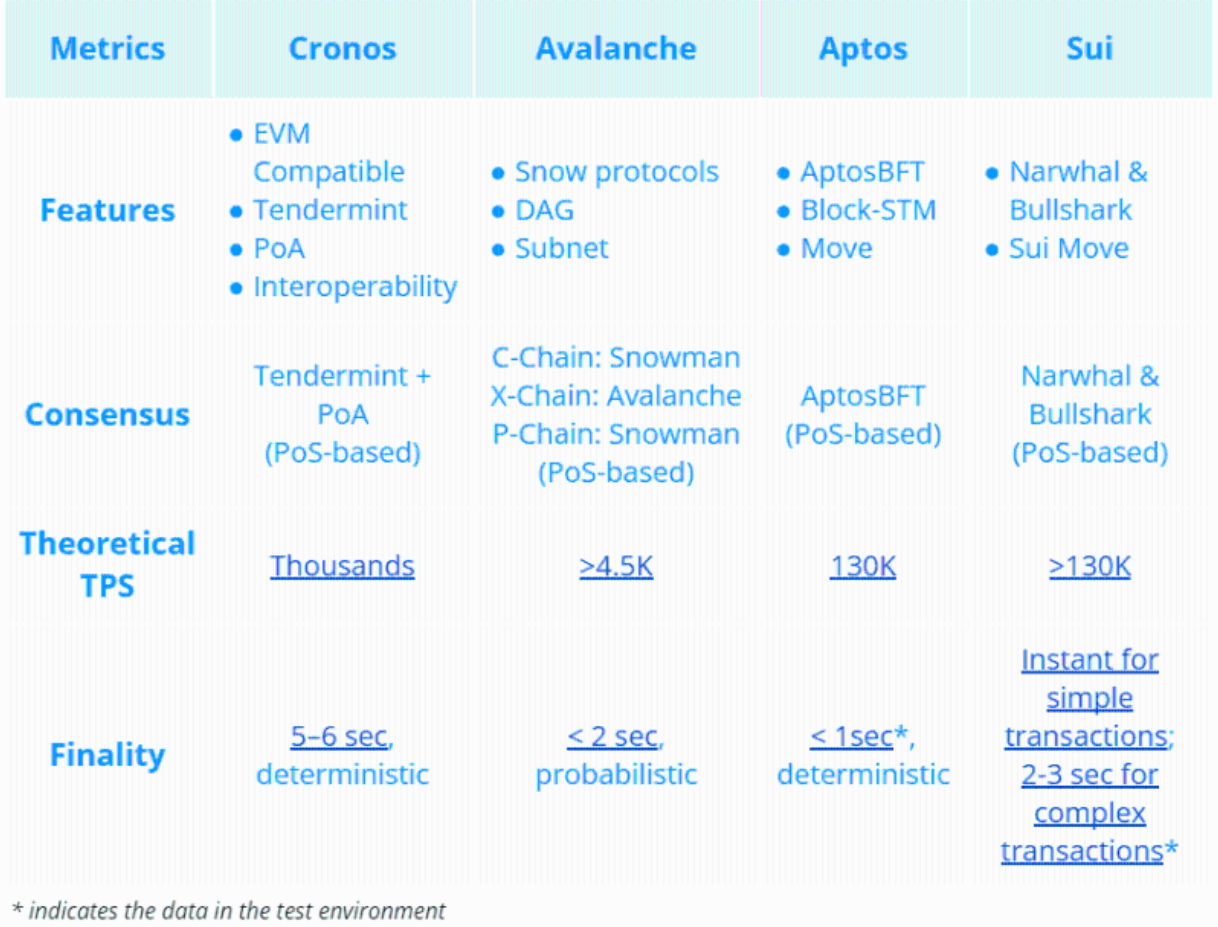
2022 年,新的第一层(L1)区块链受到关注:值得注意的例子是 Aptos 和 Sui,它们都是由 Meta 公司 Diem 团队的前开发者创建的。因此,Sui 和 Aptos 使用类似的技术,包括并行引擎和 Move 编程语言。
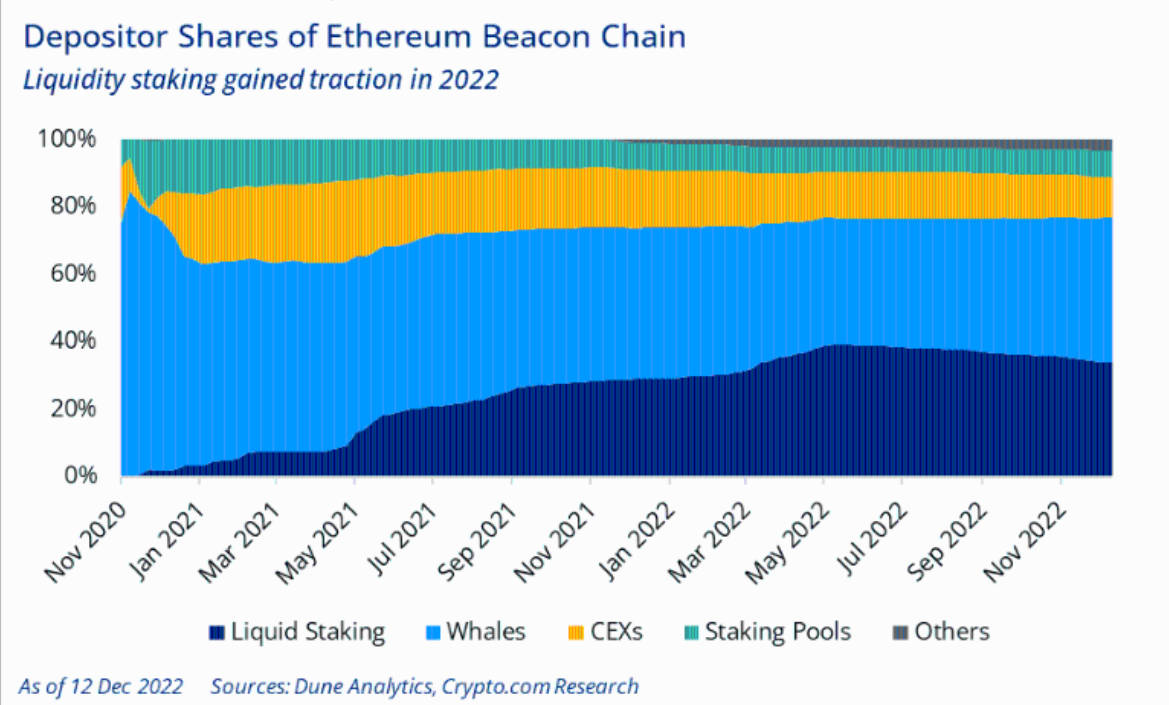
PoS 质押默认需要锁定代币,这意味着代币持有人必须在赚取收益或保留流动性之间做出选择。Liquid Staking 试图通过让代币持有者享受两全其美的方式来解决问题——在享受 PoS 代币收益的同时保持一定程度的流动性。流动性质押为质押者提供的灵活性是它在 2022 年蓬勃发展的一些原因。根据流动性定投代币的市值,ETH 是最受欢迎的代币选择。Lido Finance 继续引领流动性质押市场,占据约 78% 的市场份额。
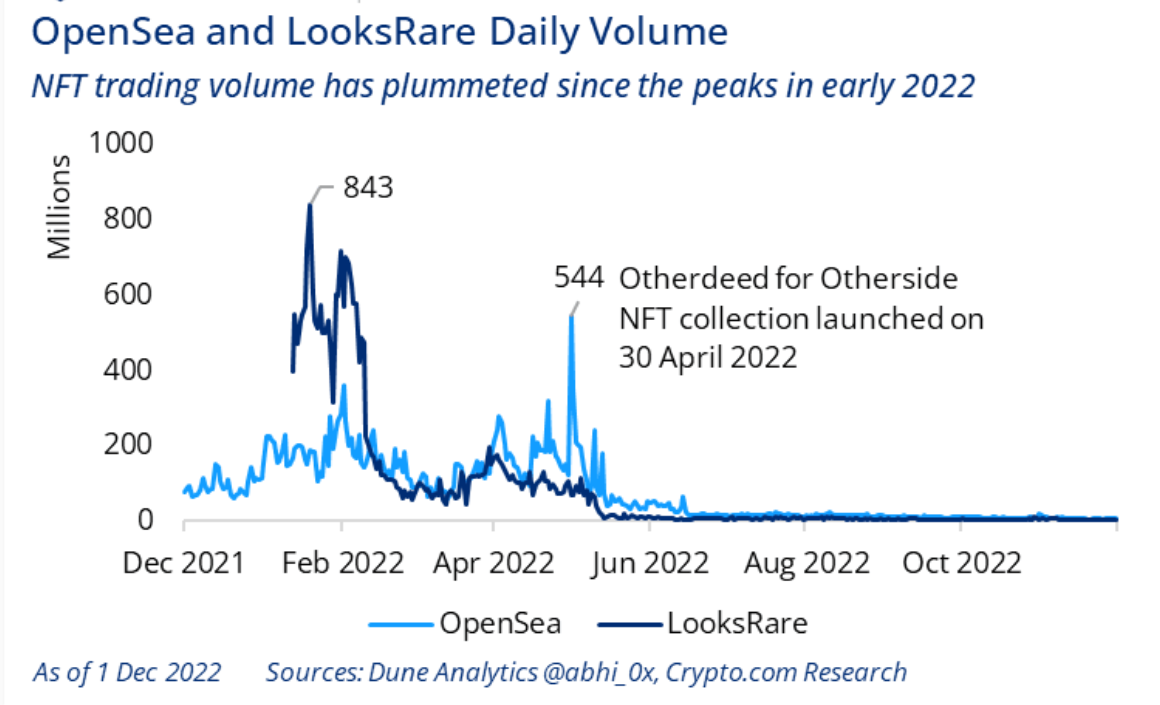
在 2022 年上半年,NFT 市场充满活力,交易量强劲。2022 年 5 月,OpenSea 的日交易量达到了 5.44 亿美元的高点,这是由蓝筹股 Bored Ape Yacht Club(BAYC)NFT 背后的公司 Yuga Labs 推出的「Otherdeed for Otherside」系列所推动。尽管最近几个月交易量疲软,但 NFT 合作和创新仍在继续。
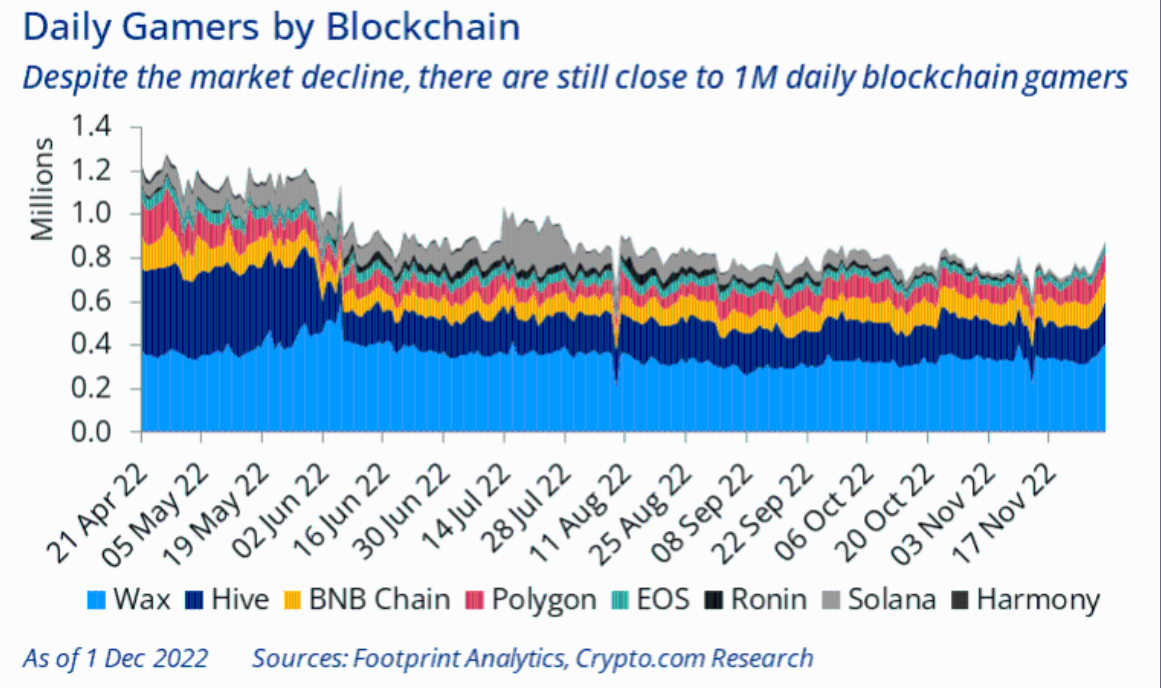
尽管市场低迷,但在 2022 年的大部分时间里,每天仍有大约 100 万区块链游戏玩家。Wax 区块链目前在每日游戏玩家数量方面处于领先地位,截至撰写本文时为 315,000 人。Wax 有不少顶级区块链游戏,例如 Splinterlands 和 Farmers World。
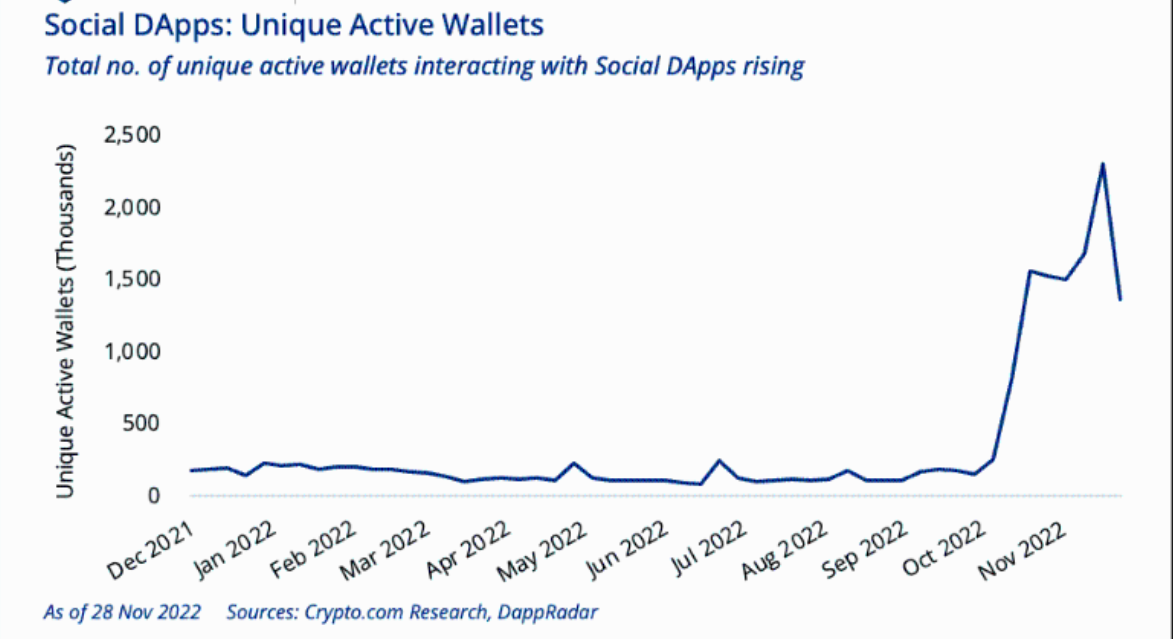
基于区块链的社交应用在 2022 年获得了关注,从与社交 DApps 的智能合约互动的独特钱包总数的急剧增长可以看出。
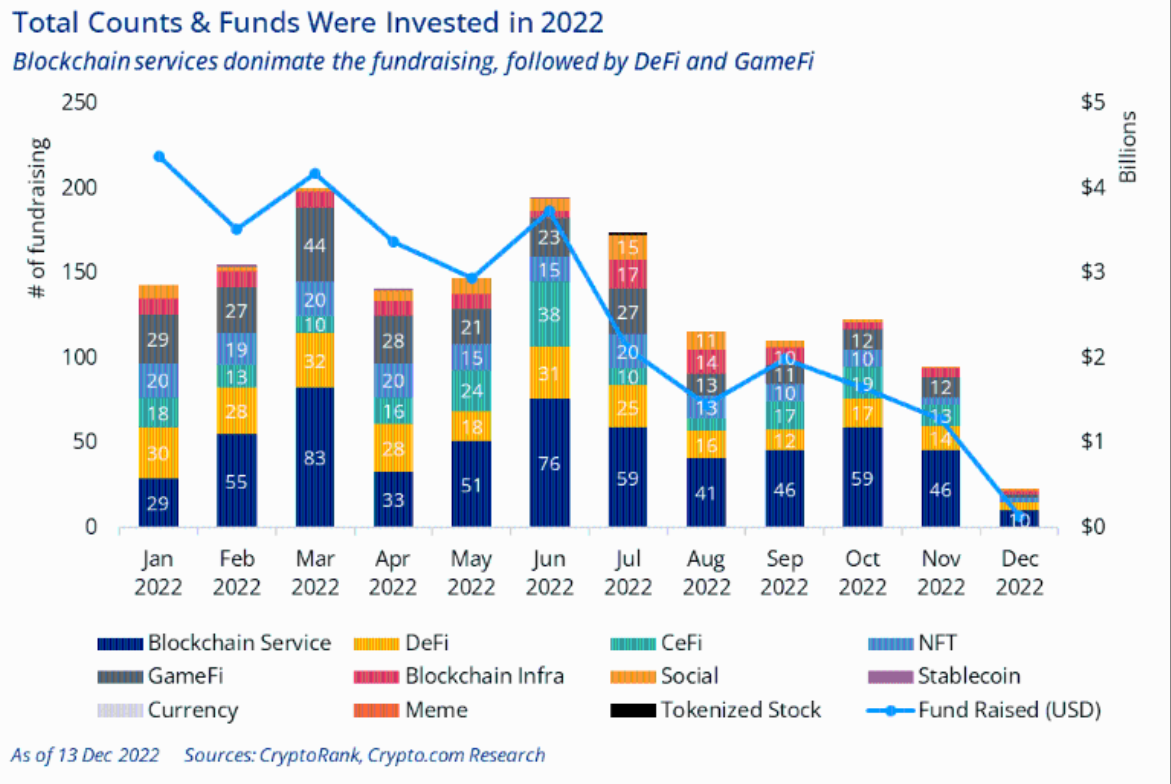
区块链领域的资本投资和项目孵化继续增长。仅在 2022 年上半年就筹集了约 290 亿美元的资金,其中基础设施和 Web3 初创公司,包括 NFT、区块链游戏和元宇宙,占据了资金池的绝大部分份额。在这头六个月里,筹集的资金总额已经超过了 2021 年的数字,2021 年全年有 1313 个轮次,投资额为 302 亿美元。就行业而言,区块链服务类别的投资在整个一年中的分布是一致的。它获得了最多的资金,总共进行了 592 轮交易,其次是 DeFi 和 GameFi 板块。
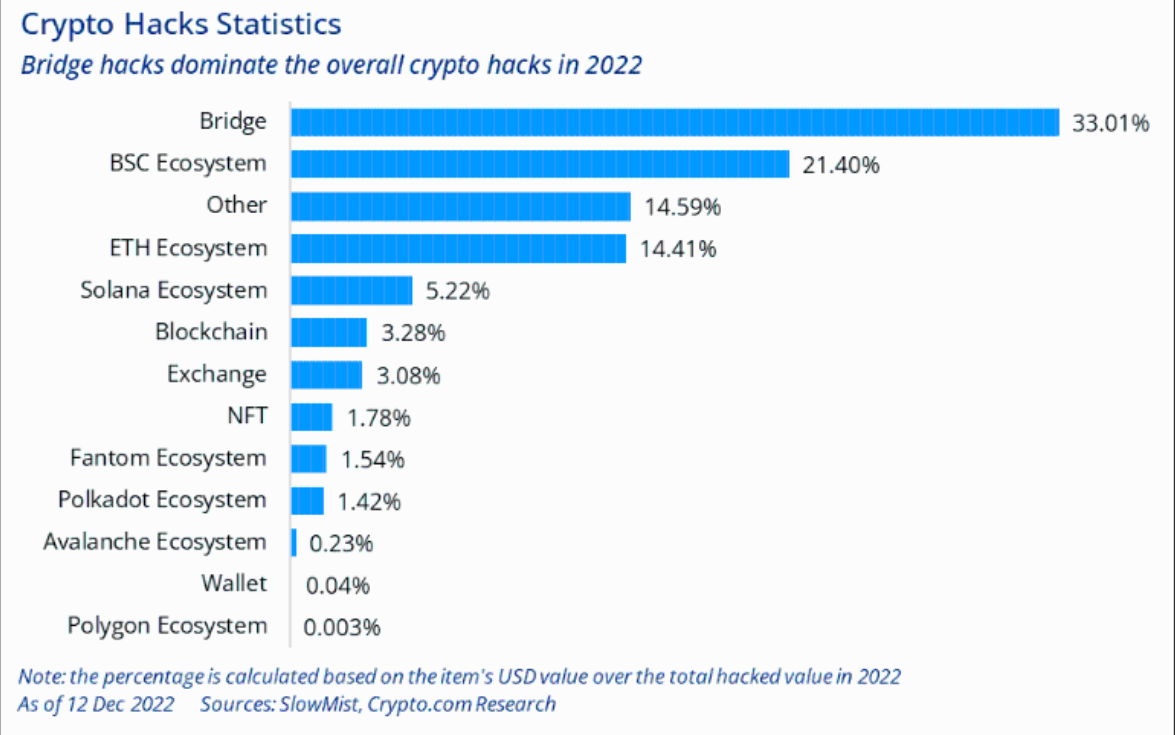
安全问题是任何区块链网络的一个焦点。在 2022 年,我们看到了很多黑客和漏洞。在撰写本文时,2022 年加密货币黑客攻击的总金额约为 37 亿美元,与 2021 年相比下降了 63%。其中跨链桥被盗金额占到总金额的三分之一以上。
2023 的展望

尽管宏观条件充满挑战,但在 2022 年,加密货币的采用增长仍然强劲。

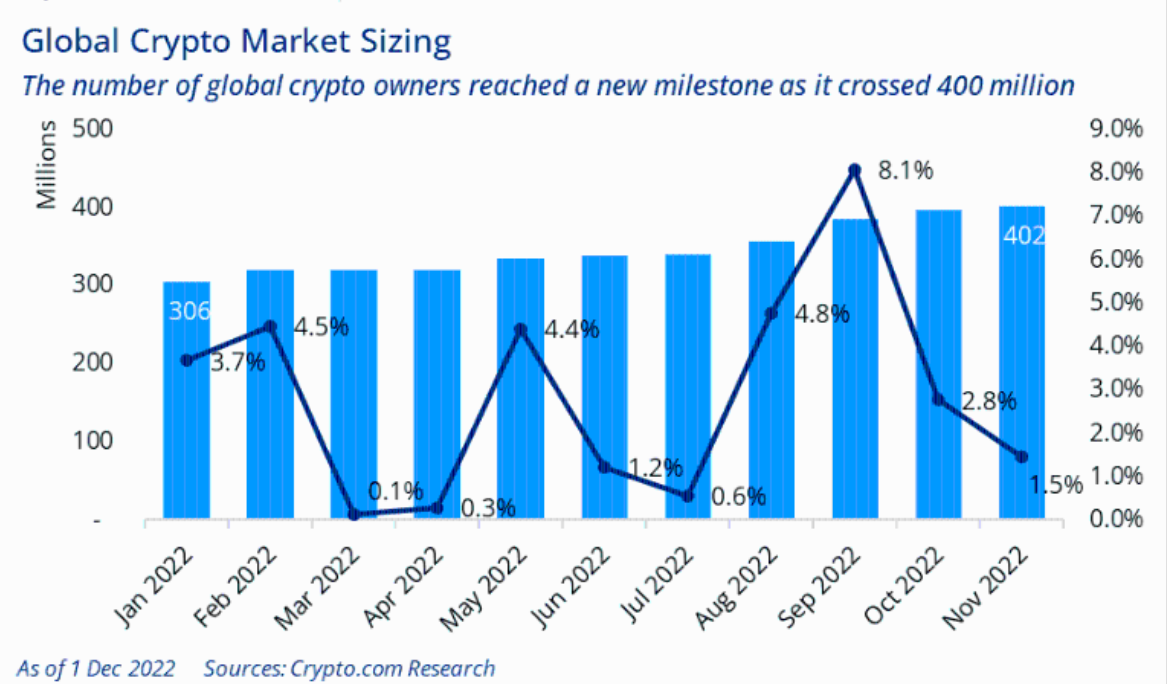
截至 2022 年 11 月,加密货币所有者的数量突破了 4 亿的里程碑,达到 4.02 亿。在这一年里,月平均采用增长率为 2.9%。

根据市场条件,我们预计 2023 年全球加密货币所有者的数量可能达到 6-8 亿。
在区块链游戏领域,我们预计在未来一两年内会看到一些 AAA 级游戏,这些游戏将为玩家提供新的游戏体验,将高性能的游戏玩法与区块链技术相结合。

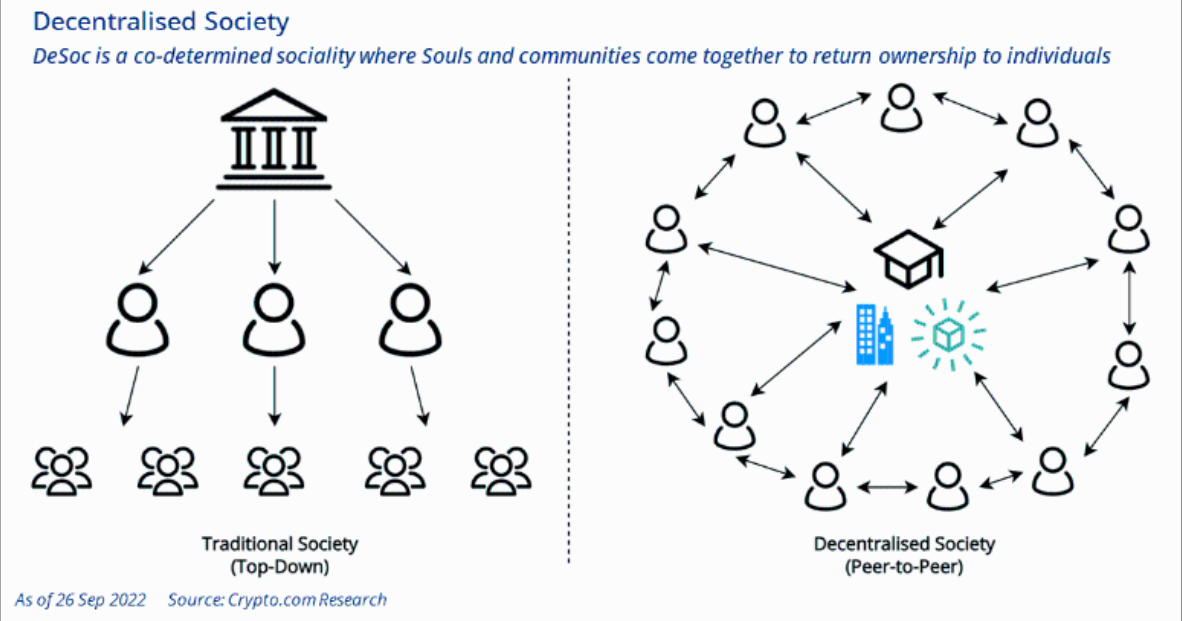
灵魂绑定代币(SBTs)的使用越来越多,这可能是另一个潜在的市场驱动。SBTs 是与个人或实体挂钩的 NFTs,不可转让,不可交易。它们旨在通过包含持有人的承诺、证书和附属关系来代表持有人的社会身份。它类似于简历或 CV 的概念。采用 SBTs 可以引导我们进入一个去中心化的社会(DeSoc)或一个共同决定的社会性,其中灵魂和社区以自下而上的方式召开。DeSoc 以不可转让的 SBT 为基础,旨在代表「灵魂」的承诺、证书和附属关系,可以对实体经济的信任网络进行编码,以建立出处和声誉。
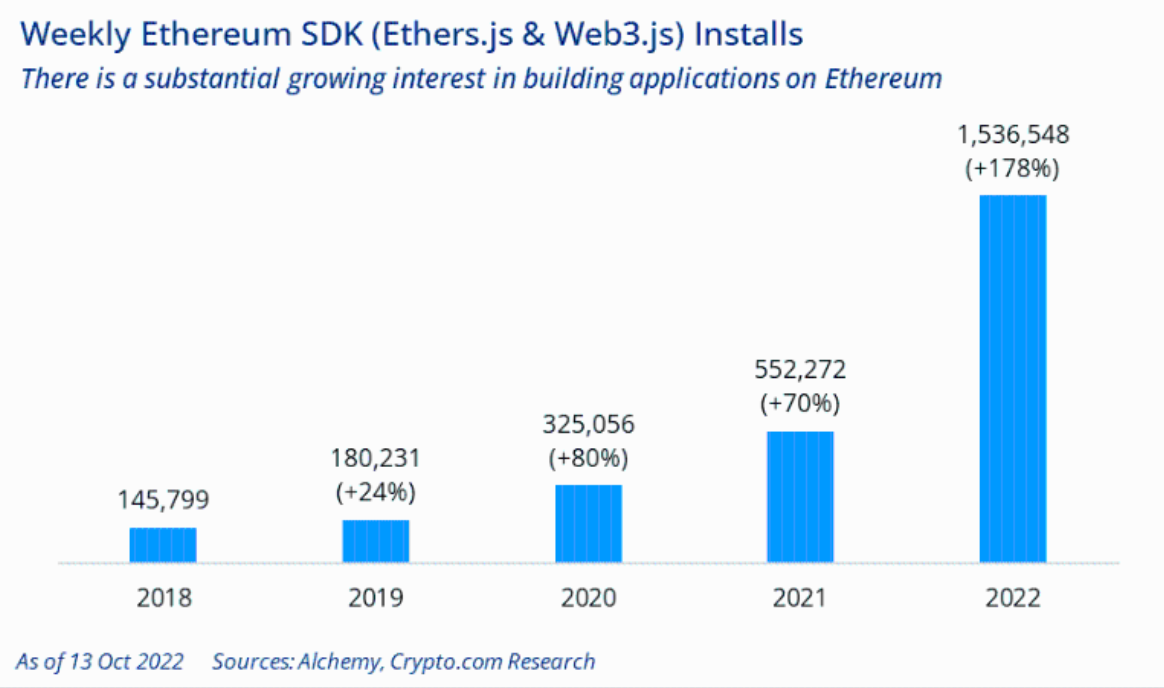
2022 年,我们看到一个有趣的现象,越来越多的 Web2 开发者对 Web3 产生了极大的兴趣。2018 年以来,两个流行的 Web3 开发库 Ethers.js 和 Web3.js 的下载量激增 10 倍。开发人员涌向 Web3 将刺激提供 Web3 开发工具公司的增长。
在 2022 年行业内发生了一些破产和黑客事件后,我们看到人们越来越关注安全以及用户教育。建立一个成功的商业模式的关键是与终端用户建立信任。进入 2023 年,我们预计这种更加关注安全和用户教育的趋势将会继续。一方面,我们可能会看到更多平台投资于安全审计和认证。另一方面,我们也期待看到在这个领域推出更多的教育举措,延续 2022 年以来的趋势。

除了上述趋势性话题外,其他领域的发展预计将受到关注,包括新的区块链基础设施、ZK 证明、更多基于效用的 DeFi 应用、以太坊的上海升级和机构采用等等。

Leituras Relacionadas

Unveiling the Whales of the World Cup Prediction Market: Smart Money Stumbles on the Pitch, 'Buy No' Outperforms 'Buy Yes'

**Title: Unveiling the Whales of the World Cup Prediction Market: "Smart Money" Stumbles on the Pitch as "Buying No" Outperforms "Buying Yes"** An analysis of pre-match trades over $5,000 on Polymarket for 20 completed group stage matches reveals a counterintuitive finding: large "smart money" bets were not consistently accurate. Aggregated pre-match buying volume was $89.55 million, with a weighted hit rate of only 48.5%. Holding these positions would have resulted in an estimated net loss of about $1.76 million (ROI -2.0%), challenging the notion that big money reliably predicts outcomes. The data highlights several key dynamics. Draws proved to be a major risk, significantly impacting bets on favored teams, as seen in Belgium-Egypt and Spain-Cape Verde. Markets were more efficient for clear mismatches (e.g., Germany's big win) but became prone to bias when favorites were overvalued. Notably, buying "No" shares (betting against a specific outcome) significantly outperformed buying "Yes," with hit rates of 62.4% vs. 37.5%. This suggests the market often overprices popular narratives, creating value in contrarian positions. Individual trades showed extreme volatility. One wallet (mintblade) earned an estimated $6.77 million by betting against Iran, while another (LEEEROYJENKINS) lost roughly $8.39 million on a Belgium win. The market favors high-risk, high-reward information trading rather than steady arbitrage. For sustained insight, wallets with consistent performance across multiple matches (e.g., swisstony) are more telling than one-off big bets. Ultimately, the Polymarket acts less as a crystal ball and more as a mirror, reflecting crowd bias and the inherent unpredictability of football. True "smart money" may lie not in predicting the future, but in identifying and exploiting market mispricings while respecting risk.

marsbitHá 17m

Unveiling the Whales of the World Cup Prediction Market: Smart Money Stumbles on the Pitch, 'Buy No' Outperforms 'Buy Yes'

marsbitHá 17m

Bezos' Third Startup Still Can't Avoid Musk

Jeff Bezos Returns as CEO for Third Venture, Still Can't Avoid Musk After stepping down as Amazon CEO in 2021, Jeff Bezos has returned to the front lines as co-CEO of Prometheus, an AI startup he founded. In a recent CNBC interview, Bezos described the experience as "Type 2 fun"—exhausting but ultimately rewarding. Founded less than a year ago, Prometheus has already raised over $18 billion in two funding rounds, achieving a staggering $41 billion valuation. Prometheus aims to develop a "General Engineer AI" to accelerate the entire "invention loop"—design, simulation, testing, and manufacturing—for complex physical products like jet engines, spacecraft, and medical devices. This positions the company at the intersection of Bezos's past experiences: Amazon's platform-building scale and Blue Origin's rigorous physical engineering. This marks Bezos's third major venture, following Amazon and Blue Origin. His co-CEO is Vik Bajaj, bringing expertise from life sciences and hard tech. Bezos now dedicates most of his time to Prometheus, signaling his belief in its transformative potential. The move also comes as Bezos's space company, Blue Origin, faces challenges, including a recent test explosion delaying its New Glenn rocket. Meanwhile, Elon Musk's SpaceX achieved a record-breaking IPO, surpassing Amazon's market cap. While Musk focuses on AI for executing physical tasks (like Tesla's robots and SpaceX's engineering), Bezos is betting on AI to *invent* in the physical world. Prometheus enters a crowded industrial AI field with players like OpenAI, NVIDIA, and Tesla's Optimus. Its lofty valuation bets on the unproven but massive opportunity to become the foundational platform for engineering in the AI era—a "blue ocean" Bezos hopes to define before Musk does.

marsbitHá 19m

Bezos' Third Startup Still Can't Avoid Musk

marsbitHá 19m

Won't US Stocks Ever Fall Again? The 'Great Melt-up' Trap in the Era of High Debt

The article analyzes a popular theory circulating online that the U.S. stock market may be mathematically incapable of a true, sustained decline due to the country's massive and growing national debt. The argument suggests that the government's only path to managing this debt is through inflation and money printing, which would nominally lift asset prices like stocks, creating a perpetual "melt-up." The author places this idea within the historical context of market melt-ups, such as the dot-com bubble and Japan's asset bubble, where prices detach from fundamentals driven by momentum and FOMO. While acknowledging that a high-debt environment creates incentives for inflation, which is generally favorable for assets over cash, the article refutes key claims of the online theory. It clarifies that interest payments are not about to exceed GDP, that printing money is not the only option for the government, and that stocks do not reliably rise in lockstep with hyperinflation, citing historical examples from Germany, Zimbabwe, and Venezuela. The more probable outcome, according to the author, is a prolonged period of financial repression—moderate inflation above interest rates that slowly erodes debt and cash purchasing power, leading to nominally higher asset prices but potentially lower real returns. The core warning is that while long-term market trends may be upward, this does not eliminate the risk of significant interim crashes (30%, 40%, or more) or guarantee real wealth creation during inflationary times. The conclusion advises against betting one's entire financial future on a smooth, perpetually rising market narrative. Instead, it recommends a disciplined, diversified strategy involving productive assets (stocks, real estate, some gold, short-term bonds) and an adequate cash buffer to avoid forced selling during downturns. The key takeaway is to avoid extreme concentration in expensive assets and leverage, and not to base investment decisions on the hope that every market dip will inevitably be rescued.

marsbitHá 40m

Won't US Stocks Ever Fall Again? The 'Great Melt-up' Trap in the Era of High Debt

marsbitHá 40m

Trading

Spot
Futuros
活动图片