Bitcoin price prints bearish technical pattern, why it could continue lower

newsbtcPublicado em 2022-12-19Última atualização em 2022-12-19

Resumo

Bitcoin price declined heavily and traded below $17,000. BTC is consolidating losses and remains at a risk of more losses below the $16,500 support. Bitcoin started a fresh decline below...

Bitcoin price declined heavily and traded below $17,000. BTC is consolidating losses and remains at a risk of more losses below the $16,500 support.
“”

  • Bitcoin started a fresh decline below the $17,200 and $17,000 support levels.
  • The price is trading below $17,000 and the 100 hourly simple moving average.
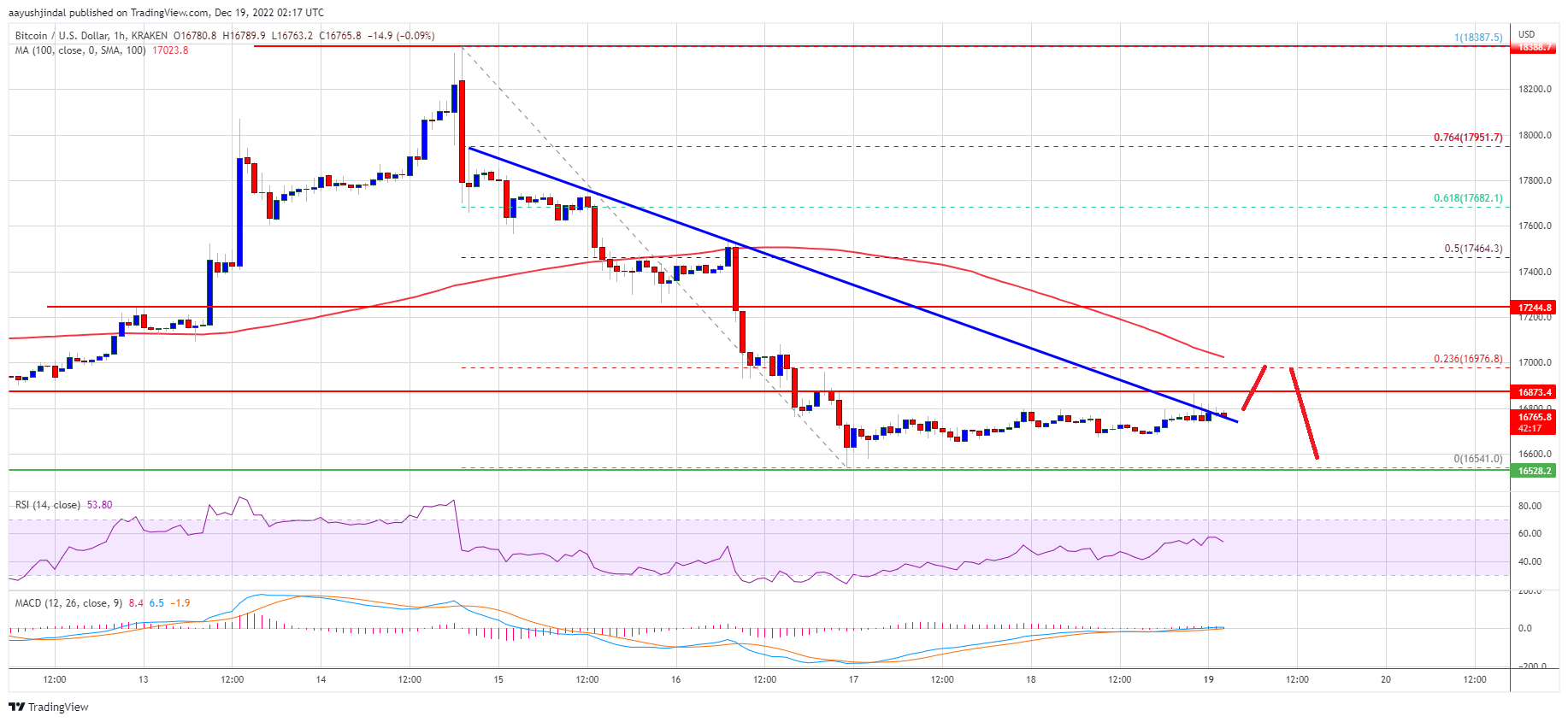
  • There is a key bearish trend line forming with resistance near $16,800 on the hourly chart of the BTC/USD pair (data feed from Kraken).
  • The pair could continue to move lower unless it clears the 100 hourly SMA.

“”

Bitcoin Price Tumbles


Bitcoin price restarted a fresh decline from the $18,400 zone resistance zone. BTC gained pace below the $17,500 and $17,200 support levels. The bears even pushed it below the $17,000 level and the 100 hourly simple moving average.


It tested the $16,500 support zone. A low is formed near $16,541 and the price is now consolidating losses. It climbed a few points higher and traded above the $16,700 level.

Bitcoin price is now trading below $17,000 and the 100 hourly simple moving average. On the upside, an immediate resistance is near the $16,800 zone. There is also a key bearish trend line forming with resistance near $16,800 on the hourly chart of the BTC/USD pair.


The first major resistance is near the $17,000 zone and the 100 hourly simple moving average. It is near the 23.6% Fib retracement level of the downward move from the $18,387 swing high to $16,541 swing low.
Bitcoin Price

Source: BTCUSD on TradingView.com


A clear move above the $17,000 resistance might call for a move towards the $17,500 resistance. It is close to the 50% Fib retracement level of the downward move from the $18,387 swing high to $16,541 swing low. The next major resistance is near $17,800, above which the price might gain pace and rise towards the $18,000 level.


More Losses in BTC?
“”

If bitcoin fails to clear the $17,000 resistance, there could be more downsides. An immediate support on the downside is near the $16,600 level.

The next major support is near the $16,500 zone. A downside break below the $16,500 support might call more losses. In the stated case, the price could decline towards the $16,000 support in the near term. Any more losses might send the price towards $15,500.


Technical indicators:


Hourly MACD – The MACD is now losing pace in the bearish zone.
Hourly RSI (Relative Strength Index) – The RSI for BTC/USD is now above the 50 level.
Major Support Levels – $16,600, followed by $16,500.
Major Resistance Levels – $16,800, $17,000 and $17,500.

Leituras Relacionadas

Observation of Data on the Top Six Cryptocurrency Protocols: Revenue Continues to Grow, So Why Aren't Token Prices Rising?

Despite generating impressive revenue, many top cryptocurrency protocols struggle to translate this success into token price appreciation. This analysis of six major protocols (Aave, Aerodrome, Hyperliquid, Pump, Sky, Uniswap) examines the disconnect, focusing on revenue generation, distribution, and tokenomics. While these protocols collectively earned over $726 million in the first half of 2026, token performance largely lagged due to factors like imbalanced token emissions, unclear value capture mechanisms, and equity-token separations that disadvantage holders. Key findings reveal that not all revenue is equal for token holders. Protocols differ significantly in how they allocate income. Hyperliquid, for instance, directs 100% of its revenue to holders via buybacks and burns, correlating with strong token performance. Others, like Aerodrome, Sky, and Uniswap, showed negative net token flows when accounting for high token emissions used for incentives, offsetting holder benefits. The article highlights two primary value capture methods: buybacks/burns and direct fee distribution (e.g., ve-tokenomics models). The analysis concludes that high revenue alone doesn't guarantee token growth. Investors must scrutinize a protocol's sustainable revenue sources, how that value is shared with token holders, and the associated token release schedules and supply pressures. The future points towards greater alignment between protocol success and tokenholder rewards, but only for projects that seriously address all three pillars: revenue, distribution, and emissions.

marsbitHá 25m

Observation of Data on the Top Six Cryptocurrency Protocols: Revenue Continues to Grow, So Why Aren't Token Prices Rising?

marsbitHá 25m

September 1st, A Major Chip Price Hike

On July 29, 2026 (US time), Qualcomm reported its Q3 FY2026 (Q2 CY) results. Revenue reached $9.95 billion, up 4% and beating estimates, but net profit fell 25% YoY to $2 billion. The "revenue up, profit down" trend is attributed to rising costs across semiconductor manufacturing, testing, packaging, and materials. In response, CEO Cristiano Amon announced price increases for all chip products, effective September 1, to pass on costs and restore historical profit margins. The stock fell over 5% in after-hours trading due to weaker-than-expected Q4 profit guidance. Qualcomm's core chip business (QCT) revenue was $8.5 billion, down 5% YoY. Handset revenue dropped 20% to $5.09 billion, reflecting a weak global smartphone market with declining shipments. In contrast, Automotive revenue surged 61% to $1.59 billion, marking 23 consecutive quarters of double-digit growth, and IoT revenue grew 9% to $1.83 billion. The licensing division (QTL) revenue was $1.28 billion, down 3%. Facing smartphone headwinds and a reduced component share in future iPhones, Qualcomm is aggressively diversifying. It is betting heavily on the data center AI market, maintaining a target of $5 billion in data center revenue for FY2027. The company completed the acquisition of AI software firm Modular to build an open software platform for generative AI. For Q4 FY2026, Qualcomm forecasts revenue between $9.7B and $10.5B, roughly in line with expectations. However, non-GAAP EPS guidance of $2.05-$2.25 fell short of the $2.36 analyst consensus. Management expects the chip price increases to gradually improve margins after September 1, but near-term profitability pressure from costs and the weak handset market persists.

marsbitHá 25m

September 1st, A Major Chip Price Hike

marsbitHá 25m

Trading

Spot
活动图片