HackVC合伙人:四年前我得知SBF是“疯狂的赌徒”后,便放弃了对他的投资

链捕手Publicado em 2022-11-18Última atualização em 2022-11-18

Resumo

4 年前,我是第一个尝试投资 SBF 的风险投资人,当时 FTX 甚至还没有推出。

4 年前,我是第一个尝试投资 SBF 的风险投资人,当时 FTX 甚至还没有推出。我与 CNBC 分享了我的一些故事,但还有更多更多。这是我学到的东西,以及为什么我基于对欺骗和鲁莽冒险的怀疑而放弃投资。

但首先,我怎么知道我是第一批与 Sam 交谈的风险投资人之一?因为Sam在推特上曾匿名吐槽过和我接触的“恐怖故事”,我们就是他所说的那个G。
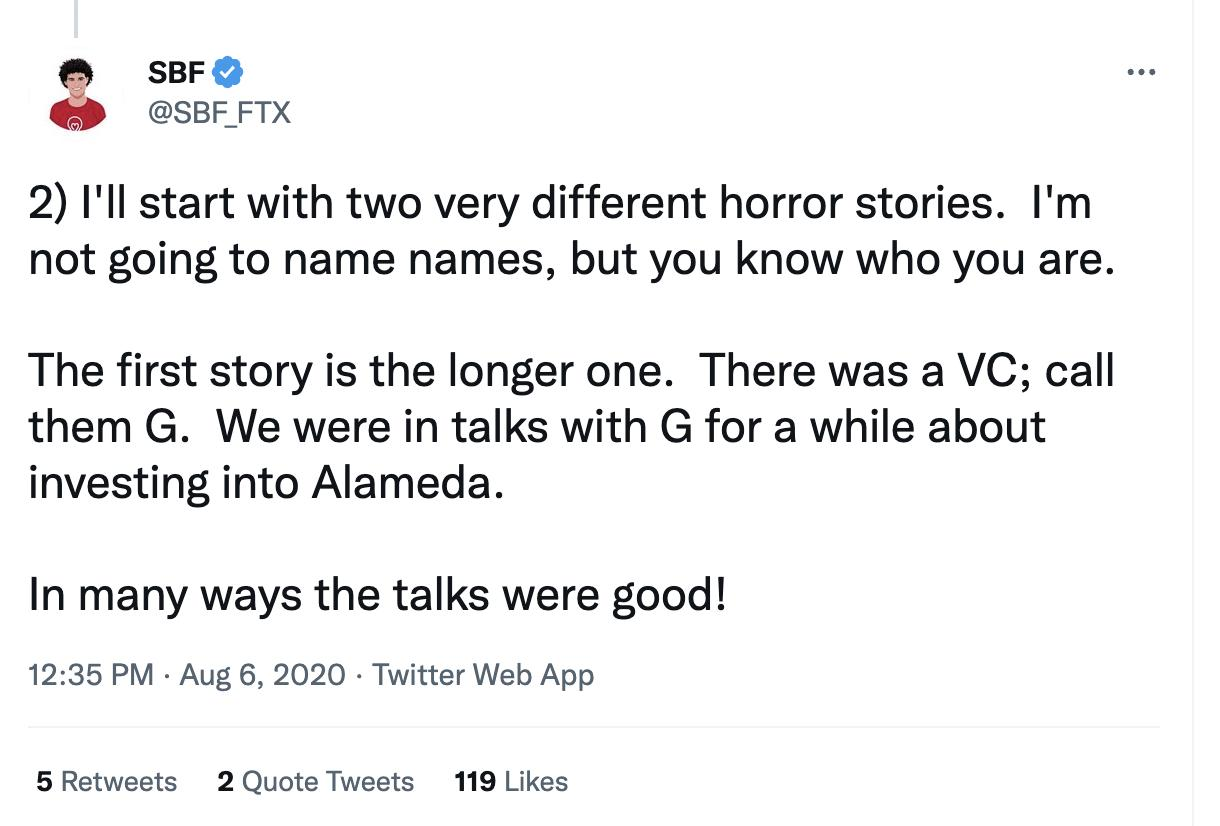
我从事加密货币风险投资有9年,为大约十几个最大的加密货币交易所和交易公司提供过种子资金。因此,当我听说一家名为Alameda Research的热门交易公司时,我很感兴趣。

我对Sam的第一印象是,他是我见过的最聪明的人之一。他雄心勃勃、善于赚钱、不惧冒险。也许是太能冒险了。

我们达成了一个高级协议,成为Alameda的第一个投资者,然后进行背调。就在这时,事情发生了变化。

在我们进行调查的几个月后,Alameda开始亏损——而且是快速亏损。我们对此感到震惊,就问这是怎么回事。Sam不慌不忙地说,他正在孵化一个不知名的加密货币交易所(后来的FTX),这吸走了他团队所有的注意力和资源。

好吧,这也不错,尽管Sam没有预先披露他关于新交易所的想法。但我们喜欢支持有新想法的创始人! 但是,Sam说Alameda和FTX是独立的两个公司...

Alameda和FTX使用一样的员工、一样的电脑,而且Alameda支付了FTX的启动费用...但Sam觉得这应该是一个单独的交易,价格另算。

这就带来一个很大的利益冲突:2018年,Sam试图利用我们在Alameda的投资来启动FTX,一个我们既不知道也不拥有的实体,这太讽刺了! 而上周Sam被抓到做了相反的事情:从FTX抽走100多亿美元来救助Alameda——他的私人公司。

在调查Alameda公司时,我们还了解到其他一些值得怀疑的事情:

在我们遇到Sam之前的几个月,Alameda因“交易错误”而损失了1000万美元——他们资产的一大笔钱。我们始终无法弄清这究竟是故意欺诈、不称职还是不小心。

在Sam 1000多万美元的“交易错误”之后(在Alameda内部被称为“四月惨败”),Alameda的联合创始人——她也可能是Sam的女朋友?她和大约团队一半的人一起离开,后来也解散了 。

Alameda从有效利他主义社区的几个富人那里获得了启动贷款。Sam担心他们可能不希望他接受新的投资,所以他提议对他们隐瞒我们作为投资人的事情。但我认为这并不妥,因为他对他的支持者并不诚实。

我们对投资保持迟疑,所以Alameda决定也尝试继续筹集资金。他们在一个加密货币会议上买了一个展位,并分发传单,宣传“高回报,无风险”和“完美无缺”。

HackVC合伙人:四年前我得知SBF是“疯狂的赌徒”后,便放弃了对他的投资

最终,我决定不投资FTX。我后来也不想投资Sam的所有其他代币项目,如Serum和FTT,现在是人所共知这些代币是他杠杆交易的抵押品。

即使在2018年,我们也很清楚,Sam拿着别人的钱不顾一切地冒险,并想用我们的资金来资助他自己的秘密项目。

可悲的是,在我们离开后,Sam为他的空壳游戏找到了其他支持。今天,FTX的投资者、客户,甚至员工都发现,他们的钱被转移到了一个他们一无所知的“无关联的”私有的高杠杆交易公司(Alameda)。

我对每个受这场灾难影响的人表示同情。加密货币是一种自由的技术,它使人们更容易做好事,但也更容易做坏事。要想社区发展,我们需要加密货币变得得更好,在坏人成为超级恶棍之前,我们需要找到并抓住他们。

我自己也应该做出行动。我一直没有讲过这个故事,因为我害怕Sam的报复。我认为这是一种合理的担心。我的意思是,看看他们原本的推文!他们非常刻薄。

不过,我和Sam的“恐怖故事”与他今天伤害的数百万人相比,还是小巫见大巫。

作者:链捕手 ChainCatcher

Leituras Relacionadas

Didier Zheng Answers: Will MicroStrategy Enter a Death Spiral? How Will the Macro Trend Unfold in the Second Half of the Year?

In the latest WuShuo Uncensored podcast, investor Didier Zheng analyzes recent market trends. He argues that Bitcoin's recent decline is primarily driven by market anticipation of MicroStrategy potentially selling small amounts of Bitcoin regularly to cover cash flow for its growing priority shares and debt, rather than macro factors or ETF outflows alone. This creates a new dynamic of expected continuous selling pressure. Didier views Token as the new form of labor in the AI era, replacing human roles in execution and driving the ongoing rally in U.S. stocks within the AI supply chain (semiconductors, data centers). This shift is seen as a long-term structural change, boosting corporate profitability. He notes that crypto exchanges are naturally expanding into U.S. stocks and real-world assets due to the scarcity of valuable native crypto assets beyond Bitcoin and major protocols. For traders, the transition may not require a drastic change in strategy, as similar speculative and fundamental assets exist in both markets. The analyst believes the native crypto altcoin rally is likely over, severely damaged by the liquidity destruction from the "1011" crash event. Liquidity has migrated to deeper markets like U.S. equities. For the macro outlook, Didier expresses increased caution for H2 2024 due to potential market pressure from mega-IPOs (e.g., SpaceX) and the U.S. midterm elections. A Democratic sweep could bring stricter regulation for Web3 and AI. Long-term, he remains optimistic about the convergence of AI and blockchain, enabling a more automated, machine-driven economy, but expects a shift towards a more mature, institutional phase for the crypto industry.

marsbitHá 10m

Didier Zheng Answers: Will MicroStrategy Enter a Death Spiral? How Will the Macro Trend Unfold in the Second Half of the Year?

marsbitHá 10m

Bitcoin's Historically Rare Pattern: When August Rises, September Always Pulls Back, Followed by an Average 44% Surge in October

Historical Seasonal Pattern for Bitcoin Resurfaces: Strong August (Up 25% YTD) Points to Potential September Dip, Followed by October Rally Bitcoin is on track for its strongest August performance since 2017, with gains of approximately 25% for the month as of late August, trading between $78K-$79K. This has revived discussion of a historical seasonal pattern observed since 2013. Data shows that in the four previous years where Bitcoin posted a positive return in August (2013, 2017, 2020, 2021), the following September consistently closed in negative territory, with an average decline of about -5.9%. Notably, a positive September has never followed a positive August in Bitcoin's history. However, the pattern shows a potential silver lining. Following each instance of a "Green August" followed by a "Red September," the subsequent month of October has historically seen significant rallies. The average gain for October after such a sequence is approximately +44%. While this pattern highlights a recurring seasonal trend, analysts caution that it is based on a limited sample size of only four occurrences. Each period had distinct macroeconomic and market conditions. Therefore, past performance is not a reliable indicator of future results, and whether 2026 will follow this sequence remains to be seen as September trading begins.

marsbitHá 10m

Bitcoin's Historically Rare Pattern: When August Rises, September Always Pulls Back, Followed by an Average 44% Surge in October

marsbitHá 10m

Strive CEO: US Bond Market Approaching a Critical Point, Bitcoin's "Home Run Moment" Taking Shape

The CEO of Strive argues that the U.S. Treasury market is approaching a critical juncture, setting the stage for a major opportunity in Bitcoin. He highlights that unsustainable U.S. fiscal deficits and expanding entitlement programs are creating fundamental pressure for higher long-term bond yields. However, the political system is unwilling to enact necessary fiscal discipline. Consequently, as the 10-year Treasury yield enters a key resistance zone of 5.25%–5.85%, the narrative will shift to a potential bond market crisis. This will force policymakers (the Treasury or Federal Reserve) to intervene aggressively to suppress yields through tools like large-scale bond buybacks or balance sheet expansion. Since the underlying fiscal imbalance remains unresolved, the adjustment pressure will be transferred to the U.S. dollar, making it the "pressure release valve" of the system. A trend decline in the dollar, potentially to multi-decade lows, would create a historically unique macro environment for Bitcoin. Bitcoin stands to benefit as a scarce, non-sovereign monetary asset, especially as AI erodes the scarcity of traditional corporate moats. The author concludes that if bond market stress causes a Bitcoin dip, it would be a major buying opportunity; if not, having exposure is still crucial. The overall expectation is that the market is still underestimating Bitcoin's long-term upside potential in this unfolding macro shift.

marsbitHá 19m

Strive CEO: US Bond Market Approaching a Critical Point, Bitcoin's "Home Run Moment" Taking Shape

marsbitHá 19m

Trading

Spot
活动图片