FTX funds on the move: bankruptcy proceedings, insider threat or a hack?

CointelegraphPublicado em 2022-11-12Última atualização em 2022-11-12

Resumo

The wallet address in question received funds from various international and U.S.-based wallets linked to FTX, which amassed over 83,878.63 ETH (worth over $105.3 million) in just two hours.

The recent tensions between the two major crypto exchanges FTX and Binance, which was accompanied by a massive selloff of FTX Token, resulted in the collapse of roughly 130 companies linked to FTX Group — including FTX Trading, FTX US, West Realm Shires Services, and Alameda Research.

""
Following the resignation of FTX CEO Sam Bankman-Fried and the revelation of the company’s intent to file for Chapter 11 bankruptcy, on-chain data hinted at the commencement of bankruptcy proceedings as multiple FTX wallets were found transferring funds over to a common Ethereum wallet address.
""

The wallet address in question received funds from various international and U.S.-based wallets linked to FTX, which amassed over 83,878.63 ETH (worth over $105.3 million) in just two hours starting at 9:20 PM ET on Nov. 11 and continued to see an influx of funds at the time of writing.
""

With all eyes on FTX, the late-night fund transfers on a Friday night raised questions about the company’s intent. While some blockchain investigators saw it as the start of the bankruptcy process, speculations around ill-intent or an external hack surfaced across the crypto ecosystem.
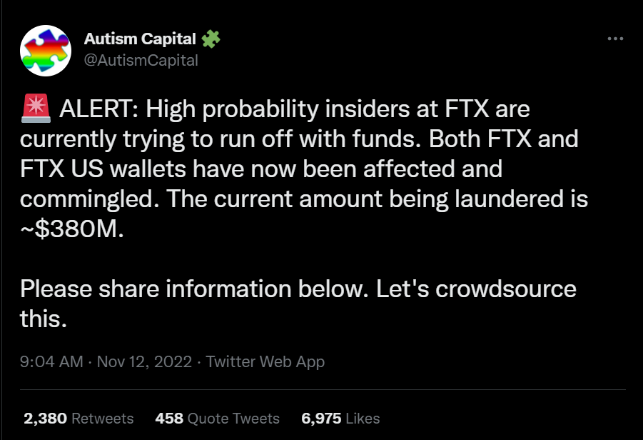
The wallet owner was found swapping $26 million Tether (USDT) to DAI via 1inclh while approving USDP — a Paxos-issued stablecoin — for trade on CoW Protocol. As the situation unfolds, the wallet also approved transfers and sales of other cryptocurrencies, including Chainlink, cUSDT and stETH.
""

The funds coming from FTX wallets were later moved to new addresses, out of which one of them was labeled as FTX on Etherscan, as pointed out by blockchain investigator PeckShield. A subsequent investigation also confirmed that 8,000 ETH was wormholed from Solana to one of the new addresses within the last hour.

The involvement of a hacker, at this time, seems unlikely as they typically would have moved funds from FTX’s wallet to their own wallets. However, many pointed out the possible involvement of an insider.
""

Until the dust settles, the community continues to monitor the movement of funds. However, investors are advised to avoid speculations until confirmed reports set in. FTX has not yet responded to Cointelegraph’s request for comment.
""

Adding to investor’s concerns, FTX sources told Reuters that between $1 billion and $2 billion of client money is unaccounted for in the company’s spreadsheet.
""

The unconfirmed report also suggests that SBF secretly moved $10 billion in funds to Alameda Research while pointing out that the whereabouts of missing funds remain unknown.

Leituras Relacionadas

Bitcoin Trading Strategy Breakdown: Celebrity Predictions and Classic Models All Fail, Only These Four Indicators Remain

Analysis of Bitcoin Trading Strategies: Why Celebrity Forecasts and Classic Models Fail, Leaving Only These Four Reliable Indicators This analysis examines the failure of common Bitcoin prediction methods and identifies four reliable indicators for constructing a trading strategy. The author reviewed all major BTC prediction approaches from 2017-2025, categorizing them into three groups: celebrity price targets (consistently over-optimistic), analytical models like Stock-to-Flow (broken post-2022), and on-chain signals. The key finding is that more data often creates confusion, not clarity. The strategy discards unreliable elements: celebrity predictions (incentivized to be extreme), pure models (invalidated by post-ETF market changes), and the Fear & Greed Index used alone (too many false signals). Four reliable indicators were selected: 1. **MVRV Z-Score:** Accurately identifies cycle bottoms when entering its green zone (e.g., 2018, 2020, 2022). Note: Its ability to call tops is now ineffective post-2024. 2. **SOPR (28-day MA):** Consistently signals bottoms when below 1.0, indicating holders are selling at a loss. 3. **ETF Net Flow:** A crucial post-2024 metric showing institutional momentum (e.g., sustained inflows = buying). 4. **Macro Liquidity (Fed policy & M2):** Sets the overall directional bias (e.g., bullish during easing cycles). The core strategy involves waiting for a multi-signal共振 (resonance). For example, a bottom signal requires MVRV in the green zone + SOPR < 1.0. A top signal requires overheated on-chain data + sustained ETF outflows. Macro policy sets the overall direction. The Fear & Greed Index is only used as a weighted confirmatory signal, never alone. Action is only taken when three or more indicators align. The author automated this into a monitoring system that sends Telegram alerts only when signals trigger. As of the article's date (April 15, 2026), the system showed a strong bottom signal: extreme fear (F&G=12), MVRV in the buy zone, and SOPR < 1.0. The only contrary signal was weak ETF flows. Historically, such triple on-chain共振 has preceded 100%+ returns. The conclusion emphasizes building a personal framework over relying on external predictions, allowing for iterative improvement and customization based on individual risk tolerance.

marsbitHá 26m

Bitcoin Trading Strategy Breakdown: Celebrity Predictions and Classic Models All Fail, Only These Four Indicators Remain

marsbitHá 26m

Trading

Spot
Futuros
活动图片