Here’s What’s Keeping Ethereum From Taking Bitcoin’s Shine, ETH Claims $1,500

newsbtcPublicado em 2022-10-28Última atualização em 2022-10-31

Resumo

Ethereum is finally coming back to life after a long period of consolidation and leading the current bullish momentum in the crypto top 10 by market cap. The slow price...

Ethereum is finally coming back to life after a long period of consolidation and leading the current bullish momentum in the crypto top 10 by market cap. The slow price action might be boring for most market participants, but an expert believes ETH underwent a critical stage to create a lasting bottom.
At the time of writing, Ethereum (ETH) trades at $1,550 with sideways movement over today’s trading session and a 20% profit in the last seven days. The meme coin records a 30% profit over the same period. In the crypto top 10, ETH’s price performance is only surpassed by Dogecoin (DOGE).

Ethereum ETH ETHUSDT CHART 1

ETH’s price with bullish momentum on the daily chart. Source: ETHUSDT Tradingview Ethereum Close To Another Multi-Year Bottom?
Senior Commodity Strategist for Bloomberg Intelligence Mike McGlone believes Ethereum’s migration to a Proof-of-Stake (PoS) consensus will be crucial in its long-term appreciation. In the current macroeconomic landscape, high energy prices and high inflation have taken a toll on global markets.
The U.S. Federal Reserve (Fed) has tightened its monetary policy in response to this situation. As a result, Ethereum and other risk assets returned to their pre-pandemic levels.
Still, the second crypto by market cap has been unable to hold the line close to its 2017 all-time high at around $1,400 to $1,500. As McGlone emphasized, ETH’s price has prevented further downside at these levels despite the Fed implementing its most aggressive strategy in forty years.
In that sense, the expert believes Ethereum is cementing its position “at the epicenter of the digitalization of finance.” McGlone wrote:
(…) the No. 2 crypto may be forming a foundation around $1,000 (…). Our graphic shows the No.2 crypto potentially building a base around the 2018 peak, when global liquidity topped out around plus 14%. Ethereum appears at a discount within an enduring bull market (…).
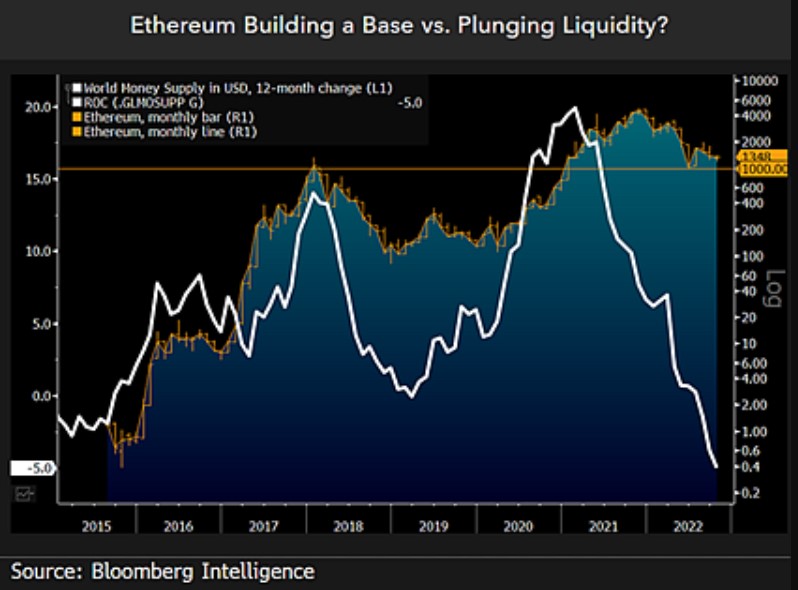
Ethereum ETH ETHUSDT Chart 2

Source: Mike McGlone via Twitter The Ultimate Deflationary Asset
If macroeconomic conditions improve and the Fed pivots its monetary approach, Ethereum might finally reclaim previously lost territory and steal Bitcoin’s thunder. The expert hints at a faster decline in the supply of ETH versus BTC.
Rising demand for digital assets and a decline in supply will prove positive for the second crypto by market cap. McGlone wrote:
(…) new Ethereum supply shrinking more quickly after a protocol change that began moving coins from circulation in August 2021 and this year’s merge. The 52-week rate-of-change in the number of new Ethereum coins from Conmetrics vs. the total outstanding has fallen under 2% and is on path to drop below that of Bitcoin.

Ethereum ETH ETHUSDT Chart 3

Source: Mike McGlone via Twitter Tags: ETHethereumETHUSDThttps://www.newsbtc.com/tag/ethusdt/

Leituras Relacionadas

Michael Saylor Says Bitcoin Could Grow 100x, Warns Regulatory Changes Could Threaten Its Future

Michael Saylor, Executive Chairman of MicroStrategy, warns that the main challenge for Bitcoin is no longer external competition but internal governance disputes. As Bitcoin transitions from a digital asset to a potential foundation for global capital markets, he argues the primary threat is changes to its core consensus rules, which act as its "constitution." Saylor contends that altering these rules to benefit specific factions could undermine the entire ecosystem and the rights of its participants. He links this governance risk to Bitcoin's long-term growth potential, stating the asset could grow 100x to become a global capital base. However, he warns that a single corrupted rule could deprive future generations of unbuilt markets and economic freedom. Saylor cites examples like BIP-110, covenant-related features, and block size increases as potentially risky changes that could impose new costs or vulnerabilities. Saylor connects protocol decisions to Bitcoin's long-term security model, noting the increasing reliance on transaction fees as block rewards halve. The rise in corporate and institutional Bitcoin adoption, he argues, heightens the need for predictable rules and network stability. He expresses concern about "protocol capture," warning that allowing political influence over consensus changes could lead to perpetual conflict, scare away capital, stifle innovation, and prevent Bitcoin from reaching its full potential.

cryptonews.ruHá 2m

Michael Saylor Says Bitcoin Could Grow 100x, Warns Regulatory Changes Could Threaten Its Future

cryptonews.ruHá 2m

To Hike or Not Tonight: Economists Unanimous on 'No', Markets Price in a 30% Chance

Federal funds futures are repricing ahead of the July FOMC decision, as traders pay a higher premium for the risk of a surprise rate hike or more hawkish signals. This contrasts with economists, where a Reuters survey of 104 analysts unanimously expects rates to remain unchanged at 3.50%-3.75%, with 78 foreseeing no change through year-end. Yet, futures markets have priced in about a 30% probability of a 25-basis-point hike. The core debate, especially under new Fed Chair Kevin Warsh, centers on how the Fed will respond to the oil price shock from Middle East tensions. The market is not necessarily predicting a hike tonight but is hedging against two tail risks: an immediate rate increase, or a hold combined with communication that seriously opens the door for a September hike. This hedging activity has driven up open interest in Fed funds futures. Analysts are divided on how to weight the oil price surge in the Fed's reaction function. Hawkish voices (e.g., BofA) worry that completely dismissing the price pressure could challenge the Fed's inflation credibility in Warsh's first major test. Dovish views (e.g., Citi) argue the shock is primarily supply-driven and that overreacting with rate hikes could unnecessarily hurt growth, unless clear signs of secondary inflation emerge. Warsh's new tenure amplifies policy path uncertainty, as markets lack a stable baseline for his communication style. This environment forces traders to price in a wider range of outcomes, explaining the divergence between unanimous economist forecasts and market hedging. The key focus will be on Warsh's post-meeting commentary. If he downplays the oil shock and stresses anchored long-term expectations, hawkish pricing may recede. If he emphasizes the risk of broader price spillovers and prioritizes returning to 2% inflation, the market will interpret this as reopening the door for a September hike. This would sustain support for the USD, keep pressure on JPY (testing intervention thresholds), and challenge risk assets like stocks and crypto through higher discount rates and weaker sentiment. The baseline remains no action in July, but the communication will determine how far this repricing extends.

marsbitHá 1h

To Hike or Not Tonight: Economists Unanimous on 'No', Markets Price in a 30% Chance

marsbitHá 1h

Trading

Spot
活动图片