Proof-of-Stake L1 Blockchain Token Aptos Climbs Close to 20% Higher in 24 Hours

newsbtcPublicado em 2022-10-24Última atualização em 2022-10-24

Resumo

Aptos Market Cap Climbs Over $1 Billion, APT Transactions per Second Increases From 4 to 16.

Proof-of-Stake L1 Blockchain Token Aptos Climbs Close to 20% Higher in 24 Hours

Five days ago, the Aptos blockchain went live after the project received an influx of capital from venture capital (VC) firms and crypto exchanges like a16z, Binance, and FTX. During the past 24 hours, aptos (APT) is up more than 19% against the U.S. dollar and up 11.1% against bitcoin’s value. The VC-backed blockchain token has managed to situate itself within the top 60 largest crypto market capitalizations in existence.

Aptos Market Cap Climbs Over $1 Billion, APT Transactions per Second Increases From 4 to 16

A new token has entered the top 100 largest crypto market caps after the developers from Aptos Labs announced the project’s mainnet launch on Monday, October 17, 2022. Prior to the mainnet launch, the layer one (L1) blockchain project has been backed by millions stemming from VC firms and crypto exchanges like Multicoin Capital, Binance, FTX, and Andreessen Horowitz (a16z).

The co-founders of Aptos Labs, Mo Shaikh and Avery Ching, worked for Facebook (now Meta) on the now-defunct Diem blockchain project. After the mainnet went live, Aptos took a great deal of flak from the crypto community, as the blockchain dubbed a ‘Solana killer’ was immediately criticized at launch.

An engineer from Paradigm stressed in a tweet that “Aptos is broken” and further noted that “Aptos is currently has lower [transactions per second (TPS)] than Bitcoin and a majority of tokens are either staked or ready to be dumped on retail investors.” At the time, the Paradigm engineer said that Aptos was handling 4 TPS, but promised 100,000 transactions per second (TPS) in its finalized version.

Aptos network explorer on October 22, 2022.

At the time of writing, Aptos is recording around 16.68 TPS and ​​8,188,514 APT transactions have been settled to date. The current 16 TPS tracked by the Aptos explorer is faster than Bitcoin’s 2.87 TPS recorded on October 22.

Meanwhile, the Aptos blockchain is very new and the native token APT has managed to situate itself in the top 60 standings in terms of market capitalization size. Presently, aptos (APT) is ranked 52 out of more than 13,000 listed crypto coin projects today.
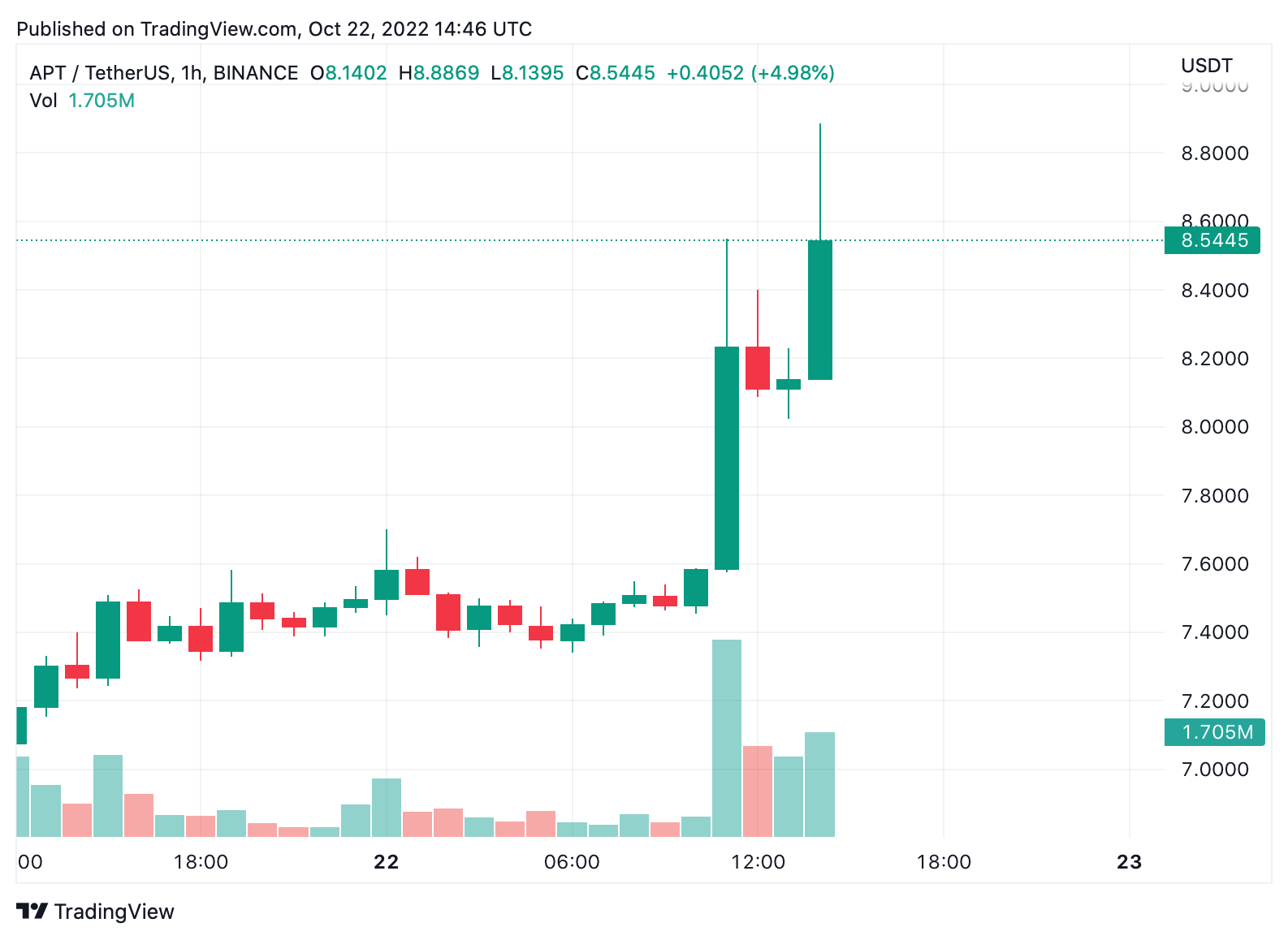
APT/USDT chart on Saturday, October 22, 2022.

APT has a circulating supply of around 130,000,000 tokens and the total supply can reach 1,000,935,772 APT tokens. On Saturday, October 22, APT has seen $322.34 million in global trade volume and the market capitalization today is just over a billion at approximately $1,060,489,188.

Market stats show the APT token has been trading for prices between $7.24 today up to $8.65 per unit. The Aptos blockchain currency is up more than 20% from the low recorded three days ago at $6.73 per coin.

Huobi Global is currently the most active exchange on Saturday, and Huobi is followed by Binance, Okex, and Digifinex respectively. Tether (USDT) is the most active trading pair with APT today and the USDT pairs are followed by BUSD, USD, and BTC.

Criptomoedas em alta

Leituras Relacionadas

Why Does 'AGI Godfather' Ben Goertzel Believe the Future of AI Relies on Blockchain?

Ben Goertzel, known as the "AGI Godfather," argues that the future of Artificial General Intelligence (AGI) must be built on blockchain to prevent its control by a few corporations or venture capital firms. He believes the core AGI code should be free and open-source, but that this alone is insufficient without a decentralized infrastructure to run it affordably. His blockchain project, SingularityNET, and the broader Artificial Superintelligence Alliance aim to create a user-owned, decentralized network for hosting and deploying AGI, contrasting with the closed models of companies like OpenAI and Anthropic. Goertzel criticizes the shift of other labs from open to closed development. He argues that while a closed path is simpler, an open, decentralized model—akin to Linux and the internet—is both possible and ultimately better for humanity. He envisions an "Agent economy" where individuals orchestrate teams of AI agents to perform tasks, including transactions, on an open network rather than corporate clouds. While his current model relies on cryptocurrency, plans include offering paid AI services to businesses with the decentralized blockchain as the backend. Goertzel predicts human-level AGI could arrive by 2029 and warns that a gap in understanding and access to AGI could drastically worsen inequality. The first test of his decentralized approach will be the upcoming release of the Agent Omega Claw.

Foresight NewsHá 3m

Why Does 'AGI Godfather' Ben Goertzel Believe the Future of AI Relies on Blockchain?

Foresight NewsHá 3m

A Company Once on the Brink of Bankruptcy Just Surpassed Bitcoin in Market Cap

On June 22nd, driven by rising stock prices, SK Hynix’s market capitalization reached $1.35 trillion, surpassing Bitcoin's total market cap of approximately $1.29 trillion. This temporarily made it South Korea's highest-valued company. The core driver of this surge is HBM (High Bandwidth Memory), for which SK Hynix is the primary supplier to NVIDIA, holding over 60% market share. AI's demand for high memory bandwidth has translated into immense profitability, with SK Hynix reporting a 72% operating profit margin in Q1. The company's success follows a 13-year bet on HBM technology, beginning in 2009. It nearly failed after the 2001 dot-com bubble, was acquired by SK Group in 2012, and was subsequently recapitalized to continue its long-term HBM development. The article contrasts this with the Crypto AI narrative. Capital currently favors AI infrastructure players like SK Hynix due to "real orders, physical barriers, and quantifiable profit margins." In comparison, Crypto AI projects, promising decentralized compute and data markets, remain largely conceptual with limited tangible progress. Examples include Bittensor, whose core mechanisms are still under development, and Bitcoin miners transitioning to AI, who face significant funding gaps and execution challenges. The piece cites analysis suggesting the AI sector has absorbed nearly all new market liquidity since 2022, leaving little for crypto. It concludes that the current AI infrastructure红利 is captured by entities with proven technical barriers and supply capabilities, while crypto networks still need to define their concrete role in the value chain.

链捕手Há 43m

A Company Once on the Brink of Bankruptcy Just Surpassed Bitcoin in Market Cap

链捕手Há 43m

Bittensor Moves Towards Ultimate Decentralization: The Critical 18 Months for the TAO Ecosystem is Here?

Bittensor, a decentralized AI protocol, is accelerating its transition to full decentralization over the next 18 months, as outlined in a recent post by co-founder Const. The project currently operates in a "semi-decentralized" state: ownership and network participation are open and permissionless, with TAO distribution based on competitive contribution. However, protocol upgrades and governance have remained under core team control to enable rapid iteration in the fast-evolving AI sector. This strategic shift comes as the ecosystem matures, boasting 128 subnets and a large community. Const argues that continued centralization now poses risks, including single points of failure and regulatory scrutiny. The upcoming decentralization roadmap includes optimizing validator competition, opening liquidity pools, introducing governance rights for Alpha holders, and refining economic models. The move could fundamentally reshape TAO's value proposition, adding governance premiums to its existing valuation based on AI narrative and scarcity. It also signals a potential maturation of the AI crypto sector, where competition may shift from hype to sustainable protocol design and real economic activity. Bittensor positions itself not just as another AI token, but as foundational infrastructure aiming to decentralize intelligence production—analogous to Bitcoin's role in decentralizing money—with the goal of creating a resilient "Millennium Intelligence Federation."

marsbitHá 56m

Bittensor Moves Towards Ultimate Decentralization: The Critical 18 Months for the TAO Ecosystem is Here?

marsbitHá 56m

Japan's AI Dark Horse Emerges: How a 7B Small Model Challenges Fable and Mythos?

In June 2026, Sakana AI's new model Fugu caused a stir in the AI community. Its Fugu Ultra variant achieved scores of 73.7 on SWE-Bench Pro and 82.1 on TerminalBench 2.1, surpassing GPT-5.5 and Claude Opus 4.8, and was claimed to be comparable to export-restricted models like Fable 5 and Mythos Preview. Remarkably, the core of this high-performance system is not a massive model, but a small 7B-parameter RL Conductor model. Fugu operates as a multi-agent orchestrator: the 7B model acts as a "foreman," dynamically analyzing user tasks and delegating subtasks to a pool of top-tier global models (e.g., GPT-5, Gemini 3.1 Pro). It then synthesizes and verifies their outputs. This architecture represents a paradigm shift from monolithic models to an expert-team approach. It enhances performance in complex, multi-step engineering tasks like code review and security testing by enabling cross-validation from specialized models, improving long-session stability and token efficiency. However, Fugu's strengths come with trade-offs: it faces inherent latency due to multiple API calls, relies heavily on underlying US model APIs (creating dependency risks), and its benchmark comparisons with Fable/Mythos are based on reported scores, not head-to-head testing. For Japan's AI ecosystem, which lacks the massive compute and data resources of the US or China, Fugu exemplifies an "asymmetric breakthrough" strategy. Instead of competing directly in parameter scale, it focuses on intelligent orchestration of existing global models, offering a degree of AI sovereignty and resilience. While a significant system-level innovation, its ultimate capability is still bounded by the underlying models it coordinates.

marsbitHá 56m

Japan's AI Dark Horse Emerges: How a 7B Small Model Challenges Fable and Mythos?

marsbitHá 56m

Trading

Spot
Futuros

Artigos em Destaque

Como comprar APT

Bem-vindo à HTX.com!Tornámos a compra de Aptos (APT) simples e conveniente.Segue o nosso guia passo a passo para iniciar a tua jornada no mundo das criptos.Passo 1: cria a tua conta HTXUtiliza o teu e-mail ou número de telefone para te inscreveres numa conta gratuita na HTX.Desfruta de um processo de inscrição sem complicações e desbloqueia todas as funcionalidades.Obter a minha contaPasso 2: vai para Comprar Cripto e escolhe o teu método de pagamentoCartão de crédito/débito: usa o teu visa ou mastercard para comprar Aptos (APT) instantaneamente.Saldo: usa os fundos da tua conta HTX para transacionar sem problemas.Terceiros: adicionamos métodos de pagamento populares, como Google Pay e Apple Pay, para aumentar a conveniência.P2P: transaciona diretamente com outros utilizadores na HTX.Mercado de balcão (OTC): oferecemos serviços personalizados e taxas de câmbio competitivas para os traders.Passo 3: armazena teu Aptos (APT)Depois de comprar o teu Aptos (APT), armazena-o na tua conta HTX.Alternativamente, podes enviá-lo para outro lugar através de transferência blockchain ou usá-lo para transacionar outras criptomoedas.Passo 4: transaciona Aptos (APT)Transaciona facilmente Aptos (APT) no mercado à vista da HTX.Acede simplesmente à tua conta, seleciona o teu par de trading, executa as tuas transações e monitoriza em tempo real.Oferecemos uma experiência de fácil utilização tanto para principiantes como para traders experientes.

139 Visualizações TotaisPublicado em {updateTime}Atualizado em 2026.06.02

Como comprar APT

Discussões

Bem-vindo à Comunidade HTX. Aqui, pode manter-se informado sobre os mais recentes desenvolvimentos da plataforma e obter acesso a análises profissionais de mercado. As opiniões dos utilizadores sobre o preço de APT (APT) são apresentadas abaixo.

活动图片