[Key interpretation] The Federal Reserve will raise interest rates to 5%,Where is the BTC low point?

HuobiPublicado em 2022-10-17Última atualização em 2022-10-18

Resumo

BTC rebounded from a low position, did it reach the point of purchase?

1. BTC is still at an absolute low

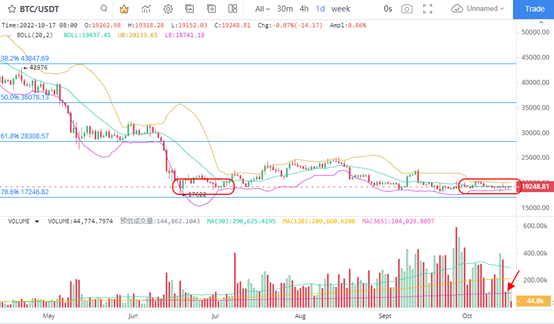
The daily K line chart of BTC shows that BTC has been at an absolute low from the perspective of closing price. In addition, although the volatility has continued to decline recently, the break of the low price has never occurred. In terms of trading volume, BTC's recent trading volume has hit a low point in three consecutive months. At present, it is the second time that the market has reached a low level, so the market is highly likely to change at this time.
2. BTC large transactions fall back

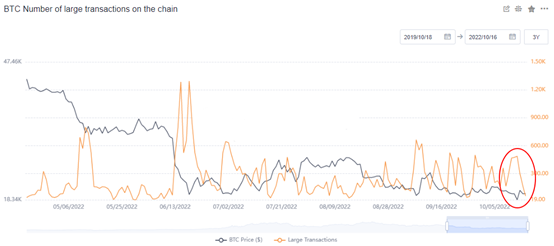
In the short term, the heat of major transactions has cooled again, and the number of large transactions per day has dropped from 488 to 60. At the same time, the number of BTCs traded in large amount per day also decreased from 244000 BTCs to 29280 BTCs, a decline of 87.7%. The cooling of the main trading heat means that the market performance is more sluggish in the short term. After the number of large transactions fell back, it means that the recent upswing of transaction heat since September 5 has shown signs of ending.

On the news side, although the Federal Reserve has raised interest rates sharply for many times in a row, the US CPI data remains firm, inflation expectations rebound again, releasing a "unfriendly" signal. The Fed is expected to raise interest rates to a high point close to 5% (previously predicted to be 4~4.5%), which may be the "last effort" of the Fed to fight inflation. This also means that the pace of interest rate increase by the Federal Reserve may not slow down in the fourth quarter. In the short term, BTC is more likely to show a technical rebound than a price reversal. Before the Federal Reserve further raises interest rates and the dollar index further strengthens, BTC has more opportunities to rebound.
3. ETH represents an upward breakthrough

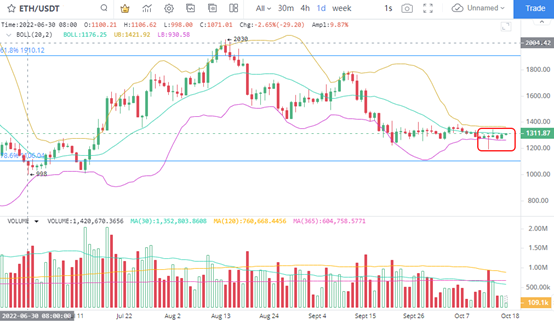
In terms of the daily K line, the intensity of ETH price fluctuation remains low, but the closing price has shown signs of recovery. Especially after the bottom of ETH hit $1190 on October 13, ETH closed up 2.43% on October 16, indicating that the market was in a moderate and strong state. Although the trading volume is not high, the recent short-term trend of ETH deserves attention. Because the price volatility can no longer be retreated, we can pay attention to the low suction signal in the rebound phase.
4. The number of new ETH addresses remains high

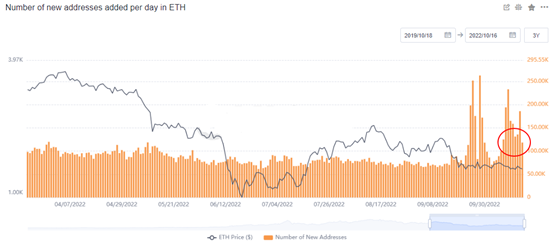
The number of new addresses in ETH is maintained at a high level, which is significantly higher than the average level since 2022. The growth of the number of new addresses started on September 16, which is now the second amplification of this indicator. Therefore, ETH's price strength will be maintained in the short term. In terms of price, ETH has little room for fluctuation in the near future, but the number of newly added addresses has remained active in the near future, indicating that the receiver is willing to enter the market at the current point, which also provides a respite for the rebound. In terms of pressure level, focus on the possible selling of $1400. On the news side, we continued to pay attention to the negative impact of the Federal Reserve's interest rate hike on the market.
5. QNT is steadily rising

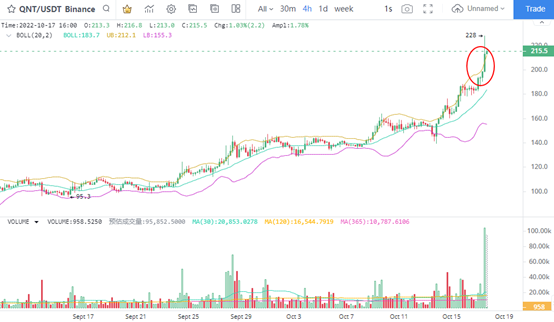
QNT has maintained the upward rhythm of prices recently. Although the current price rise shows signs of acceleration, the volatility and trading volume are significantly higher than expected. It is judged that the price recovery of QNT may continue. The trading volume of QNT in 4 hours will be more than 6 times larger when the amplitude of the short line after the 4-hour K line drawing reaches 15%. At this point, QNT is near $220 in the short term, which is still far from the historical high of $430. Since the trend of QNT is stable, and the main force with the largest number of coins increased its holdings of QNT on the 7th, it means that the price may still perform more strongly at a high level.

Leituras Relacionadas

Open Systems Will Ultimately Prevail: Why Ethereum Is the Next Linux?

The article "Open Systems Will Ultimately Prevail: Why Ethereum Is the Next Linux?" argues that Ethereum, like Linux before it, will triumph over closed, proprietary systems in finance due to its open, permissionless, and credibly neutral nature. It draws a historical parallel: just as the open internet defeated corporate private networks and Linux outcompeted proprietary Unix systems, open financial infrastructure like Ethereum will surpass private blockchains. The core advantage lies in the "bazaar" development model (as described in Eric Raymond's "The Cathedral and the Bazaar"), where decentralized, permissionless innovation by a global community of developers outpaces the controlled "cathedral" approach of centralized entities. This model fosters rapid innovation, as seen with Ethereum standards like ERC-20 and applications like Uniswap, which were built without needing permission. Ethereum's key, irreplicable strength is its credible neutrality: transparent, equally applicable, immutable rules that allow anyone to participate. This ensures sovereign independence, meaning no single entity (company, government) can control or change its core rules—a critical feature for global financial infrastructure. In contrast, private blockchains and consortium chains (like SWIFT or various bank-led projects) suffer from platform risk, central control, and an inability to attract broad developer ecosystems, leading to frequent failures. The article notes that major institutions (e.g., BlackRock, JPMorgan, Coinbase, Robinhood) are already building on Ethereum or its Layer 2 networks, recognizing its security, developer ecosystem, and network effects. While critics argue finance requires accountable, controlled systems, the response is that compliance (KYC, regulations) can be built at the application layer on top of a neutral settlement layer like Ethereum, just as secure commerce was built on the open internet via HTTPS. Ultimately, the thesis is that attempting to build walled-garden, proprietary financial networks is a flawed strategy that stifles innovation. The winning approach is to build applications on top of open, credibly neutral infrastructure like Ethereum, which is poised to become the foundational settlement layer for global finance.

Foresight NewsHá 10m

Open Systems Will Ultimately Prevail: Why Ethereum Is the Next Linux?

Foresight NewsHá 10m

The Computing Power Dilemma in the Sino-US AI Rivalry

The Sino-US AI rivalry faces a fundamental bottleneck: the widening compute power gap. While Chinese AI chip companies have seen investment surges, their current focus remains largely on the less demanding inference market. The real challenge lies in the high-end training chip sector, crucial for developing cutting-edge large language models (LLMs), where Nvidia holds a near-monopoly. The compute disparity is stark. US tech giants like Meta, Google, and xAI command massive GPU clusters, enabling them to train trillion-parameter models rapidly. Estimates suggest US data center count and total compute capacity significantly outstrip China's. This "brute force" advantage allows for faster model iteration and exploration of larger parameter scales, with top US models reportedly leading their Chinese counterparts by 8 to 15 months. Chinese alternatives, such as Huawei's Ascend and others from companies like Moore Thread and Biren, are emerging. They show promise in inference and some training scenarios, closing the performance gap with mid-range Nvidia products. However, the core hurdle extends beyond raw chip performance to the entrenched software ecosystem, exemplified by Nvidia's CUDA platform. The path forward involves "walking on two legs": navigating import restrictions while heavily investing in the domestic chip industry. Though still in a catch-up phase, China's vast market, talent pool, and capital are fostering progress. The ultimate test is whether Chinese firms can build a competitive hardware-software ecosystem to power the next generation of AI.

marsbitHá 16m

The Computing Power Dilemma in the Sino-US AI Rivalry

marsbitHá 16m

He Kaiming's Team's New Work: After Deleting VAE and Private Data, Text-to-Image Generation Becomes Even Stronger

KaiMing He's team introduces **MiniT2I**, a minimalist text-to-image (T2I) model that challenges the complexity of mainstream approaches. It eliminates components commonly considered essential: the VAE encoder-decoder, AdaLN conditioning mechanisms, auxiliary losses, private training data, and post-training alignment stages like RL/DPO. Instead, it uses a pure flow-matching objective trained directly on RGB pixels. The model employs a simplified **MM-JiT** Transformer architecture. It removes AdaLN blocks for conditioning and instead prepends two lightweight text adapter blocks to a standard pre-norm Transformer, allowing frozen T5 text features to adapt to the denoiser. Training follows a two-stage, LLM-like paradigm using only public datasets: pre-training on LLaVA-recaptioned CC12M for coverage, followed by fine-tuning on ~120k high-quality image-text pairs. With just 258M parameters (B/16), MiniT2I achieves competitive scores (0.87 on GenEval, 84.2 on DPG-Bench), outperforming larger pixel-space models. Scaling to 912M parameters (L/16) yields results comparable to SD3-Medium (~2B parameters) in style, composition, and imagination, though it lags in text rendering and named entities due to public data limitations. Key advantages include lower computational cost (~570 GFLOPs vs. ~1379 for latent models) and architectural simplicity. Acknowledged limitations include patch boundary artifacts in pixel space, side effects of high CFG scales, resolution ceilings for sequences longer than 1024 tokens, and the aforementioned data bottlenecks. The work demonstrates that high-performance T2I generation is possible with a radically simplified, publicly reproducible baseline.

marsbitHá 20m

He Kaiming's Team's New Work: After Deleting VAE and Private Data, Text-to-Image Generation Becomes Even Stronger

marsbitHá 20m

The Insurance Industry Faces Its Biggest Competitor: Are Prediction Markets the "Barbarians at the Gate"?

The insurance industry, long a stable "ballast" in the economy, may face a significant challenge from the rise of prediction markets, which are beginning to function as a new form of risk hedging and insurance. Platforms like Kalshi and Polymarket are demonstrating their utility in areas traditionally dominated by insurers. Examples include Kalshi's partnership with sports insurance broker Game Point Capital to offer more cost-effective hedging for NBA team performance bonuses, and Polymarket's collaboration with real estate platform Parcl, allowing users to hedge against housing price fluctuations in major US cities. A New York bar also used Kalshi to hedge a marketing promotion tied to an NBA game outcome, highlighting prediction markets' potential for small business risk management. These markets offer advantages over traditional insurance and sports betting in transparency, liquidity, and flexibility. They allow information monetization across a wider range of events, act as neutral platforms rather than direct counterparties, and provide clearer pricing. A historical precedent is the "Mattress Mack" marketing campaigns, which used sports betting for large-scale customer refunds, but prediction markets offer a more systematic and accessible model. Experts like SIG CEO Jeff Yass see their potential for efficient, parameter-based risk sharing, such as for weather-related property damage. However, challenges remain, including liquidity issues, unclear regulatory boundaries, and potential manipulation of event outcomes. Despite these hurdles, prediction markets represent a growing competitive force for both traditional gambling platforms and segments of the insurance industry.

marsbitHá 21m

The Insurance Industry Faces Its Biggest Competitor: Are Prediction Markets the "Barbarians at the Gate"?

marsbitHá 21m

Trading

Spot
Futuros
活动图片