Jamaican central bank to airdrop Jam-Dex CBDC to early adopters

CointelegraphPublicado em 2022-03-11Última atualização em 2022-03-11

Resumo

The first 100,000 Jamaican citizens to use the country’s new central bank digital currency (CBDC) known as Jam-Dex, will be given a free $16 payment in the hopes of promoting widespread adoption. 

The first 100,000 Jamaican citizens to use the country’s new central bank digital currency (CBDC) known as Jam-Dex, will be given a free $16 payment in the hopes of promoting widespread adoption. 
Jamaican prime minister Andrew Holness first announced the news in a Facebook post on Thursday. The post received a mixed response as some Facebook users praised Holness for “embracing a digital future”, while others expressed concern about the motivations of the Jamaican government, accusing Holness of trying to “bribe” citizens into the federal banking system.
According to the Jamaica Observer, approximately 17% of the Jamaican population is currently unbanked. While social media users postulate about government motives, the Observer points out that remaining unbanked is both costly and time-consuming for poorer Jamaicans. It is hoped that this new payment incentive, among others, will encourage low and middle-income citizens to join the national banking system.
The announcement comes as the Bank of Jamaica (BoJ) officially completed its 8-month long pilot program for Jam-Dex on Dec. 31 last year, and is expected to complete a national rollout as soon as next month. The BoJ further outlined that all Jamaicans with pre-existing bank accounts will be automatically eligible for Jam-Dex digital wallets.
Jamaican Finance Minister Nigel Clarke said in a speech to the country’s House of Representatives on March 9 that Jam-Dex must achieve widespread adoption by citizens and their businesses in order to be successful.
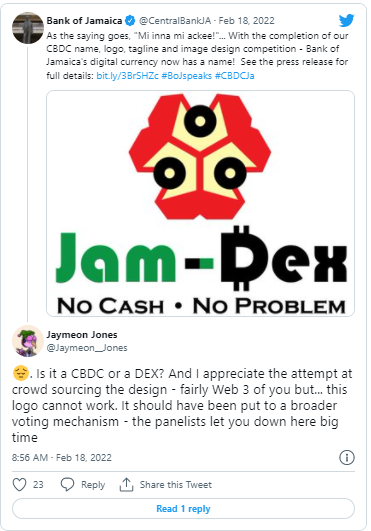
According to the report provided by the BoJ on Feb. 17, the new digital currency will be called Jamaica Digital Exchange or Jam-Dex for short, and comes with its own logo and the following tagline, “no cash, no problem”. The BoJ expects the currency to be launched as soon as next month.
The name “Jam-Dex”, was met with a great deal of criticism for both technical and aesthetic reasons. While the Jam-Dex is potentially making reference to the fact that currencies are “exchanged”, and that it is both “digital” and “Jamaican”, the terminology has created a good deal of confusion for many.
Users on Twitter were quick to point out the obvious misnomer in the currency’s namesake, as Jam-Dex is simply a digital currency whereas “DEX” in crypto parlance refers to a decentralized exchange, a place where cryptocurrencies are bought and sold.
Despite China being one of the first countries to announce the development of its CBDC, the “digital yuan”, countries in the Caribbean have quickly become leaders in the adoption and proliferation of CBDCs — with Eastern Caribbean Central Bank (ECCB) having now rolled out its own CBDC, DCash to eight different member countries.
The adoption of DCash however has been mired after a crash on Jan. 14 saw the central bank-backed digital currency go offline for nearly 2 months. It wasn’t until Mar. 9 that the ECCB announced that DCash was once again fully functional, stating the reason for the crash was an “expiring certificate” on the Hyperledger Fabric that hosts the DCash ledger.
Numerous other countries around the world are beginning to experiment with the implementation of CBDCs, with the Philippines announcing plans to launch Project CBDCPh as recently as Mar. 8. Iran, Kenya, and the European Union are also among the most recent countries to begin looking at introducing some form of CBDC.


Leituras Relacionadas

Blocked Its Own Treasure, WeChat AI Steps Up

Tencent's stock surged over 10% on June 2nd amid reports that WeChat, with 1.43 billion monthly users, is finalizing tests for a native AI Agent. The reported feature, accessible by swiping right from the main interface, allows users to issue commands in natural language. The AI then decomposes tasks and automatically calls upon relevant Mini Programs within WeChat to complete actions like ordering food, booking tickets, or making payments, creating a closed-loop service execution system. This strategic shift follows the internal conflict and subsequent "blocking" of Tencent's standalone AI app, Yuanbao, by WeChat for violating sharing rules during a 2026 Spring Festival promotion. The incident highlighted a lack of internal consensus and exposed the weakness of competing in the standalone AI assistant arena against rivals like ByteDance's Doubao (345M MAU) and Alibaba's Qianwen. The new WeChat AI Agent aims to leverage WeChat's unique assets—its massive user base, standardized Mini Program APIs, WeChat Pay, and identity system—to move from simple content generation to actual task execution. Analysts note this changes the competitive landscape from model benchmarks to which AI can connect to more real-world services. However, success depends on key variables: the capability of Tencent's underlying Hunyuan model, managing massive inference costs, and redesigning incentives for Mini Program developers whose traffic might be bypassed. The move is seen as an attempt to keep user service intent within WeChat's ecosystem as AI begins to redefine how users access services.

marsbitHá 23m

Blocked Its Own Treasure, WeChat AI Steps Up

marsbitHá 23m

ByteDance Adopts Arm CPUs, Jensen Huang: So Sad I Didn't Buy Arm

**Summary:** At Computex 2026, Arm CEO Rene Haas announced that ByteDance and Oracle have adopted Arm's self-designed Arm AGI data center CPU. The company expects significant revenue growth from this product, projecting $20 billion in demand for the 2027/2028 fiscal years. Haas noted that restricting AI-capable CPUs from the US to China is nearly impossible due to their widespread applications. Arm's stock has surged dramatically this year, notably rising 16% after NVIDIA's Arm-based Vera CPU and RTX Spark announcements. A highlight was the informal, humorous on-stage conversation between Haas and NVIDIA CEO Jensen Huang. Huang joked about NVIDIA's failed attempt to acquire Arm and playfully lamented selling his Arm shares. Both executives showed a clear sense of camaraderie and shared regret over the missed merger. Key technical topics were discussed: 1. **AI PC Design:** Huang explained NVIDIA's RTX Spark superchip (with a 20-core Arm CPU) is designed for future AI agents that will autonomously run and use tools on PCs, blending local and cloud processing. 2. **Agent vs. OS:** Huang emphasized the operating system remains crucial, as AI agents rely on its APIs and tools to function. 3. **Growth Constraints:** He identified the shift to "useful AI" that generates profitable tokens as a primary driver for immense, almost limitless, computational demand. Haas outlined Arm's strategy across PC and data centers. For PCs, Arm collaborates with partners like NVIDIA and MediaTek, offering its compute subsystem (CSS) for custom SoCs. In data centers, its Arm AGI CPU (built on TSMC's 3nm process) has gained major partners including OpenAI, Meta, and now ByteDance and Oracle. Arm presented a multi-year roadmap for its in-house CPU line. The article concludes that while GPUs dominated the AI training race, the explosion of AI agents is shifting significant focus to CPUs for inference, state management, and tool orchestration. The industry is trending towards vertical integration, with companies like cloud providers designing chips and chip/IP firms offering full solutions, all competing to deliver more efficient computing per watt.

marsbitHá 43m

ByteDance Adopts Arm CPUs, Jensen Huang: So Sad I Didn't Buy Arm

marsbitHá 43m

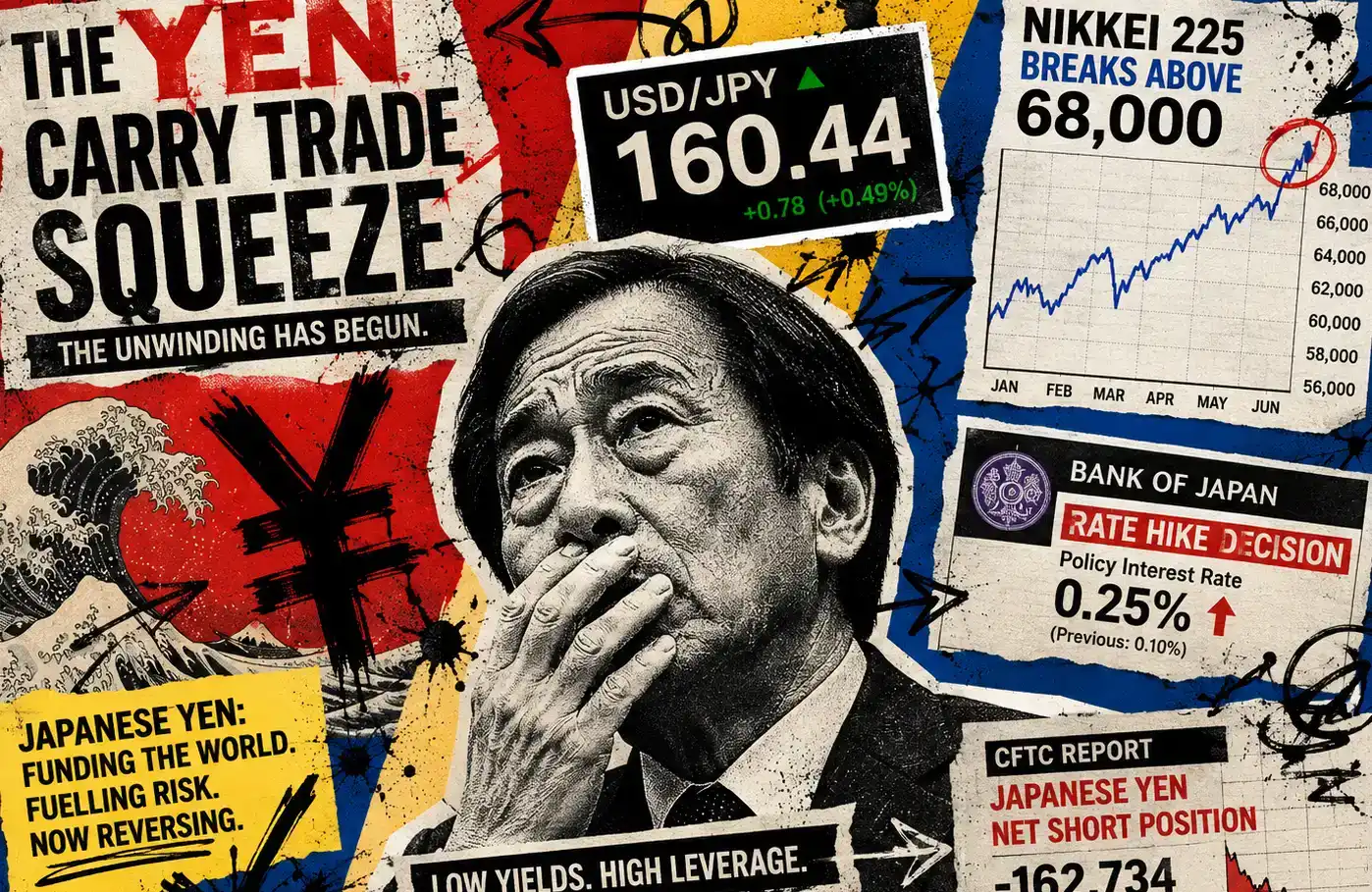
New Wall Street Play: Yen Shorts Still Adding, But Japan Stocks Don't Rely on Carry Trade Unwinding

On June 3rd, USD/JPY hit 160.44, its highest level since July 2024, while the Nikkei 225 surged past 68,000 points. Contrary to popular narratives of an imminent "carry trade unwind" akin to August 2024, data reveals a more complex picture. Speculative net short positions in yen futures have actually increased, reaching -114,667 contracts by late May, suggesting traders are doubling down rather than retreating. Meanwhile, Japan's Finance Ministry conducted its largest-ever single-round FX intervention (11.73 trillion yen) in April-May but failed to hold the 160 yen line. The Nikkei's rally is not driven by carry trade dynamics. Foreign investors are aggressively buying Japanese stocks, with net purchases in 2026 running nearly 16 times higher than 2025 levels. This inflow is concentrated in AI and semiconductor-related stocks like SoftBank and Socionext, fueled by positive sector outlooks, rather than being a flight from unwinding yen shorts. Furthermore, the Nikkei has continued climbing despite the Bank of Japan's (BOJ) rate hikes to 0.75%. This disconnect exists because the current equity boom is fueled by AI-driven foreign investment, not reliant on cheap yen funding. However, this relationship remains fragile. Should the BOJ hike rates further (e.g., to 1.0%) while dollar weakness increases carry trade costs, the trajectories of the yen and Japanese stocks could reconverge, potentially triggering volatility.

marsbitHá 47m

New Wall Street Play: Yen Shorts Still Adding, But Japan Stocks Don't Rely on Carry Trade Unwinding

marsbitHá 47m

Broadcom's Q3 Guidance Misses Expectations by $12 Billion, After-Hours Trading Plummets Over 13%, AI Narrative "Cooling"?

On June 3, Broadcom released record Q2 FY26 results with revenue of $22.19B, up 48% YoY, and AI chip sales of $10.8B, up 143%. Adjusted EPS of $2.44 beat estimates. However, its Q3 AI semiconductor revenue guidance of $16B, while up over 200% YoY, fell roughly $1.2B (7%) short of analyst consensus expectations of $17.2B. This miss, coupled with slightly weaker-than-expected software revenue, triggered a severe market reaction. CEO Hock Tan maintained the FY26 AI revenue outlook of over $100B but did not raise it, disappointing investors who had priced in more robust growth. The stock plummeted over 13% in after-hours trading, erasing roughly $270B in market cap. The sell-off extended to peers like Marvell. A key concern for markets, particularly for Chinese optical module suppliers, was Tan's comment that the contribution of AI networking (e.g., Ethernet switches, optical interconnect chips) to AI revenue, currently near 40%, is expected to normalize to around 30% over time, signaling a potential peak in growth for that segment. Despite the guidance shortfall, Tan reiterated that AI demand remains "insatiable" and reaffirmed the long-term target of exceeding $100B in AI revenue by FY27. The reaction highlights the heightened sensitivity and premium valuation placed on AI-exposed stocks, where anything less than stellar guidance can prompt significant profit-taking. The broader question is whether this represents a cooling AI narrative or a correction in overstretched valuations.

marsbitHá 47m

Broadcom's Q3 Guidance Misses Expectations by $12 Billion, After-Hours Trading Plummets Over 13%, AI Narrative "Cooling"?

marsbitHá 47m

Trading

Spot
Futuros

Artigos em Destaque

Como comprar SNT

Bem-vindo à HTX.com!Tornámos a compra de Status Network Token (SNT) simples e conveniente.Segue o nosso guia passo a passo para iniciar a tua jornada no mundo das criptos.Passo 1: cria a tua conta HTXUtiliza o teu e-mail ou número de telefone para te inscreveres numa conta gratuita na HTX.Desfruta de um processo de inscrição sem complicações e desbloqueia todas as funcionalidades.Obter a minha contaPasso 2: vai para Comprar Cripto e escolhe o teu método de pagamentoCartão de crédito/débito: usa o teu visa ou mastercard para comprar Status Network Token (SNT) instantaneamente.Saldo: usa os fundos da tua conta HTX para transacionar sem problemas.Terceiros: adicionamos métodos de pagamento populares, como Google Pay e Apple Pay, para aumentar a conveniência.P2P: transaciona diretamente com outros utilizadores na HTX.Mercado de balcão (OTC): oferecemos serviços personalizados e taxas de câmbio competitivas para os traders.Passo 3: armazena teu Status Network Token (SNT)Depois de comprar o teu Status Network Token (SNT), armazena-o na tua conta HTX.Alternativamente, podes enviá-lo para outro lugar através de transferência blockchain ou usá-lo para transacionar outras criptomoedas.Passo 4: transaciona Status Network Token (SNT)Transaciona facilmente Status Network Token (SNT) no mercado à vista da HTX.Acede simplesmente à tua conta, seleciona o teu par de trading, executa as tuas transações e monitoriza em tempo real.Oferecemos uma experiência de fácil utilização tanto para principiantes como para traders experientes.

147 Visualizações TotaisPublicado em {updateTime}Atualizado em 2026.06.02

Como comprar SNT

Discussões

Bem-vindo à Comunidade HTX. Aqui, pode manter-se informado sobre os mais recentes desenvolvimentos da plataforma e obter acesso a análises profissionais de mercado. As opiniões dos utilizadores sobre o preço de SNT (SNT) são apresentadas abaixo.

活动图片