Anthropic's Prospectus Reveals $518 Billion Computing Power Gamble, IPO Valuation Potentially Exceeding $2 Trillion

marsbitPublished on 2026-09-30Last updated on 2026-09-30

Abstract

The article reveals financial details from Anthropic's IPO prospectus, highlighting a staggering $518 billion commitment to future computing and infrastructure spending. This massive bet underpins an IPO valuation target that could exceed $2 trillion. Despite a massive revenue jump from approximately $400 million in 2024 to $4.6 billion in 2025, the company reported a net loss of $42 billion for 2025. Approximately $34 billion of this loss stemmed from accounting charges related to the revaluation of past fundraising, not direct cash outflows. However, its operating loss still reached $8.06 billion, with $7.33 billion spent on compute and infrastructure. A key challenge is that nearly a quarter of 2025 revenue came from just two clients, and many major customers lack long-term contracts. This creates uncertainty over whether future customer demand can sustain the enormous $518 billion compute outlay. While investors are betting on aggressive future growth—with revenue projections reaching $190-$200 billion by 2028—the company must prove its revenue can outpace its soaring costs. The IPO, potentially delayed until after the US mid-term elections in November, will test whether the market believes in this high-stakes, capital-intensive growth model.

The push for a $2 trillion IPO valuation is backed by a staggering $518 billion computing power gamble!

On September 28, Reuters disclosed financial details from Anthropic's IPO filing materials.

Supporting this sky-high valuation expectation is a steep growth curve:

In 2025, Anthropic's revenue approached $4.6 billion, approximately 12 times that of the previous year.

Investors are betting that more and more businesses will continuously pay for Claude, sustaining such growth.

However, growth projections are not orders, much less realized revenue.

While future customer order volumes remain uncertain, the commitment for $518 billion in computing power and infrastructure expenditure over the coming years has been pre-written.

If the rate at which customers pay fails to keep pace with the rate at which computing power burns cash, the confidence of early deployment could turn into heavy financial pressure.

$4.6 Billion in Annual Revenue, Why Report a $42 Billion 'Huge Loss'?

Opening Anthropic's 2025 ledger reveals a stark contrast between two sets of numbers:

Revenue surged to about 12 times the previous year's, nearing $4.6 billion; yet the net loss for the same period reached approximately $42 billion.
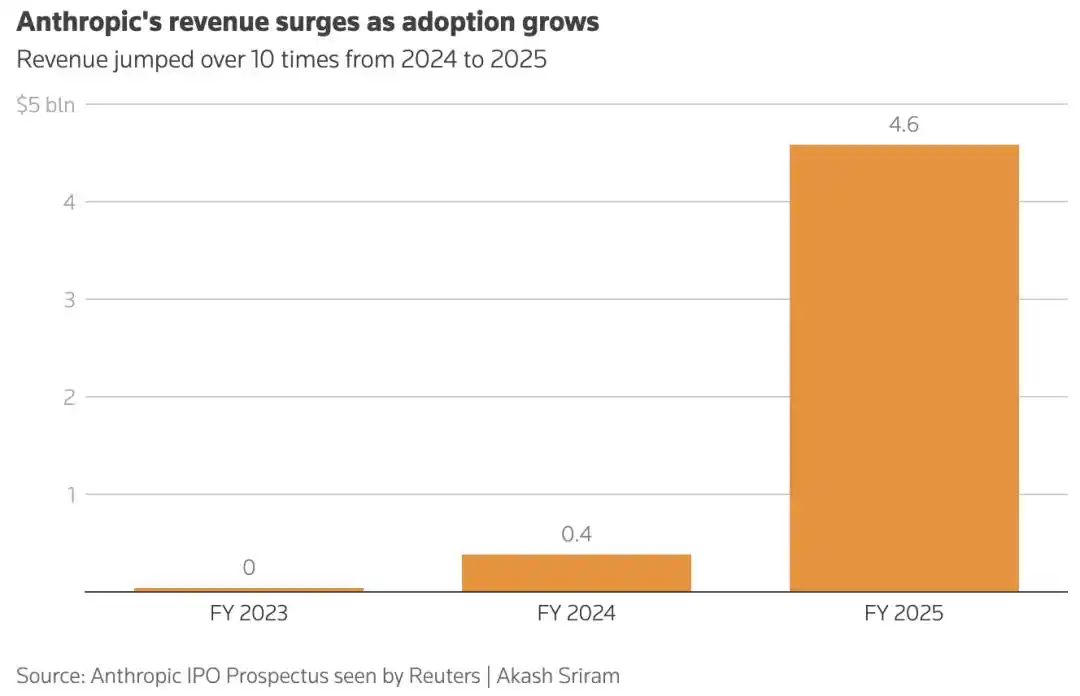
Anthropic's revenue grew from about $400 million in 2024 to nearly $4.6 billion in 2025. (Source: Reuters)

$4.6 billion in annual revenue, $42 billion net loss—the loss is roughly 9 times the revenue.
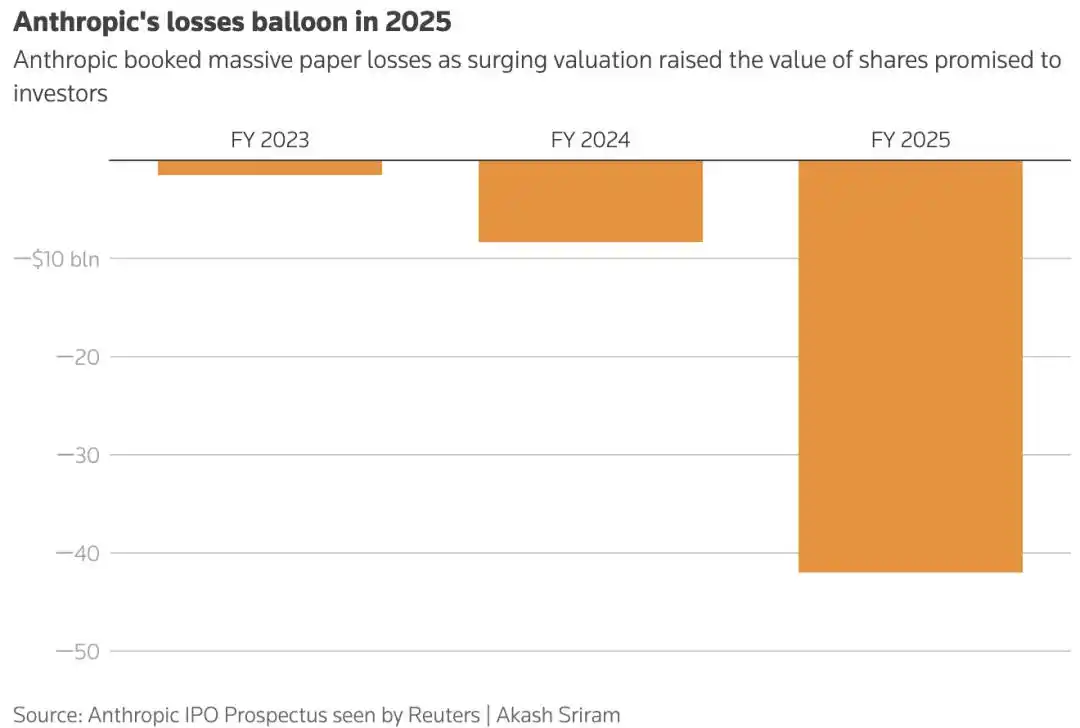
Anthropic reported a net loss of approximately $42 billion in 2025, primarily affected by paper losses from the revaluation of financing. (Source: Reuters)

According to Reuters, of this $42 billion net loss, about $34 billion is related to valuation changes from previous financing rounds.

Some of Anthropic's past financing may be convertible into company shares in the future. As the company's valuation rises, the value of this 'conversion right' held by investors also increases.

For the company, the financing obligations it needs to fulfill for investors increase on the books accordingly. Under the accounting rules applicable to such financing arrangements, this increased value must be recorded as a loss for the current period.

Therefore, this approximately $34 billion is primarily a paper expense from the revaluation of financing, not corresponding to an equivalent amount of cash outflow, nor can it be considered money the company actually spent on model R&D, computing power procurement, or user services that year.

However, stripping away this accounting factor, Anthropic's operational pressure remains significant.

Anthropic's operating loss in 2025 reached $8.06 billion.

Of this, computing power and infrastructure expenditure alone accounted for $7.33 billion, nearly 60% of operating expenses.

And as revenue and user scale continue to grow, this computing power bill will continue to rise.

Taking Claude Code as an example, Anthropic disclosed on February 12 this year that its weekly active user count had doubled since the beginning of the year.

This implies greater computing power demand.

If computing power is insufficient when customer demand surges, even the strongest model might not handle the incoming business.

But the more computing power prepared, the higher the cost will climb.

For Anthropic, the real test is not whether to expand, but whether revenue can grow faster than costs.

Going forward, whether revenue growth can gradually outpace cost growth will determine if this high-speed expansion can ultimately yield profits.

$518 Billion: The Computing Power Gamble Bet on the Future

$7.33 billion is only the computing power and infrastructure investment Anthropic spent in 2025.

The truly larger bet lies in the future.

The IPO materials show that Anthropic has already committed to long-term expenditure of up to $518 billion over the next several years, covering cloud services, computing resources, and infrastructure.

To roll out computing power in advance, Anthropic disclosed in May this year that it had signed new computing power agreements with Amazon, Google, and Broadcom, and reached a GPU computing power cooperation with SpaceX.
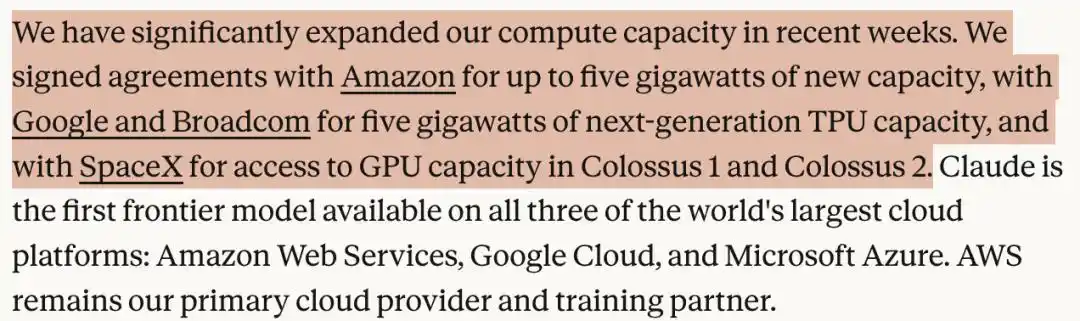
Anthropic signed computing power agreements with Amazon, Google, Broadcom, and SpaceX.

These agreements are chips Anthropic is preparing in advance for future growth.

But while computing power can be locked in early, customer demand cannot be guaranteed in advance.

If enterprise customers cut budgets, competitors start price wars, or product usage falls short of expectations, these long-term computing power commitments could turn from growth chips into heavy financial burdens.

$518 billion is already written into future expenditure plans. The real question now is:

Can future orders support this massive computing power bill?

Nearly a Quarter of Revenue Relies on Two Customers

A number disclosed in the IPO materials adds another layer of suspense to this gamble.

In 2025, nearly a quarter of Anthropic's revenue came from two customers.

This Reuters report did not disclose the specific names of these two clients.

Major clients can quickly boost revenue, but they also make the company more dependent on their orders. If one significantly cuts procurement, the company could lose a large chunk of income.

Another risk lies in how long customer orders can be locked in.

According to Reuters, Anthropic warned in its risk factors that many of its largest customers have not signed long-term contracts and may reduce or even stop their spending.

Computing power needs to be prepared ahead of time, but how much customers will buy in the future may not be guaranteed by long-term contracts.

And whether customers are willing to continue paying depends on whether using AI is actually cost-effective.

Going forward, the ability to make customers continue buying and expand usage is the key to supporting the $518 billion long-term computing power investment.

$2 Trillion Valuation: The Market Is Already Betting on 2028

With risks clearly on the table, why are supporters still calling for a $2 trillion IPO valuation?

Look at Anthropic's growth rate.

In 2024, the company's revenue was about $400 million; by 2025, this number had approached $4.6 billion, an increase of approximately 12 times over the previous year.

In May this year, the company announced the completion of a $65 billion financing round, with a post-money valuation reaching $965 billion, and stated that its monthly revenue annualized run rate had exceeded $47 billion, equivalent to extrapolating the revenue pace at that time to a yearly scale.

And investors' gaze has even turned toward 2028.

In August, Reuters cited informed sources reporting that Anthropic forecasts 2028 revenue at approximately $190 to $200 billion, and bankers and investors are valuing it with reference to future revenue.

For long-term forecasts to become reality, a series of conditions need to be continuously met: sustained expansion of customer demand, maintained product competitiveness, and revenue growth gradually outpacing the costs supporting the expansion.

Any shortfall in these areas could put pressure on the valuation.

What Will Support the $2 Trillion Expectation?

SpaceX, xAI's parent company, has already taken the lead in entering the capital markets.

In June this year, it went public with an IPO valuation of $1.77 trillion.
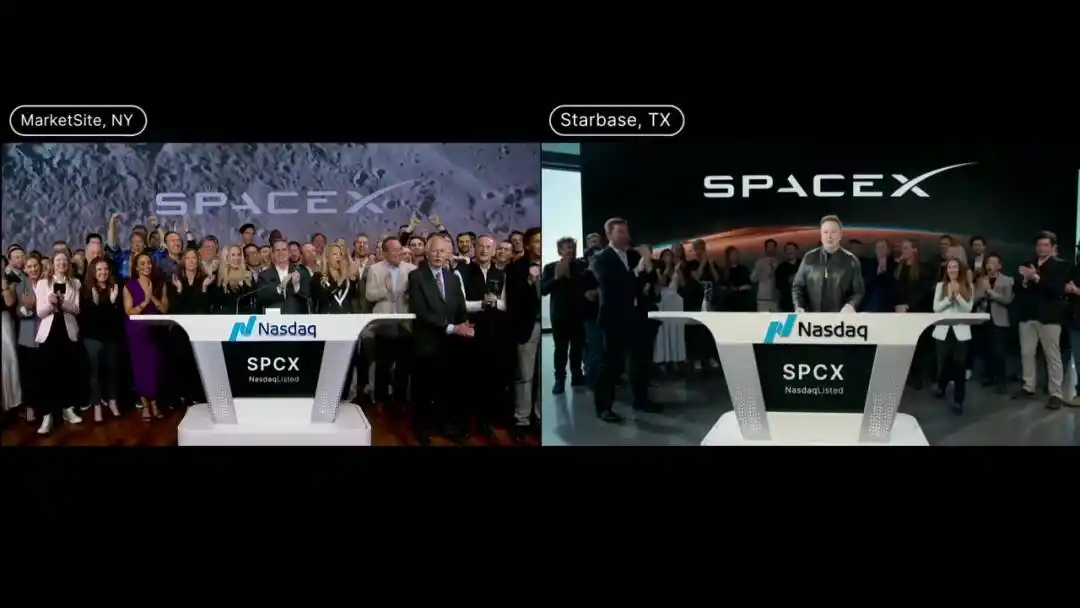
June 12, 2026, SpaceX bell-ringing ceremonies in New York and Texas.

Anthropic is aiming for a potentially over $2 trillion IPO valuation, but the listing timing remains unconfirmed.

Reuters stated the IPO might be postponed until after the US mid-term elections in November. OpenAI has also confidentially filed for an IPO; according to media reports, it might go public in early 2027, with the specific timing still uncertain.

Trillion-dollar valuations are placing these companies' futures on the capital market's scales ahead of time.

But listing is just a milestone; sustaining the valuation relies on continuous growth, cost control, and reliable products.

For users of Claude and ChatGPT, this competition boils down to one question:

For the same subscription fee, who can do more work with fewer errors, requiring less rework and worry from you?

The capital market can price the future in advance, but users are paying for today's experience.

Whether it's Anthropic or OpenAI, every subscription renewal supporting their astronomical valuations requires a sufficiently solid reason.

References:

https://www.reuters.com/business/finance/anthropics-ipo-prospectus-shows-sweeping-ai-vision-surging-costs-2026-09-28/

This article is from the WeChat public account "New Zhiyuan", author: ASI Apocalypse

Related Questions

QWhat is the primary factor behind Anthropic's massive net loss in 2025, and how much of it was a non-cash accounting adjustment?

AAnthropic's primary net loss of approximately $42 billion in 2025 was driven largely by a $34 billion non-cash accounting adjustment. This adjustment resulted from the revaluation of financing obligations that are convertible into company shares. As Anthropic's valuation increased, the value of these obligations on its books also increased, which accounting rules require to be recorded as an expense, even though it did not represent actual cash outflow.

QWhat is the core business challenge highlighted by Anthropic's $518 billion long-term compute commitment, according to the article?

AThe core challenge is the mismatch between a fixed, massive future expense and uncertain future revenue. Anthropic has committed to $518 billion in long-term spending on cloud services and compute infrastructure. However, customer demand, which must generate revenue to pay for this commitment, cannot be guaranteed in advance. If revenue growth does not outpace this enormous cost burden, the commitment could become a severe financial strain.

QHow concentrated is Anthropic's revenue stream based on the information in its IPO prospectus?

AAnthropic's revenue stream is highly concentrated. In 2025, nearly a quarter (approximately 25%) of its total revenue came from just two major customers. This concentration creates a significant risk, as the loss or reduced spending from either of these clients could substantially impact the company's overall financial performance.

QWhat future revenue target are banks and investors reportedly using to justify Anthropic's potential $2 trillion+ IPO valuation?

ABanks and investors are reportedly basing Anthropic's potential $2 trillion+ IPO valuation on its projected revenue for the year 2028. According to Reuters, the company has forecast its 2028 revenue to be in the range of $190 billion to $200 billion.

QWhat key metric did Anthropic announce in May 2026 that demonstrated its rapid growth, and what was the figure?

AIn May 2026, Anthropic announced its annualized revenue run rate had exceeded $47 billion. This metric, which extrapolates current monthly revenue to a full year, demonstrated the company's extremely rapid growth trajectory at that time.

Related Reads

GPT-6.1 Sol Participates in Live Brain Surgery! Three Rounds of Localization, Each More Accurate Than the Last

Exin Therapeutics CEO Gabriel Ocana-Santero reported an experiment in which GPT-6.1 Sol participated in three rounds of real mouse brain surgery positioning. The task involved locating Bregma and Lambda, two key skull landmarks used to calibrate stereotaxic coordinates for accurate targeting of brain regions. After each round, a professional surgeon corrected the model's positioning results, and the model retained its images, measurements, and expert corrections for reference in subsequent rounds. By the third round, GPT-6.1 Sol reduced landmark search time from 169 to 86 seconds, required corrections from four to two, and cut positioning error from 0.6 mm to 0.3 mm. Ocana-Santero described this as in-context learning from real-world experience. The team did not disclose how the experience records are integrated into the model or whether underlying weights are updated, so it cannot be described as autonomous training or parameter-level self-evolution. The sample is only three operations, far from proving stable surgical capability, but it demonstrates AI accumulating experience from real observations and expert feedback. This follows earlier Exin work in which AI selected gene therapy vectors, chose injection targets and coordinates, and controlled a stereotaxic device in a mouse experiment, with a licensed veterinarian supervising and safety limits in place. In a further experiment, Claude Sonnet 5, GPT-6.1 Sol, and Grok 4.7 chose different brain regions and treatment strategies for the same scientific goal, suggesting models may reason toward different experimental paths.

marsbit10h ago

GPT-6.1 Sol Participates in Live Brain Surgery! Three Rounds of Localization, Each More Accurate Than the Last

marsbit10h ago

From Drones to Nuclear Reactors: What Has Paradigm Invested in Since Leaving the Crypto World?

Paradigm, a venture capital firm known for crypto investments like Coinbase and Uniswap, is rapidly expanding into hard tech. In November, it co-led a $1.5 billion funding round for Zipline, a US drone delivery company now valued at $21.5 billion—nearly triple its valuation from January. Zipline, founded in 2014, began delivering medical supplies in Rwanda and now operates a large-scale automated logistics network, having completed 150 million miles of commercial autonomous flights. Walmart plans to add 300 new delivery sites, and Uber aims to scale their partnership to one million daily orders by 2029. Paradigm's broader portfolio now spans AI, robotics, manufacturing, semiconductors, space defense, and nuclear energy. Investments include open-source AI lab Nous Research, math-reasoning AI firm Harmonic, AI data company Idler, and GPU platform Andromeda. It also backs SendCutSend (metal parts manufacturing), Fab2 (compact semiconductor factories), True Anomaly (space defense), and Antares (micro nuclear reactors). In July, Paradigm launched a $12 billion new fund for frontier tech. This shift reflects a broader VC trend toward AI and physical technology, as crypto's path to sustained commercial revenue remains uncertain. Paradigm's bets focus on companies solving concrete industrial problems with existing markets, aiming to build a hard-tech network that transcends crypto cycles.

marsbit11h ago

From Drones to Nuclear Reactors: What Has Paradigm Invested in Since Leaving the Crypto World?

marsbit11h ago

Nomura: "Blue Wave" Hits US Data Centers, China's AI Benefits Instead

Nomura argues that the Democratic "blue wave" in the US midterms could paradoxically benefit China's AI economy. Democratic victories in key data-center states will likely tighten regulation, shift grid upgrade costs onto developers, and lengthen approval timelines, slowing US data-center expansion. Market reaction was sharp: the Nasdaq fell 5.5% in a single day, the SOX dropped nearly 15% over two days, Nvidia fell about 12%, and Micron about 24%. Because US cloud giants had been hoarding global GPU, HBM, and advanced logic chip capacity—driving black-market premiums of 200–300% at Asian logistics hubs—a US capex slowdown could collapse those speculative premiums, letting Chinese AI firms, cloud providers, and research institutions obtain GPUs, HBM modules, and advanced packaging materials more cheaply through intermediary trade hubs. China is also building a state-led national AI data-center network, with roughly RMB 2 trillion planned under the 15th Five-Year Plan to integrate regional computing by 2028, supported by low-cost renewable power in western hubs under the "East Data, West Computing" program. Morgan Stanley, meanwhile, does not see the blue wave as a real easing of US-China tensions; it expects strategic competition to persist but sees greater policy predictability. It prefers China's "self-sufficiency" AI trade—supported by both supply and demand under national policy priorities—over export chains tied to global AI capex. It also notes more balanced opportunities in Chinese equities, with valuations near historic lows.

marsbit11h ago

Nomura: "Blue Wave" Hits US Data Centers, China's AI Benefits Instead

marsbit11h ago

After GPT-6, Embodied Large Models Are Trapped in Their Own Territory! Next Year's Self-Research Budget Is Probably Up in the Air

The article discusses how the release of GPT-6 Astra (and the imminent GPT-6.2 Astra) has disrupted the embodied AI/robotics industry. General-purpose large models are now encroaching on capabilities that embodied AI companies previously developed in-house—such as in-context learning, out-of-distribution generalization, error correction, and open-vocabulary manipulation—often without task-specific post-training. On benchmarks like RoboDojo, teams combining general models with robot-use-agent techniques saw scores jump from 20–30 to 50–60, prompting many to question whether self-developing embodied foundation models still makes sense. Some companies have begun cutting algorithm roles. However, the article notes GPT-6 Astra still struggles with complex physical contact, force control, object deformation, and high-precision manipulation, and its cloud API inference latency is high (though this is not seen as a fundamental barrier). Experts argue that general models' current weaknesses shouldn't be treated as durable moats for embodied companies, since OpenAI is already hiring robotics talent and future models may absorb more robot operation data. The core argument is economic: embodied companies' opportunity lies not in building smarter models but in delivering better economic value. Stable, standardized industrial tasks may be better served by lightweight, specialized models or rule-based strategies, while open-ended tasks (e.g., home service robots) may benefit from general models. Ultimately, companies need to re-prioritize their R&D directions—leveraging general models for language understanding and task planning while focusing in-house efforts on physical interaction, embodiment-specific control, real-world adaptation, and deployment efficiency. The article concludes that the industry is moving past the demo-and-burn-investment stage, and the elimination round among the "hundred robot wars" has begun.

marsbit11h ago

After GPT-6, Embodied Large Models Are Trapped in Their Own Territory! Next Year's Self-Research Budget Is Probably Up in the Air

marsbit11h ago

Trading

Spot
活动图片