5 in a row! Here’s why monthly perp volumes have been falling since October

ambcryptoPublicado em 2026-04-07Última atualização em 2026-04-07

Resumo

Perpetual trading volumes on decentralized exchanges have declined for five consecutive months, falling nearly 50% from a peak of $1.36 trillion in October 2025 to $699 billion by March 2026. This drop reflects ongoing bear market conditions and cautious trader sentiment following last year's market crash, which erased nearly $1 trillion in value. Open interest also declined by 50% from pre-October levels, indicating reduced speculative activity. While the decline highlights persistent bearish pressure, it also suggests traders are recalibrating risk more strategically. This measured behavior helps stabilize markets, reduce volatility, and may lay a stronger foundation for crypto's next rally.

In crypto trading, market crashes leave marks that investors don’t forget.

Looking back at Q4 last year, things were rough across the board; spot trading and even long-term HODLing all took a hit. Crypto markets lost nearly $1 trillion, triggering massive liquidity sweeps, forcing deleveraging, and sending shocks across the market, which left investors cautious and their sentiment fragile for months.

Fast forward to now, that wave of volatility hasn’t fully disappeared. Data from DeFiLlama shows that perpetual volumes across major DEX chains have been on a steady decline for five consecutive months. From a peak of $1.36 trillion in October 2025, volumes slid all the way down to $699 billion by March 2026.
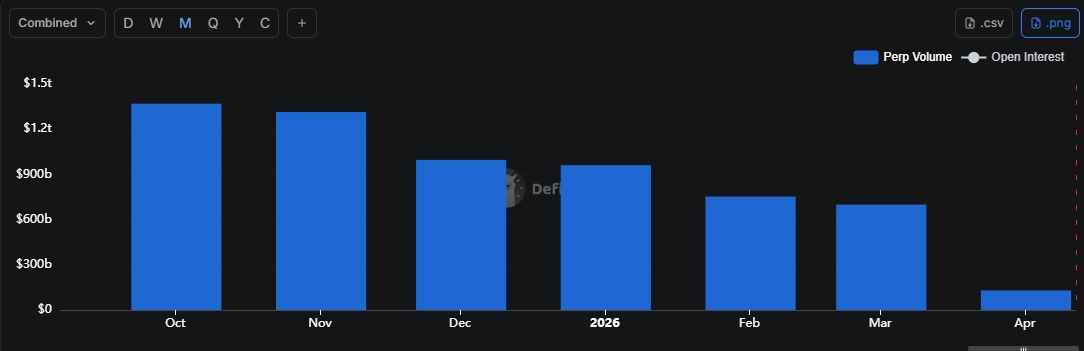
Source: DeFiLlama

Technically speaking, traders wiped out nearly half of last quarter’s perp volume. For context, perp volume measures the total value of all perpetual contract trades happening on decentralized exchanges. It’s basically a snapshot of how actively traders are betting on short- and long-term price moves in crypto.

And let’s be real, anything involving “bets” is pure speculation. In a bull market, that speculative capital acts like rocket fuel, pushing rallies higher and giving momentum to the market. But since the October crash, crypto still sits about 40% below pre-crash levels, showing how much ground the market has yet to cover.

So what do we make of falling perp volume in a bear market? Could it be a healthy sign that traders are stepping back and markets are consolidating, or is it a warning that liquidity is drying up?

Falling perp volumes highlight lingering bear market pressure in crypto

Unlike spot trading, speculative trading is highly sensitive to macro conditions.

In other words, traders in perpetual markets don’t just react to crypto-specific news. Instead, they watch the broader financial landscape closely. Global market shifts, interest rate changes, and even geopolitical events can quickly influence their positions. In this context, that nearly 50% wipeout of perp volume really highlights the bearish setup the market is facing right now.

Adding to that, Coinglass data shows that open interest (OI) across all crypto assets combined has also dropped 50% from the $200 billion pre-October levels. For context, open interest is basically the total value of all “outstanding” contracts that haven’t been settled yet, showing how much capital traders have at risk.
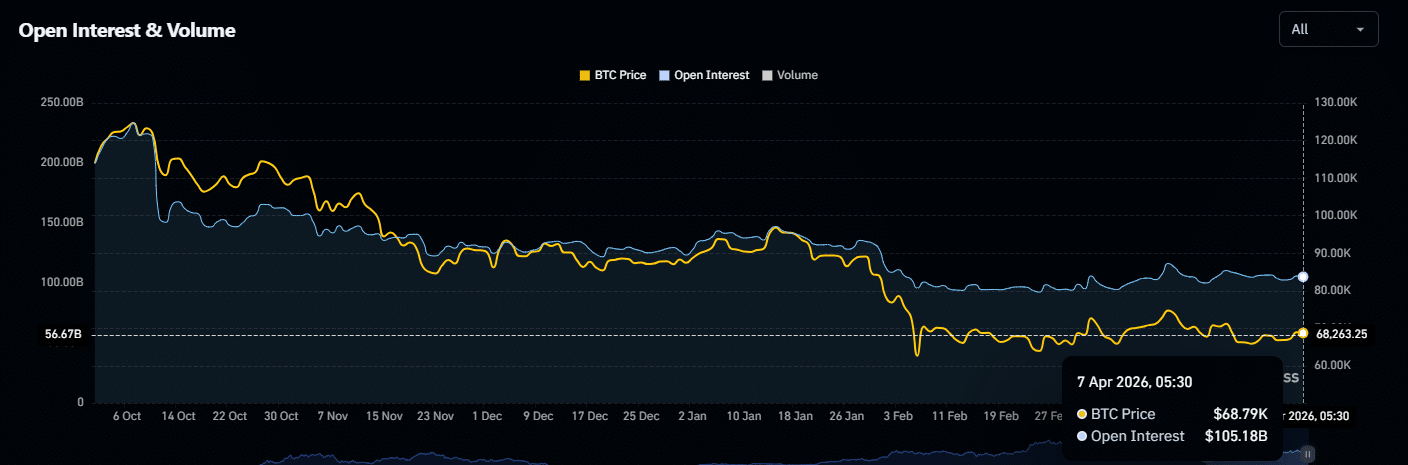
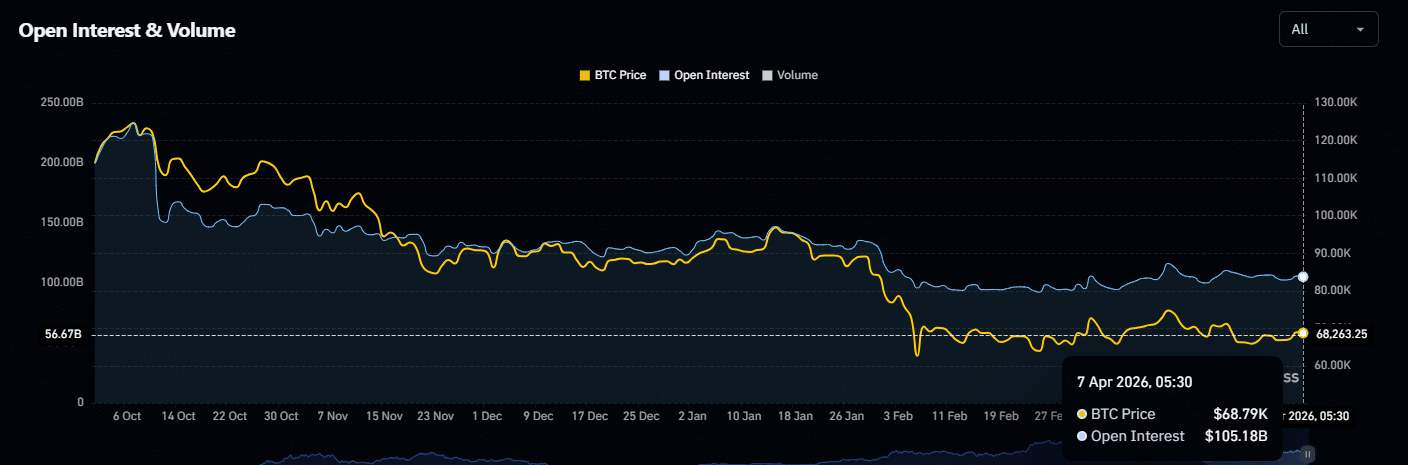
Source: Coinglass

Taken together, the drop in perp volume and open interest tells a clear story: crypto traders are actively recalibrating risk and waiting for clearer signals before jumping back in. In a bear market, that’s actually a bullish sign. It indicates that traders aren’t blindly chasing moves. Instead, they’re letting the market settle, which helps reduce the risk of sudden swings and wild volatility.

At the same time, the scars from the October crash haven’t fully healed.

Still, traders are taking notes from past shocks, pulling back when risk is high, and redeploying capital more strategically. As a result, the market may look quiet on the surface, yet behind the scenes, this cautious behavior is quietly building a stronger foundation for crypto’s next move.


Final Summary

  • Perp volume and open interest are down nearly 50%, reflecting traders’ caution and a still-bearish market setup.
  • Measured trading behavior in a bear market helps stabilize liquidity, limit volatility, and lay the groundwork for the next crypto rally.


Perguntas relacionadas

QWhat has been the trend in monthly perpetual trading volumes on major DEX chains since October 2025, according to DeFiLlama data?

APerpetual trading volumes have been on a steady decline for five consecutive months, falling from a peak of $1.36 trillion in October 2025 to $699 billion by March 2026.

QWhat does the combined drop in perp volume and open interest indicate about current trader behavior?

AThe drop indicates that crypto traders are actively recalibrating risk and waiting for clearer signals before jumping back in, showing caution and a more strategic deployment of capital.

QHow does speculative trading in perpetual markets differ from spot trading in terms of market sensitivity?

ASpeculative trading is highly sensitive to macro conditions, meaning traders react to global market shifts, interest rate changes, and geopolitical events, not just crypto-specific news.

QWhat is the significance of falling perp volume in a bear market, according to the article?

AIn a bear market, falling perp volume can be a bullish sign as it indicates traders are not blindly chasing moves, which helps reduce the risk of sudden swings and builds a stronger foundation for the next market move.

QBy what percentage did the crypto market drop from its pre-crash levels following the October crash?

AThe crypto market still sits about 40% below pre-crash levels.

Leituras Relacionadas

La Liga Team Bets $1 Million Against Themselves Before Match: Does Using Prediction Markets for Insurance Comply with Sports Regulations?

A Spanish La Liga club, reportedly Osasuna, purchased insurance against relegation and was linked to a transaction of over $1 million on the prediction market platform Kalshi, betting against its own victory in a crucial season-ending match. While Osasuna confirmed buying €1.2 million insurance for a potential €6 million payout in case of relegation through broker Howden, it did not confirm involvement with Kalshi. The reported trade involved intermediaries like Game Point Capital and Greenlight Commodities, with quant firm Susquehanna as the counterparty. This incident highlights the blurring line between financial hedging and gambling in prediction markets. Such markets allow trading on future event outcomes, like sports results. In the US, Kalshi operates as a regulated event contract market under the CFTC. However, Spanish authorities recently initiated penalties against Kalshi and Polymarket, considering their activities unlicensed gambling. The case raises core questions about prediction markets: who can trade, how insider information is handled, and whether participants can influence outcomes, especially in sports where results are human-driven. While leagues like La Liga and Serie A have partnered with Polymarket in North America, the regulatory clash and potential for conflicts of interest, as seen in this club's alleged transaction, present significant challenges as prediction markets evolve toward institutional risk management.

Foresight NewsHá 6m

La Liga Team Bets $1 Million Against Themselves Before Match: Does Using Prediction Markets for Insurance Comply with Sports Regulations?

Foresight NewsHá 6m

From Shouting 150 Dollars to Liquidating HYPE in Just Three Days, How Much Credibility Does Arthur Hayes Have Left?

How much of Arthur Hayes's market credibility remains? Recently, the "godfather of crypto perpetual swaps" and BitMEX co-founder has faced public criticism, including accusations from on-chain investigator ZachXBT about creating exit liquidity for his followers. Starting last week, Hayes executed multiple sudden sell-offs. He had repeatedly publicly predicted the HYPE token would reach $150. After a $100,000 bet defending Hyperliquid on June 1st, he announced just three days later that he had completely sold his HYPE and NEAR holdings, successfully exiting near the peak. He also sold ZEC and WLD. His sale of WLD appeared to be a classic "pump and dump" maneuver. On June 3rd, he publicly set a $10 target for WLD, causing its price to surge over 35%. By June 6th, he announced he had sold his WLD, citing "anomalous" SpaceX pre-IPO price action, which triggered a sharp price drop. On June 9th, Hayes published a lengthy article explaining his actions, citing factors like rising energy costs and a potential AI bubble burst. Consequently, his family office, Maelstrom, now holds positions in US energy producers and only core crypto assets BTC and ETH, having sold AI-related stocks and non-core cryptocurrencies. This pattern is not new. In 2025, he similarly touted HYPE before selling it at what turned out to be a cycle peak, only to repurchase it at the next cycle's low. Similar scenarios played out with tokens like ETHFI and ENA. Long-term observers have developed a strategy: ignore Hayes's public statements but closely monitor his on-chain actions—be cautious following his buys, but decisively follow his sells. If he continues these tactics, especially as seen with the WLD case, his market credibility risks being permanently damaged. As Hayes himself admitted in his latest article, "I remain an unapologetic gambler."

marsbitHá 24m

From Shouting 150 Dollars to Liquidating HYPE in Just Three Days, How Much Credibility Does Arthur Hayes Have Left?

marsbitHá 24m

Fundraising is Like a Strange Dance: The 'Absurd Drama' of Silicon Valley Founders' Capital Raises

The article details a series of absurd and revealing anecdotes shared by Silicon Valley founders about their venture capital fundraising experiences, sparked by Greg Isenberg's story of pitching to a sleeping a16z partner. Founders describe surreal pitch meetings: one faced a barefoot, peanut-eating investor who offered triple the requested amount after 30 seconds; another performed a pitch in a VC's parked car; a founder discovered his audience understood no English beyond "yes." These stories highlight the often irrational and performative nature of fundraising. Beyond the absurdity, darker power imbalances are exposed. Stories include investors suggesting founders fire co-founders for their equity, blatant market misjudgments, disrespectful behavior from LPs, and discriminatory remarks. A debate also emerges around "Sequoia's" practice of splitting a round into two valuations. However, the thread isn't solely critical. Positive counter-narratives celebrate supportive VCs who offered crucial advice during crises, respected founders' timelines, and showed simple gestures of respect—like a partner personally fetching coffee before a major pitch. Ultimately, the collective sharing acts as a pressure release, illustrating that fundraising is a complex dance of power, trust, and sometimes sheer theater. It underscores that beyond capital, mutual respect and integrity remain the most enduring foundations of the founder-investor relationship.

marsbitHá 38m

Fundraising is Like a Strange Dance: The 'Absurd Drama' of Silicon Valley Founders' Capital Raises

marsbitHá 38m

Trading

Spot
Futuros
活动图片