48 Hours, $2.7 Billion: Strategy's STRC ATM Mechanism is Accumulating Bitcoin at an Unprecedented Pace

marsbitPublicado em 2026-04-15Última atualização em 2026-04-15

Resumo

Strategy's STRC ATM (At-The-Market) mechanism is accelerating its Bitcoin acquisition at an unprecedented pace. In just the first two trading days of the week, it generated $2.74 billion in volume, absorbing approximately 29,914 BTC—more than double the 13,927 BTC acquired in the entire previous week, representing a 115% increase. Notably, 100% of the STRC shares traded on both Monday and Tuesday were above the $100 face value threshold, the condition required to trigger the ATM and convert equity demand into Bitcoin purchases. Tuesday alone saw an estimated $1.57 billion in volume, absorbing 16,762 BTC—equivalent to 37 times the daily Bitcoin mining output. This surge demonstrates a new scale of sustained demand for the variable-rate perpetual preferred shares. If this pace continued, the weekly acquisition could reach roughly 75,000 BTC, fundamentally redefining corporate Bitcoin treasury strategies. While such extreme velocity may not be sustained, the mechanism is consistently converting market demand into large-scale Bitcoin accumulation.

Written by: Nick Ward

Compiled by: AididaoJP, Foresight News

Strategy's STRC ATM generated over $2.7 billion in trading volume in just the first two trading days this week, more than the total for the entire previous week, absorbing approximately 29,914 BTC, with every share traded above par value.
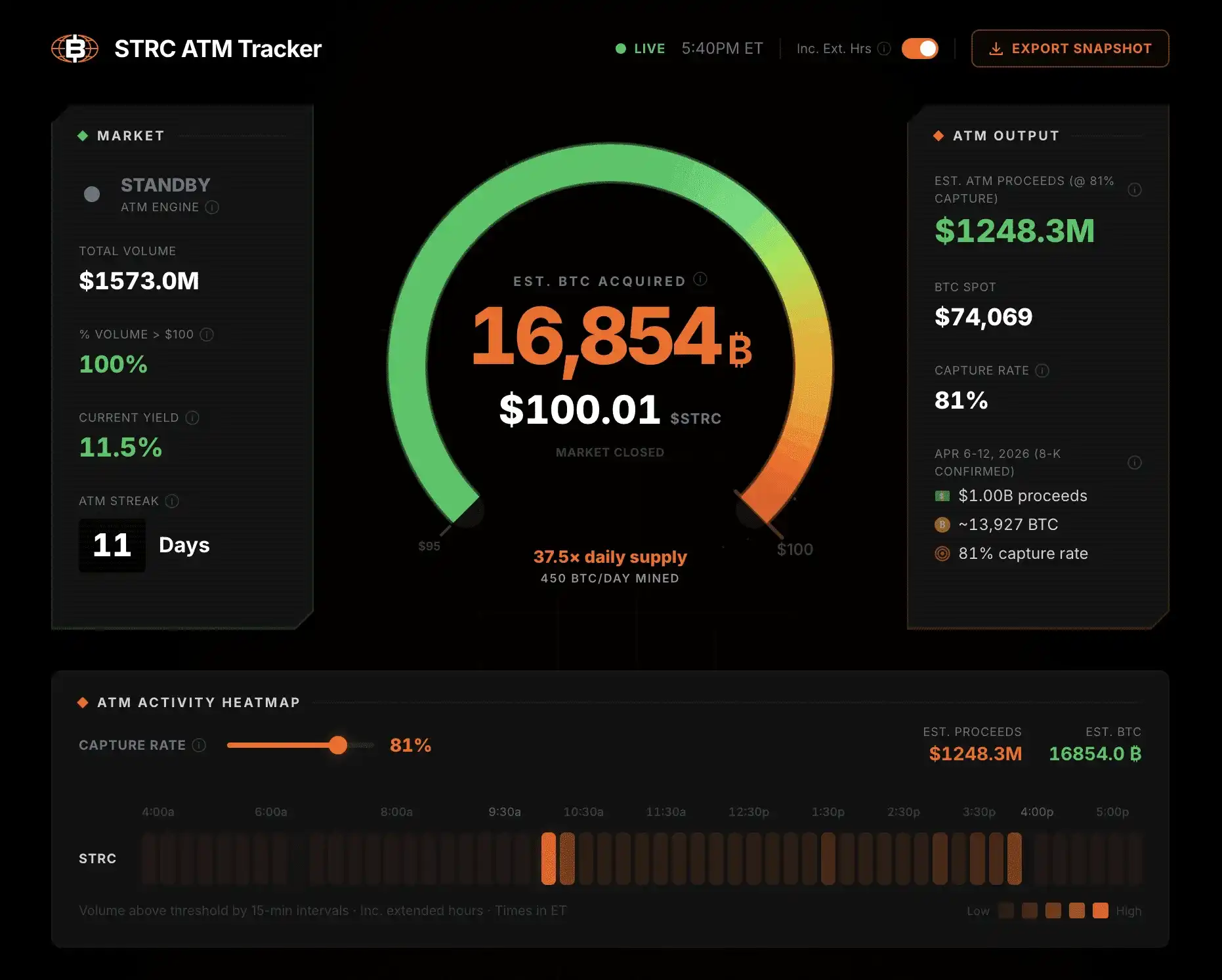
Note: Strategy (formerly MicroStrategy) is the publicly traded company holding the most Bitcoin globally. STRC is a variable-rate perpetual preferred stock it issued with a par value of $100, featuring a built-in ATM (At-The-Market) issuance mechanism—when the stock price is above par, the company can sell new shares to the market and use the raised funds directly to accumulate more Bitcoin. In the first two trading days this week, the STRC ATM has generated approximately $2.74 billion in trading volume, estimated to have purchased about 29,914 BTC.

Strategy's STRC ATM just had its first billion-dollar trading day, and today it did it again, on an even larger scale.

On Tuesday, April 14th, STRC volume is estimated to have closed at $1.57 billion, with 100% of the trades executed above the $100 par value threshold, meaning it absorbed approximately 16,762 BTC in a single day. This is 37 times the daily Bitcoin mining output, equivalent to removing over a month's worth of newly issued supply from the market in one trading day.

Combined with Monday's $1.17 billion, the STRC volume for the first two days of the week reached $2.74 billion—and through the ATM mechanism, acquired approximately 29,914 BTC.

For reference: According to Strategy's latest filed 8-K form, it confirmed acquiring 13,927 BTC over the five full trading days last week.

This week, that number was more than doubled in just 48 hours. A 115% increase, with three trading days still remaining this week.

Every Day, Every Share Traded

One data point should not be overlooked: Both on Monday and Tuesday, 100% of STRC trades occurred above the $100 par value threshold. The STRC ATM Tracker is the best way to observe this process in real-time.

This is the trigger condition for the ATM mechanism. The design intent of Strategy's variable-rate perpetual preferred stock is to convert demand into Bitcoin purchases when the share price is above par. For two consecutive trading days, every single trade met this condition. Not 84%, not 95%, but every single share.

This is a level of demand persistence previously unseen by the STRC ATM Tracker.

Quantifying the Acceleration

  • Last Week (Confirmed, 5 trading days): $1 Billion in Capital · 13,927 BTC
  • This Week (So far, 2 trading days): $2.18 Billion in Capital · 29,914 BTC
  • Change: BTC acquisition increased by 115%, using only 40% of the trading time
  • Consecutive Active Days for ATM: 10 consecutive trading days with trades above par value

At the current pace, this week is on track to acquire approximately 75,000 BTC over five trading days. If this holds, this number would fundamentally redefine the term "large corporate Bitcoin treasury."

It's almost certain this pace won't be sustained; Monday and Tuesday's figures are themselves outliers. But even if it slows down significantly in the latter part of the week, the rate of Bitcoin acquisition through Strategy's STRC ATM will still be multiples of any recorded week. You can observe the trend for the next three trading days in real-time here.

What Has Changed

Two mechanistic changes:

Price Discipline: STRC is firmly anchored at $100 flat, yielding 11.5%, with zero deviation. Every share traded at the trigger price.

Volume Expansion: From $1.17 billion on Monday to $1.57 billion on Tuesday, a 34% day-over-day growth on an already record-breaking base. Demand not only not subsided but accelerated during the trading day.

The pattern Strategy has been executing—building the tool, maintaining it at par, letting the market do the conversion—is working at a scale that was theoretical just last year.

The Bigger Picture

In the 10 trading days since the ATM mechanism was activated, the amount of BTC absorbed by the market is already comparable to the treasury strategies accumulated over years by some corporate Bitcoin buyers. And this tool has only one task: to keep buying.

Today's numbers are not a one-day pulse; it's the second day of a pattern. And this pattern, so far, looks like this:

Consecutive weeks of absorbing billions of dollars. Consecutive days of absorbing billions of dollars, with every share traded above par, and three trading days still remaining this week.


Perguntas relacionadas

QWhat is Strategy's STRC ATM mechanism and how does it work?

AStrategy's STRC ATM (At-The-Market) mechanism is part of its variable-rate perpetual preferred stock with a $100 face value. When the stock trades above this face value, the company can issue and sell new shares to the market. All the capital raised from these sales is used exclusively to purchase more Bitcoin for its treasury.

QHow much Bitcoin did Strategy acquire through the STRC ATM in the first two trading days of the week mentioned?

AIn the first two trading days of the week, Strategy's STRC ATM mechanism generated approximately $2.74 billion in volume, which was used to acquire an estimated 29,914 BTC.

QHow does the daily BTC acquisition volume from the STRC ATM compare to Bitcoin's daily mining output?

AOn Tuesday alone, the STRC ATM mechanism absorbed an estimated 16,762 BTC. This is 37 times the daily Bitcoin mining output, meaning it removed over a month's worth of new Bitcoin supply from the market in a single day.

QWhat was significant about the trading price of every STRC share during the two-day period?

AA key significant detail is that 100% of the STRC shares traded during both Monday and Tuesday were transacted at prices above the $100 face value threshold. This meant every single trade triggered the ATM mechanism, allowing the company to issue new stock and buy Bitcoin.

QWhat two mechanical changes does the article highlight that contributed to the accelerated Bitcoin acquisition?

AThe article highlights two key mechanical changes: 1. Price Discipline: STRC traded steadily at its $100 trigger price with a 1.5% yield, meaning every single share was sold at a price that activated the ATM. 2. Volume Expansion: Trading volume grew from $1.17 billion on Monday to $1.57 billion on Tuesday, a 34% day-over-day increase, showing accelerating demand.

Leituras Relacionadas

Super-Rich Hoarded Record Cash in February, Stock Market Hit New Highs Four Months Later: Who's Getting Fooled?

In February, the total assets in US money market funds reached a record high of approximately $8.25 trillion, a trend highlighted by high-net-worth individuals increasing their cash holdings. Notably, Warren Buffett's Berkshire Hathaway amassed a $381.7 billion cash pile ahead of his 2025 retirement, while other prominent figures like Peter Thiel sold tech stocks, fueling narratives of wealthy investors seeking safety. However, by June, the trend reversed. Money market fund assets fell to around $7.87 trillion, indicating a flow of capital back into equities. Concurrently, the S&P 500 and Nasdaq reached all-time highs, with the S&P 500 surpassing 7600 points. This market surge occurred despite the earlier defensive moves, highlighting a potential opportunity cost for those who retreated to cash. Analysis shows that since early 2022, the S&P 500's total return significantly outpaced that of prime money market funds. The capital shifted from equities appears to have been partly reallocated into alternative investments like real estate, art, and private credit, especially among ultra-high-net-worth individuals. Meanwhile, major investment banks like Goldman Sachs and Morgan Stanley have raised their year-end targets for the S&P 500, citing AI-driven earnings growth, while also cautioning about risks including market concentration and economic fragility beneath the surface rally.

marsbitHá 17m

Super-Rich Hoarded Record Cash in February, Stock Market Hit New Highs Four Months Later: Who's Getting Fooled?

marsbitHá 17m

Robot Vacuums Have Been Competing for 20 Years, So Why Are 90% of Chinese Households Still Hesitant?

The article explores why over 90% of Chinese households are still hesitant to adopt robotic vacuum cleaners despite two decades of industry development, identifying a core "trust gap" as the primary barrier. The central issue is not a lack of need, but user concerns about reliability in dynamic, real-world home environments. Common anxieties include the robot dragging pet waste, colliding with transparent objects, tangling in cords, scattering cat litter, getting stuck on thresholds, missing corners under furniture, and requiring high-maintenance bases that develop odors. The industry's past focus on competing on technical specs (suction power, mopping functions) has not adequately addressed these practical usability and trust problems. The piece then examines DJI's entry into the market with its ROMO 2 model as a potential new approach. Leveraging its expertise in spatial perception and obstacle avoidance from drones, DJI's solution emphasizes "less intervention" through three key principles: less manual re-cleaning, less user rescue missions, and less maintenance. Specific ROMO 2 features highlighted include advanced obstacle recognition (handling transparent objects and small items), adaptive leg mechanisms for climbing thresholds (up to 8.5cm), an extendable arm for reaching under furniture, AI for identifying and appropriately handling different mess types (e.g., avoiding scattering dry debris), and a self-cleaning base designed to minimize user upkeep. The article argues the next phase of competition should shift from a "parameter race" to a "trust race." It draws a parallel to the iPhone's simplification of the smartphone, suggesting that focusing on a reliable, low-hassle user experience—where people feel confident leaving their floors to the machine—is what's needed to finally convince the vast majority of观望ing families. The ultimate test for products like the ROMO 2 will be long-term user adoption, retention, and口碑, not just technical specifications.

marsbitHá 17m

Robot Vacuums Have Been Competing for 20 Years, So Why Are 90% of Chinese Households Still Hesitant?

marsbitHá 17m

The Unclear American Economy: Resilient or Cooling Down?

**U.S. Economic Outlook: Resilient or Cooling Down?** This analysis examines whether the U.S. economy is heading towards a recession. While still growing, the economy shows significant signs of strain. Key data points include Q1 2026 GDP growth of 1.6% and Q1 PCE inflation at 4.5% (annualized), more than double the Fed's target. The labor market remains resilient but is softening, with unemployment at 4.3%. Critical recession indicators present a mixed picture: the yield curve has normalized after a prolonged inversion (historically a late-cycle signal), and the Conference Board's Leading Economic Index has been declining. Current recession probability for 2026 is estimated at 19%, but rises to 41% for 2027, indicating heightened delayed risks. Major pressures are building: a wall of corporate debt refinancing at higher rates, depleted consumer savings, a contracting housing sector, and an energy price shock. The economy exhibits stagflationary characteristics—high inflation alongside slowing growth—which constrains the Federal Reserve's policy options. Historical patterns show recessions are often preceded by Fed tightening and yield curve inversions. If a recession occurs, it is expected to be mild, similar to 2001 rather than 2008. For investors, a defensive portfolio shift toward staples, healthcare, and short-term high-quality bonds may be prudent, while maintaining a long-term, diversified perspective. Key developments to monitor include upcoming GDP, employment, and inflation data, as well as policy signals from the new Fed Chair.

marsbitHá 25m

The Unclear American Economy: Resilient or Cooling Down?

marsbitHá 25m

The Most Advanced Large Models Are Now Subject to Export Controls Like Enriched Uranium

In an unprecedented move mirroring the control of enriched uranium, the US Commerce Department has imposed an export control ban on Anthropic's advanced AI models, Fable 5 and Mythos 5, forcing their global shutdown. This marks the first time a purely digital entity—a set of neural network weights—has been subjected to such hardware-like strategic export restrictions, based not on physical scarcity but on its concentrated "capability density." The article draws a direct parallel to the historical control of nuclear technology, arguing that just as uranium ore becomes a controlled substance only when enriched to a critical threshold, AI capabilities become subject to regulation when compressed into a single, potent, and easily accessible interface. This "enriched AI" is seen as crossing a threshold where its aggregated power poses a potential threat. The author predicts three major consequences over the next decade. First, capability auditing will become institutionalized, with governments setting compliance checklists and thresholds for model power, triggering automatic export controls. Second, jurisdictional boundaries will blur as US export controls extend their reach globally, governing any user of American AI services regardless of location, forcing non-US entities to reconsider their AI supply chain dependencies. Third, a technological bifurcation will occur, splitting the AI landscape into a restricted, high-risk track of advanced US proprietary models and a more reliable track of open-source or locally developed alternatives, where guaranteed access may outweigh raw performance. The core crisis exposed is the lack of a legal property rights framework for AI "intelligence." While companies invest heavily in integrating these models into their production systems, legally they only purchase a service that can be revoked at any time, leaving them with no recourse for their sunk investments. The conclusion warns of a permanently fractured digital world where the most capable models may not be the most usable, and clear, unassailable ownership of technology will become paramount.

marsbitHá 37m

The Most Advanced Large Models Are Now Subject to Export Controls Like Enriched Uranium

marsbitHá 37m

Trading

Spot
Futuros

Artigos em Destaque

Como comprar ATM

Bem-vindo à HTX.com!Tornámos a compra de Atletico De Madrid Fan Token (ATM) simples e conveniente.Segue o nosso guia passo a passo para iniciar a tua jornada no mundo das criptos.Passo 1: cria a tua conta HTXUtiliza o teu e-mail ou número de telefone para te inscreveres numa conta gratuita na HTX.Desfruta de um processo de inscrição sem complicações e desbloqueia todas as funcionalidades.Obter a minha contaPasso 2: vai para Comprar Cripto e escolhe o teu método de pagamentoCartão de crédito/débito: usa o teu visa ou mastercard para comprar Atletico De Madrid Fan Token (ATM) instantaneamente.Saldo: usa os fundos da tua conta HTX para transacionar sem problemas.Terceiros: adicionamos métodos de pagamento populares, como Google Pay e Apple Pay, para aumentar a conveniência.P2P: transaciona diretamente com outros utilizadores na HTX.Mercado de balcão (OTC): oferecemos serviços personalizados e taxas de câmbio competitivas para os traders.Passo 3: armazena teu Atletico De Madrid Fan Token (ATM)Depois de comprar o teu Atletico De Madrid Fan Token (ATM), armazena-o na tua conta HTX.Alternativamente, podes enviá-lo para outro lugar através de transferência blockchain ou usá-lo para transacionar outras criptomoedas.Passo 4: transaciona Atletico De Madrid Fan Token (ATM)Transaciona facilmente Atletico De Madrid Fan Token (ATM) no mercado à vista da HTX.Acede simplesmente à tua conta, seleciona o teu par de trading, executa as tuas transações e monitoriza em tempo real.Oferecemos uma experiência de fácil utilização tanto para principiantes como para traders experientes.

141 Visualizações TotaisPublicado em {updateTime}Atualizado em 2025.03.21

Como comprar ATM

Discussões

Bem-vindo à Comunidade HTX. Aqui, pode manter-se informado sobre os mais recentes desenvolvimentos da plataforma e obter acesso a análises profissionais de mercado. As opiniões dos utilizadores sobre o preço de ATM (ATM) são apresentadas abaixo.

活动图片












