$467K In Crypto Seized As Spain Cracks Down On Illegal Piracy Platform

bitcoinistPublicado em 2026-04-24Última atualização em 2026-04-24

Resumo

Spanish police seized €400,000 ($467,000) in cryptocurrency from two cold wallets hidden inside a wall thermometer during a raid in Almería. Three suspects were arrested in connection with the country’s largest illegal Spanish-language manga distribution platform, operational since 2014. The site generated over €4 million ($4.55 million) in ad revenue by offering pirated content. Authorities have not confirmed whether they can access the seized funds, as cold wallets require PINs or seed phrases. The case highlights challenges law enforcement face in handling crypto seizures, illustrated by custody failures in other countries like South Korea.

Spanish police made an unusual discovery during their raid — two crypto cold wallets tucked inside a household wall thermometer. The devices contained roughly 400,000 euros, about $467,000.

Authorities arrested three suspects in Almería in connection with what officials described as the biggest illegal Spanish-language manga distribution platform in the country’s history.

The site had been running since 2014. Over roughly a decade, it pulled in more than 4 million euros — around $4.55 million — mostly through advertising revenue. Visitors got free access to pirated manga while the operators quietly collected ad money in the background.

Spain’s Interior Ministry confirmed the arrests and the seizure. The investigation was opened in June 2025 after rights holders filed complaints against the platform.
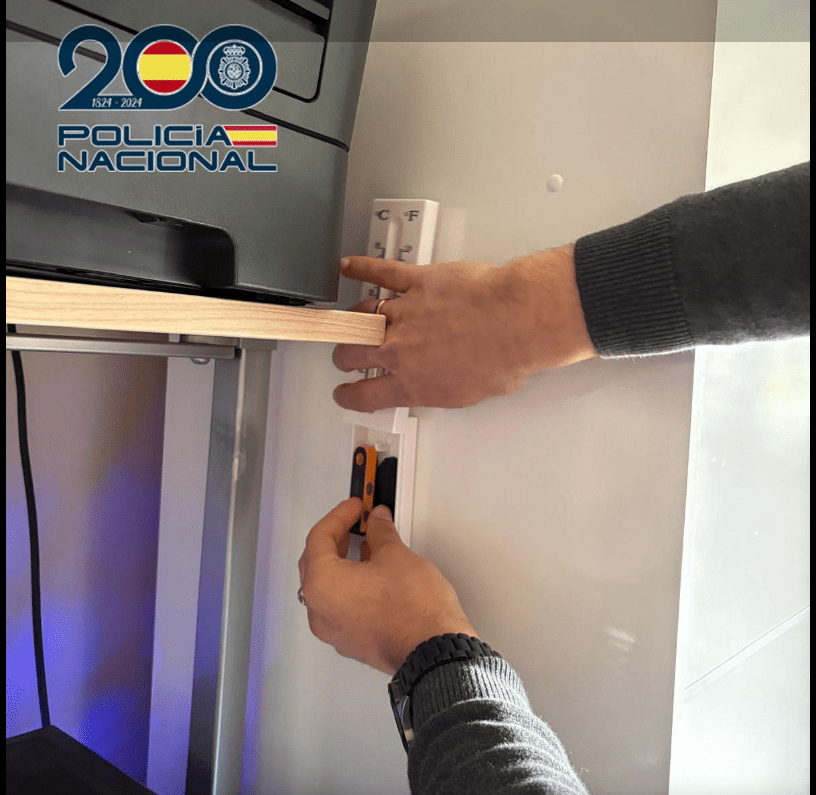
Authorities uncovered an unusual find during the raid: two crypto cold wallets hidden inside a household wall thermometer. Source: Ministerio Del Interior

Whether Police Can Actually Access The Funds Remains Unclear

Seizing a cold wallet is one thing. Getting inside it is another.

Cold wallets require a PIN or a seed phrase to unlock. Without those credentials, the hardware is essentially useless — the funds stay locked, inaccessible to anyone, including law enforcement.

Officials have not said whether they obtained the information needed to open the devices. Spain’s Interior Ministry had not responded to requests for comment before the story was published.

The case puts a spotlight on a problem that police departments worldwide are still working through. Hardware wallets are showing up in investigations that have nothing to do with crypto fraud or digital currency schemes. Piracy operations, it turns out, are now storing earnings the same way crypto investors do.

BTCUSD currently trading at $77,860. Chart: TradingView

South Korea Has Faced Its Own Custody Failures

Even when authorities can access seized crypto, holding onto it has proven difficult. South Korea has dealt with two high-profile losses of confiscated digital assets in recent years.

In one case, about 22 Bitcoin — valued at $1.5 million at the time — went missing from the Gangnam Police Station.

The funds had been seized in 2021 and vanished without the cold wallet being physically stolen, according to reports. A nationwide audit of digital asset custody practices uncovered the loss.

Featured image from DualShockers, chart from TradingView

Perguntas relacionadas

QWhat unusual item did Spanish police discover during their raid that contained the seized funds?

ATwo crypto cold wallets hidden inside a household wall thermometer.

QHow much money, in US dollars, was contained in the seized crypto wallets?

AApproximately $467,000.

QWhat was the primary source of revenue for the illegal manga distribution platform?

AAdvertising revenue.

QWhat is one major challenge law enforcement faces when seizing a cold wallet?

AAccessing the funds without the required PIN or seed phrase.

QWhich country was cited as an example of facing high-profile losses of confiscated digital assets?

ASouth Korea.

Leituras Relacionadas

$9.4 Billion: The Largest Robotics Funding This Year Has Emerged

Munich-based humanoid robotics company Neura has completed a $1.4 billion (approximately RMB 94.9 billion) Series C funding round, valuing the company at around $7 billion and positioning it among the global leaders in the sector. The investment round is notable not just for its size—reportedly the largest in robotics this year—but also for its strategic backers, which include tech giants like NVIDIA and Amazon, alongside established industrial players such as German engineering firms Bosch and Schaeffler. This mix of investors signals a significant shift in the industry's focus from technological demonstrations and general-purpose narratives toward practical, industrial deployment and commercialization. Neura's approach centers on developing humanoid robots for defined, high-value industrial tasks rather than pursuing a general-purpose model. Its early validation comes from a partnership with BMW, where its robots are being tested on actual production lines. The involvement of Bosch and Schaeffler, companies deeply embedded in global manufacturing, underscores a growing belief that humanoid robots are transitioning from labs to viable factory-floor solutions. The article highlights two converging trends driving investment: advancements in AI and large language models, which enhance robots' perception and decision-making in unstructured environments, and mounting pressure from labor shortages and rising costs in major manufacturing regions. The funding landscape is now bifurcating between companies like Figure AI, focusing on versatile general-purpose robots, and firms like Neura, targeting specific vertical industrial applications with clearer, shorter paths to ROI. While technical hurdles remain, the core challenges for widespread adoption are increasingly seen as engineering and commercial in nature: managing the high integration and customization costs for different factory environments and establishing robust, localized maintenance and service networks. The record investment in Neura, particularly from industrial capital, indicates the industry's growing confidence in moving from proving feasibility to solving the practical problems of scalability, reliability, and building sustainable business models around humanoid robots in real-world settings like automotive manufacturing and hazardous labor environments.

marsbitHá 7h

$9.4 Billion: The Largest Robotics Funding This Year Has Emerged

marsbitHá 7h

Trading

Spot
Futuros
活动图片





