The Year's Most Expensive New Stock Hits the Market: Pinson Laser, Bright Prospects Amid Concerns

marsbitPublicado em 2026-08-18Última atualização em 2026-08-18

Resumo

Annual Most Expensive IPO Debuts: Pinsun Laser's Bright Prospects Shadowed by Concerns Pinsun Laser, dubbed "A-share's first precision laser stock", has made its debut on the STAR Market with a record-high issue price of 186.88 yuan per share this year. Despite the hype, its journey is marked by challenges. The company's allure lies in its "small and beautiful" profile. It issued a small float of only 10 million new shares, boosting its price elasticity and retail investor appeal. Financially, it has shown strong performance with revenue growing at a 68.2% CAGR from 2023 to 2025 and gross margins consistently above 67%. As the domestic leader in precision lasers for quantum technology, it holds a 9.21% global and 16.85% domestic market share in 2024, offering a scarce A-share investment opportunity. Its P/E ratio of 49.42x at issuance was below the industry average, suggesting room for valuation growth. However, Pinsun's path is fraught with hurdles. Its core market—lasers for quantum tech (computing, sensing, communication)—remains a niche, research-driven sector. Global demand is projected to grow at a modest sub-8% CAGR through 2030, constrained by the distant commercialization timeline of quantum computing, which heavily relies on research funding cycles. The company's prestigious clientele, including top global universities, exposes it to funding volatility. It faces intense competition from entrenched giants like Germany's Toptica and the US's Coherent. While Pinsun ...

By | Alpha Factory

The year's most expensive new stock has been listed.

Upon opening, Pinson Laser will officially debut on the STAR Market. As "the first stock in the A-share market for precision lasers," Pinson Laser's issue price per share reached 186.88 yuan, making it the most expensive new stock of the year. In comparison, the most discussed stock on the STAR Market currently, Yushu, has an issue price of 150.8 yuan per share.

Over the past three years, the company's revenue has grown at a compound annual growth rate of 68.2%, with gross margin consistently above 67%. The company is engaged in the R&D, production, and sales of precision lasers, primarily serving fields with grand prospects like quantum technology.

However, before reaching that future, Pinson Laser still faces a series of real-world challenges, including fluctuations in downstream demand and competition from overseas giants.

01 How Did Pinson Laser Become the 'Year's Most Expensive New Stock'?

"Small yet beautiful" is an important reason why Pinson Laser became the most expensive new stock.

"Small" refers to its small float.

In this IPO, Pinson Laser issued only 10 million new shares, making it one of the new stocks with the smallest number of shares issued this year. Calculated at the issue price, the company is expected to raise a total of 1.869 billion yuan.
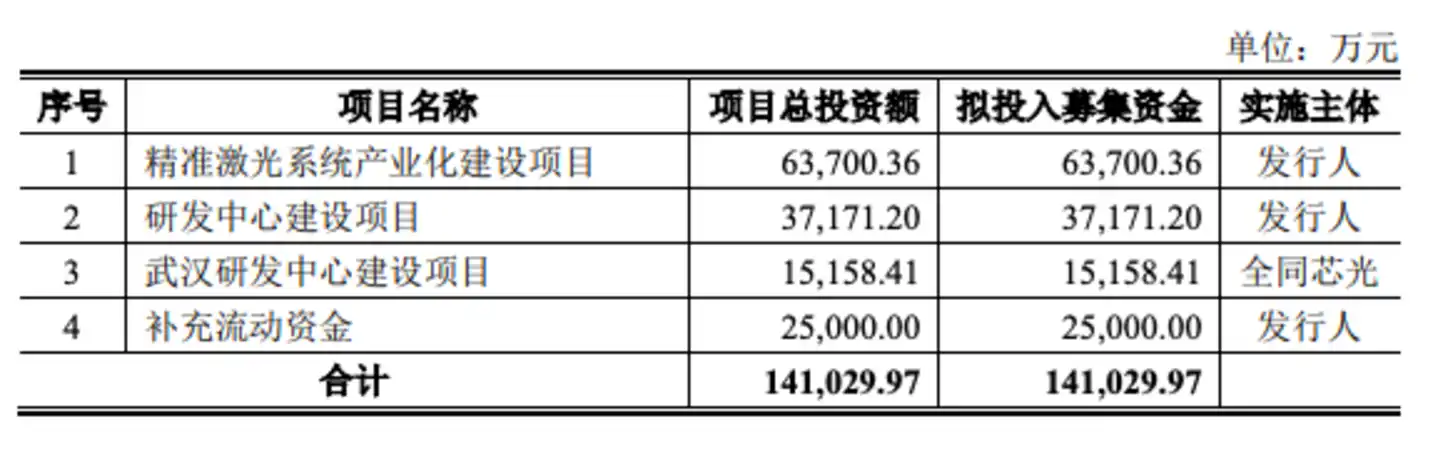
Pinson Laser's proposed fundraising projects are expected to use 1.41 billion yuan of the raised funds; Data source: Prospectus

The small share capital not only pushed up the issue price but also increased the post-listing stock price volatility. Pinson Laser's unrestricted float is only 7.6178 million shares, accounting for 19.04% of the total share capital, corresponding to a float market value of approximately 1.42 billion yuan—this size is also not large within the STAR Market.

At the same time, this makes the subscription threshold quite friendly. The upper limit for online subscription is 2,000 shares, requiring a Shanghai market value of only 20,000 yuan for a full subscription, allowing many retail investors to participate. Consequently, Pinson Laser's lottery winning rate is quite low at only 0.02%.

Pinson Laser's "beauty" refers to its impressive performance.

Pinson Laser's main business is precision lasers, with its core application scenario being the quantum technology field.

In terms of performance, from 2023 to 2025, the company's revenue was 148 million yuan, 292 million yuan, and 418 million yuan respectively, achieving a three-year compound growth rate of 68.2%. During the same period, net profit attributable to shareholders grew from 60.46 million yuan to 159 million yuan, with profit growth largely matching revenue expansion.

Performance growth has also strengthened the company's position in the industry. According to QY Research data, in 2024, Pinson Laser held a 9.21% market share in the global quantum technology laser market and a 16.85% share in the domestic market. In the niche field of precision lasers, Pinson Laser is already the domestic leader.

Furthermore, the company's gross margin has remained stable at a high level between 67% and 70%, indicating that Pinson Laser's growth is driven by genuine demand rather than price competition.

Besides being "small yet beautiful," the valuation premium brought by scarcity is another significant reason why Pinson Laser became the "year's most expensive new stock."

For investors looking to buy into a core hardware player in the quantum technology sector, Pinson Laser is currently almost the only choice in the A-share market. This "one-of-a-kind" scarcity supports the market's acceptance of its high pricing, a logic that has been repeatedly validated on the STAR Market this year.

It's worth noting that Pinson Laser's price-to-earnings (P/E) ratio at issuance is 49.42 times, lower than the industry average P/E ratio (68.04 times). This largely implies that the company's high gross margin has not been fully "priced in."

02 The Road to the Stars and Beyond is Paved with Thorns

Quantum technology is often imbued with "star-reaching" imagination. Whether it's quantum computing, quantum precision measurement, or quantum communication, each direction points toward disruptive technological revolutions. And lasers are indispensable core hardware for these cutting-edge technologies.

But stripping away the conceptual halo, the quantum information laser track where Pinson Laser operates is currently still a niche market dominated by scientific research procurement.

Data from QY Research shows that the global scientific research laser market size in 2024 was approximately $2.147 billion, expected to reach $3.331 billion by 2030, with a compound annual growth rate of less than 8%.

An 8% growth rate might be respectable in the manufacturing sector, but this growth rate clearly cannot support excessively high imaginations.

The reason for the limited market size is straightforward: quantum computing and quantum precision measurement are still mainly in the laboratory stage, with true industrial applications still far off.

Pinson Laser's customer list is quite impressive, covering top-tier quantum research institutions in Europe and America such as Harvard University, University of Colorado, California Institute of Technology, and ETH Zurich.

This client list certainly testifies to the company's technical strength from the side. However, the demand from research institutions is significantly influenced by funding cycles. Orders surge when funding is ample and contract sharply when budgets tighten—a challenge faced by all scientific instrument and equipment manufacturers.

Pinson Laser also frankly admits in its prospectus that if downstream market demand declines or competition increases significantly in downstream application segments, the company may face risks of declining gross margin and operating performance.

Competition from overseas giants is another layer of pressure. The high-end narrow-linewidth precision laser market has long been dominated by overseas manufacturers, with Germany's Toptica and America's Coherent being the traditional powerhouses in this field.

Pinson Laser's technical approach has its own characteristics, adopting a "seed source + fiber amplification + nonlinear frequency conversion + frequency stabilization" architecture, which differs from the traditional schemes of overseas manufacturers. It can achieve narrow linewidth, low-noise laser output across the full spectrum from 177nm to 5000nm. While this route offers advantages in cost and spectral coverage, it still needs time to catch up in terms of brand recognition.

A greater variable lies in the significant uncertainty surrounding the industrialization pace of quantum computing. The industry generally believes that commercial applications for general-purpose quantum computers are at least a decade or more away.

Before that, the primary customers for quantum technology lasers will remain research institutions, with a clearly visible market ceiling. If the industrialization process of quantum computing is slower than expected, Pinson Laser's growth story will need to find new support.

The semiconductor business has been entrusted with high hopes as a second growth curve. Pinson Laser's products have already penetrated semiconductor fields such as wafer fabrication, wafer measurement and inspection, and wafer stealth dicing. From 2023 to 2025, the company's revenue in this field increased from 25.15 million yuan to 104 million yuan.

The semiconductor equipment market is far larger than the scientific research laser market. If Pinson Laser can gain a foothold in the semiconductor field, it would undoubtedly significantly raise the company's business ceiling.

But competition in the semiconductor market is equally fierce. International giants like Coherent and II-VI have deep layouts in the semiconductor laser field. For Pinson Laser to increase its share from 1.98% in the semiconductor sector will be no easy task.

R&D is another test for Pinson Laser. During the reporting period, the company's R&D expenses were 22.12 million yuan, 41.71 million yuan, and 61 million yuan respectively, accounting for 14% to 15% of revenue. This proportion is not low, but the absolute amount pales in comparison to the hundreds of millions of dollars in R&D investment by overseas giants.

It's not hard to see that between the "star-reaching" prospects and revenue lies a long path of industrialization.

For Pinson Laser, focusing on the present is more likely to lead to the shores of the future.

Criptomoedas em alta

Perguntas relacionadas

QWhat are the main factors that made Pinzhun Laser the most expensive IPO of the year?

AThe main factors are its 'small but beautiful' characteristics. 'Small' refers to its small float share, which increases price volatility and makes it accessible to retail investors. 'Beautiful' refers to its impressive financial performance, with revenue CAGR of 68.2% over three years and consistently high gross margins above 67%. Additionally, its scarcity as a core hardware player in the quantum technology sector creates valuation premiums, and its P/E ratio was lower than the industry average, suggesting its high profitability wasn't fully priced in.

QWhat are the primary risks or challenges facing Pinzhun Laser's business in the quantum technology sector?

AThe primary risks include: 1) A limited, niche market dominated by research institutions whose demand is volatile and dependent on research funding cycles. 2) Fierce competition from established international giants like Germany's Toptica and America's Coherent. 3) Significant uncertainty around the industrialization timeline for quantum computing, which is likely more than a decade away, keeping the market's growth ceiling relatively low in the near term.

QHow does Pinzhun Laser plan to expand its business beyond the quantum technology research market?

APinzhun Laser is focusing on the semiconductor sector as its second growth curve. The company has already begun supplying products for wafer manufacturing, measurement/inspection, and stealth dicing. Revenue from this segment grew significantly from 25.15 million yuan in 2023 to 104 million yuan in 2025. The semiconductor equipment market is much larger than the research laser market, offering a substantial opportunity to raise the company's business ceiling.

QWhat is the structure of the global market for quantum technology lasers, and what is Pinzhun Laser's position within it?

AThe global quantum technology laser market is currently a small, research-driven market. According to QY Research data, the global market size was approximately $2.147 billion in 2024. In this niche, Pinzhun Laser has established itself as a domestic leader. In 2024, it held a 9.21% market share in the global market for lasers used in quantum technology and a 16.85% share in the domestic Chinese market.

QWhat is unique about Pinzhun Laser's technical approach compared to its overseas competitors?

APinzhun Laser employs a unique technical architecture consisting of 'seed source + fiber amplification + nonlinear frequency conversion + frequency stabilization.' This differs from the traditional solutions used by overseas competitors like Toptica and Coherent. Pinzhun's approach offers advantages in cost and wavelength coverage, enabling narrow-linewidth, low-noise laser output across the full spectrum from 177nm to 5000nm.

Leituras Relacionadas

Arthur Hayes Ten Thousand Words Interview: ETH to $30,000; FLOP Will Surpass ETH

Arthur Hayes Interview Summary: In a wide-ranging interview, Arthur Hayes discusses macroeconomic drivers for crypto, bullish predictions for ETH and BTC, and details his new project, Flop Network. On Macroeconomics & Market Outlook: Hayes argues that unsustainable US debt and potential Yield Curve Control (YCC) will drive massive liquidity into hard assets like Bitcoin. He views recent Treasury bond回购 operations as a key signal, comparing the current environment to the 2008 financial crisis that birthed Bitcoin. He predicts Bitcoin will break its all-time high, reaching around $126,000 by year-end, and could soar to $500,000 if the Fed removes limits on its FEMA repo facility. On Ethereum & Altcoins: Hayes is particularly bullish on ETH, calling it his top large-cap altcoin pick. He believes it will significantly outperform in this cycle, potentially reaching $20,000-$30,000, as it hasn't yet broken its 2021 high unlike other major assets. He values ETH for its established developer community and Lindy effect. On Regulation: He dismisses the US Clarity Act as irrelevant for crypto's core value proposition, stating that macroeconomic liquidity, not regulation, is the primary driver. On Flop Network: Hayes unveils his new project, Flop Network, designed to be a native currency for the AI Agent economy. The core thesis is that AI Agents need a货币 that can be directly converted into compute power (measured in FLOPs - Floating Point Operations). The network will use a "Proof of Useful Inference" consensus where miners earn FLOP tokens for processing AI推理 tasks. It will also provide decentralized storage for AI memory/context. The token will be distributed via a massive airdrop (targeting 20% of the 10-year supply) to early testnet participants and users, with no VC预售 or public sale. Mainnet is slated for Q1 2025. Hayes believes FLOP has a "binary" outcome: it could become the base money for the AI economy and rival Bitcoin, or it could fail.

Odaily星球日报Há 16m

Arthur Hayes Ten Thousand Words Interview: ETH to $30,000; FLOP Will Surpass ETH

Odaily星球日报Há 16m

Goldman Sachs Research Report Analysis: Samsung Electronics' Shareholder Returns Fall Short of Expectations, FCF Expansion Supports Valuation Recovery

Gold Sachs research report analysis indicates Samsung Electronics' announced shareholder return pool for 2026 (projected 90-110 trillion KRW) fell short of market expectations for a larger one-time payout. However, Goldman emphasizes that sustained Free Cash Flow (FCF) expansion and a stable, phased return mechanism are the true drivers for valuation repair, not a single event. The report maintains a Buy rating on Samsung ordinary shares with a 740,000 KRW target price, implying 74% upside. Samsung plans a ~30 trillion KRW dividend in Q3 2024, with the remaining returns from the 2026 pool executed post-January 2027 earnings via dividends and share buybacks/cancellations. Goldman estimates 2024-2026 cumulative FCF at ~270 trillion KRW. Assuming a 50% return ratio, total shareholder returns would be ~135 trillion KRW. After accounting for 2024-2025 payouts, the 2026 return is estimated near 106 trillion KRW, at the high end of guidance. While Samsung's short-term return scale lags peers like SK Hynix, its future return capacity is underpinned by robust FCF growth from memory and HBM businesses. Goldman forecasts FCF will significantly rise in 2027-2028, potentially boosting annual return pools to 179 trillion and 232 trillion KRW respectively under the existing policy, potentially matching or exceeding peers. Samsung's current valuation (1.7x P/B for 2027) is seen as attractive given high ROE projections (40%-50%). The core thesis is that Samsung's shareholder return story represents a structural improvement based on durable cash flow generation, not a one-time event.

marsbitHá 22m

Goldman Sachs Research Report Analysis: Samsung Electronics' Shareholder Returns Fall Short of Expectations, FCF Expansion Supports Valuation Recovery

marsbitHá 22m

Trading

Spot

Artigos em Destaque

O que é MRNA

MRNA refere-se a 1 ação da Moderna, Inc. (Nasdaq: MRNA), cotada em USD. A Moderna desenvolve medicamentos de RNA mensageiro (mRNA), incluindo vacinas para doenças infeciosas e terapias oncológicas.

179 Visualizações TotaisPublicado em {updateTime}Atualizado em 2026.08.20

O que é MRNA

O que é SOFTBANK

A SoftBank Group Corp., com sede em Tóquio, Japão, é um conglomerado global que oferece uma vasta gama de serviços, com um foco principal em telecomunicações tanto a nível nacional como internacional. As suas extensas operações estão estrategicamente organizadas em cinco segmentos distintos: Negócio de Investimento de Empresas Holding, SoftBank Vision Funds, SoftBank, Arm e Fundos da América Latina. Para além dos serviços tradicionais de comunicação móvel, banda larga e fixa, bem como da venda de dispositivos móveis, a empresa está profundamente envolvida no panorama digital. Isto inclui publicidade na internet, distribuição de anúncios online e a provisão de conteúdo digital, como e-books e a distribuição de vídeo, voz e dados. 

160 Visualizações TotaisPublicado em {updateTime}Atualizado em 2026.08.20

O que é SOFTBANK

O que é ANET

A Arista Networks (NYSE: ANET), fundada em 2004 e com sede em Santa Clara, CA, desenvolve soluções de rede em nuvem centradas em switches Ethernet de alto desempenho e no seu sistema operativo proprietário EOS. A empresa serve centros de dados hyperscale, fornecedores de nuvem e empresas, tendo como principais clientes a Microsoft e a Meta. A Arista é uma beneficiária direta da construção de infraestrutura de IA, detendo uma quota de mercado líder em comutação de centros de dados 400G/800G.

104 Visualizações TotaisPublicado em {updateTime}Atualizado em 2026.08.21

O que é ANET

Discussões

Bem-vindo à Comunidade HTX. Aqui, pode manter-se informado sobre os mais recentes desenvolvimentos da plataforma e obter acesso a análises profissionais de mercado. As opiniões dos utilizadores sobre o preço de O (O) são apresentadas abaixo.

活动图片