Hang Seng TECH Index Launches Largest Reform in History

marsbitPublicado em 2026-08-12Última atualização em 2026-08-12

Resumo

The Hang Seng Tech Index is undergoing its most significant reform since its launch in 2020. In a consultation paper, Hang Seng Indexes proposed major changes to enhance the index's market representation, reflecting the evolution of Hong Kong's tech sector. Key proposed revisions include completely removing industry classification restrictions, updating six key technology themes (e.g., Digital Platforms, AI, Advanced Hardware), and implementing a dual-track selection mechanism. This new mechanism will pick 40 constituents based on market capitalization and 10 based on revenue growth, expanding the total number of constituents from 30 to 50. The reform aims to address the index's historical concentration in large internet platforms like Tencent and Alibaba, which has caused it to miss gains from newer, high-growth tech areas such as AI and semiconductors. Many of these newer companies are smaller in market cap but show stronger revenue growth. The proposed changes would significantly increase exposure to themes like Advanced Hardware (from 5 to 15 simulated constituents) and AI (from 3 to 6). Simulated results show the reform would slightly reduce the index's concentration in its top ten holdings, diversify its thematic exposure, and incorporate faster-growing companies. The "revenue growth" subset of new constituents shows a median growth rate of 82%, far exceeding the current index's 13.8%. Final revisions are expected by late September, with changes taking effect in Dec...

The Hang Seng TECH Index is actively embracing hard technology.

On the evening of August 10, Hang Seng Indexes Company issued a consultation paper stating that the composition of Hong Kong's technology sector continues to expand, with faster-growing revenue companies often having smaller market capitalizations. To enhance the market representation of the Hang Seng TECH Index, they are seeking market opinions on the index revision proposal.

The key points of this reform include: fully removing industry restrictions; revising six technology themes; introducing a dual-track stock selection mechanism based on market capitalization and revenue growth; and expanding the number of constituent stocks from 30 to 50.

"The Hang Seng Index has been under significant pressure over the past six months, missing out on the gains brought by the global AI (Artificial Intelligence) surge," a source close to Hang Seng Indexes Company told Caijing. "This is just the first step of the reform, starting with the consultation paper. We will see how the market responds next."

According to simulation calculations by Hang Seng Indexes Company, among the 50 constituent stocks of the revised Hang Seng TECH Index, the number of stocks related to advanced hardware and artificial intelligence would increase from the current 5 and 3 to 15 and 6, respectively.

The results of this revision are expected to be announced by the end of September, with changes to the constituent stocks taking effect on the official index adjustment date in December. If the plan is ultimately approved, this would be the most significant and systematic structural reform of the Hang Seng TECH Index since its launch in 2020.

As of the end of June 2026, the global fund assets tracking this index have reached US$40.4 billion. Any changes to the constituent list and weights will trigger large-scale passive fund rebalancing, and its impact on Hong Kong's technology sector extends far beyond technical adjustments to index compilation.

1

Changes in Hong Kong's Tech Ecosystem

Looking back to July 2020, the Hang Seng TECH Index was officially launched, with the original intention of providing global investors with a tool to track the overall performance of Hong Kong-listed technology companies, selecting the 30 largest technology firms by market capitalization. Today, the Hang Seng TECH Index has grown into one of the most influential flagship indices in the Hong Kong stock market, with tracking assets increasing from an initial US$1.5 billion to US$40.4 billion, a nearly 26-fold increase.

Although the index's market status has grown, its representative capacity has not kept pace with the dramatic changes in Hong Kong's technology ecosystem. In the past, because the Hang Seng TECH Index has been highly concentrated in the Network and E-commerce themes since its inception, the weights of internet platform companies such as Tencent, Meituan, and Alibaba have long dominated. The index's fluctuations were largely tied to the outcomes of food delivery subsidy wars, e-commerce promotional season data, and even the approval rhythm of game licenses.

The scope of technology investment in Hong Kong continues to expand. Over the past few years, Hong Kong has welcomed a batch of companies in artificial intelligence, semiconductors, robotics, and specialized technology, with enterprises listed under the HKEX's new Chapter 18C rules also increasing. However, these companies generally have short listing histories and small market capitalizations, systematically excluded by the market capitalization threshold.

According to Hang Seng Indexes Company data, at the end of 2021, the Network theme had the highest share among Hong Kong tech stocks, accounting for 37.3%. By the first half of 2026, Network's share had dropped to 25.0%, surpassed by Intelligent Transformation at 32.1%.

Furthermore, within Hong Kong's technology sector, companies with stronger revenue growth tend to have smaller market capitalizations. Hang Seng Indexes Company data shows that the median revenue growth of current Hang Seng TECH Index constituents is significantly lower than that of smaller-cap, non-constituent companies.

Currently, the Hang Seng TECH Index has included two major AI listed companies, but this has not impacted the heavyweight stocks. The latest Hang Seng TECH Index changes effective on June 8 included MiniMax and Zhipu AI, with a combined weighting of less than 1%.

2

What Impact Will the Two Major Revision Proposals Have?

The revision proposals for the Hang Seng TECH Index involve structural adjustments around two dimensions.

The first is expanding the coverage of technology themes. Specific suggestions include: removing industry requirements, as technological innovation has integrated into all industries and is not limited by traditional sector classifications; revising six major technology themes to cover Digital Platforms & Solutions, Artificial Intelligence, Advanced Hardware, Robotics & Automation, Cloud, and Frontier Technology. Additionally, expanding the number of technology sub-themes under the six major themes from 16 to 24.
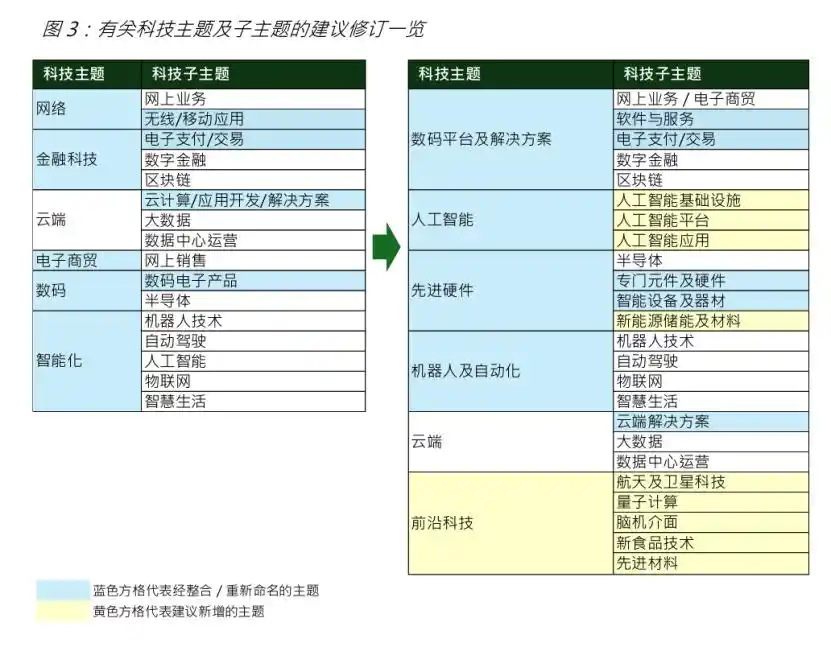
Source: Hang Seng Indexes Company website

The second is introducing a grouping selection mechanism. Hang Seng Indexes Company proposes that the stock selection scope for the Hang Seng TECH Index be limited to constituents of the Hang Seng Composite LargeCap & MidCap Index, while introducing a grouping selection mechanism. Selection will proceed via a dual-track system based on "Market Capitalization Group" and "Revenue Growth Group," and the number of constituent stocks will increase from 30 to 50. Specifically, the top 40 will be selected by market capitalization ranking, and the top 10 will be selected by revenue growth ranking.
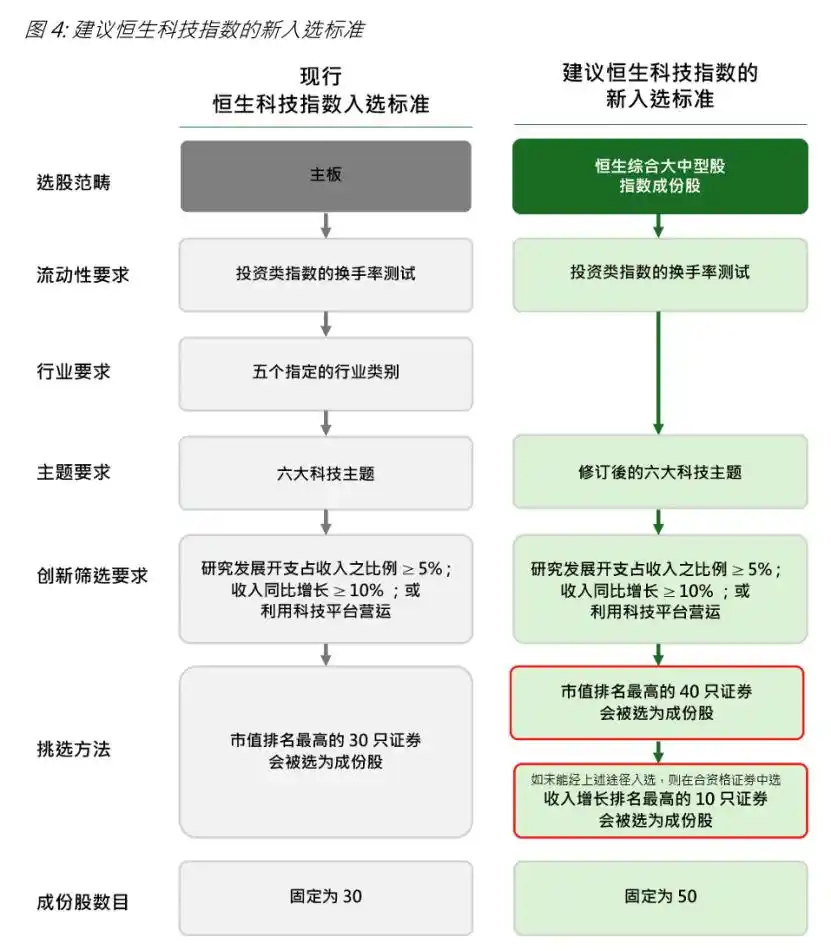
Source: Hang Seng Indexes Company website

According to simulation results released by Hang Seng Indexes Company, the revision will bring three major impacts on index characteristics.

First, index concentration will decrease slightly. Hang Seng Indexes Company simulation results show that the weight of the top ten constituents will drop from the current 70.6% to 66.3%, dispersing the index's exposure to leading companies somewhat.

Second, the distribution of technology themes will become more diverse. Under the new thematic framework, the number of constituents related to "Advanced Hardware" will increase from 5 to 15, and those related to "Artificial Intelligence" will increase from 3 to 6. Newly added themes like "Frontier Technology" will also gain inclusion space, significantly broadening the index's coverage of technology attributes.

Finally, the Revenue Growth Group will introduce high-growth targets. Simulation results show that the 10 new constituent stocks added via the "Revenue Growth Group" have a median revenue growth rate as high as 82%, higher than the 23.4% for those added via the "Market Capitalization Group," and far exceeding the 13.8% revenue growth rate of existing constituents.

This article is from the WeChat public account "Read One Insight" (ID: dushuyizhi007), author: Cheng Mengqi, editor: Guo Nan.


Criptomoedas em alta

Perguntas relacionadas

QWhat are the main objectives of the proposed reforms to the Hang Seng TECH Index?

AThe main objectives are to enhance the index's market representation by adapting to the evolving Hong Kong tech ecosystem. Key changes include removing industry restrictions, revising the six tech themes, introducing a dual-track selection mechanism based on market cap and revenue growth, and expanding the number of constituent stocks from 30 to 50.

QHow does the proposed dual-track selection mechanism for the Hang Seng TECH Index work?

AThe dual-track selection mechanism involves selecting constituents based on two criteria: market capitalization and revenue growth. The top 40 stocks will be chosen by market cap ranking, and the top 10 stocks will be chosen by revenue growth ranking, resulting in a total of 50 constituent companies.

QWhat changes are expected in the thematic composition of the Hang Seng TECH Index based on the reform proposal?

AThe thematic composition will become more diversified. The number of constituents related to 'Advanced Hardware' is projected to increase from 5 to 15, and those related to 'Artificial Intelligence' from 3 to 6. New themes like 'Frontier Technology' will also gain representation.

QAccording to the article, how has the focus of Hong Kong's listed tech stocks shifted between 2021 and 2026?

AThe focus has shifted from internet-centric to intelligence-centric. In 2021, the 'Network' theme comprised 37.3% of listed tech stocks. By H1 2026, its share had fallen to 25.0%, while the 'Intelligent Implementation' theme had become the largest, accounting for 32.1%.

QWhat is the significance of the Hang Seng TECH Index's asset under management (AUM) growth mentioned in the article?

AThe article highlights that the global assets tracking the Hang Seng TECH Index have grown from $1.5 billion at launch to $40.4 billion as of June 2026. This 26-fold increase signifies the index's status as a major flagship index. Consequently, any changes to its constituents or weights will trigger significant passive fund reallocations, impacting the broader Hong Kong tech sector.

Leituras Relacionadas

Arthur Hayes Ten Thousand Words Interview: ETH to $30,000; FLOP Will Surpass ETH

Arthur Hayes Interview Summary: In a wide-ranging interview, Arthur Hayes discusses macroeconomic drivers for crypto, bullish predictions for ETH and BTC, and details his new project, Flop Network. On Macroeconomics & Market Outlook: Hayes argues that unsustainable US debt and potential Yield Curve Control (YCC) will drive massive liquidity into hard assets like Bitcoin. He views recent Treasury bond回购 operations as a key signal, comparing the current environment to the 2008 financial crisis that birthed Bitcoin. He predicts Bitcoin will break its all-time high, reaching around $126,000 by year-end, and could soar to $500,000 if the Fed removes limits on its FEMA repo facility. On Ethereum & Altcoins: Hayes is particularly bullish on ETH, calling it his top large-cap altcoin pick. He believes it will significantly outperform in this cycle, potentially reaching $20,000-$30,000, as it hasn't yet broken its 2021 high unlike other major assets. He values ETH for its established developer community and Lindy effect. On Regulation: He dismisses the US Clarity Act as irrelevant for crypto's core value proposition, stating that macroeconomic liquidity, not regulation, is the primary driver. On Flop Network: Hayes unveils his new project, Flop Network, designed to be a native currency for the AI Agent economy. The core thesis is that AI Agents need a货币 that can be directly converted into compute power (measured in FLOPs - Floating Point Operations). The network will use a "Proof of Useful Inference" consensus where miners earn FLOP tokens for processing AI推理 tasks. It will also provide decentralized storage for AI memory/context. The token will be distributed via a massive airdrop (targeting 20% of the 10-year supply) to early testnet participants and users, with no VC预售 or public sale. Mainnet is slated for Q1 2025. Hayes believes FLOP has a "binary" outcome: it could become the base money for the AI economy and rival Bitcoin, or it could fail.

Odaily星球日报Há 16m

Arthur Hayes Ten Thousand Words Interview: ETH to $30,000; FLOP Will Surpass ETH

Odaily星球日报Há 16m

Goldman Sachs Research Report Analysis: Samsung Electronics' Shareholder Returns Fall Short of Expectations, FCF Expansion Supports Valuation Recovery

Gold Sachs research report analysis indicates Samsung Electronics' announced shareholder return pool for 2026 (projected 90-110 trillion KRW) fell short of market expectations for a larger one-time payout. However, Goldman emphasizes that sustained Free Cash Flow (FCF) expansion and a stable, phased return mechanism are the true drivers for valuation repair, not a single event. The report maintains a Buy rating on Samsung ordinary shares with a 740,000 KRW target price, implying 74% upside. Samsung plans a ~30 trillion KRW dividend in Q3 2024, with the remaining returns from the 2026 pool executed post-January 2027 earnings via dividends and share buybacks/cancellations. Goldman estimates 2024-2026 cumulative FCF at ~270 trillion KRW. Assuming a 50% return ratio, total shareholder returns would be ~135 trillion KRW. After accounting for 2024-2025 payouts, the 2026 return is estimated near 106 trillion KRW, at the high end of guidance. While Samsung's short-term return scale lags peers like SK Hynix, its future return capacity is underpinned by robust FCF growth from memory and HBM businesses. Goldman forecasts FCF will significantly rise in 2027-2028, potentially boosting annual return pools to 179 trillion and 232 trillion KRW respectively under the existing policy, potentially matching or exceeding peers. Samsung's current valuation (1.7x P/B for 2027) is seen as attractive given high ROE projections (40%-50%). The core thesis is that Samsung's shareholder return story represents a structural improvement based on durable cash flow generation, not a one-time event.

marsbitHá 22m

Goldman Sachs Research Report Analysis: Samsung Electronics' Shareholder Returns Fall Short of Expectations, FCF Expansion Supports Valuation Recovery

marsbitHá 22m

Trading

Spot

Artigos em Destaque

O que é MRNA

MRNA refere-se a 1 ação da Moderna, Inc. (Nasdaq: MRNA), cotada em USD. A Moderna desenvolve medicamentos de RNA mensageiro (mRNA), incluindo vacinas para doenças infeciosas e terapias oncológicas.

179 Visualizações TotaisPublicado em {updateTime}Atualizado em 2026.08.20

O que é MRNA

O que é SOFTBANK

A SoftBank Group Corp., com sede em Tóquio, Japão, é um conglomerado global que oferece uma vasta gama de serviços, com um foco principal em telecomunicações tanto a nível nacional como internacional. As suas extensas operações estão estrategicamente organizadas em cinco segmentos distintos: Negócio de Investimento de Empresas Holding, SoftBank Vision Funds, SoftBank, Arm e Fundos da América Latina. Para além dos serviços tradicionais de comunicação móvel, banda larga e fixa, bem como da venda de dispositivos móveis, a empresa está profundamente envolvida no panorama digital. Isto inclui publicidade na internet, distribuição de anúncios online e a provisão de conteúdo digital, como e-books e a distribuição de vídeo, voz e dados. 

160 Visualizações TotaisPublicado em {updateTime}Atualizado em 2026.08.20

O que é SOFTBANK

O que é ANET

A Arista Networks (NYSE: ANET), fundada em 2004 e com sede em Santa Clara, CA, desenvolve soluções de rede em nuvem centradas em switches Ethernet de alto desempenho e no seu sistema operativo proprietário EOS. A empresa serve centros de dados hyperscale, fornecedores de nuvem e empresas, tendo como principais clientes a Microsoft e a Meta. A Arista é uma beneficiária direta da construção de infraestrutura de IA, detendo uma quota de mercado líder em comutação de centros de dados 400G/800G.

104 Visualizações TotaisPublicado em {updateTime}Atualizado em 2026.08.21

O que é ANET

Discussões

Bem-vindo à Comunidade HTX. Aqui, pode manter-se informado sobre os mais recentes desenvolvimentos da plataforma e obter acesso a análises profissionais de mercado. As opiniões dos utilizadores sobre o preço de O (O) são apresentadas abaixo.

活动图片