ENS Plans Large-Scale Expansion of Institutional Activity via Foundation Launch

cryptonews.ruPublicado em 2026-08-11Última atualização em 2026-08-11

Resumo

The Ethereum Name Service ($ENS) DAO token holders ratified the "Next Era of $ENS DAO" proposal, leading to the launch of the $ENS Foundation on-chain as a legal operational entity with a paid executive director, staff, and a five-member board, according to an August 11 blog post by $ENS Labs. This new foundation addresses limitations of the DAO structure, enabling activities like signing standardization agreements, hiring full-time staff, pursuing trademark infringements, and interacting with regulators and courts. $ENS Labs will now focus on technical development, including the ENSv2 upgrade, while the foundation handles off-chain operations, engages with bodies like ICANN and W3C, and pursues a .eth top-level domain. The $ENS DAO retains 54.6% of the total token supply and control over the protocol. The foundation is funded by .eth domain registration revenues, with its transactions subject to a 9-day security council veto period. It is a separate legal entity from $ENS Labs. The inaugural board includes Alexander Urbelis (Executive Director, former $ENS Labs CISO), founder Nick Johnson ($ENS Labs CEO), and three independent directors. Board terms last two years. This update follows governance tensions earlier in the year, including a June proposal for a temporary security council restructure. CEO Nick Johnson's significant token holdings reportedly influenced a vote against extending prior security council agreements, leading to a new eight-member council. Currently,...

$ENS token holders have ratified the "Next Era $ENS DAO" proposal and launched the executable code on the blockchain, creating the $ENS Foundation as a working organization with a paid executive director, employees, and a five-member board of directors, $ENS Labs announced in a blog post on August 11.

This change provides $ENS with its first legal entity capable of holding meetings where the DAO cannot. Furthermore, this entity will handle day-to-day operations, while token holders will continue to control the protocol.

Why the DAO Could Not Sign Documents

According to data from $ENS Labs, the DAO is not qualified to sign standardization agreements, hire full-time employees, sue a trademark owner for a phishing clone, or respond to legal inquiries.

Until now, most representative work remained undone, with some of it being handled by $ENS Labs; however, given that the company primarily specializes in engineering development, it was not prepared to objectively assess this role.

Now that the Foundation has been launched, $ENS Labs states it can focus on development, including the upgrade to ENSv2.

The Foundation has been tasked with taking on the off-chain computational workload. It can now join discussions with ICANN, IETF, and W3C and pursue recognition for the .ens top-level domain.

As a legal entity, it is also responsible for engaging with regulators, registrars, standardization bodies, and courts. Additionally, its duties include consolidating the $ENS brand's trademarks and assets to be able to combat impersonators.

What $ENS Says About Where the Money Remains

$ENS DAO's share of the total token supply is 54.6%, and it will continue to be under the control of the DAO, which includes token holders.

The Foundation, funded by revenue from .eth domain registrations, stores its assets in its own accounts; however, its transactions are now subject to a nine-day lock.

During these nine days, the $ENS Security Council can cancel any transaction that falls outside the Foundation's mandate.

The same post emphasized that the $ENS Foundation and $ENS Labs are not legally identical, and each functions as a separate legal entity. The Foundation does not own $ENS Labs, and the latter has no governance rights over the Foundation, its funds, or the protocol.

The closest ties the labs have with the Foundation are that the founder holds a seat on the Foundation's five-member board of directors; however, he does not participate in decisions regarding funding for the labs.

Who is on the $ENS Foundation's Five-Person Board of Directors?

The inaugural board includes Alexandre Urbelis, a cybersecurity attorney who previously held the roles of Chief Legal Counsel and Chief Information Security Officer (CISO) at $ENS Labs, and served as CISO for the NFL, and now holds the position of Executive Director.

Nick Johnson, founder and CEO of $ENS Labs, holds the founder seat.

The board consists of the remaining three Ventures and ETHGlobal; Brett Sun, co-founder of Prelude; and Anthony Leutenegger, CEO of Aragon. Kartik Talwar from A.Capital

Board directors will serve for two years, and their terms may be renewed by token holders.

The update from $ENS comes in a year already marked by some governance conflicts on the platform. In June a proposal for an interim review aimed to restructure their operations with a focus on the DAO and the foundation.

Johnson, the CEO, who owns approximately 3.26 million $ENS (equivalent to US bonds), has also been a source of some controversy, as, given the size of his holdings, he has the ability to influence the course of voting. This occurred when, reportedly, at the end of June, he managed to secure around 80% of votes against extending agreements with the Security Council.

They later approved a new eight-member council with a stricter requirement of 5 out of 8 votes for a two-year term.

Currently, $ENS is trading at approximately $4.12, down over 1.9% in the last 24 hours, according to CoinMarketCap data. It is now more than 95% below its peak of $85.69 reached in November 2021.


Criptomoedas em alta

Perguntas relacionadas

QWhat did the token holders of Ethereum Name Service ($ENS) vote to create, and what is its main purpose?

AThe $ENS token holders ratified the 'Next Era $ENS DAO' proposal and launched the executable code on the blockchain, creating the $ENS Foundation. Its main purpose is to serve as a legal operating entity that can handle tasks the DAO cannot, such as signing standardization agreements, hiring full-time employees, pursuing legal action, and engaging with regulatory bodies and standards organizations.

QWhy was a foundation necessary for the $ENS ecosystem, according to the article?

AThe $ENS DAO lacked the legal authority to perform key functions like signing contracts, hiring full-time staff, suing trademark infringers, or responding to court requests. The new foundation takes over these off-chain operational burdens, allowing the DAO to focus on protocol governance and $ENS Labs to concentrate on technical development, including the upgrade to ENSv2.

QHow is the $ENS Foundation funded, and what financial safeguards are in place?

AThe $ENS Foundation is funded by revenue from .eth domain registrations. As a financial safeguard, the foundation's transactions are locked for nine days. During this period, the $ENS Security Council has the power to veto any transaction that falls outside the foundation's mandate.

QWho is the Executive Director of the newly formed $ENS Foundation, and what is his background?

AThe Executive Director of the $ENS Foundation is Alexander Urbelis. His background includes serving as Chief Legal Officer and Chief Information Security Officer (CISO) at $ENS Labs, and previously as CISO for the NFL.

QWhat recent governance controversy involving $ENS founder Nick Johnson is mentioned in the article?

AThe article mentions a governance controversy where $ENS Labs CEO and founder Nick Johnson, who holds approximately 3.26 million $ENS tokens, reportedly influenced a vote in late June. He was able to sway about 80% of votes against extending agreements with the Security Council. This later led to the approval of a new, 8-member council with stricter requirements.

Leituras Relacionadas

MSX US Stock Daily Observation: Alibaba FY2027 Q1 Earnings: AI Cloud Revenue Growth Hits Record High, AI Cloud Achieves Profitable Closed Loop

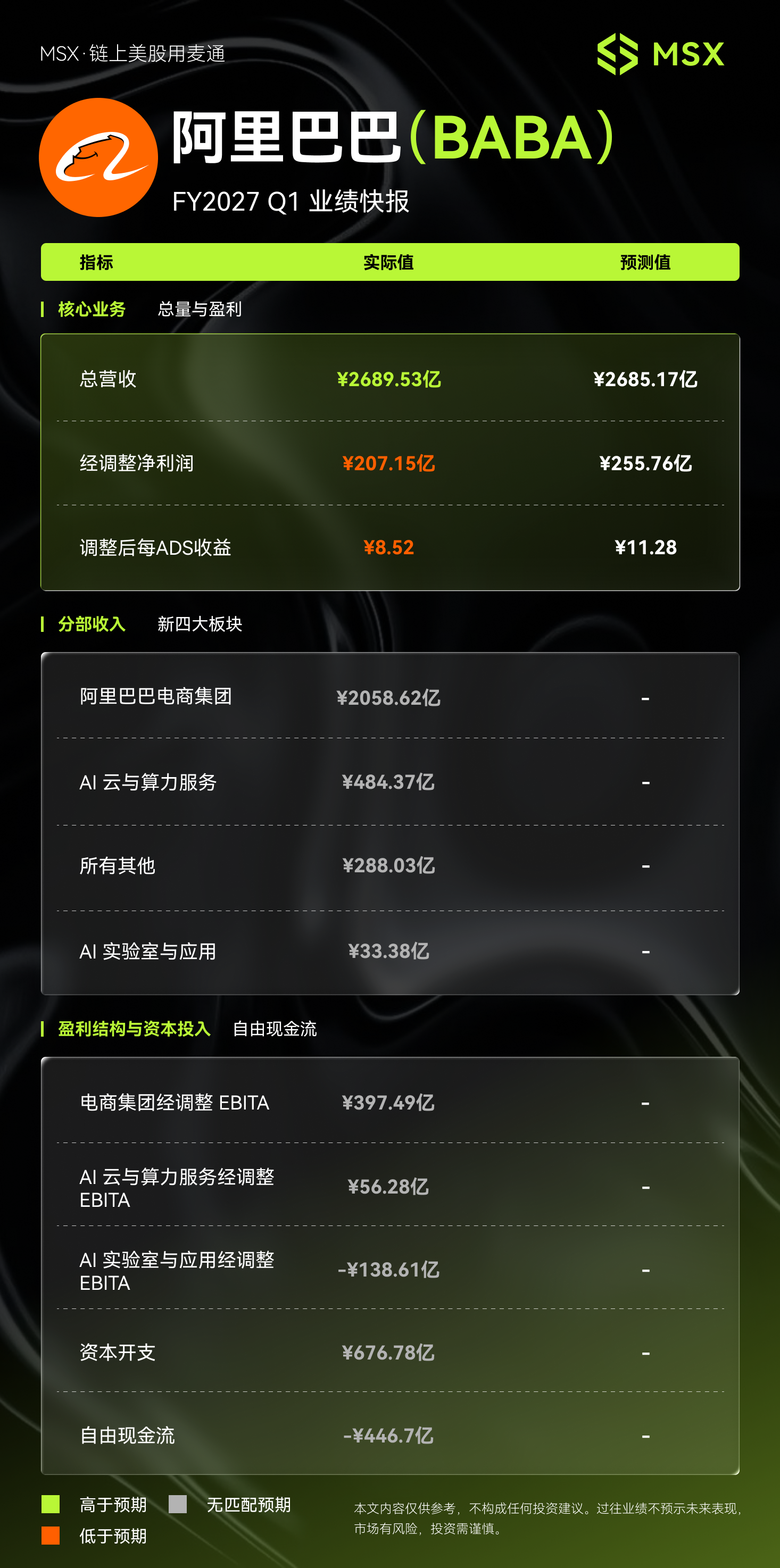
**MSX Daily US Stock Watch: Alibaba FY2027 Q1 Earnings – AI Cloud Revenue Hits Record Growth, Achieves Profitability Milestone** Alibaba's Q1 FY2027 revenue slightly exceeded expectations at 268.9B yuan (+9% YoY). However, adjusted net profit of 20.7B yuan (-38% YoY) and adjusted EPS missed consensus significantly. This shortfall was primarily driven by increased AI investments and two one-time items: a 5.5B euro provision for an EU Digital Services Act fine and 4.46B yuan in goodwill impairment. The restructured business segments showed clear divergence. The standout performer was the AI Cloud & Computing Services unit, with revenue surging 45% YoY to 48.44B yuan. Crucially, its adjusted EBITA jumped 133% YoY to 5.63B yuan, with margins expanding to 12%, signaling a profitable commercial loop for AI infrastructure. Within the Commerce Group, revenue growth was mixed: China Local Services (instant retail) grew 45% to 53.3B yuan, largely offsetting an 8% decline in Traditional China Commerce (110.9B yuan). International commerce revenue fell 1%. Despite this, the Commerce Group's adjusted EBITA dipped only 1% YoY to 39.75B yuan. A key area to watch is cash flow. Capital expenditures soared 75% YoY to 67.68B yuan, turning free cash flow to a net outflow of 44.67B yuan. However, operating cash flow remained positive and grew 11% YoY to 22.95B yuan, indicating the cash burn is a strategic choice for AI capacity build-out rather than operational weakness. In summary, while headline profits were pressured by heavy AI spending and one-off charges, the core takeaway is the emerging profitability of the AI Cloud business. The success of Alibaba's current investment cycle hinges on whether the profit improvement in AI Cloud can outpace the depreciation costs of its massive computing infrastructure expansion.

Odaily星球日报Há 38m

MSX US Stock Daily Observation: Alibaba FY2027 Q1 Earnings: AI Cloud Revenue Growth Hits Record High, AI Cloud Achieves Profitable Closed Loop

Odaily星球日报Há 38m

Trading

Spot

Artigos em Destaque

Como comprar ENS

Bem-vindo à HTX.com!Tornámos a compra de Ethereum Name Service (ENS) simples e conveniente.Segue o nosso guia passo a passo para iniciar a tua jornada no mundo das criptos.Passo 1: cria a tua conta HTXUtiliza o teu e-mail ou número de telefone para te inscreveres numa conta gratuita na HTX.Desfruta de um processo de inscrição sem complicações e desbloqueia todas as funcionalidades.Obter a minha contaPasso 2: vai para Comprar Cripto e escolhe o teu método de pagamentoCartão de crédito/débito: usa o teu visa ou mastercard para comprar Ethereum Name Service (ENS) instantaneamente.Saldo: usa os fundos da tua conta HTX para transacionar sem problemas.Terceiros: adicionamos métodos de pagamento populares, como Google Pay e Apple Pay, para aumentar a conveniência.P2P: transaciona diretamente com outros utilizadores na HTX.Mercado de balcão (OTC): oferecemos serviços personalizados e taxas de câmbio competitivas para os traders.Passo 3: armazena teu Ethereum Name Service (ENS)Depois de comprar o teu Ethereum Name Service (ENS), armazena-o na tua conta HTX.Alternativamente, podes enviá-lo para outro lugar através de transferência blockchain ou usá-lo para transacionar outras criptomoedas.Passo 4: transaciona Ethereum Name Service (ENS)Transaciona facilmente Ethereum Name Service (ENS) no mercado à vista da HTX.Acede simplesmente à tua conta, seleciona o teu par de trading, executa as tuas transações e monitoriza em tempo real.Oferecemos uma experiência de fácil utilização tanto para principiantes como para traders experientes.

413 Visualizações TotaisPublicado em {updateTime}Atualizado em 2026.06.02

Como comprar ENS

Discussões

Bem-vindo à Comunidade HTX. Aqui, pode manter-se informado sobre os mais recentes desenvolvimentos da plataforma e obter acesso a análises profissionais de mercado. As opiniões dos utilizadores sobre o preço de ENS (ENS) são apresentadas abaixo.

活动图片