The $6.4 Billion CRO Accumulation Plan of Trump Media Group Falls Apart

marsbitPublicado em 2026-08-10Última atualização em 2026-08-10

Resumo

A $6.4 billion plan to create a publicly-listed CRO treasury company, announced a year ago by Trump Media & Technology Group (DJT), Crypto.com, and SPAC Yorkville, has been terminated. The ambitious deal, which aimed to accumulate approximately 6.3 billion CRO tokens (nearly 20% of supply at the time), never progressed beyond a framework agreement. Related plans for a prediction market integrated into Truth Social and ETF custody services by Crypto.com were also shelved, scaled back to a simple marketing partnership. The collaboration followed significant political alignment, with Crypto.com donating to Trump's inauguration and a pro-Trump super PAC, and its CEO meeting with Trump. The SEC also closed an investigation into the exchange shortly before the deal was announced, raising conflict-of-interest concerns. Officially, the termination was attributed to an unfavorable market environment. CRO's price has fallen roughly 70% since the announcement, and the broader market for publicly-traded digital asset treasuries has cooled significantly, with Bitcoin nearly halving from its late-2025 peak. The only completed transaction from the 2025 agreements remains intact: Trump Media's ~$105 million CRO purchase and Crypto.com's $50 million purchase of DJT stock. The termination aligns with DJT's strategic pivot away from crypto; the company is now pursuing a multi-billion dollar all-stock merger with nuclear fusion firm TAE Technologies, shifting its focus to clean energy.

Original Author: angelilu, Foresight News

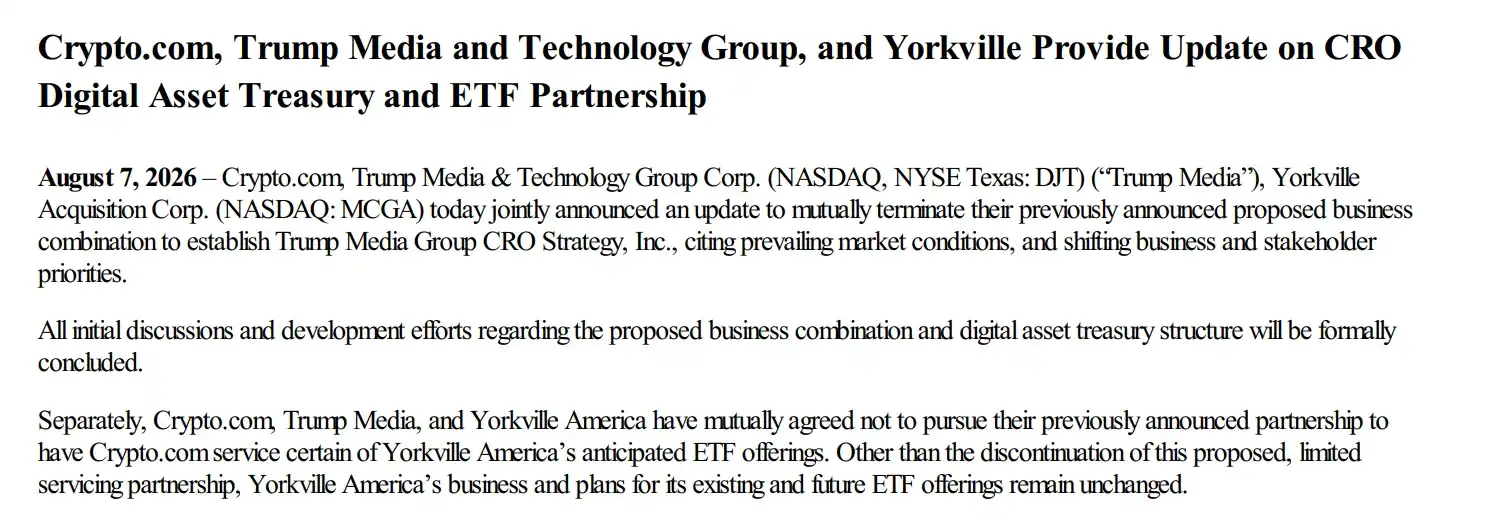
A year ago, Trump Media & Technology Group (DJT) and the cryptocurrency exchange Crypto.com joined forces with great fanfare, announcing plans to establish a listed treasury company to hoard billions of dollars worth of CRO. At that time, this politically connected company and a leading exchange put on a grand show, creating immense buzz. One year later, this capital game has ended in disappointment.

On August 7, DJT, Crypto.com, and the SPAC company Yorkville officially announced the termination of this plan, along with the previously announced cooperation on the prediction market and ETF custody solutions. Bitcoin has nearly halved from its peak, and listed accumulation-focused companies are collectively receding—this partnership, which started with political proximity, ultimately never made it to the implementation chapter.
How Far Did the Halted Cooperation Progress?

The most significant part of this deal was to create another listed CRO treasury company. In August 2025, the three parties loudly declared: Trump Media would use the SPAC company Yorkville as a shell to establish a company called Trump Media Group CRO Strategy, claiming it would be the "first and largest listed CRO treasury company," planning to accumulate approximately 6.313 billion CRO—close to one-fifth of CRO's circulating supply at the time. The entire company scale was about $6.42 billion, built on $1 billion in CRO, $200 million in cash, $220 million in warrants, and a $5 billion equity credit line.

However, despite the grand announcements, this treasury plan never truly materialized. What was announced in August 2025 was only a framework agreement; the process of going public via a shell still required a lengthy series of SEC filings and approvals, which would have taken the better part of a year; it remained in a "to-be-completed" state until it was directly halted a year later, never being established.

Two accompanying plans also fell through. The prediction market product Truth Predict, which was originally to be integrated into Truth Social—allowing users to bet on political, economic, and sports events—has now been scaled down to a mere marketing partnership, with Crypto.com only promoting its own prediction market to Truth Social users. The arrangement for Crypto.com to provide custody for ETFs under Trump Media has also been abandoned.
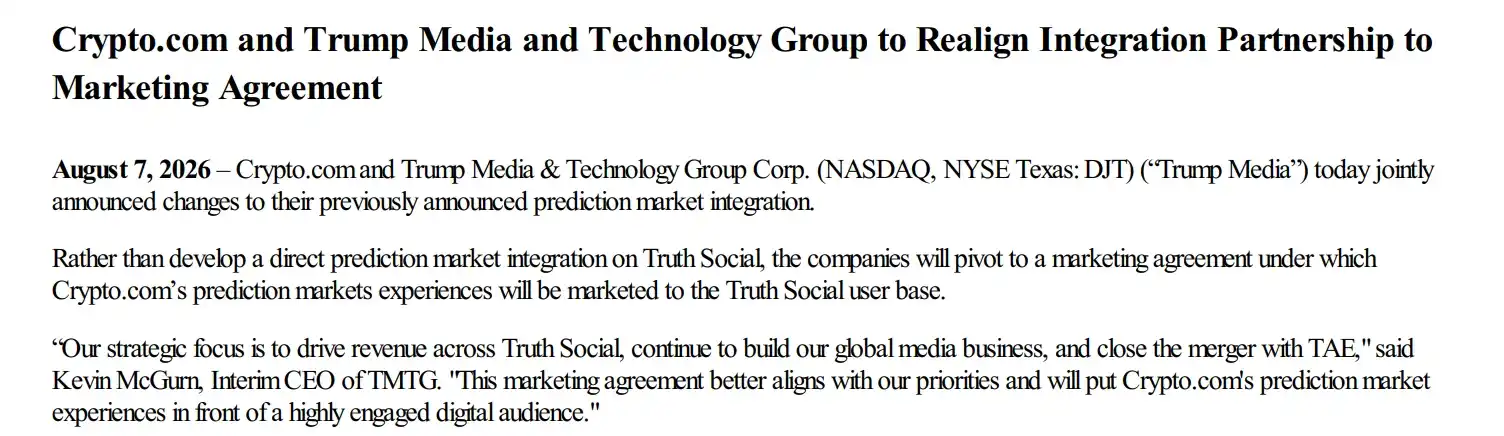
The only part that was actually implemented and remains effective is another independent agreement. In August 2025, Trump Media spent approximately $105 million to purchase CRO for its balance sheet, while Crypto.com reciprocated by buying $50 million worth of DJT stock. This transaction is settled and unaffected by the termination, becoming the sole unbroken link in this dissolution.

Political Alignment First, Business Deal Later

To understand why Crypto.com was chosen for this game, one must look back—it was political alignment that paved the way for business dealings.

Around the 2024 U.S. presidential election, Crypto.com had been extending olive branches to the Trump camp: it donated $1 million to the inauguration and contributed $10 million to the pro-Trump super PAC MAGA Inc.; CEO Kris Marszalek also personally visited Mar-a-Lago to discuss crypto policy with Trump face-to-face. In March 2025, the U.S. Securities and Exchange Commission (SEC) closed its investigation into Crypto.com—shortly before, the agency had issued warnings to the exchange regarding potential enforcement actions.

Once the relationship was smoothed, the business cooperation in August 2025 followed naturally. Trump Media wanted a crypto narrative, a batch of tokens for its balance sheet, and an ETF custodian; Crypto.com, on the other hand, sought to leverage Trump's influence to endorse its own CRO token.

This is precisely why the deal carried an air of conflict of interest from the very day it was announced—the Trump administration itself held the power to regulate the crypto industry, yet a company linked to his family was deeply entangled with an exchange that had just made donations and was recently cleared by the SEC. Senators like Elizabeth Warren publicly called for investigations into whether political factors influenced the SEC's decision.

Why Was It Pulled? Price and Market Conditions Offer No Opportunity

The official explanation was quite frank. Crypto.com's CEO Kris Marszalek stated in the announcement: "After examining these proposed ETFs and DATs from every angle, we reached the same conclusion—it is not reasonable to continue advancing under current market conditions." He also noted that the company would repurpose the CRO originally committed to the treasury to drive revenue, demand, and ecosystem value. According to a report by The Block, sources close to the deal revealed that this shift was more due to changes in the competitive landscape rather than concerns over the awkward situation of "a Trump-linked enterprise being regulated by the Trump administration."

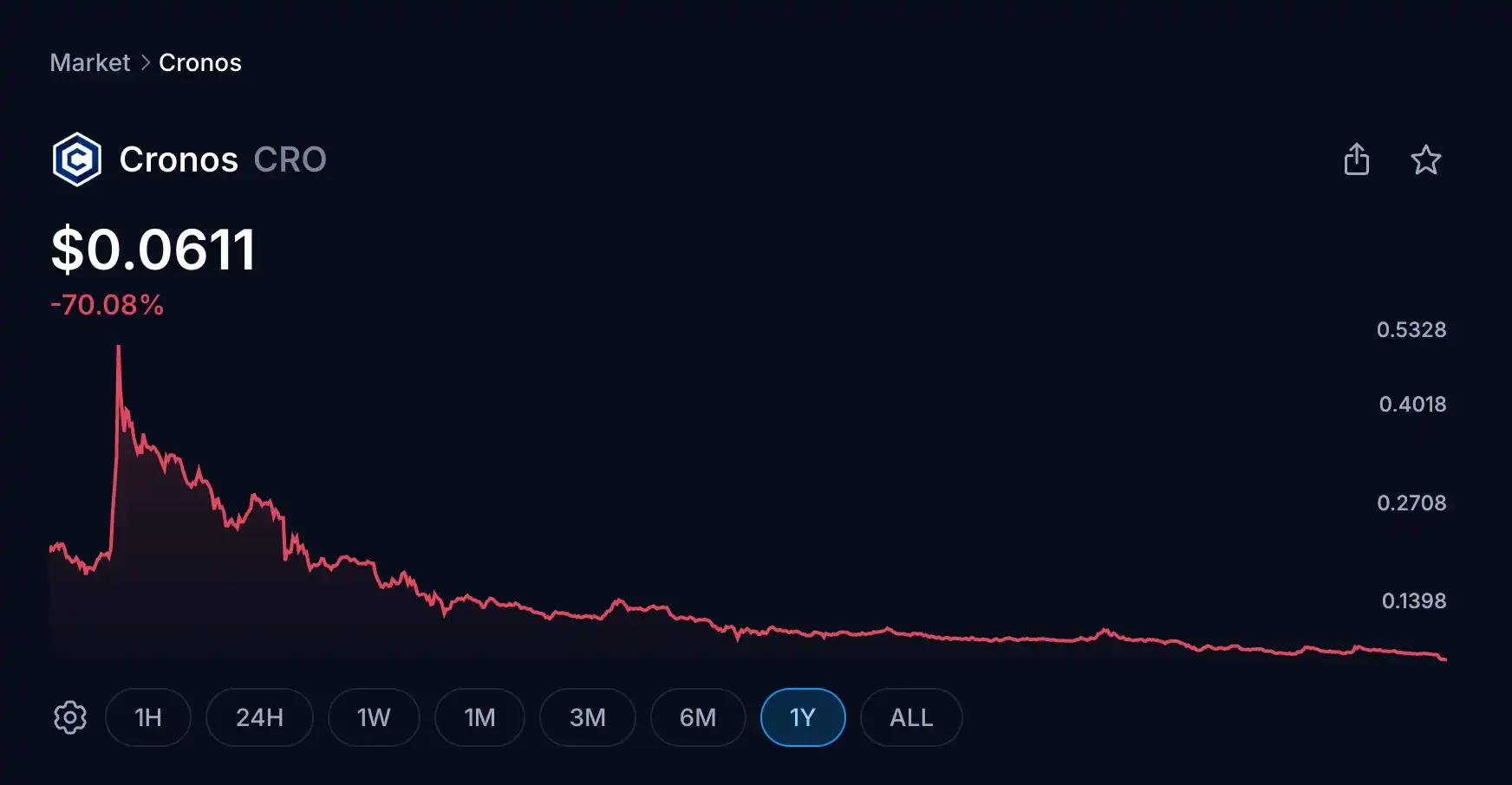
But the market had already written the answer in the price. As of publication, CRO is trading at approximately $0.0616, having fallen about 70% over the past year—a continuous decline since the announcement of the partnership last year.
Looking at the bigger picture, Bitcoin has dropped from its peak of around $126,000 in October 2025 to about $65,000 now, nearly halving. The hype around listed accumulation-focused companies is receding overall—data from early January 2026 showed that at least 37 of the world's top 100 DATs were trading below their net asset value (NAV) held in tokens. Even the industry benchmark Strategy (formerly MicroStrategy) was trading at a discount and had started selling Bitcoin to cover dividends for its preferred stock.

When the tide goes out, who would want to build another multi-billion-dollar CRO treasury?

Trump Media's Next Stop: Turning to Nuclear Fusion

With the crypto story extinguished, Trump Media has already pivoted in a direction that has little to do with crypto. In December 2025, the company announced an all-stock merger with nuclear fusion company TAE Technologies, with a valuation exceeding $6 billion. Shareholders of both companies would own approximately half of the combined entity upon completion, expected by mid-2026. Founded in 1998, this nuclear fusion company will use Trump Media as a vehicle to enter the capital markets. The post-merger focus has clearly shifted from social media and crypto to clean energy.

In other words, the termination of the CRO treasury plan is not an isolated retreat, but part of Trump Media's broader strategic pivot—it is busy rebranding itself from a "Trump-themed crypto player" to a company betting on cutting-edge energy technology.

Criptomoedas em alta

Perguntas relacionadas

QWhat was the core component of the planned collaboration between DJT, Crypto.com, and Yorkville, and what was its fate?

AThe core component was to create a publicly-listed CRO treasury company named 'Trump Media Group CRO Strategy' via a SPAC merger with Yorkville. Its announced goal was to accumulate approximately 6.313 billion CRO (worth around $64.2 billion at the time). Its fate was termination. The plan never progressed beyond the initial framework agreement and was officially called off on August 7, 2026.

QAccording to the article, what were the official and market-driven reasons for the termination of the CRO treasury plan?

AOfficially, Crypto.com's CEO stated that after review, proceeding with the proposed ETF and DAT (Digital Asset Treasury) plans was not reasonable in the 'current market environment'. Market-driven reasons included CRO's price falling roughly 70% in the year following the announcement and a broader downturn in the crypto market, with Bitcoin's price nearly halving from its 2025 peak, leading to a loss of momentum for listed treasury companies.

QWhich specific transactions between Trump Media and Crypto.com from August 2025 are still valid despite the termination of the larger plan?

AA separate, independent transaction from August 2025 remains valid. Trump Media purchased approximately $105 million worth of CRO for its balance sheet, and Crypto.com purchased $50 million worth of DJT stock. This exchange of assets was completed and was not affected by the termination of the broader collaborative plans.

QWhat alternative strategic direction has Trump Media and Technology Group (DJT) pivoted towards after moving away from its crypto-focused plans?

ADJT has pivoted towards the clean energy sector, specifically nuclear fusion. In December 2025, it announced an all-stock merger with nuclear fusion company TAE Technologies, valued at over $6 billion. The merged entity is expected to shift its focus from social media and crypto to frontier energy technology, with the deal anticipated to close around mid-2026.

QWhat political connections and regulatory context preceded the 2025 business deal between Trump Media and Crypto.com?

APrior to the deal, Crypto.com actively cultivated political ties with the Trump camp. It donated $1 million to the 2024 inauguration and $10 million to the pro-Trump super PAC MAGA Inc. Its CEO also met with Trump personally. In March 2025, the SEC dropped its investigation into Crypto.com shortly after warning it about a potential enforcement action, a decision that drew scrutiny from lawmakers like Senator Elizabeth Warren over potential political influence.

Leituras Relacionadas

Claude's Watermark Has Been Cracked, Gaining 11k Stars, But Installation Is Refused

The article discusses the controversy surrounding Anthropic's implementation of a hidden watermark in all text generated by its AI, Claude. This policy, based on Google DeepMind's SynthID-Text technique, embeds a statistical signature by making inconsequential word choices. The watermark applies globally, even to human-written text lightly edited by Claude, sparking user backlash over issues of ownership and the creation of an "AI content second-class citizen" status. In response, an open-source tool called "watermarks-remover" (originally "remove-claude-marks") was released on GitHub, quickly gaining 11k stars. It works on three levels: removing invisible Unicode characters, using an agent to rewrite text and break statistical patterns, and stripping metadata from various file formats. Notably, Claude itself refused to install this removal tool as an Agent Skill, a task ultimately completed by another AI model, GLM 5.2. The article points out the irony that the removal code may have been written by Claude. The piece frames this as an ongoing battle between watermarking for traceability against misinformation and the desire for unmarked, owned content from paying users. It questions the practicality of mandatory technical markings when AI-generated text becomes indistinguishable from human writing, suggesting the open-source community's rapid development of countermeasures will continually outpace regulatory efforts.

marsbitHá 1h

Claude's Watermark Has Been Cracked, Gaining 11k Stars, But Installation Is Refused

marsbitHá 1h

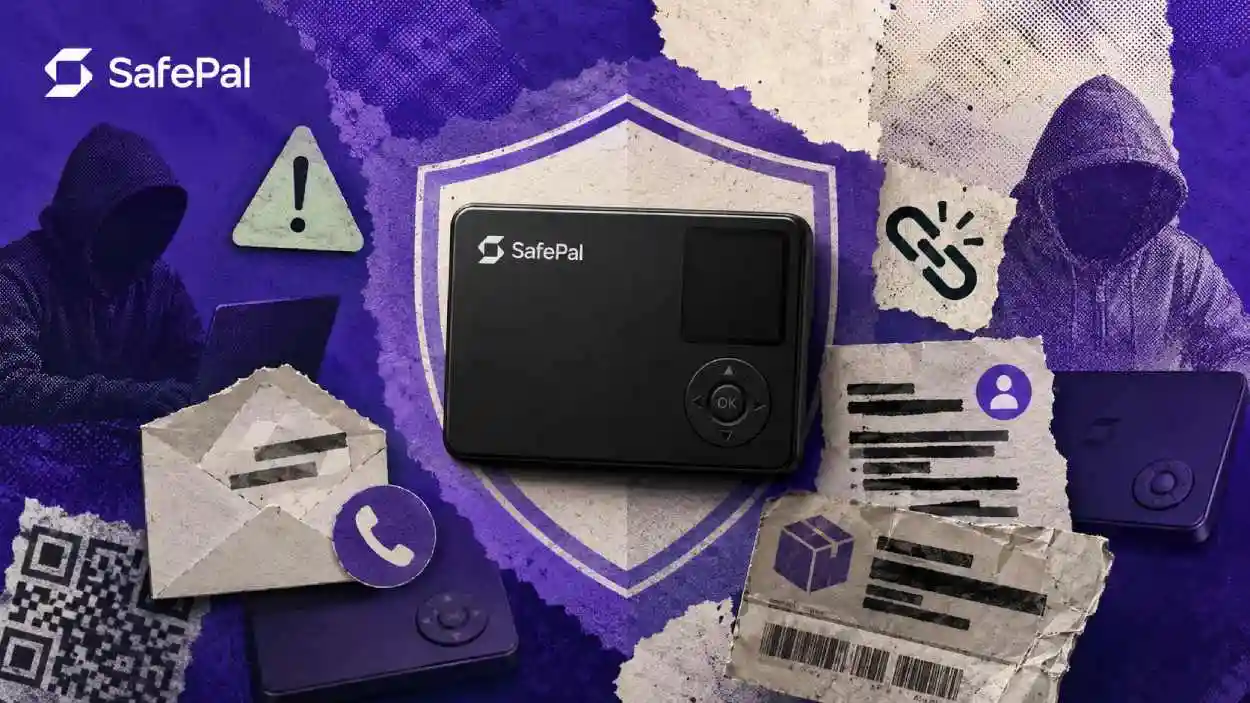
SafePal Leaks Data of Nearly 40,000 Hardware Wallet Buyers: Private Keys Intact, Yet Danger Moves Closer to the Physical

Hardware wallet manufacturer SafePal has disclosed a data breach affecting approximately 39,798 customers who placed orders between March 2025 and April 2026. The leak exposed personal information including names, email addresses, phone numbers, physical delivery addresses, and purchase records. The company confirmed that private keys, recovery phrases, wallet passwords, and financial details were not compromised, as the cold storage systems operate in an isolated environment separate from the e-commerce servers. However, the breach poses significant risks beyond digital theft. Attackers now possess a high-value list of confirmed hardware wallet owners, effectively marking them as likely holders of substantial cryptocurrency. This enables highly targeted social engineering attacks, such as phishing emails referencing real order details, fake hardware deliveries, or phone scams impersonating SafePal support. The company has already identified and taken down over 30 related phishing sites. A critical aspect of the incident is the delayed disclosure timeline. SafePal acknowledged receiving initial user reports of phishing attempts in May but treated them as isolated. A full investigation began in July, with a public announcement not made until August, leaving users exposed for approximately three months. Furthermore, a configuration error prevented a data-purge routine from deleting old order information as intended, potentially increasing the scope of the leaked data. The incident highlights a structural paradox in the hardware wallet industry: while the devices are designed to secure private keys offline, the necessary e-commerce process collects sensitive personal data that, if leaked, makes the user a target. This mirrors a similar breach suffered by Ledger in 2020. Affected users are advised to be extremely vigilant. They should verify if they are impacted via SafePal's dedicated page, treat all unsolicited communications (emails, calls, physical mail) referencing SafePal as suspicious, and never share recovery phrases. Users who may have entered sensitive information on a phishing site must create a new wallet immediately. The breach underscores that in cryptocurrency security, the most vulnerable link is often the human user, not the cryptographic technology.

marsbitHá 1h

SafePal Leaks Data of Nearly 40,000 Hardware Wallet Buyers: Private Keys Intact, Yet Danger Moves Closer to the Physical

marsbitHá 1h

30 Years After Being Crushed by AI, People Have Fallen Back in Love with Chess

On May 11, 1997, IBM's "Deep Blue" defeated chess champion Garry Kasparov, marking the first time a machine triumphed in a top-level intellectual game. The narrative of human defeat by AI seemed cemented when AlphaGo beat Lee Sedol in Go in 2016, a game once considered AI's final frontier. Yet, nearly 30 years after AI's dominance began, chess is experiencing unprecedented popularity. Chess.com boasts over 250 million registered users and 10 million daily active players. Its CEO, Erik Allebest, attributes this resurgence to several waves: the pandemic, the Netflix series *The Queen's Gambit*, and viral AI chess bots like "Mittens" on social media. Crucially, each surge left a permanently higher user base. The key insight is that AI liberated the game. When machines unequivocally became the best, the pressure to "win" as the ultimate human was removed. Chess returned to its core: the intrinsic joy of play—the thrill of a tactical combo, the tension of a time scramble, the curiosity of post-game analysis. AI, now serving as an always-available coach and anti-cheat tool, became infrastructure that enhanced rather than killed the experience. In contrast, Go, deeply rooted in East Asian elite culture and often pursued for mastery and status, suffered a "collapse of meaning" at the professional level after AlphaGo. Players began mimicking AI moves, erasing distinctive styles and narrative. While some Go players gained fame as online personalities, it didn't translate to widespread engagement with the game itself. The divergence highlights a fundamental question in the age of AI: is the motivation for an activity about *winning* or *playing*? Activities where the process itself is the reward, like chess, can thrive when the pressure of being the best is gone. AI may rightly take over tasks done purely for outcome, but it cannot replace the human experience of simply enjoying the game.

marsbitHá 1h

30 Years After Being Crushed by AI, People Have Fallen Back in Love with Chess

marsbitHá 1h

Exiting Top Ten Shareholders of Kweichow Moutai, 'Long-term Capital' Portfolio Adjustments Revealed: National Social Security Fund Enters 12 New Stocks, Invests in Hard Tech Mthreads

With the ongoing release of semi-annual reports, the second-quarter investment moves of long-term institutional investors like the National Social Security Fund (NSSF) and insurance capital are becoming clear. Central Huijin Asset Management and China Securities Finance Corp., often referred to as the "national team," are no longer among the top ten shareholders of Kweichow Moutai. Data shows that as of August 14th, the NSSF held positions in 33 A-share companies, with a total portfolio value exceeding 11 billion yuan. It added 12 new stocks in Q2, spanning sectors like chemicals, food & beverage, and semiconductors. The NSSF maintains its stable investment style, favoring companies with solid performance and attractive valuations. Apart from exiting Moutai, Huijin and China Securities Finance also left the top ten shareholder lists of companies like Ping An Bank and Dahua Technology. Insurance capital heavily invested in 41 companies in Q2, with a total holding value over 26 billion yuan. They showed a continued preference for cyclical sectors like non-ferrous metals and chemicals, as well as high-dividend-yield stocks. Analysts note that these long-term funds act as market stabilizers and investment bellwethers. Their presence is reshaping the market ecology, steering focus towards fundamental corporate value and away from speculative trading. A notable move was the NSSF's new investment in Moore Threads, a loss-making but leading domestic GPU design company listed on the STAR Market, indicating interest in hard technology sectors. Looking ahead, analysts expect long-term capital to continue a dual-strategy: maintaining a foundation in high-dividend-value stocks while gradually increasing exposure to growth areas aligned with industrial upgrading, such as advanced manufacturing and tech self-sufficiency. The market's recovery is seen as gaining a firmer footing after recent adjustments.

marsbitHá 1h

Exiting Top Ten Shareholders of Kweichow Moutai, 'Long-term Capital' Portfolio Adjustments Revealed: National Social Security Fund Enters 12 New Stocks, Invests in Hard Tech Mthreads

marsbitHá 1h

Data of 54,000 wallet users leaked, Clarity odds just 10%: Hodler’s Digest, Aug. 16

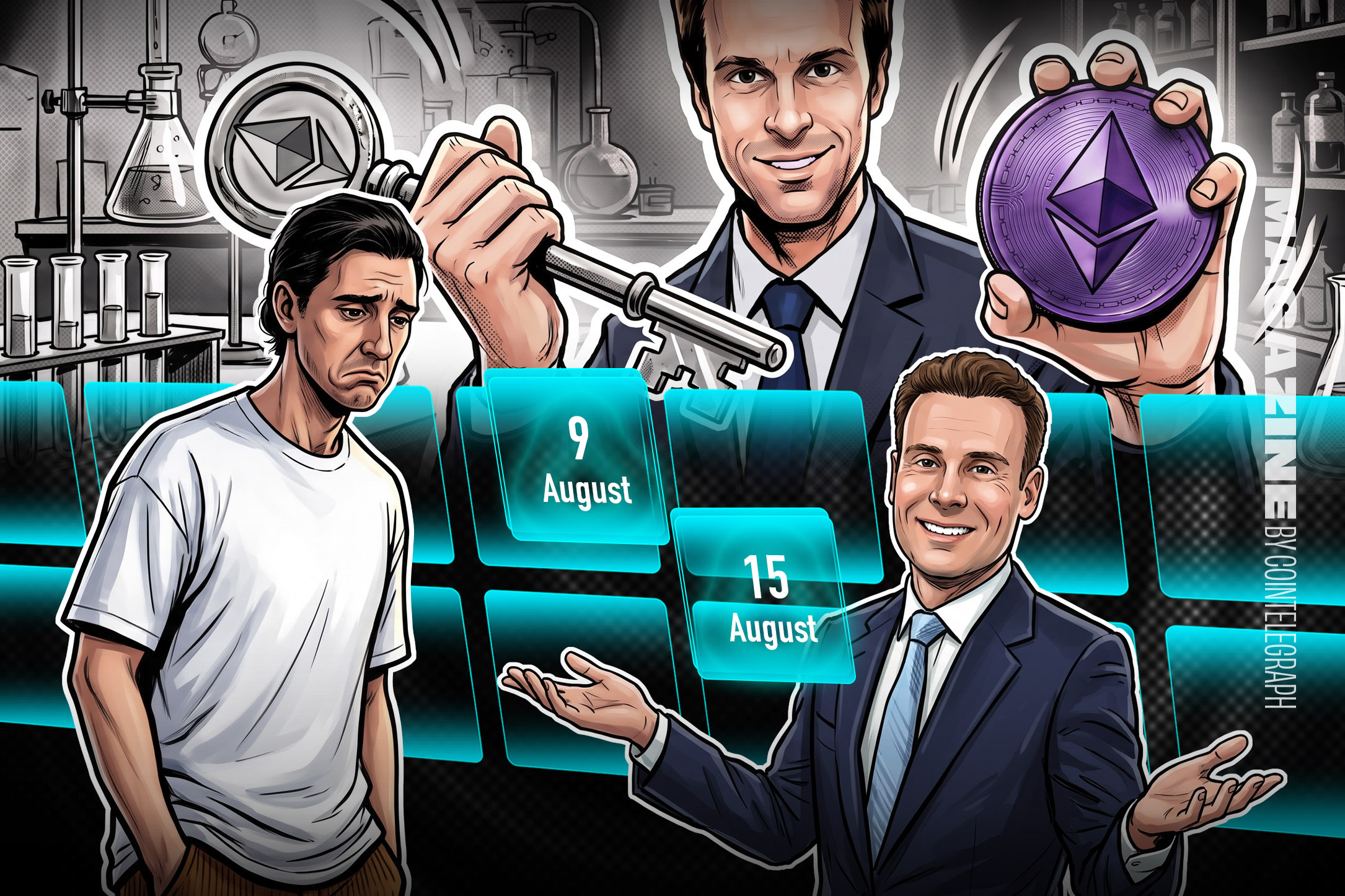
Galaxy Digital has slashed the odds of the CLARITY Act passing in 2026 from 75% to just 10%, citing limited Senate session days. If it fails, the SEC and CFTC plan to issue their own crypto rules, though an SEC meeting was abruptly cancelled. High-profile meetings at the White House are planned to discuss the bill. Amid growing hack fears, crypto companies are urging AI labs to grant developers early access to advanced AI models for cybersecurity, following a $116M Coldcard wallet theft. Data breaches at Trezor and SafePal have exposed over 54,000 users' personal information. The CFTC is clashing with states over regulating prediction markets like Kalshi, ordering it to ignore a New York restraining order to maintain a national market, while a Washington state judge ruled against it. The Ethereum Foundation is revising its post-quantum plan, moving away from the Poseidon hash function, and scoping its next major upgrade, Hegotá, for next year. Tether received its first full clean audit opinion from KPMG, showing reserves exceeding liabilities by $6.814 billion. Marketwise, major cryptos saw weekly declines. Predictions include a possible Bitcoin bottom in October, while analysts dispute the feasibility of BTC reaching $1M by 2030. Glassnode notes Bitcoin is in its longest capitulation phase since FTX's collapse. Three men were charged for an alleged Bitcoin kidnapping plot in Missouri.

cointelegraphHá 2h

Data of 54,000 wallet users leaked, Clarity odds just 10%: Hodler’s Digest, Aug. 16

cointelegraphHá 2h

Trading

Spot

Artigos em Destaque

O que é G$

Compreender o GoodDollar ($G$): Um Plano para um Rendimento Básico Universal Descentralizado Introdução No panorama em constante evolução das criptomoedas e da tecnologia blockchain, iniciativas que procuram abordar questões sociais prementes têm ganhado uma atenção crescente. Um desses projetos é o GoodDollar ($G$), uma solução de rendimento básico universal (UBI) baseada na Web3. O GoodDollar esforça-se para enfrentar a desigualdade e reduzir a disparidade de riqueza, criando e distribuindo recursos econômicos acessíveis aos que mais precisam. Através da sua utilização inovadora das finanças descentralizadas (DeFi), o GoodDollar apresenta um modelo único que poderia potencialmente reconfigurar a forma como a assistência financeira é percebida e entregue globalmente. O que é o GoodDollar ($G$)? O GoodDollar é um protocolo de criptomoeda que facilita a emissão e distribuição de tokens digitais, referidos como $G$, aos seus utilizadores registados diariamente. Esses tokens funcionam como uma forma de rendimento básico universal, promovendo o empoderamento financeiro de indivíduos de diversas origens, especialmente aqueles tradicionalmente excluídos do sistema financeiro. Operando na blockchain, o GoodDollar utiliza múltiplas cadeias, incluindo Ethereum, Celo e Fuse, assegurando acesso amplo e usabilidade. O objetivo fundamental do GoodDollar é tornar as criptomoedas acessíveis e benéficas para todos, independentemente do seu ponto de partida econômico. O Criador do GoodDollar ($G$) Os detalhes sobre o criador do GoodDollar permanecem um pouco obscuros. No entanto, é notavelmente destacado que o projeto tem um forte apoio da eToro, uma plataforma de investimento amplamente reconhecida que forneceu o financiamento inicial e o suporte fundamental para o desenvolvimento do GoodDollar. A visão por trás do projeto não é apenas orientada para o lucro, mas inclina-se fortemente para o empreendedorismo social, visando uma mudança sistémica na acessibilidade econômica. Investidores do GoodDollar ($G$) O GoodDollar goza do apoio financeiro e operacional da eToro. Esta parceria desempenhou um papel significativo no lançamento do protocolo e nos seus desenvolvimentos subsequentes. Enquanto a eToro foi instrumental na estabelecer a fundação do projeto, o GoodDollar visiona uma transição para um modelo financiado pela sua comunidade a longo prazo. Esta mudança para o financiamento comunitário está em linha com o compromisso do GoodDollar com a descentralização, permitindo que os seus utilizadores tenham uma participação direta no futuro do projeto. Como Funciona o GoodDollar ($G$)? O framework operacional do GoodDollar baseia-se fortemente nos princípios de DeFi para gerar juros a partir de criptomoedas em stake. Este mecanismo permite ao projeto cunhar e distribuir tokens $G$ como um rendimento básico digital para utilizadores em todo o mundo. Várias características-chave contribuem para a singularidade e inovação do GoodDollar: Rendimento Básico Universal (UBI): Todos os dias, os utilizadores registados recebem tokens gratuitos, estabelecendo um fluxo de rendimento automático destinado a aliviar as pressões financeiras. Modelo Económico Sustentável: A tokenómica do projeto visa equilibrar a oferta e a procura de tokens $G$, garantindo que o valor permaneça estável ao longo do tempo. Tokens Garantidos por Reservas: Cada token $G$ é garantido por uma reserva de criptomoedas, conferindo-lhe um valor inerente e fiabilidade, um aspecto crucial para manter a confiança dos utilizadores. Governança Descentralizada: O GoodDollar incorpora uma abordagem democrática à tomada de decisões através de governança descentralizada com poder de tokens. Isso permite que os membros da comunidade participem ativamente na definição da trajetória do projeto, tornando-o verdadeiramente orientado pela comunidade. Acessibilidade Global: O GoodDollar estabeleceu uma considerável pegada comunitária, com mais de 640.000 membros espalhados por 181 países. Tal alcance generalizado é instrumental na facilitação do UBI em escala global. Cronologia do GoodDollar ($G$) A evolução do GoodDollar é marcada por vários marcos significativos ao longo da sua história: 2019: O lançamento da carteira GoodDollar marcou o primeiro passo para operacionalizar a sua visão de entregar UBI através de criptomoeda. 2020: Após o bem-sucedido lançamento da carteira, o protocolo GoodDollar fez a sua estreia oficial. Isso marcou uma fase crucial na sua missão de fornecer rendimento diário distribuído. 2021: O projeto avançou ainda mais com a introdução da sua Organização Autónoma Descentralizada (DAO), promovendo um maior nível de envolvimento e governança comunitária. 2022: O GoodDollar revelou a sua versão 2 (V2) amiga das DeFi, esforçando-se por um maior envolvimento dos utilizadores e eficiência operacional. O mesmo ano também viu a transição para uma estrutura de governança descentralizada através do GoodDAO. 2022: Um novo roteiro foi conceptualizado, focando em iniciativas como um programa de subsídios destinado a promover empreendimentos relacionados com $G$ e um Mercado GoodDollar atualizado. Características Principais do GoodDollar ($G$) O projeto GoodDollar introduz inúmeras características críticas destinadas a redefinir o cenário do rendimento básico: Rendimento Básico Universal: A entrega diária de tokens gratuitos aos seus utilizadores sublinha fundamentalmente a sua missão de eliminar a precariedade económica. Operação Multi-Cadeia: A utilização de múltiplas redes de blockchain melhora a acessibilidade e escalabilidade, assegurando uma participação mais ampla. Envolvimento com Finanças Descentralizadas: O uso de DeFi permite o financiamento sustentável do modelo UBI, reforçando a sua viabilidade como uma solução económica. Envolvimento e Governança Comunitária: O GoodDollar imagina um modelo onde a comunidade influencia as operações através da participação democrática, promovendo transparência e responsabilidade. Comunidade Global: Com uma comunidade global diversificada, o projeto pode implementar soluções de UBI adaptadas a vários contextos culturais e económicos. Conclusão O GoodDollar representa um salto transformador para a incorporação dos princípios de rendimento básico universal através da lente inovadora da tecnologia blockchain. Ao aproveitar as finanças descentralizadas, o projeto não apenas fornece uma solução para a desigualdade financeira, mas também envolve ativamente os utilizadores na sua governança e operações. Com uma comunidade em crescimento e um roteiro em evolução, o GoodDollar destaca-se como um jogador significativo na interseção entre criptomoeda e bem social, abrindo caminho para um futuro financeiro mais equitativo. À medida que continua a evoluir, a jornada do GoodDollar poderá, em última análise, inspirar outras iniciativas a considerar modelos semelhantes, promovendo ainda mais a causa do empoderamento económico para todos.

156 Visualizações TotaisPublicado em {updateTime}Atualizado em 2024.12.03

O que é G$

Como comprar G

Bem-vindo à HTX.com!Tornámos a compra de Gravity (G) simples e conveniente.Segue o nosso guia passo a passo para iniciar a tua jornada no mundo das criptos.Passo 1: cria a tua conta HTXUtiliza o teu e-mail ou número de telefone para te inscreveres numa conta gratuita na HTX.Desfruta de um processo de inscrição sem complicações e desbloqueia todas as funcionalidades.Obter a minha contaPasso 2: vai para Comprar Cripto e escolhe o teu método de pagamentoCartão de crédito/débito: usa o teu visa ou mastercard para comprar Gravity (G) instantaneamente.Saldo: usa os fundos da tua conta HTX para transacionar sem problemas.Terceiros: adicionamos métodos de pagamento populares, como Google Pay e Apple Pay, para aumentar a conveniência.P2P: transaciona diretamente com outros utilizadores na HTX.Mercado de balcão (OTC): oferecemos serviços personalizados e taxas de câmbio competitivas para os traders.Passo 3: armazena teu Gravity (G)Depois de comprar o teu Gravity (G), armazena-o na tua conta HTX.Alternativamente, podes enviá-lo para outro lugar através de transferência blockchain ou usá-lo para transacionar outras criptomoedas.Passo 4: transaciona Gravity (G)Transaciona facilmente Gravity (G) no mercado à vista da HTX.Acede simplesmente à tua conta, seleciona o teu par de trading, executa as tuas transações e monitoriza em tempo real.Oferecemos uma experiência de fácil utilização tanto para principiantes como para traders experientes.

628 Visualizações TotaisPublicado em {updateTime}Atualizado em 2026.06.02

Como comprar G

O que é @G

Graphite Network, $@G: A Conexão entre TradFi e Web3 Introdução ao Graphite Network, $@G No vibrante mundo das criptomoedas e projetos web3, o Graphite Network emerge como um farol de inovação. Com o seu token nativo, $@G, esta blockchain de Camada 1, Proof-of-Authority (PoA) é projetada para preencher a lacuna entre as finanças tradicionais (TradFi) e o ecossistema Web3 em rápida evolução. À medida que as moedas digitais ganham tração, o Graphite Network esforça-se por oferecer uma plataforma blockchain que prioriza a segurança, conformidade e velocidade, apresentando-se como um facilitador de confiança e responsabilidade. O que é o Graphite Network, $@G? O Graphite Network não é apenas mais um projeto de blockchain; visa redefinir como a descentralização, segurança e responsabilidade do utilizador são percebidas no domínio das finanças digitais. O projeto possui uma série de características distintas: Blockchain Baseada em Reputação: No seu núcleo, o Graphite Network implementa uma política de um utilizador, uma conta, reforçada com mecanismos integrados de Know Your Customer (KYC) e de pontuação. Este design assegura um equilíbrio entre a privacidade do utilizador e a transparência—um aspecto crítico das operações financeiras no mundo digital de hoje. Rendimento de Nós de Ponto de Entrada: A rede incentiva os utilizadores a configurar nós de ponto de entrada, permitindo que os operadores ganhem recompensas a partir das transações da rede. Este modelo de geração de rendimento não só aumenta o envolvimento dos utilizadores, mas também reforça a saúde e descentralização da rede. Compatibilidade com EVM: Com uma máquina virtual (VM) compatível com Ethereum, o Graphite Network permite a integração sem costura de aplicações descentralizadas (dApps) e contratos inteligentes existentes em Solidity, convidando assim os desenvolvedores a aproveitar as suas capacidades sem modificações extensivas. Integração de KYC: Numa era em que a conformidade é primordial, o quadro KYC integrado com múltiplos níveis de verificação melhora o controlo sobre as operações financeiras sem participação obrigatória, estabelecendo um precedente para a autonomia do utilizador. Quem é o Criador do Graphite Network, $@G? O Graphite Network nasce dos esforços da Graphite Foundation, uma organização sem fins lucrativos dedicada ao desenvolvimento, manutenção e evolução do Graphite Network. O compromisso da fundação sublinha a visão do projeto de criar um ambiente blockchain seguro e sustentável, focado no envolvimento genuíno dos utilizadores e na conformidade. Quem são os Investidores do Graphite Network, $@G? Atualmente, há informações limitadas disponíveis sobre os investidores específicos que apoiam a iniciativa Graphite Network. A organização fundadora, a Graphite Foundation, funciona de forma independente na promoção do crescimento do projeto, enquanto procura parcerias que ressoem com a sua visão de uma plataforma blockchain acessível e em conformidade. Como Funciona o Graphite Network, $@G? A operação do Graphite Network está fundamentada no seu mecanismo de consenso único Proof-of-Authority, que encontra um impressionante equilíbrio entre alta capacidade de processamento e descentralização. Vamos explorar os vários componentes que definem a sua operação: Nós de Transporte: Servindo como nós de ponto de entrada, estes são críticos para o ecossistema. Os operadores podem ganhar receita a partir das transações que atravessam a rede, o que não só empodera os utilizadores individuais, mas também reforça a descentralização da rede. Nós Autorizados: No coração do Graphite Network estão os validadores principais que passam por rigorosos testes de conformidade, abrangendo uma verificação KYC robusta juntamente com avaliações técnicas. Este nível de confiança é essencial para garantir que as transações dentro da rede mantenham um alto nível de integridade. Sistema de Tickers: O Graphite Network utiliza um sistema de ticker distinto para os seus tokens embrulhados, denotados como @G. Esta característica melhora a clareza na integração de ativos, tornando as transações dos utilizadores compreensíveis e diretas. A abordagem inovadora do Graphite Network reflete um passo significativo na resolução das questões cruciais das finanças digitais, posicionando-se favoravelmente para o futuro à medida que mais utilizadores transitam de formas tradicionais de finanças para o mundo das aplicações descentralizadas. Cronologia do Graphite Network, $@G Para entender a progressão e os marcos do Graphite Network, é benéfico rever eventos-chave na sua cronologia: 2021: A incepção do Graphite Network pela Graphite Foundation marca o início de um novo capítulo no desenvolvimento de blockchain, focando na conformidade e no empoderamento do utilizador. Desenvolvimentos Chave: Após o seu lançamento, a introdução do rendimento de nós de ponto de entrada, o estabelecimento de um modelo baseado em reputação, a verificação KYC integrada e a provisão de compatibilidade EVM representam avanços significativos no projeto. Atividades Recentes: O contínuo desenvolvimento e esforços de nutrição da Graphite Foundation têm-se concentrado em aumentar as características da rede enquanto fomentam o crescimento do ecossistema, demonstrando um compromisso a longo prazo com a sustentabilidade e inovação. Pontos Adicionais Além dos seus componentes fundamentais, o Graphite Network abrange várias ferramentas e características que reforçam a sua usabilidade: Graphite Wallet: Uma extensão do Chrome fácil de usar que facilita o acesso a várias características e aplicações da rede em cadeias compatíveis com Ethereum, melhorando a conveniência do utilizador. Graphite Bridge: Esta utilidade permite transferências sem costura de ativos Graphite entre diferentes redes, promovendo um ecossistema integrado e interoperável. Graphite Explorer: Servindo como uma ferramenta essencial dentro do ecossistema, esta característica permite aos utilizadores visualizar e verificar o código-fonte dos contratos inteligentes, rastrear transações e explorar outras informações vitais em tempo real. Graphite Testnet: O projeto fornece um ambiente de teste robusto para desenvolvedores, permitindo-lhes garantir estabilidade e escalabilidade antes da implementação na mainnet. Esta iniciativa não só empodera os desenvolvedores, mas também melhora a fiabilidade de toda a rede. Conclusão O Graphite Network, com o seu token nativo $@G, representa um avanço significativo na conexão entre as finanças tradicionais e a tecnologia blockchain de ponta. Ao focar na segurança, conformidade e descentralização, esta plataforma inovadora está pronta para liderar a transição para a era Web3. À medida que o envolvimento dos utilizadores cresce e mais projetos aproveitam as suas capacidades, o Graphite Network está posicionado para fazer contribuições duradouras para o panorama digital em rápida evolução. Em conclusão, o Graphite Network é um testemunho do que pode ser alcançado quando o pensamento inovador encontra as crescentes demandas das finanças e tecnologia modernas. À medida que o mundo explora o potencial das finanças descentralizadas, o Graphite Network sem dúvida continuará a ser um jogador notável nesta arena.

105 Visualizações TotaisPublicado em {updateTime}Atualizado em 2025.01.06

O que é @G

Discussões

Bem-vindo à Comunidade HTX. Aqui, pode manter-se informado sobre os mais recentes desenvolvimentos da plataforma e obter acesso a análises profissionais de mercado. As opiniões dos utilizadores sobre o preço de G (G) são apresentadas abaixo.

活动图片