CryptoRank recorded 153 distinct venture capital firms participating in crypto funding rounds for the month up to July 31, the lowest monthly level since November 2020. This statistic counts the number of unique, deduplicated institutions that participated in at least one disclosed crypto funding round; it does not mean only 153 VC firms remain in the market.
This number peaked at 1,177 firms monthly in 2022, subsequently decreasing by about 87%. A total of 651 institutions participated in crypto funding in Q2 2026, a drop of roughly 75% compared to the 2,564 firms in Q2 2022.
CryptoRank data shows this metric reached 395 firms in March 2026, briefly rebounded to 314 in May, and then fell again to 244 in June.
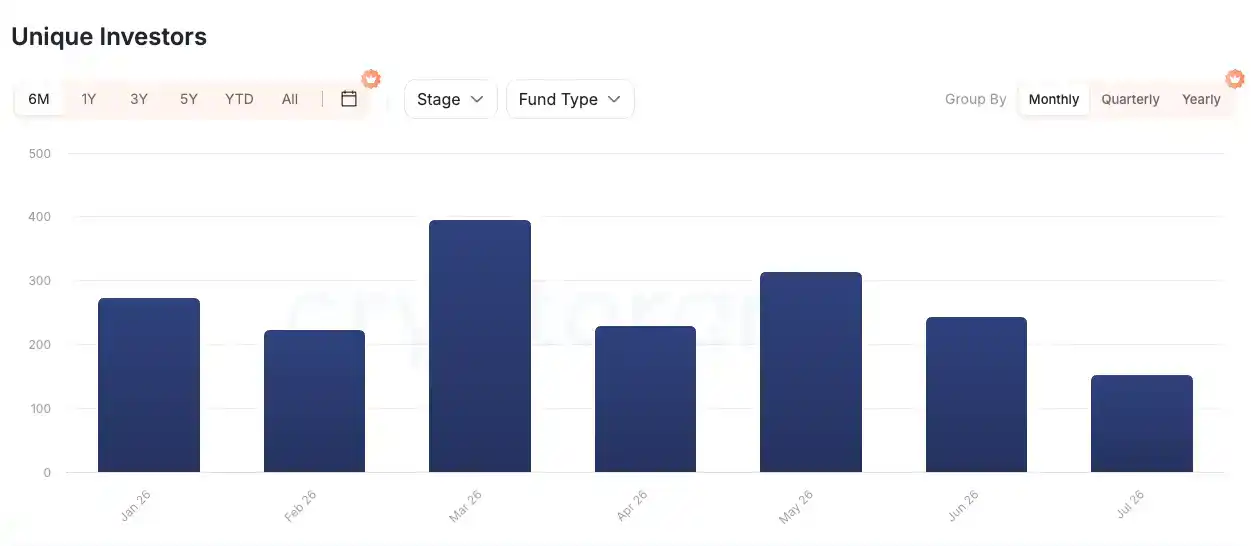
CryptoRank: Monthly Deduplicated Investor Count in 2026
On the other hand, this reduction in crypto venture capital activity is occurring during a phase of expansion in the global venture capital landscape. Global venture capital investment reached $227.4 billion across 8,440 deals in Q2 2026, marking the second-highest quarter on record; the total for the first half of the year reached $560.4 billion, second only to the same period in 2021. Large funding rounds for AI companies like Anthropic, Prometheus, and DeepSeek were the primary drivers.
According to KPMG statistics, by the end of Q2, global VC funds had raised approximately $98.8 billion in the year to date, involving 727 funds. Among these, 19 funds that raised over $1 billion each collectively absorbed $53.2 billion, accounting for more than half of the total. The number of deals remains relatively weak, with large sums primarily flowing to AI and mature companies with proven business models.
Bleeding off this enthusiasm, both capital and deal count in the crypto market have retreated simultaneously. Galaxy Research statistics show that in Q1 2026, crypto and blockchain startups completed 355 funding rounds, raising approximately $4.0 billion, representing quarterly declines of 16% and about 50%, respectively. Only 8 new crypto VC funds completed fundraising in that quarter, raising a total of around $1.1 billion, the lowest since Q3 2020.
Galaxy attributed the fundraising difficulties to multiple factors, including pressure from historical returns due to industry turbulence in 2022-2023, the macro environment, competition for limited partner funds from AI, and the availability of more liquid crypto exposure through spot crypto ETFs and digital asset treasury companies. Global capital remains abundant, but the focus of allocation and the list of favored managers are narrowing.
First 7 Months Funding: $11.778 Billion, May Alone Contributed One-Third
According to CryptoRank's public dashboard as of July 31, crypto projects completed 481 funding rounds in the first 7 months of 2026, with a disclosed total of approximately $11.778 billion.
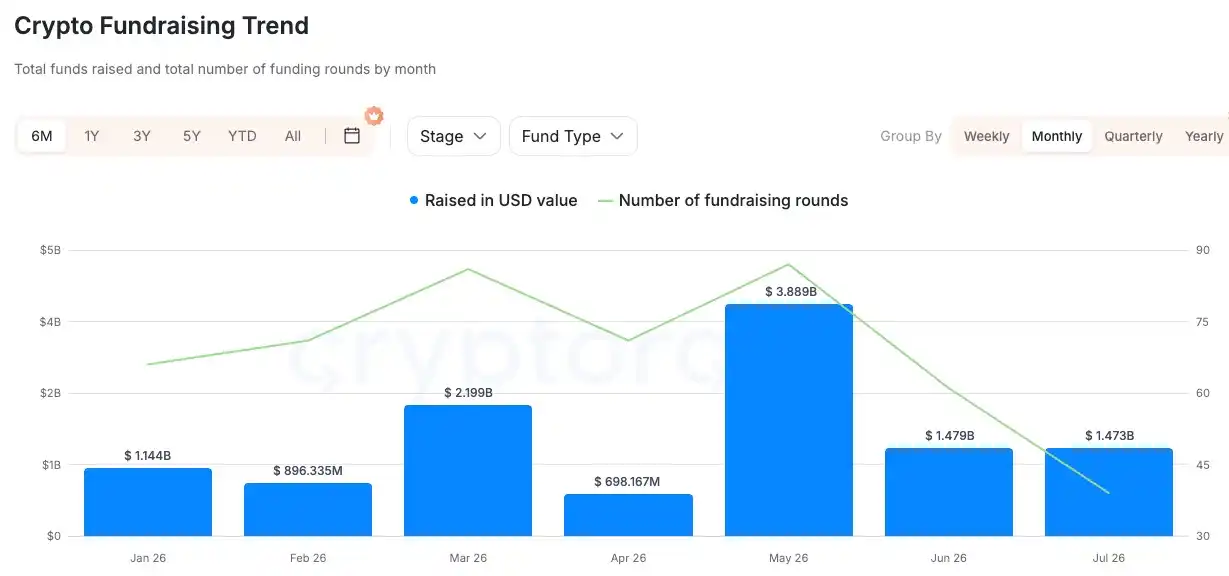
CryptoRank: Monthly Crypto Funding Amount and Number of Rounds in 2026
May, with $3.889 billion across 87 rounds, was the year's high point, accounting for about 33% of the total for the first 7 months. April saw only $698 million across 71 rounds. May's funding amount surged to 5.6 times that of the previous month, while the number of rounds increased by only about 23%. Projects of a similar quantity scale can correspond to vastly different total funding amounts, indicating that a few large deals still dominate the monthly curves.
March and May together absorbed approximately $6.088 billion, accounting for about 52% of the year-to-date total. Funding amounts fell to $1.479 billion in June and $1.473 billion in July, while the number of publicly disclosed rounds dropped from 61 to 39.
Trading Platforms, Prediction Markets, and Payments Absorb 53% of Capital
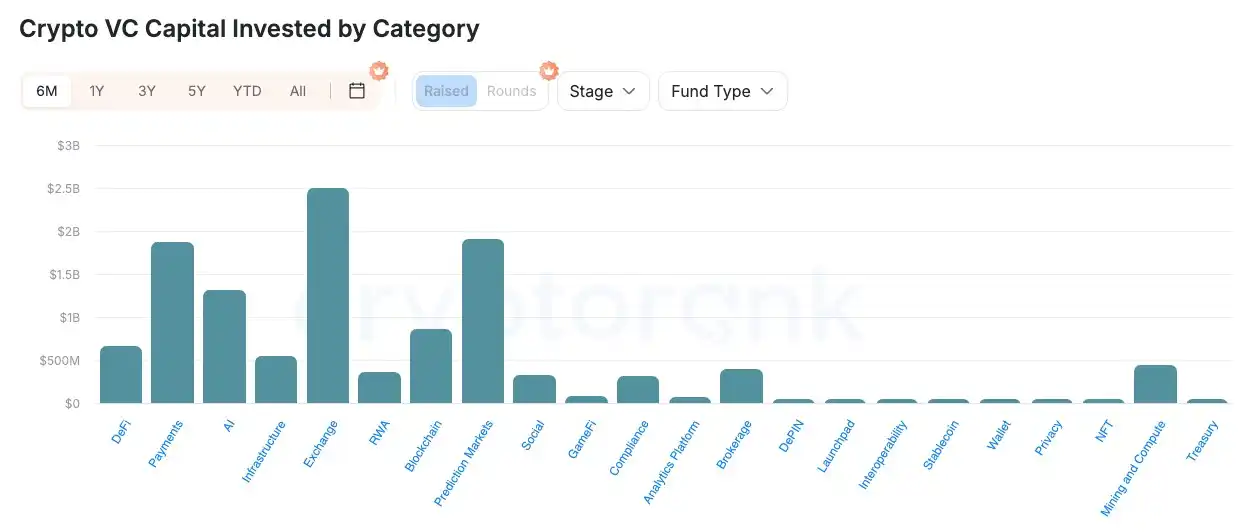
According to CryptoRank's project category classification, Trading Platforms, Prediction Markets, and Payments ranked top three in terms of funding amount for the year to date, raising $2.490 billion, $1.897 billion, and $1.861 billion respectively. Combined, this totals approximately $6.247 billion, representing 53% of the funding for the first 7 months. AI ranked fourth with $1.305 billion.
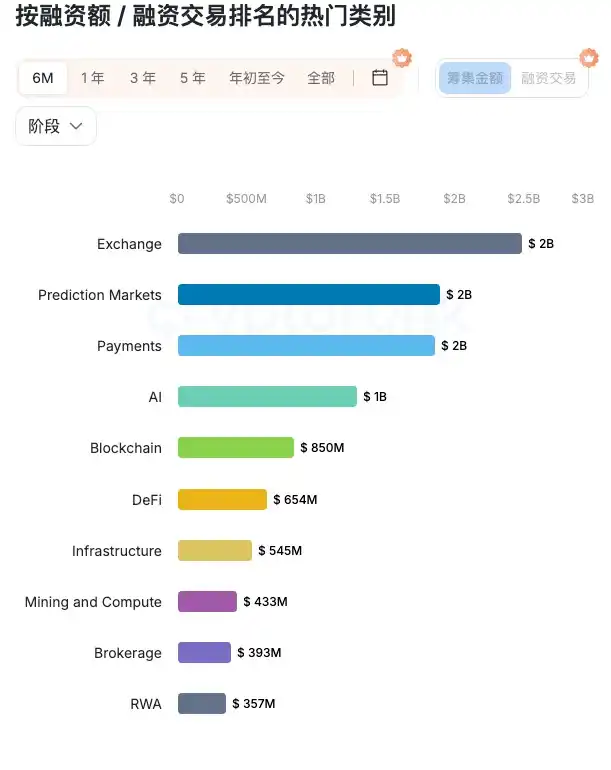
Interestingly, DeFi ranked first with 78 rounds but secured only about $654 million; Payments and AI completed 73 and 65 rounds respectively. High-frequency early-stage funding still exists, but capital is more concentrated in sectors like trading platforms and prediction markets, which can accommodate large later-stage transactions.
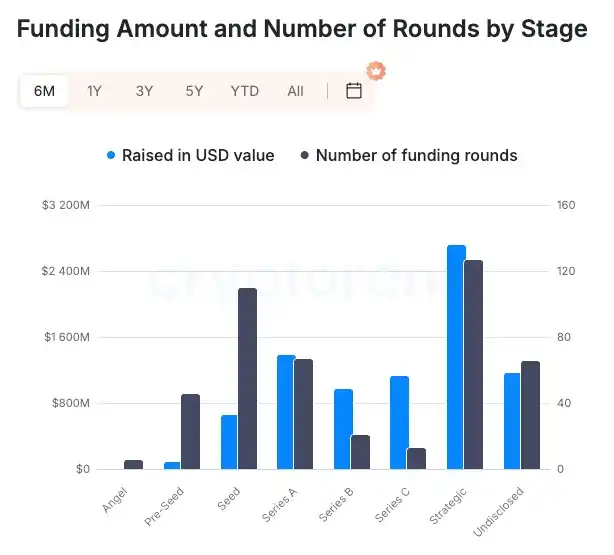
The funding stage further amplifies this disparity. CryptoRank recorded only 20 Series C and later rounds, but they absorbed approximately $3.333 billion. The seed stage, including Pre-Seed and extension rounds, comprised 156 rounds with a disclosed amount of about $750 million. Strategic funding rounds totaled 127, raising about $2.718 billion. Rounds are mainly distributed across early-stage and strategic funding, while the peaks in amount are driven by a handful of late-stage projects.
The value of mergers and acquisitions (M&A) in the crypto industry surged from $272 million in Q4 2025 to $7.23 billion in Q2 2026, expanding over 26-fold in six months. This amount is not included in the aforementioned $11.778 billion funding figure but indicates that capital is also flowing through M&A to companies that have already established business operations and assets.
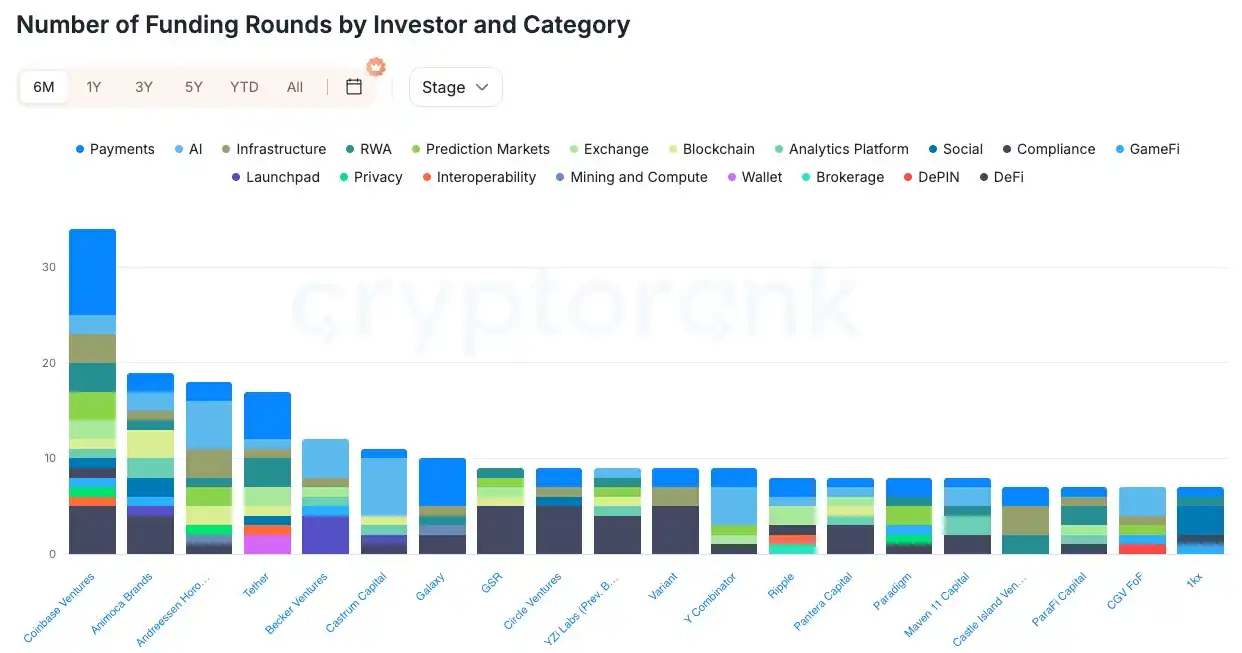
The investor leaderboard also shows a concentration trend. Coinbase Ventures participated in 34 rounds year-to-date, while Animoca Brands, a16z crypto, and Tether participated in 19, 18, and 17 rounds respectively. Repeated investments by a single institution increase the transaction count but do not increase the deduplicated investor metric, explaining the concurrent state where funding activity continues while the total number of active institutions keeps declining.
Top Funds Can Still Raise Capital; Long-Tail Institutions Exiting Reduces Project Options
Dragonfly completed its $650 million fourth fund in February, and a16z crypto announced raising a $2.2 billion fifth fund in June. In contrast, Galaxy Research statistics show that in Q1 2026, only 8 new crypto VC funds completed fundraising, raising a total of approximately $1.1 billion, the lowest since Q3 2020. Top-tier managers can still secure substantial capital, but the list of institutions capable of sustainable fundraising is shrinking.
Rob Hadick, a partner at Dragonfly, previously described in an interview with Fortune magazine that the crypto VC industry is experiencing a "mass extinction." The number of active institutions has shrunk by nearly 90% from its peak, diverging from the concurrent expansion of the global venture capital total. This indicates that this contraction is more a shift in capital allocation. The AI sector and secondary market instruments are simultaneously diverting capital that would have otherwise flowed into primary crypto projects, a trend unlikely to reverse in the short term.
However, early-stage projects can still maintain a certain frequency of transactions, albeit with limited individual deal sizes; large sums of capital are concentrated in a few later-stage sectors like trading platforms and prediction markets, as well as in M&A transactions. This means the crypto primary market has not vanished, but risk appetite has clearly converged, favoring projects with proven business models and accumulated assets.
While top funds complete large fundraises, numerous small and medium-sized institutions are no longer participating in new funding rounds. This landscape has practical implications for startup teams: the pool of potential investors is shrinking, negotiation space on terms is narrowing, and project selection criteria are rising. The decline in the number of institutions, capital scale, and transaction frequency may not necessarily be a negative signal, but it does signify rising industry barriers, with stricter requirements on project quality, capital efficiency, and exit paths than before.