"史上最强"之后,海力士开始难超预期了

华尔街见闻Publicado em 2026-07-29Última atualização em 2026-07-29

Resumo

SK海力士二季度营收79.32万亿韩元、营业利润暴增557%,利润率76.3%刷新存储业历史纪录,毛利率83%已超越英伟达——却成了本轮超级周期中唯一miss共识的巨头。根源在于:HBM霸主地位反噬,50%收入被LTA长协锁定,现货狂涨时只能眼看三星、美光收割ASP弹性。这不是经营恶化,而是一场"用确定性换弹性"的主动选择。下半年HBM4放量,才是判断这笔交易值不值的真正答案。

SK 海力士今日交出了一份"史上最强"财报,却也成了AI存储牛市里最微妙的 miss。

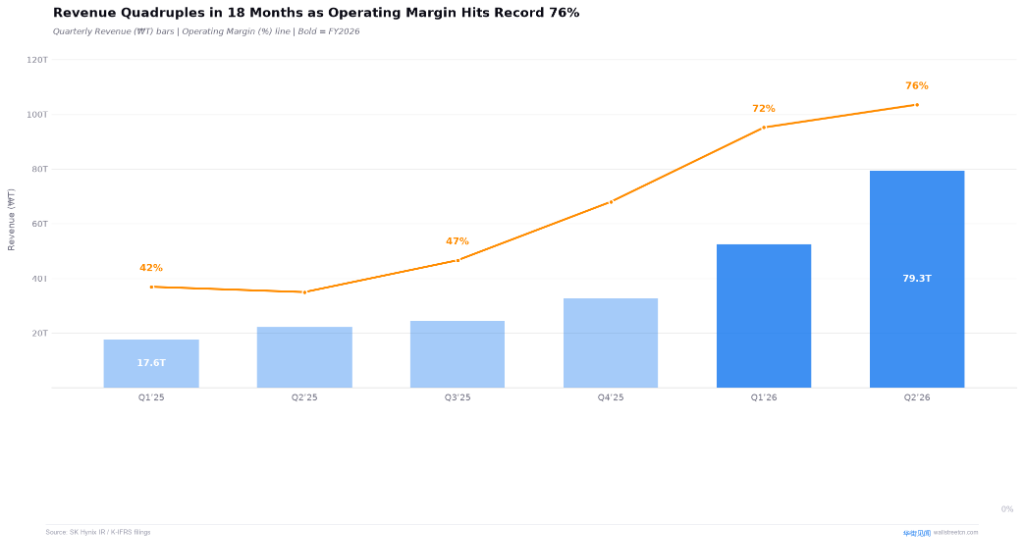
2026 财年第二季度,海力士营收 79.32 万亿韩元,同比暴增 257%、环比增长 51%,看似无可挑剔,却低于市场预期约 5.5%(共识 83.9 万亿韩元);营业利润 60.54 万亿韩元,同比暴涨 557%、环比增长 61%,但同样低于共识约 5.7%(64.2 万亿韩元)。

营业利润率达到 76.3%,刷新存储行业有记录以来的最高水平;毛利率达到 83%——已超过英伟达(约 75%),逼近 Meta(约 82%)等软件平台巨头的盈利区间。

更耐人寻味的是市场反应:财报公布前,海力士股价已从 6 月 22 日高点累计下跌约 47%,财报公布后美股 ADR 先跌 5% 以上,随后转涨;韩国本地市场次日开盘涨 3-4%,随后暴跌。

一句话概括:数据绝对值创历史,但弹性不及预期,市场在"史上最强"与"不及预期"之间反复博弈。
为什么利润涨了 557% 还 miss?LTA 是答案

海力士 miss 的根源,藏在 HBM 超高收入占比里。

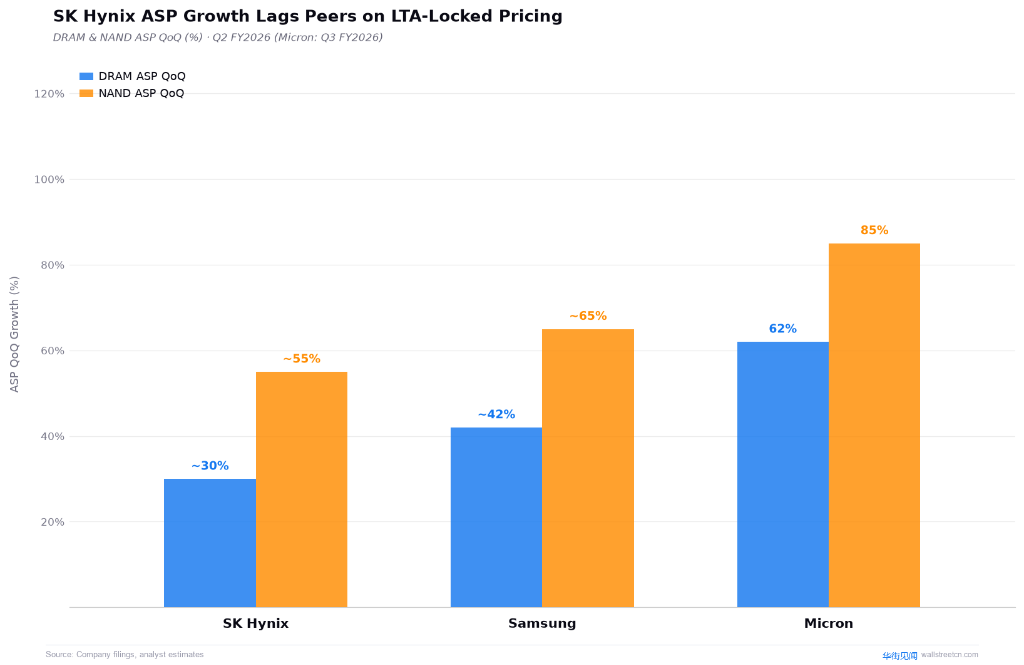
所谓 LTA(Long-Term Agreement,3-5 年期长期供货协议),是 AI 芯片客户与海力士等存储厂商签订的长期采购合约,价格在签约阶段即被锁定,不随现货市场每月波动。对于 AI 训练芯片出货量最大的英伟达而言,这种锁定关系是供应安全的保证;但对于海力士,它是一把双刃剑——当季 DRAM 平均售价(ASP)环比涨幅从第一季度的约 60% 骤降至约 30%,NAND ASP 涨幅也从约 70% 回落至 50-55%。

背后的算术很简单:海力士约 50% 的收入被 LTA 合约锁定,而 LTA 恰恰是它 HBM 份额最高的体现。与此同时,现货 DRAM 市场在同一个季度持续飙升——据 TrendForce 数据,二季度通用 DRAM 合约价环比上涨 58-63%,NAND 闪存价格上涨 70-75%,而海力士实际 ASP 涨幅仅为前者的一半左右,导致海力士"吃"到了成交量,却没能完全"吃"到价格上涨的弹性。韩国 KIS 证券在 7 月 13 日的报告中已提前预警这一矛盾,并将二季度营业利润预测下调至 60.4 万亿韩元——实际值 60.54 万亿韩元,几乎分毫不差。

需要强调的是,miss 不是经营恶化。恰恰相反,营业利润率从一季度 71.5% 进一步提升至 76.3%,绝对利润、营收、毛利率、营业利润率全部创历史新高。问题只在于:市场把预期打到了现货价上涨的路径上,而海力士选择了一条更稳、但也更不刺激的 LTA 路径。
三家巨头的分水岭:三星、美光 beat、海力士 miss

同一轮存储超级周期里,三家巨头的表现出现罕见分化。

三星电子二季度营收 171 万亿韩元,营业利润 89.4 万亿韩元,营收与利润双双 beat 共识。其 DRAM ASP 环比上涨超过 40%,NAND ASP 上涨至 mid-60%,HBM4 已于 2 月开始量产,销售额已超过 12 亿美元。三星在 HBM 赛道一度落后,但如今正以集团资源优势追赶。

美光科技(Micron)三季度财报则是一场大胜:营收 414.6 亿美元,比预期高 16%;非 GAAP EPS 25.11 美元,比预期高 22.5%;毛利率 84.9%,第四季度指引营收 500 亿美元(±10 亿)、毛利率约 86%。其 DRAM ASP 环比上涨 60% 以上,NAND ASP 上涨约 85%,均远超海力士。

而海力士在公司整体层面营业利润率最高(76.3% vs 三星集团 52% vs 美光约 68%),却是本季度唯一 miss 共识的厂商。需要指出,三星半导体(DS)部门利润率估计约 80%,高于海力士——但三星集团包含手机、显示等低利润业务,拉低了整体水平。这种反差说明:HBM 霸主地位带来了最高的公司级利润率和最稳定的客户关系,但也因为 LTA 锁定最强,现货涨价的弹性被压缩得最厉害。简言之,海力士用 ASP 弹性换了确定性。

HBM4 量产与下半年放量:ASP 弹性回归的催化剂

如果 LTA 是二季度 miss 的主因,那么 HBM4 的放量节奏就是下半年能否扭转预期的关键变量。

海力士在财报中确认,HBM4 已在第二季度开始量产发货,下半年将持续扩大出货规模;更先进的 HBM4E 样品已在 2026 年上半年交付客户。KIS 证券预测,HBM4 从三季度开始放量后,海力士的 ASP 将重新向市场平均水平靠拢。这意味着三季度 DRAM ASP 环比涨幅有望从 30% 的水平回升,LTA 锁定带来的"折扣"可能被部分抵消。

下游需求端,英伟达下一代 AI 加速器(Vera Rubin)的放量将直接拉动 HBM4 需求;同时,Agentic AI 应用的扩展正在把 AI 内存需求从训练端推向推理端。海力士管理层强调,当前客户需求仍然超过供给,公司的关键竞争优势在于能够满足大规模出货要求。换句话说,二季度的 ASP 折扣并非因为订单不足,而是因为合约价本身低于现货价——只要 HBM4 的出货结构改善,单位收入仍有显著上行空间。

在供给端,海力士的资本开支继续加码:2026 年全年 capex 预计在 40-50 万亿韩元的上沿,主要用于 M15X DRAM 工厂量产提速、P&T7 先进封装工厂、M17 NAND 生产基地,以及 2027 年初投产的龙仁半导体集群。截至二季度末,海力士现金储备暴增至 88 万亿韩元,净现金 69.4 万亿韩元(约 456 亿美元),资产负债表已经完全从周期底部翻身。

LTA 模式正在重塑存储行业的估值逻辑

短期看,LTA 让海力士在本轮现货涨价中跑得比三星、美光慢;长期看,它可能正在改变存储行业的估值方式。

传统上,存储行业被当作强周期股估值:ASP 涨跌决定利润率起伏,利润率又决定股价弹性。但 LTA 的普及让存储厂商的收入曲线变得更平滑——海力士 50% 收入被 LTA 锁定,美光已签署 16 份 SCA(战略客户协议)目标将 50% 以上收入转为长期合约,三星也在加速推进类似模式。

当 ASP 波动被压缩,市场定价的锚点就从"单季 ASP 涨幅"转向"高盈利可持续性"。这对海力士、美光等龙头而言,意味着估值中枢可能从"周期股"向"AI 基础设施资产"迁移。代价是:在超级周期的某些季度,股价弹性会显得"不够刺激";投资者需要适应的是,存储龙头的利润曲线将更像云服务或半导体设备公司,而非传统大宗商品存储厂商。

回到财务报表,有一个数字需要格外注意:海力士二季度净利润 93.92 万亿韩元,净利率高达 118%——超过 100% 是因为计入了以出售铠侠(Kioxia)股权为主的非营业收益合计约 62.17 万亿韩元(税前)。按公司有效税率约 23.5% 折算,该非营业收益的税后影响约 47.6 万亿韩元;扣除后,核心经营性净利润约为 46.3 万亿韩元。这一异常值不影响主营业务判断,但阅读时必须留意,避免误读为经营性净利率破百。

紧盯HBM4放量后的ASP涨幅

海力士这份财报的真正看点,不是 557% 的利润增长,而是 AI 存储牛市进入第二阶段后,行业定价机制发生的变化。

下季度最值得跟踪的不是营收能否再破纪录,而是HBM4放量能否把ASP涨幅重新拉回到与三星、美光同一条水平线上。

如果三季度 DRAM ASP 环比涨幅回到 40%-50%,那么二季度的 miss 就会被重新定义为"过渡性折价";如果 ASP 继续停留在 30% 附近,市场可能开始认真讨论 LTA 对存储龙头估值天花板的长期压制。

无论哪种路径,存储行业的估值逻辑都已经和两年前完全不同了。

Leituras Relacionadas

Iran Launches 'Sudden Strike' on US Base in Jordan; Oil Prices Jump Nearly 4%, Threatening Bitcoin Rally

Iran launched a "sudden strike" with ballistic missiles targeting a US base near Jordan's Muwaffaq Salti Air Base on July 28. US Central Command reported all missiles were intercepted by Patriot air defense systems, with no casualties. Iran claimed the attack was retaliation for perceived US actions against its interests. This strike broke a brief ceasefire that began after President Trump paused offensive operations against Iran days earlier. The attack triggered immediate financial market reactions. WTI crude oil prices surged nearly 4% to $83.08 per barrel, while Brent crude rose to $87.34. US stock index futures also saw gains as traders priced in renewed Middle East risks. This price jump reversed a significant portion of the oil price decline that followed the initial ceasefire announcement. Bitcoin's price movement mirrored this volatile cycle. It had recovered to around $65,200 as oil prices fell during the ceasefire, but dropped back to the $63,600-$63,800 range following news of the missile strike. While Bitcoin has shown some resilience compared to purely risk-on assets during the conflict, the July 28 attack directly challenged the "truce" narrative that had supported its recent stability. The pattern of price declines following escalations and recoveries during pauses has become familiar since the conflict began in February.

cryptonews.ruHá 2m

Iran Launches 'Sudden Strike' on US Base in Jordan; Oil Prices Jump Nearly 4%, Threatening Bitcoin Rally

cryptonews.ruHá 2m

When 8 Million ETH Start 'Moving': The Post-Pectra Era Ushers in a Structural Transformation for Staking?

A major shift is underway in Ethereum staking, as Lido begins migrating over 8 million ETH (worth ~$16B) from traditional validators to a new architecture enabled by the Pectra upgrade. This migration involves consolidating over 265,000 legacy validators (using 0x01 withdrawal credentials) into a smaller number of higher-balance "0x02" validators, potentially reducing the total validator count on Ethereum by nearly a third. The core driver is EIP-7251 from the Pectra upgrade, which introduced "compounding validators." These allow a single validator's effective balance to grow up to 2048 ETH, with staking rewards automatically reinvested to compound earnings. This contrasts with the old model, where rewards exceeding 32 ETH were automatically sent to a withdrawal address, creating idle funds and operational complexity for reinvestment. While the direct APR boost from compounding is modest—estimated at a ~4.7% relative improvement for smaller validators—the structural benefits are significant. For large operators like Lido, the primary value is operational efficiency: managing fewer validators reduces node, key management, and network message overhead. For smaller individual stakers, the upgrade lowers the barrier to reinvestment by eliminating the need to manually accumulate 32 ETH for new validators. The migration signifies a deeper change in Ethereum's staking landscape. Competition is evolving beyond simple yield, focusing instead on capital efficiency, liquidity management, risk distribution, and infrastructure optimization. Lido's parallel move to require node operator security deposits further highlights this shift towards more robust, capital-backed services. Ultimately, Pectra's compounding validators represent a key step in maturing Ethereum's staking lifecycle, moving the ecosystem from standardized yield products towards more sophisticated capital management and infrastructure solutions.

marsbitHá 15m

When 8 Million ETH Start 'Moving': The Post-Pectra Era Ushers in a Structural Transformation for Staking?

marsbitHá 15m

Trading

Spot
活动图片