In a recent report, Bernstein has brought the long-term purchase agreements in the memory industry back into the spotlight. Micron and SanDisk have signed new LTAs (Long-Term Agreements) with purchase commitments, minimum price floors, and financial guarantees, attempting to add a floor to profits for the coming years.
This floor is not as thick as it appears.
According to public filings and conference call comments from Micron and SanDisk, Micron has signed 16 strategic customer agreements. Of these, 14 agreements represent cumulative minimum revenue of approximately $100 billion calculated at minimum contract prices, with related cash deposits and financial commitments totaling about $22 billion. SanDisk disclosed that three contracts signed in the quarter correspond to around $42 billion in minimum contracted revenue, and five agreements collectively have financial guarantees exceeding $11 billion.
The combined $33 billion in guarantees from the two companies indeed makes it more expensive for large customers to walk away. However, Bernstein's model estimates the potential revenue that might need LTA protection over the next 3-5 years at approximately $5.2 trillion. By this report's metric, the existing guarantees only amount to about 0.6%.
This is precisely the divergence the report seeks to highlight: LTAs are changing the negotiation dynamics between memory companies and large customers, but they act more as a cushion for the downside of the cycle rather than transforming DRAM and NAND into utility-like businesses.
Major Customers Locked into Long-Term Agreements, Guarantees Begin to Translate into Real Money
LTAs are not complex. Customers commit to future purchase volumes years in advance, while suppliers provide supply assurances and pricing mechanisms. If a customer fails to purchase, they may forfeit prepaid guarantees or bear other economic costs.
What's different this time compared to the purchase intentions common in the memory industry's past is the emphasis on financial guarantees being incorporated into the contract structure.
Micron has signed 16 strategic customer agreements valid through June 2026, including 4 mega-customers and 3 mid-sized customers. Fourteen of these agreements represent cumulative minimum revenue of about $100 billion based on minimum contract prices, with expected cash deposits and related financial commitments of approximately $22 billion. This figure includes agreements signed both during and after the quarter and is not entirely equivalent to the RPO (Remaining Performance Obligation) on the balance sheet at period-end.
SanDisk disclosed an RPO of $41.6 billion as of April 3, 2026. The company also mentioned on its conference call that three contracts signed in the quarter provide about $42 billion in minimum contracted revenue, and five agreements collectively have over $11 billion in financial guarantees, covering over one-third of bit supply in FY27.
The mechanisms differ between the two companies. Micron's guarantees are more back-end weighted. As contracts progress and the customer's remaining purchase obligations decrease, the proportion of guarantees relative to RPO increases, making the cost of walking away heavier later in the contract. SanDisk's guarantees are closer to fixed amounts, expected to remain relatively stable throughout the contract period.
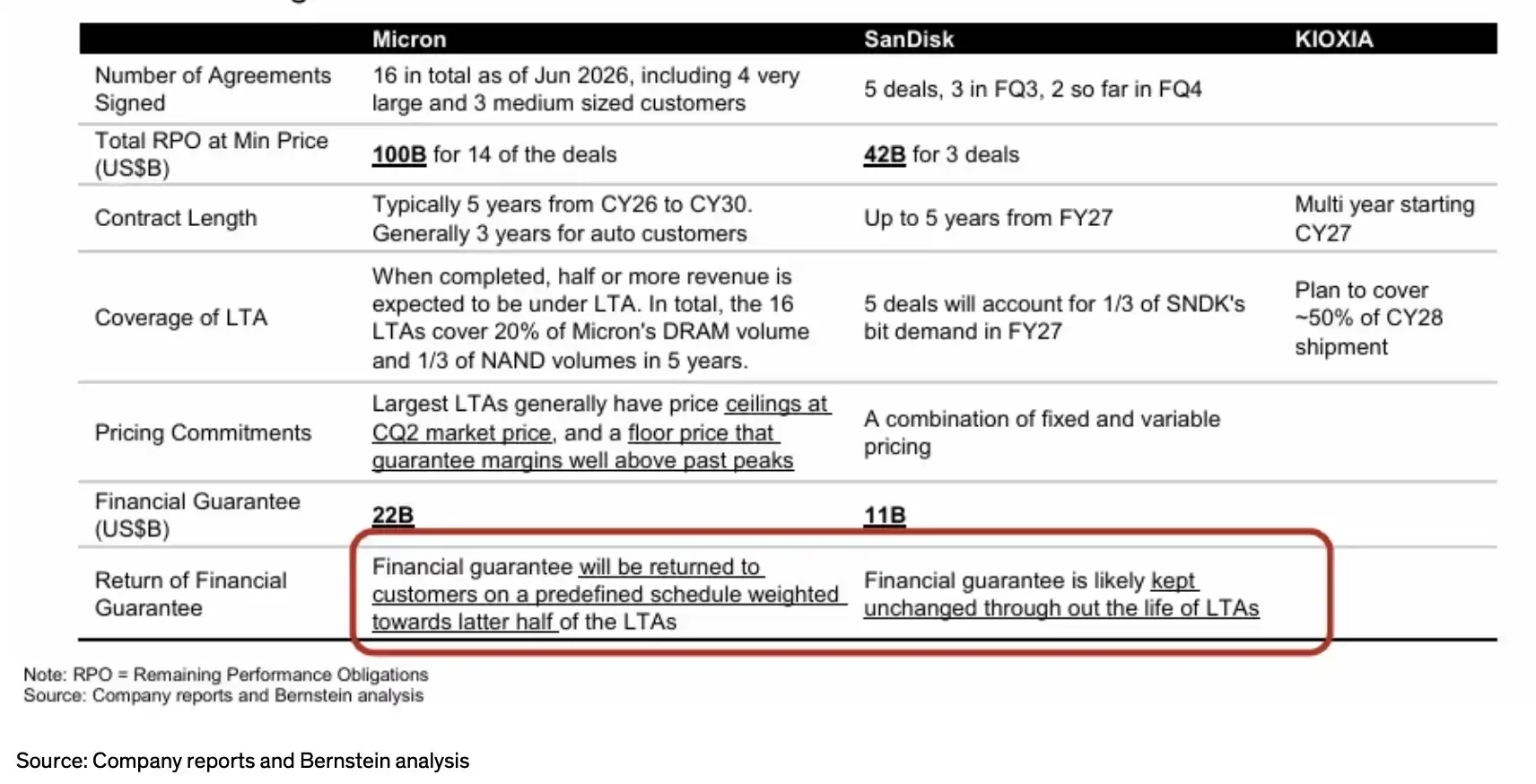
Micron: 16 agreements, ~$100 billion RPO, ~$22 billion guarantees; SanDisk: 5 agreements, ~$42 billion RPO, >$11 billion guarantees.
This is the point bulls focus on most. The biggest problem for the memory industry in the past has been the rapid collapse of profits when prices fall. If large customers are willing to pay guarantees for long-term supply, suppliers can at least gain a clearer revenue floor, and their capital expenditures and capacity planning need not be entirely dictated by spot prices.
$33 Billion in Guarantees Is Not Thin, But It Can't Fully Cushion a Deep Downturn
The scale of guarantees and the scale of revenue needing protection are not on the same order of magnitude.
Using its model, Bernstein estimates that if LTAs were to cover potential revenue over the next 3-5 years, the corresponding protection scale would be around $5.2 trillion. This figure is based on the report's model; public company filings do not directly disclose a similar industry-wide revenue metric, and distinctions need to be made between memory, total semiconductor revenue, and supplier sample revenue.
Nevertheless, the 0.6% guarantee ratio still indicates one thing: LTAs cannot prop up profits under all price scenarios.
If spot prices fall only mildly, it is not economical for customers to walk away. The costs of losing the guarantee, damaging the supply relationship, and potentially losing access to scarce capacity in the future are enough to keep customers fulfilling their obligations. Customers like AI server, cloud, and data center clients also have a stronger need for stable supply than typical consumer electronics customers.
However, if prices fall deeply enough, customers will still do the economic math. If the remaining purchase volume is still large and the spot price falls sufficiently below the contractual floor price, customers may find it cheaper to buy on the open market, even after accounting for the lost guarantee.
The back-end weighting mechanism can mitigate this issue. As the contract nears its end and the remaining RPO declines, the proportion of the guarantee relative to the remaining obligation rises, increasing the customer's cost of abandoning the contract. Protective power may be stronger in the later stages of the contract, which is precisely when the memory cycle often needs it most.
It is still not unconditional insurance. The protective power of LTAs depends on three numbers: how low spot prices fall, how much purchase obligation the customer has left, and how much guarantee balance remains.
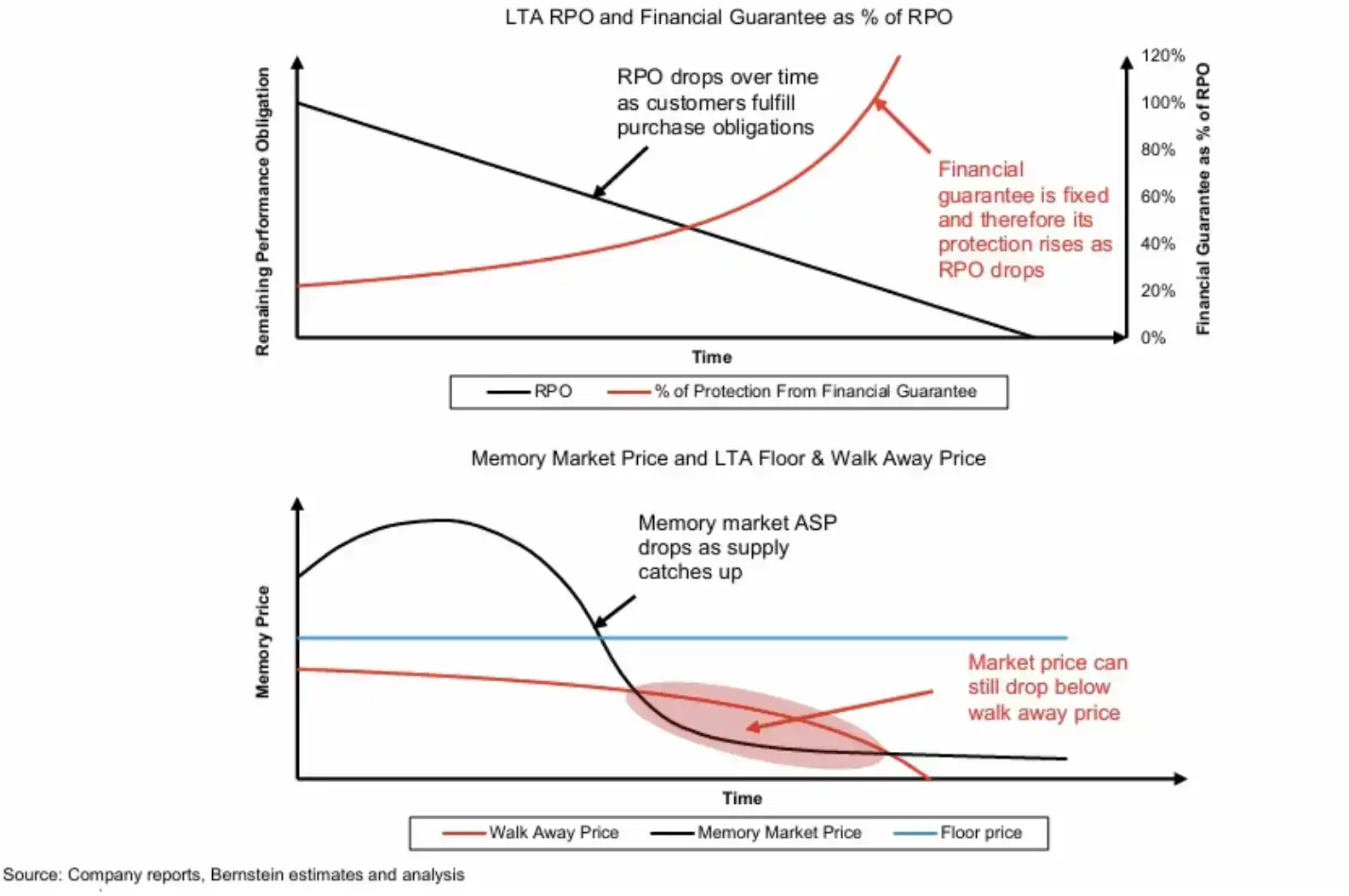
RPO declines over time, guarantee/RPO ratio rises; if spot ASP falls too far below the contract floor price, customers may still choose to walk away.
This is also the core of the bull-bear divergence. Bulls see memory companies finally securing long-term commitments backed by real money from customers. Bears worry that the scale of these commitments is still insufficient to protect peak profits, and that customers will still act based on cost if the downturn is deep enough.
Not All Memory Demand Is Willing to Be Locked into LTAs
LTAs also have a practical limit: not all customers are suitable for long-term agreements.
U.S. cloud service providers are ideal candidates. They have large demand, strong credit, are sensitive to supply stability for AI infrastructure, and have more incentive to lock in supply via long-term agreements. Micron has largely completed negotiations with U.S. CSPs and is still progressing with Chinese CSPs, enterprises, and some other customers.
The consumer business is different. SanDisk's CFO has stated that the consumer business is "more transactional" and LTAs are "not applicable." Mobile phones, PCs, and consumer storage channels are more accustomed to purchasing based on price and inventory cycles. Once prices fall, customers naturally want to maintain flexibility rather than being locked into multi-year floor prices.
Chinese customers may also not become stable buyers under LTAs. On one hand, Chinese cloud vendors and end customers may prefer local suppliers. On the other hand, the expansion of local DRAM and NAND supply adds uncertainty to long-term purchase commitments.
Bernstein estimates that approximately 30%-50% of the total DRAM and NAND end-market share may be difficult to cover with LTAs. Even if leading suppliers lock in major U.S. customers, a significant portion of the market will continue to operate based on spot prices, short-term orders, and cycle expectations.
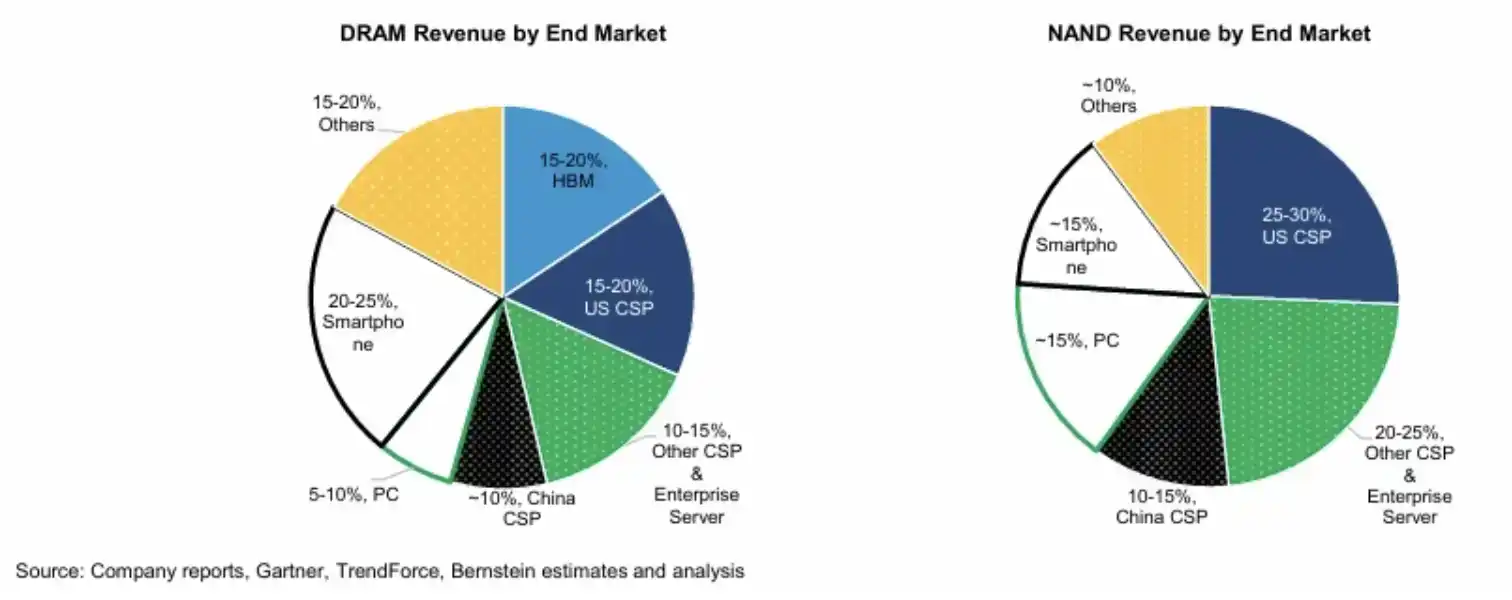
A breakdown of the DRAM/NAND end-market shows that beyond U.S. CSPs, there is demand from Chinese CSPs, enterprise servers, consumer/PCs, smartphones, etc. About 30%-50% of the market may be difficult to cover with LTAs.
As long as a sufficiently large proportion of demand remains in the spot or short-term contract system, price signals will not disappear. As long as price signals exist, supplier capacity expansion, customer inventory destocking, and channel order cuts will still amplify cyclical fluctuations.
AI Demand Supports Valuations, But Peak Profits Cannot Be Simply Extrapolated
The market's willingness to assign higher valuations to memory companies is partly due to AI demand altering the shape of this cycle's bottom.
On the DRAM side, HBM demand remains strong. Bernstein's Asia team predicts HBM prices in 2027 could be 2-2.5 times higher than in 2026. Commercial prices for conventional DRAM have already risen significantly and may remain elevated over the next 12 months. While HBM is more stable than ordinary memory, it shares some production capacity with conventional DRAM, and capacity allocation decisions affect other product lines.
On the NAND side, AI inference and longer context windows also bring new demand potential. Early AI training primarily consumed HBM and DRAM, but as inference, Agentic AI, and long-context applications increase, storage demand may continue to rise. It should be noted that references to Vera Rubin-related capacity should not simply be written as "GPU NAND capacity"; Nvidia's official page discloses 20.7TB of HBM4 GPU memory.
In this environment, the value of LTAs is more akin to locking down a portion of high-growth revenue. If AI demand remains strong, suppliers can secure purchases from some large customers via long-term agreements. If prices retreat, the guarantees and floor prices can slow the profit decline.
SanDisk's stress tests point to similar conclusions. Bernstein's model shows that under stringent assumptions, LTAs can still result in FY29-FY30 EPS being higher than in a no-LTA scenario across most penetration rate scenarios, with protection being particularly stronger in later periods. However, the same set of stress tests also indicates that peak profits cannot be simply extrapolated. Under lower operating margin scenarios, EPS could be significantly below current run-rate levels.
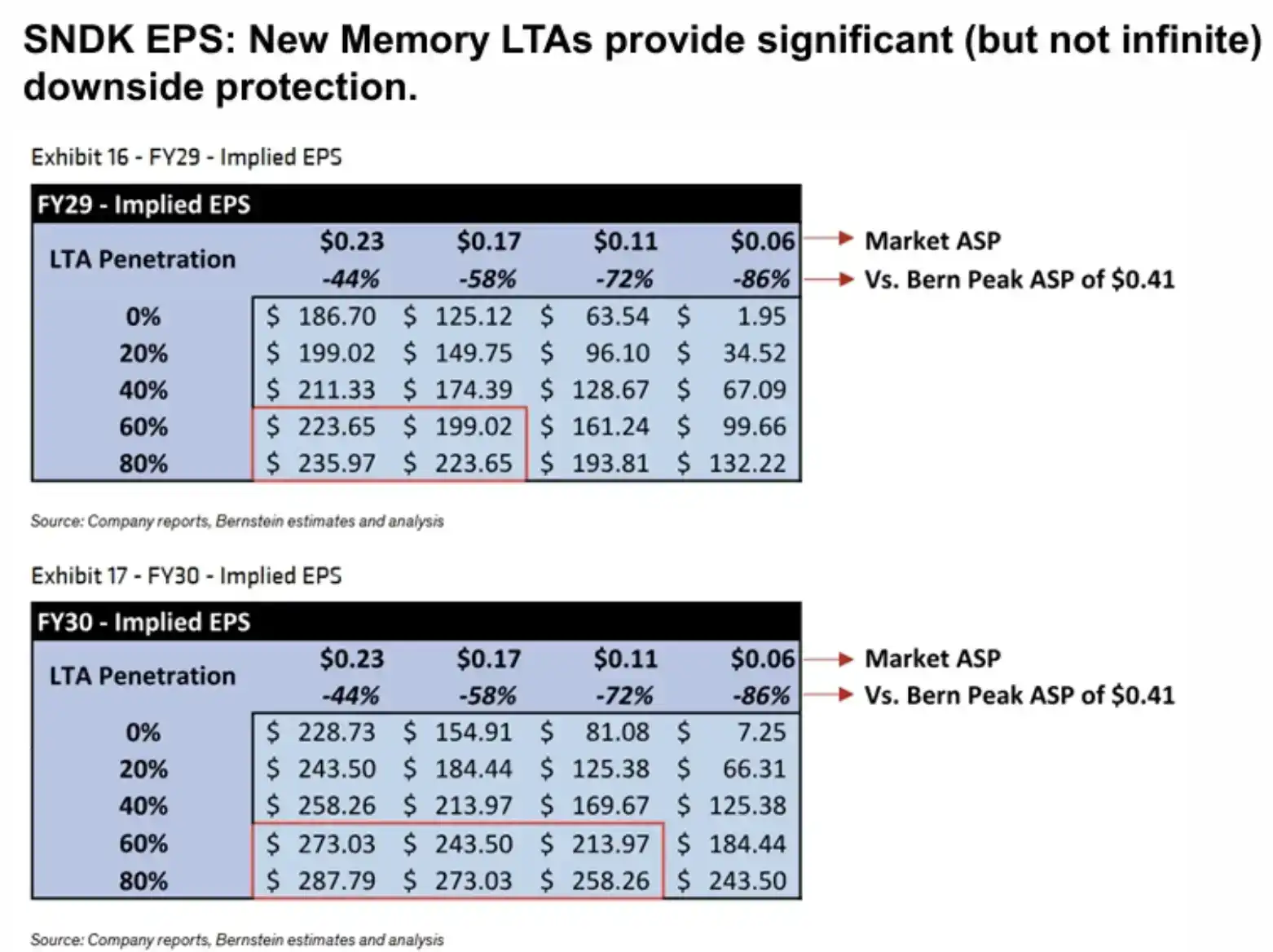
SanDisk FY29-FY30 EPS sensitivity table shows a wide EPS range under different ASP and LTA penetration rate scenarios. LTAs improve downside scenarios but cannot lock in peak profits.
The most valuable takeaway from this report is not "the memory cycle is over," but rather "the downside of the cycle may be softened."
The fact that Micron and SanDisk have secured long-term agreements with financial guarantees indicates that major customers are willing to pay for supply certainty in the AI era. For memory companies, this improves revenue visibility for the coming years and makes it easier for capital markets to believe in a higher profit floor than in the past.
The limitations are equally clear. $33 billion in guarantees can only provide a partial buffer; consumer, Chinese customer, and some transactional demand will not all enter long-term agreements. Bernstein also estimates that China's DRAM share could rise from about 8% to 16% in the coming years, and NAND may face stronger supply pressure post-2028.
What LTAs truly need to prove is not whether they can be signed during an upturn, but whether customers will honor them in the next downturn, whether the guarantees will be painful enough, and whether suppliers will maintain capacity discipline. Until these questions are answered, LTAs are a new cushion for the memory industry, not the button that ends the cycle.