What’s next as GENIUS Act misses first major rulemaking deadline?

ambcryptoPublicado em 2026-07-18Última atualização em 2026-07-18

Resumo

The GENIUS Act, the U.S. stablecoin framework passed in July 2027, has missed its first major rulemaking deadline. Regulators, including the Federal Reserve, were required to finalize rules by July 18, 2027, but none of the 10 related proposals have been officially completed. Six are past the comment period, while four remain open. Federal Reserve Chairman Kevin Warsh indicated final rules could be issued imminently. The banking industry has expressed concerns about the legislation creating an uneven playing field. Despite the regulatory delay, the stablecoin market has responded positively, with total supply growing from $250 billion to over $300 billion since the law's passage, and firms like Fidelity launching new offerings. Senator Bill Hagerty, a co-sponsor, hailed the act as a "watershed moment" for U.S. leadership in digital assets.

The U.S. stablecoin framework, the GENIUS Act, has hit the initial deadline of the 18th of July. Passed into law on the 18th of July 2027, the framework set multiple milestones for its progressive enactment.

For the first year after passage, regulators, including the Federal Reserve and the OCC, were mandated to finalize rulemakings for the GENIUS Act by the 18th of July, 2027.

In 18 months, or by January 2027, the framework should begin taking effect after the regulators publish final rules.

Finally, the transition period will end after three years, by mid-2028. After this, there will be no firm allowed to offer or handle stablecoins in the U.S. without GENIUS Act compliance.

Why are the final rules delayed?

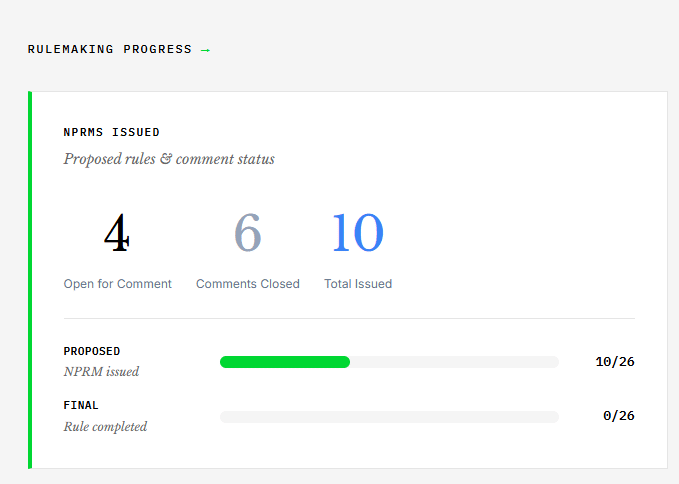
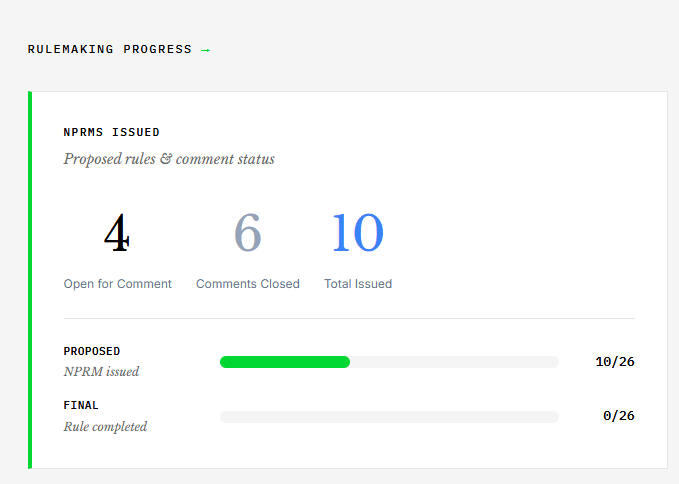
Six regulators have issued 10 rulemaking proposals related to the law. But none of the proposals have been officially completed, at least as of writing. Only six of the proposals have closed their comment period, meaning the regulators could issue final rulings for them.
Source: Paradigm

Still, four other proposals, including Bank Secrecy Act and sanction compliance for FDIC-supervised stablecoin issuers, are still open for comment.

In other words, despite hitting the rulemaking deadline, the GENIUS Act was still far from finalizing key rules.

What’s next for the GENIUS Act?

However, it’s worth noting that in a recent Congress hearing, Kevin Warsh, the chairman of the Federal Reserve, said that the final rules could be issued soon.

We’re racing to put that out (GENIUS Act final rules) by this deadline, this Saturday.

For the banking industry, which has opposed the legislation due to the stablecoin yield loophole, it called for a review of the proposed rules to avoid.

Uneven playing field or opportunities for regulatory arbitrage, unintended policy consequences, or unworkable or incongruous requirements.

How has the stablecoin market responded?

The GENIUS Act is the first formal stablecoins framework in the U.S that aims to advance innovation and protect consumers. To achieve this, it has reserve requirements and anti-money laundering provisions.

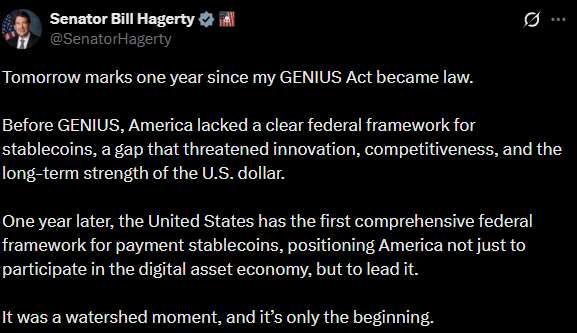
Commenting on the legislation, Senator Bill Hagerty, who co-sponsored it, said,

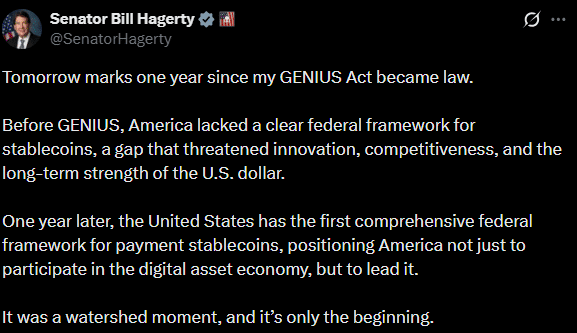
The United States has the first comprehensive federal framework for payment stablecoins, positioning America not just to participate in the digital asset economy, but to lead it. It was a watershed moment, and it’s only the beginning.
Source: X

Since the law, the stablecoin market supply surged from $250B to over $300B. Even several firms like Fidelity have begun their stablecoin offerings.

Additionally, some crypto platforms like Phantom recorded a 20% increase in stablecoin balance from $2.33B to $2.82B since the GENIUS Act was passed.

It remains to be seen how the growth will accelerate when regulators publish final rules as the legislation enters its second year.


Final SummaryThe

  • GENIUS Act has entered its second year, but final rules will likely stretch beyond the rulemaking deadline
  • Stablecoin market supply increased by over $50B after legislation became law, with Sen. Hagerty calling ‘watershed moment’


Criptomoedas em alta

Perguntas relacionadas

QWhat is the first major rulemaking deadline that the GENIUS Act has missed, and who was responsible for meeting it?

AThe first major rulemaking deadline was July 18, 2027. Regulators, including the Federal Reserve and the OCC, were mandated to finalize rules for the GENIUS Act by this date, but none of the proposals have been officially completed.

QAccording to the article, what are two key reasons why the final rules for the GENIUS Act have been delayed?

ATwo reasons for the delay are: 1) Only six out of ten rulemaking proposals have closed their comment period, meaning regulators could only potentially issue final rules for those. 2) Four proposals, including those on Bank Secrecy Act and sanction compliance for FDIC-supervised issuers, are still open for comment.

QWhat specific market impact has the passage of the GENIUS Act had on the stablecoin sector?

ASince the GENIUS Act became law, the stablecoin market supply has surged from $250 billion to over $300 billion, an increase of over $50 billion. Firms like Fidelity have launched stablecoin offerings, and platforms like Phantom saw a 20% increase in stablecoin balances.

QWhat did Federal Reserve Chairman Kevin Warsh recently indicate about the timing of the final rules for the GENIUS Act?

AIn a recent Congress hearing, Federal Reserve Chairman Kevin Warsh said that the final rules could be issued soon, stating, "We're racing to put that out (GENIUS Act final rules) by this deadline, this Saturday."

QWhat is the banking industry's primary concern regarding the GENIUS Act, as mentioned in the article?

AThe banking industry opposes the legislation due to the stablecoin yield loophole. They have called for a review of the proposed rules to avoid an uneven playing field, opportunities for regulatory arbitrage, unintended policy consequences, or unworkable requirements.

Leituras Relacionadas

Bitcoin Mining Farms Are Becoming AI Factories

Bitcoin mines are transforming into AI factories. This shift is driven by the convergence of three key assets from the previous crypto cycle: infrastructure, talent, and capital. Crypto mining companies like Crusoe, CoreWeave, and Bitdeer are repurposing their core competency—securing power, land, and grid connections in remote locations—to build data centers for AI clients. These firms are signing multi-billion dollar, long-term contracts with companies like Anthropic, AWS, and Microsoft, as AI's demand for reliable, high-capacity compute surpasses the profitability of Bitcoin mining. Simultaneously, crypto entrepreneurs and engineers are applying their skills to new AI ventures. Examples include OpenSea's co-founder launching OpenRouter (an AI model aggregator), and former Coinbase engineers building Fal.ai (a generative media infrastructure platform). Their experience in building scalable, global software networks translates effectively to the AI space. Furthermore, capital accumulated during the crypto boom is now fueling AI. Figures like Jed McCaleb (co-founder of Ripple) funded Voltage Park, a large-scale GPU cloud provider. Notably, some crypto investments, like FTX's early bets on Anthropic and Cursor, have generated astronomical paper returns, demonstrating how high-risk crypto capital flowed into AI before it became mainstream. The transition is not just about repurposing hardware, but about redirecting critical resources—power infrastructure, distributed systems expertise, and venture funding—to the next technological frontier: artificial intelligence.

链捕手Há 50m

Bitcoin Mining Farms Are Becoming AI Factories

链捕手Há 50m

Morpho Launches Fixed-Rate Product Midnight: Lenders and Borrowers Set Their Own Rates, Ending the Era of Interest Rate Models

Morpho Launches Fixed-Rate Product Midnight: Lenders and Borrowers Set Their Own Rates, Ending the Era of Algorithmic Interest Models On-chain lending has grown to $60 billion but remains minuscule compared to traditional finance's $200 trillion annual credit volume. Morpho identifies the lack of fixed rates and maturity dates as key bottlenecks. Institutions need predictability, not the passive floating rates set by algorithmic models. Midnight allows lenders and borrowers to directly quote rates, set terms, and become price makers, not takers. Fixed-rate lending is now viable due to cheaper, faster blockchains and the entry of institutions demanding control and certainty over returns, costs, and duration. Morpho Blue previously gave users control over risk; Midnight adds control over interest rates. Past attempts at on-chain fixed-rate lending failed primarily because they were built on top of floating-rate pools (creating unpredictability) or lacked sufficient active participants. Midnight avoids these pitfalls as a standalone primitive with fixed rates at its core, built upon Morpho Blue's existing large and active user base. Midnight offers distinct value: institutions gain predictable term structures and full control; fintech companies can offer tailored fixed-rate products; lenders/borrowers achieve predictability and efficiency; and curators can now differentiate by configuring both risk and interest rates. Morpho Midnight is not a replacement for Morpho Blue. The Morpho network will now feature two complementary market structures: floating-rate/open-term (Blue) for flexibility and fixed-rate/fixed-term (Midnight) for predictability. Liquidity can flow between them. The launch will be gradual, prioritizing security. Initially, it will support direct lending on Base network with one trading pair (cbBTC/USDC) and limited maturity dates. Advanced features like auto-rollovers will be introduced later.

marsbitHá 51m

Morpho Launches Fixed-Rate Product Midnight: Lenders and Borrowers Set Their Own Rates, Ending the Era of Interest Rate Models

marsbitHá 51m

Trading

Spot

Artigos em Destaque

Como comprar GENIUS

Bem-vindo à HTX.com!Tornámos a compra de Genius (GENIUS) simples e conveniente.Segue o nosso guia passo a passo para iniciar a tua jornada no mundo das criptos.Passo 1: cria a tua conta HTXUtiliza o teu e-mail ou número de telefone para te inscreveres numa conta gratuita na HTX.Desfruta de um processo de inscrição sem complicações e desbloqueia todas as funcionalidades.Obter a minha contaPasso 2: vai para Comprar Cripto e escolhe o teu método de pagamentoCartão de crédito/débito: usa o teu visa ou mastercard para comprar Genius (GENIUS) instantaneamente.Saldo: usa os fundos da tua conta HTX para transacionar sem problemas.Terceiros: adicionamos métodos de pagamento populares, como Google Pay e Apple Pay, para aumentar a conveniência.P2P: transaciona diretamente com outros utilizadores na HTX.Mercado de balcão (OTC): oferecemos serviços personalizados e taxas de câmbio competitivas para os traders.Passo 3: armazena teu Genius (GENIUS)Depois de comprar o teu Genius (GENIUS), armazena-o na tua conta HTX.Alternativamente, podes enviá-lo para outro lugar através de transferência blockchain ou usá-lo para transacionar outras criptomoedas.Passo 4: transaciona Genius (GENIUS)Transaciona facilmente Genius (GENIUS) no mercado à vista da HTX.Acede simplesmente à tua conta, seleciona o teu par de trading, executa as tuas transações e monitoriza em tempo real.Oferecemos uma experiência de fácil utilização tanto para principiantes como para traders experientes.

336 Visualizações TotaisPublicado em {updateTime}Atualizado em 2026.06.02

Como comprar GENIUS

Discussões

Bem-vindo à Comunidade HTX. Aqui, pode manter-se informado sobre os mais recentes desenvolvimentos da plataforma e obter acesso a análises profissionais de mercado. As opiniões dos utilizadores sobre o preço de GENIUS (GENIUS) são apresentadas abaixo.

活动图片