Founder of Baixing.com: The Notion That Large Language Models Will Devour Everything, I Believe Half of It

marsbitPublicado em 2026-07-07Última atualização em 2026-07-07

Resumo

Founder of Baixing.com: I Only Half-Believe the Saying “Large Language Models Will Devour Everything” Author: Wang Jianshuo, Founder of Baixing.com Many proclaim that large models are everything, but the author is skeptical. He argues that such sweeping claims often stem from a limited understanding of the future. Drawing parallels to past technologies like electricity and the internet—which were predicted to “devour everything” but didn’t—he suggests that large language models (LLMs) are better seen as a foundational base. Like electricity, this base is essential for modern development, but its real value emerges only when applied to specific scenarios through various “machines” or “tools” (e.g., Claude Code for programming, Claude Design for design). The author acknowledges that LLMs may indeed replace many existing software systems built on rigid rules, workflows, and forms (e.g., CRMs, SaaS tools), as these are precisely what LLMs excel at processing. However, he emphasizes that beyond software, elements like customer data, execution capabilities (e.g., booking a flight), trust, and physical-world interactions will not be “devoured.” Instead, he foresees that after streamlining existing software, LLMs will open up a larger space for innovative, next-generation applications. These new tools will likely feature fluid interfaces and rely less on fixed rules, unleashing greater creativity. The author cautions against short-sightedness, recalling how in 2004 many believed ...

Author: Wang Jianshuo, Founder of Baixing.com

Many people readily proclaim, "Large models are everything." I don't quite buy it.

Every time I hear phrases like "devour everything," I feel it's mostly because our understanding of the future hasn't reached that level, hence we casually throw out such a broad statement. Otherwise, how could one thing devour everything? Take the internet—it's been shouting about devouring everything for years, has it truly devoured everything now? So which one is it, the internet devours everything, or large models devour everything? Both are devouring, leaving nothing behind?

So I'd rather put it differently: it is a very important foundation. Without this foundation, the whole world can't develop, just like the internet without its underlying backbone network, or like using electricity without power plants. That, I acknowledge.

But after the foundation is in place, that's where the real excitement happens above.

Take electricity. As soon as electricity was generated, what was the first application people saw? The light bulb. Thomas Edison lit the first one, and it just kept shining, shining, shining. If the world stopped there, with only a light bulb, then I could completely say: the power plant is the core of the whole world, the power plant devours everything.

But that's not how things went. Later came motors, to drive machines; and then you find that once a fundamental thing like electricity exists, countless appliances grow on top of it to utilize it. Washing machines are for washing clothes, televisions are for watching TV, vacuum cleaners are for vacuuming—they are all applications of electricity. Without electricity, none of these things would exist. But if you say "electricity devours everything," I don't believe it.

It's the same with large models. They provide foundational intelligence. But this intelligence must be placed into a specific, scenario-oriented "machine" or "device" before it can play its role and truly change the world.
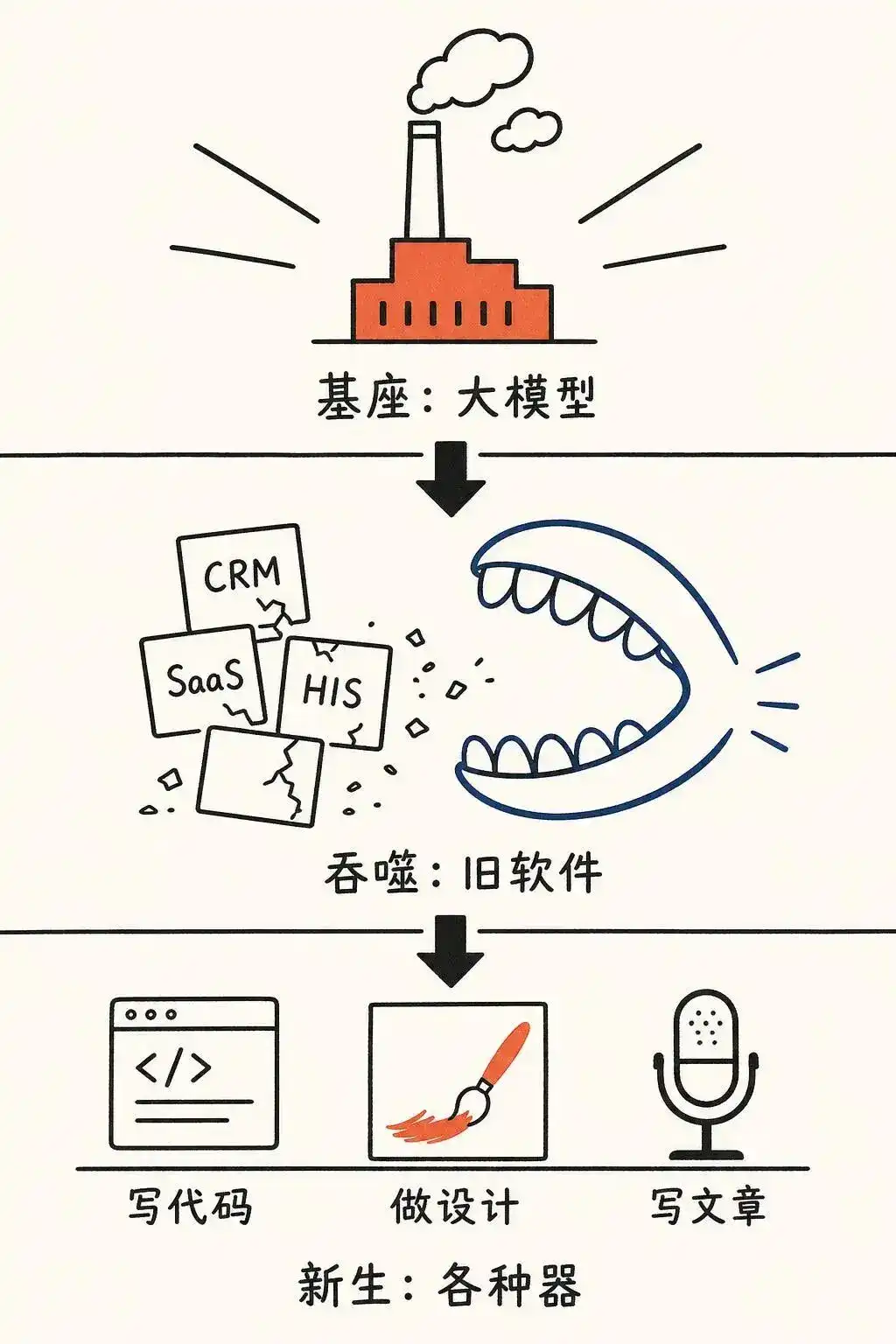
Claude Code is for writing code, Claude Design is for design, VoiceDrop is for writing articles. Using the same large model, placed into different devices, solves completely different problems.

With only electricity, only water, without a washing machine, clothes still can't be washed. Imagine, a power plant produces a massive amount of electricity, electricity is very powerful, and then what? Without a washing machine, can this pile of electricity wash clothes by itself?

Intelligence is great, but most things in the world require the combination of multiple elements to work, just as a washing machine needs to combine elements like electricity, water, and even a tub; large models might be able to replace a lot in the field of software, but application scenarios in the world that require only one element are not many.

Here's a current example. Now we have large models, but having just a large model isn't enough. There needs to be a layer above it called Harness—this layer has only recently emerged—it interacts with code, and finally forms something truly usable. A large model by itself can't write code. Of course, the core of Claude Code, frankly, I could write it with a little over fifty lines; a bit longer with a few more lines, and it can run and write programs. But you have to see: with only a large model and without this outer layer, it's still not easy to use—that is, the intelligence of a large model, if not combined with the code execution capabilities provided by the operating system, relying on the large model for calculations isn't economical, and sometimes even impossible.

The core value of this interface layer is to help us put that intelligence, which is like electricity or water, into a specific application scenario, turning it into a machine that can solve specific problems.

Now, of course, the logic behind "devour everything," I don't completely disbelieve it either.

What it primarily refers to is existing software. So far, we have built up a very, very large layer of software—things pieced together by many rules, forms, buttons, workflows, a lot of it. Massive numbers of filters, fixed templates, a bunch of backend operations, many SaaS detection features. And all the various things we used to know as "M" systems, whether CRM, or HIS (hospital information system), all sorts of so-called "systems," "software," and the like, a whole pile.

This layer, I believe large language models will indeed devour quite a bit of.

Why? Because these original software programs were, by nature, clear, computer-executable instructions, solidified and repeatedly executed—we call this software. And this is precisely what large language models are most adept at chewing through.

But.

Within this layer, besides software, there are many other things. Customer information. Execution capabilities—like when you book a flight ticket, the actual capability to move a plane, to transport a person from here to there. Also trust. Many things in the physical world. These, I don't think will be devoured.

After devouring that layer, it actually opens up a much larger space—the new type of software on top of it.

The interface of the new software will certainly be flow-based, it likely won't solidify as many rules as before. After handing all those rules to AI, think about it, the CRM we could achieve like Salesforce before, that was already the pinnacle of human effort, using all possible strength. But if this part becomes relatively easier to solve, then what everyone will do next is to unleash even more imagination and possibilities on top of it—and that part is precisely what we haven't seen yet.

This is where we often make mistakes. When a new technology arrives, because we can't see the bigger road beyond it, we can only stare at the part in front of us. The leaf blocks the view, obscuring the mountain.

Let alone this kind of trend judgment. I remember back in 2004, a group of friends were complaining, saying that the entire internet could no longer produce companies bigger than Sina, Sohu, and NetEase, that the internet was nearly over, and they would monopolize everything. And look how many years have passed since then? The world turned upside down. We would be crying at our own shortsightedness back then.

So my proposition is this: Are large models important? Yes, they are the foundation, the main driving force in recent times. But once they become stable, continuously provided things, then various kinds of "machines" and "devices" on top are needed to solve specific problems. That thick layer—where it's used, how it's used—is precisely the mainstream of the second wave of this trend.

The phrase "devour everything" is too imprecise. In this world, which thing, which social form, which technology has ever truly devoured everything?

Finding opportunities in the places it does devour—that's the truly important thing.

Criptomoedas em alta

Perguntas relacionadas

QWhat is the core viewpoint of the author, the founder of Baixing.com, regarding the statement 'Large language models will devour everything'?

AHe believes it only half. He views large language models as a crucial foundational platform, like electricity or the internet, but argues that they alone cannot 'devour everything.' True value and transformation come from applying this foundational intelligence to specific scenarios through various 'machines' or applications built on top of it.

QHow does the author use the analogy of electricity to explain the role of large language models?

AThe author compares large language models to electricity. Electricity itself is a foundational utility (like a power plant), but it doesn't 'devour everything.' Its real-world impact comes from the diverse array of appliances (like washing machines, TVs) built on top of it to solve specific problems. Similarly, LLMs provide base intelligence, but they need to be integrated into specific applications (like Claude Code for programming) to be truly useful and transformative.

QAccording to the article, what specific layer of existing technology does the author believe large language models are likely to 'devour' or replace?

AThe author believes large language models are likely to replace a significant portion of existing, rule-based, fixed-template software systems, such as many CRM, HIS, and various SaaS applications. These systems are composed of clear, computer-executable instructions, which is precisely what LLMs are good at handling and generating.

QWhat does the author identify as elements that will NOT be 'devoured' by large language models, even as software systems change?

AThe author identifies several elements that will not be devoured: customer information, execution capabilities (like physically moving people or goods), trust, and many aspects of the physical world. These components are essential and exist alongside or beyond the software logic that LLMs might replace.

QWhat is the 'second wave' of the AI浪潮 (wave/tide) that the author predicts will follow the establishment of large language models as a stable foundation?

AThe author predicts the 'second wave' will be focused on the thick layer of applications built *on top* of the large language model foundation. This involves creating the various 'machines' and 'tools' that leverage the base intelligence to solve concrete, specific problems in different domains. This application layer is where the next major phase of innovation and opportunity lies.

Leituras Relacionadas

Zuckerberg Begins Betting on Prediction Markets, While Asian Countries Still View Them as Gambling

Mark Zuckerberg is backing prediction markets, with Meta developing its own app "Arena," signaling major tech validation. This industry now sees over $14 billion in monthly volume. These markets function as binary contracts (payout $1 if an event occurs, $0 if not), with trading prices reflecting real-time event probabilities. Results are settled by oracles. Prediction markets originated from informal political betting and academic experiments like the Iowa Electronic Markets. Their core mechanism relies on "skin in the game"—participants risk their own money, making aggregated information more reliable than polls or expert opinions. They have proven accurate in forecasting areas like monetary policy, elections, and market events. While Western markets are integrating them into regulated financial systems, many Asian jurisdictions still classify them as gambling, leading to regulatory divergence. This stance creates three major issues for Asia: regulatory arbitrage and capital outflow, loss of informational sovereignty as valuable social data accumulates offshore, and a lack of user protection within a formal framework. The article argues that Asia's focus should shift from blocking these markets to responsibly harnessing the data they generate within a regulated system. The current avoidance of discussion cedes leadership and advantages to foreign entities.

Foresight NewsHá 8m

Zuckerberg Begins Betting on Prediction Markets, While Asian Countries Still View Them as Gambling

Foresight NewsHá 8m

Beyond Private Keys: From Wallets and L2 to Supply Chains, How to Guard the Security Perimeter of Web3?

Beyond Private Keys: Securing Web3's Expanding Attack Surface from Wallets to L2s and Supply Chains The crypto space faced a wave of security incidents in June, with over $75 million lost across 40 major attacks. These breaches highlighted risks beyond private key theft, exposing vulnerabilities across the entire user interaction chain. Wallet security was compromised not through stolen seed phrases, but via a critical flaw in the Cardano wallet SecondFi's signing implementation. This bug allowed attackers to potentially derive private keys from publicly visible signature data, emphasizing that wallet security depends on correct cryptographic implementation, ideally in open-source, auditable code. Layer-2 networks also revealed complex trust chain risks. Attacks on legacy Aztec deployments exploited inconsistencies in proof systems, showing that a valid zero-knowledge proof is only as secure as its underlying rules. Another attack on Taiko's SGX-based prover stemmed from a leaked signing key and inadequate verification checks. Furthermore, a technical glitch halted Base's block production, underscoring that L2 security encompasses network availability and reliable user exit paths as much as asset safety. Finally, the Polymarket incident demonstrated that even audited smart contracts are not immune. A compromised third-party supplier led to a malicious script being injected into the platform's frontend, resulting in user fund losses. This "supply chain attack" shows that the security of the entire interaction path—from the webpage to the wallet signature—is critical. The conclusion is clear: Web3 security now involves safeguarding the entire journey from transaction intent to on-chain settlement. Users must adopt layered security habits: isolating long-term holdings, using dedicated wallets for daily interactions, scrutinizing transaction details before signing, and managing authorizations cautiously. Defense must evolve from protecting a single point (the private key) to securing a complete chain of interactions.

marsbitHá 1h

Beyond Private Keys: From Wallets and L2 to Supply Chains, How to Guard the Security Perimeter of Web3?

marsbitHá 1h

Robinhood Chain Goes Viral in One Week: Memes Drive Traffic, Stablecoins Support TVL

Robinhood Chain, an Arbitrum-based Layer 2 network launched on July 1st, experienced explosive growth in its first week. While meme coin hype drove user activity, stablecoin deposits fueled its surge in Total Value Locked (TVL). The chain's rapid adoption was driven by multiple factors. CEO Vlad Tenev reversed his initial stance, endorsing the chain for meme coins despite its original focus on Real-World Assets (RWA). The integration of the popular Solana-based launchpad Pump.fun significantly lowered the barrier for meme trading. Furthermore, the prediction market application World announced a migration from Solana to Robinhood Chain. Meme coin mania, led by tokens like CASHCAT, generated massive trading volume, with daily active addresses skyrocketing from near zero to hundreds of thousands. However, the primary driver of the chain's TVL, which soared past $234 million, was a major institutional deposit. Ethena injected approximately $50 million in stablecoins into the Morpho lending protocol, which underpins Robinhood's Earn product, accounting for the bulk of locked value. This highlights two concurrent narratives: retail-driven meme speculation boosting transactions, and institutional stablecoin deposits building foundational liquidity. In contrast, the chain's flagship RWA offerings, like tokenized stocks, remain a minor part of the ecosystem at around $12.8 million. The first week demonstrates a path where speculative trading and yield-seeking capital provide initial momentum, while the core RWA vision is still in early development.

Foresight NewsHá 1h

Robinhood Chain Goes Viral in One Week: Memes Drive Traffic, Stablecoins Support TVL

Foresight NewsHá 1h

Trading

Spot

Artigos em Destaque

Como comprar PEOPLE

Bem-vindo à HTX.com!Tornámos a compra de ConstitutionDAO (PEOPLE) simples e conveniente.Segue o nosso guia passo a passo para iniciar a tua jornada no mundo das criptos.Passo 1: cria a tua conta HTXUtiliza o teu e-mail ou número de telefone para te inscreveres numa conta gratuita na HTX.Desfruta de um processo de inscrição sem complicações e desbloqueia todas as funcionalidades.Obter a minha contaPasso 2: vai para Comprar Cripto e escolhe o teu método de pagamentoCartão de crédito/débito: usa o teu visa ou mastercard para comprar ConstitutionDAO (PEOPLE) instantaneamente.Saldo: usa os fundos da tua conta HTX para transacionar sem problemas.Terceiros: adicionamos métodos de pagamento populares, como Google Pay e Apple Pay, para aumentar a conveniência.P2P: transaciona diretamente com outros utilizadores na HTX.Mercado de balcão (OTC): oferecemos serviços personalizados e taxas de câmbio competitivas para os traders.Passo 3: armazena teu ConstitutionDAO (PEOPLE)Depois de comprar o teu ConstitutionDAO (PEOPLE), armazena-o na tua conta HTX.Alternativamente, podes enviá-lo para outro lugar através de transferência blockchain ou usá-lo para transacionar outras criptomoedas.Passo 4: transaciona ConstitutionDAO (PEOPLE)Transaciona facilmente ConstitutionDAO (PEOPLE) no mercado à vista da HTX.Acede simplesmente à tua conta, seleciona o teu par de trading, executa as tuas transações e monitoriza em tempo real.Oferecemos uma experiência de fácil utilização tanto para principiantes como para traders experientes.

504 Visualizações TotaisPublicado em {updateTime}Atualizado em 2026.06.02

Como comprar PEOPLE

Discussões

Bem-vindo à Comunidade HTX. Aqui, pode manter-se informado sobre os mais recentes desenvolvimentos da plataforma e obter acesso a análises profissionais de mercado. As opiniões dos utilizadores sobre o preço de PEOPLE (PEOPLE) são apresentadas abaixo.

活动图片