'Mari Selesaikan Pekerjaan Ini' – Senator Cynthia Lummis Dorong Undang-Undang CLARITY Meski Ada Penundaan

ambcryptoPublicado em 2026-07-06Última atualização em 2026-07-06

Resumo

Tenggat waktu 4 Juli untuk pengesahan UU CLARITY kembali terlewat, memperumit upaya penyelesaian sebelum pemilu paruh waktu AS 2026 karena hari sidang yang tersisa semakin sedikit. Meski negosiasi antara Komite Pertanian dan Perbankan Senat masih berlangsung, Senator Cynthia Lummis tetap mendorong disahkannya RUU ini, menyatakannya sebagai warisan inovasi dan kebebasan Amerika. Peluang persetujuan RUU saat ini turun menjadi 48%, menimbulkan kekhawatiran baru. Namun, sentimen pasar tetap optimis hati-hati dengan 41,6% partisipan bersikap bullish. Jika disahkan, UU CLARITY diharapkan dapat menghilangkan ambiguitas regulasi, mendorong perusahaan kripto meluncurkan produk baru, menarik modal, serta membuka jalan bagi pembentukan modal bisnis hingga $50 juta per tahun. Beberapa proyek seperti Abstract menunggu RUU ini untuk meluncurkan produk mereka. Dukungan juga datang dari organisasi seperti National Organization of Black Law Enforcement Executives (NOBLE), sementara Major County Sheriffs of America (MCSA) mengubah sikap menjadi netral. Namun, tantangan politik tetap ada setelah Presiden AS Donald Trump menyatakan tidak akan menandatangani RUU lain hingga Kongres Republik menyetujui SAVE America Act, yang ia anggap sebagai darurat nasional. Dengan tenggat baru pada 7 Agustus, nasib RUU CLARITY masih menggantung.

Tenggat waktu yang sangat dinanti-nantikan pada 4 Juli untuk menandatangani Undang-Undang CLARITY menjadi hukum sekali lagi terlewat. Para pembuat undang-undang sekali lagi gagal memenuhi tenggat waktu untuk memajukan rancangan undang-undang struktur pasar cryptocurrency yang telah lama dinantikan.

Hal ini menjadi perhatian karena Kongres segera akan mengalihkan perhatiannya pada kampanye, menyisakan hari-hari legislatif yang lebih sedikit untuk mengesahkan RUU ini sebelum pemilihan tengah periode AS 2026.

Senator Lummis Tetap Dorong Persetujuan

Namun, staf Senat masih berusaha mendamaikan perbedaan antara versi yang dibuat oleh Komite Pertanian dan Perbankan. Meski ada penundaan, mereka yang secara cermat mengikuti negosiasi tetap optimis.

Misalnya, Senator Cynthia Lummis mengatakan,

Dua ratus lima puluh tahun inovasi Amerika, kebebasan Amerika, dan keteguhan hati Amerika. Undang-Undang Kejelasan (Clarity Act) adalah kontribusi generasi ini untuk warisan itu. Mari kita selesaikan pekerjaan ini!

Peluang Persetujuan Mengkhawatirkan

Meski begitu, tenggat waktu baru untuk memajukan RUU ini adalah 7 Agustus, sesi terakhir Senat yang dijadwalkan sebelum masa reses musim panas.

Para pendukung berpikir bahwa jika disahkan, ambiguitas regulasi yang telah berlangsung lama dapat dihilangkan, yang akan mendorong perusahaan cryptocurrency untuk memperkenalkan produk baru dan menarik modal baru. Namun pada saat penulisan, peluangnya turun menjadi 48%, memunculkan kekhawatiran baru.
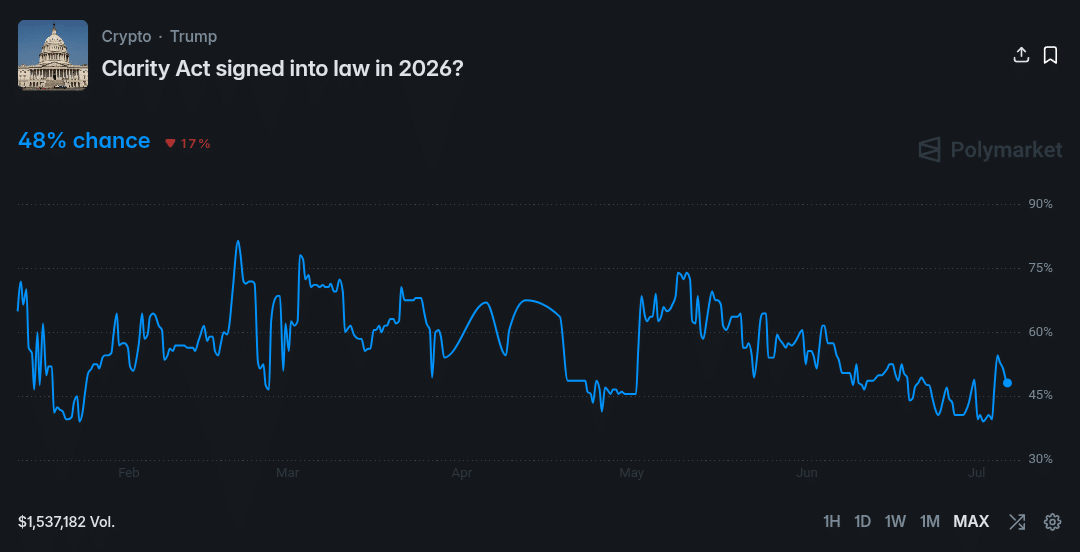
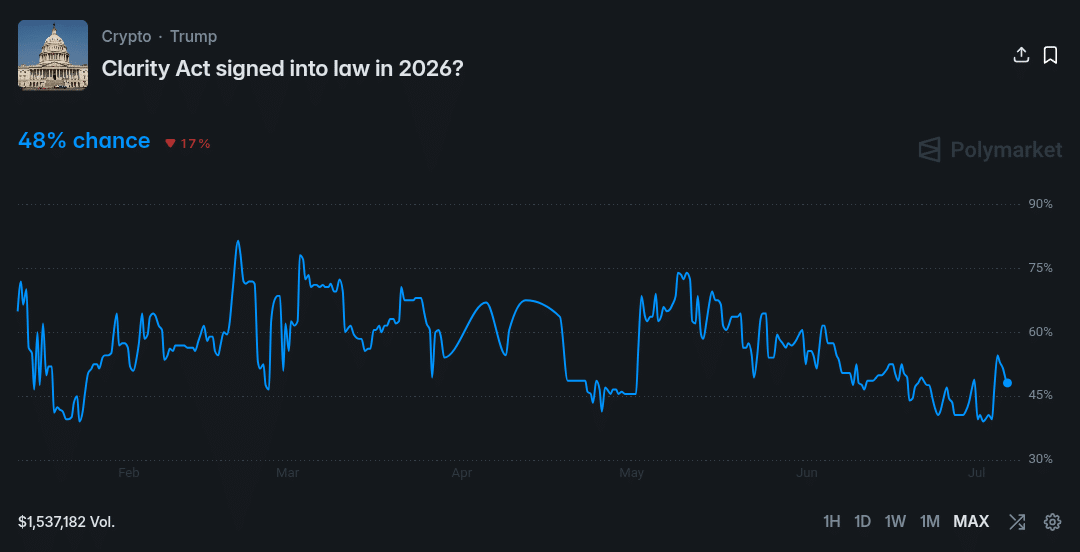
Sumber: Polymarket

Namun, dengan 41,6% peserta mengungkapkan pandangan optimis dalam 24 jam terakhir, sentimen pasar terkait Undang-Undang CLARITY masih optimis dengan hati-hati.
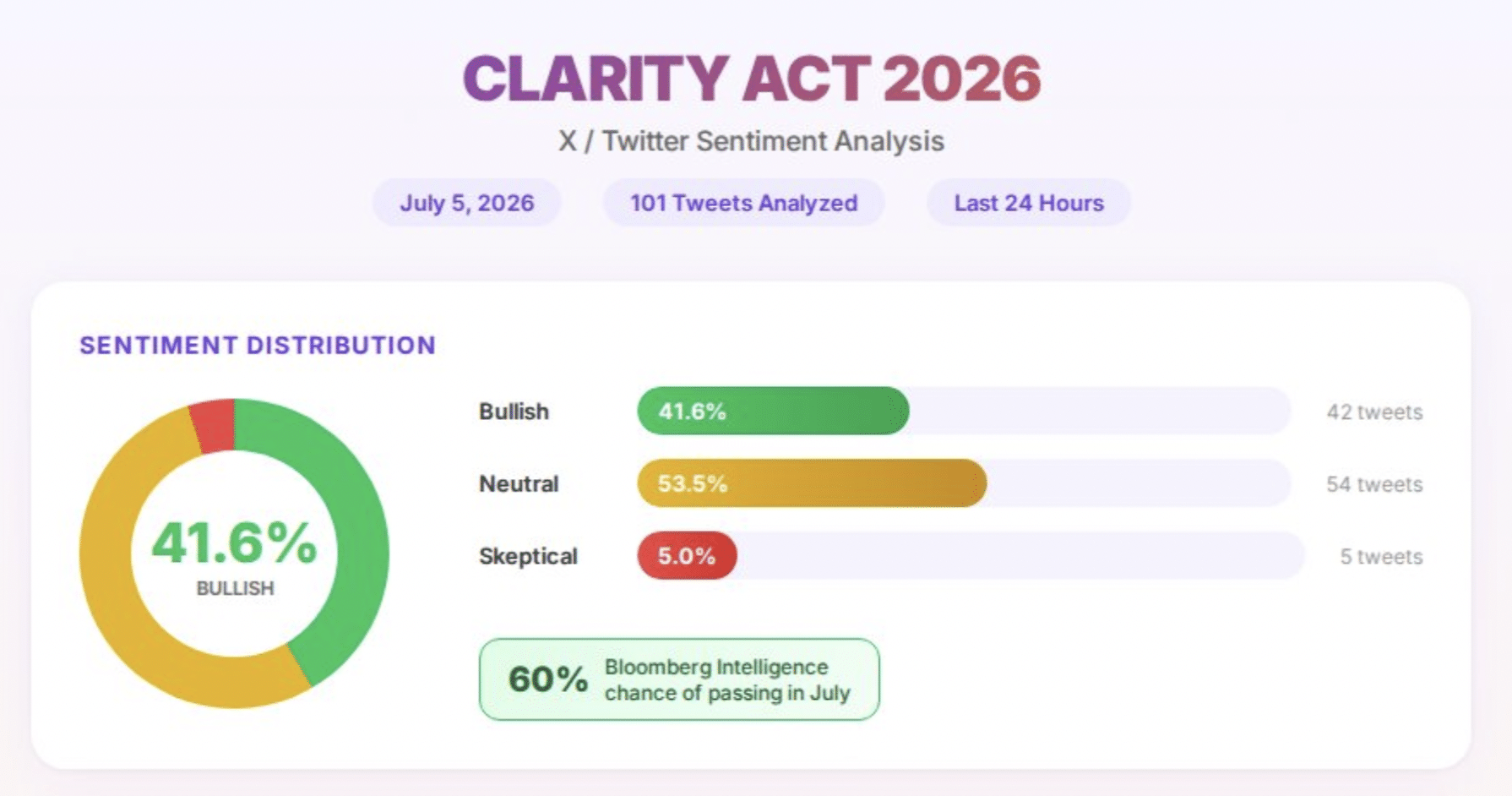
Sumber: X

Manfaat Persetujuan

Faktanya, seorang analis menekankan bahwa banyak proyek cryptocurrency menunggu persetujuan legislatif untuk Undang-Undang CLARITY. Misalnya, Abstract menunggu perubahan ini sebelum memperkenalkan Project Quantum. Undang-Undang CLARITY juga diantisipasi akan membuka jalan lebih lanjut bagi pembentukan modal, memungkinkan bisnis mengumpulkan $50 juta per tahun.

Selain itu, banyak organisasi besar juga mendukung RUU ini. Misalnya, National Organization of Black Law Enforcement Executives (NOBLE) adalah kelompok penegak hukum besar pertama yang mendukung RUU ini.

Sementara itu, baru-baru ini, setelah mempertimbangkan klausulnya, Major County Sheriffs of America (MCSA) baru-baru ini memberitahu Senat dalam sebuah surat bahwa mereka telah mengubah sikapnya terhadap RUU ini menjadi "netral."

Masalah Tetap Ada

Namun, undang-undang ini masih menghadapi kendala politik, karena Presiden AS Donald Trump baru-baru ini mengatakan bahwa dia "tidak akan menandatangani RUU lain" sampai Partai Republik di Kongres mengesahkan Undang-Undang SAVE America.

Oleh karena itu, nasib RUU ini masih menggantung, seperti yang ditekankan Trump,

Konferensi Pers dan Penandatanganan Berita Perumahan Hari Ini dengan ini dibatalkan sampai saat kami mengesahkan Undang-Undang SAVE AMERICA yang sangat dibutuhkan, yang saya anggap sebagai Darurat Nasional.


Ringkasan Akhir

  • Senator Cynthia Lummis mendesak pengesahan Undang-Undang CLARITY untuk inovasi dan kebebasan Amerika.
  • Volatilitas dalam peluang persetujuan semakin menambah ketidakpastian untuk persetujuan RUU ini pada tahun 2026.


Criptomoedas em alta

Perguntas relacionadas

QApa yang menjadi perhatian utama mengenai kemajuan RUU CLARITY Act menurut artikel?

AJadwal Kongres yang semakin sempit karena fokus akan beralih ke kampanye, sehingga menyisakan sedikit hari legislatif untuk mengesahkan RUU sebelum pemilu paruh waktu AS 2026.

QApa yang dikatakan Senator Cynthia Lummis tentang pentingnya CLARITY Act?

ADia menyatakan bahwa CLARITY Act adalah kontribusi generasi ini untuk warisan inovasi, kebebasan, dan keteguhan Amerika yang telah berlangsung 250 tahun, dan mendorong untuk 'menyelesaikan pekerjaan'.

QMenurut artikel, apa salah satu manfaat utama jika CLARITY Act disetujui?

ARUU ini dapat menghilangkan ambiguitas regulasi yang sudah lama ada, mendorong perusahaan kripto untuk meluncurkan produk baru, menarik modal baru, serta membuka jalan bagi pembentukan modal hingga $50 juta per tahun untuk bisnis.

QApa tantangan politik yang disebutkan dapat menghambat RUU CLARITY Act?

APresiden AS Donald Trump mengatakan bahwa dia 'tidak akan menandatangani RUU lain' sampai Partai Republik di Kongres mengesahkan SAVE America Act, yang dia anggap sebagai Darurat Nasional.

QBagaimana sentimen pasar terhadap CLARITY Act berdasarkan data dari Polymarket?

ASentimen pasar tetap optimis hati-hati dengan 41.6% peserta menunjukkan pandangan bullish dalam 24 jam terakhir, meskipun peluang persetujuannya turun menjadi 48%.

Leituras Relacionadas

MSTR Discloses Sale of 3,588 Bitcoins, Stock Price Drops Over 5% at One Point During Trading

MicroStrategy, the world's largest corporate holder of Bitcoin, has significantly shifted its business model. Between June 29 and July 5, the company sold 3,588 bitcoins for approximately $216 million to fund quarterly dividends for its preferred stock. This marks its largest-ever Bitcoin sale and signals a strategic pivot: Bitcoin is transitioning from a "buy-and-hold" reserve asset to a liquidity management tool for the company. This move follows a recent authorization allowing Bitcoin sales when equity fundraising is less attractive. The announcement contributed to a more than 5% intraday drop in MicroStrategy's stock price, while Bitcoin fell to around $61,800—below the company's average holding cost of roughly $75,700. The sale represents a major departure from MicroStrategy's long-standing "never sell" commitment, which saw its first minor breach in May with a $2.5 million sale. The latest, hundred-times-larger transaction underscores growing financial pressures. Analysts note the company faces about $1.5 billion in annual preferred dividend obligations, far exceeding cash flow from its software business. As of July 5, MicroStrategy holds 843,775 bitcoins. Its current operational logic involves buying Bitcoin during favorable financing conditions and selling portions to cover dividends when needed, creating a flexible capital management cycle amidst a challenging market environment.

华尔街日报Há 2h

MSTR Discloses Sale of 3,588 Bitcoins, Stock Price Drops Over 5% at One Point During Trading

华尔街日报Há 2h

Q-Day Countdown: Will Quantum Computing End Cryptocurrencies?

Quantum Computing's Threat to Cryptocurrency: A Countdown to Q-Day Quantum computing, specifically Shor's algorithm, poses a fundamental threat to the public-key cryptography (e.g., ECDSA, RSA) that secures blockchain networks like Bitcoin and Ethereum. This critical juncture, known as Q-Day, is estimated to occur potentially within the next 5-15 years. The core vulnerability stems from the public and immutable nature of blockchains. Assets in addresses where the public key is already exposed on-chain (e.g., spent outputs) are at direct risk, as a sufficiently powerful quantum computer could derive the private key. This threatens the very trust model of cryptocurrencies. The response lies in Post-Quantum Cryptography (PQC)—algorithms like lattice-based ML-DSA and hash-based SLH-DSA, which are resistant to quantum attacks. NIST has standardized key PQC algorithms (FIPS 203, 204, 205), providing a migration path. However, the primary challenge is not technical but socio-economic and involves complex governance: * **Bitcoin's** path is constrained by its conservative ethos. Migrating requires a soft-fork to new address types, facing hurdles like significantly larger signature sizes and, most critically, the divisive governance question of how to handle at-risk legacy UTXOs without violating core principles. * **Ethereum** is pursuing a "cryptographic agility" strategy, with a multi-layered roadmap. It leverages account abstraction for user accounts and is developing compressed hash-based signatures (e.g., leanXMSS) for its consensus layer, aiming for a full-stack upgrade over time. In conclusion, quantum computing does not spell an instant end for cryptocurrency but initiates a critical countdown. The industry has a limited "engineering comfort window" to orchestrate a coordinated, ecosystem-wide migration to PQC. The ultimate bottlenecks are the immense coordination efforts and governance decisions required for this foundational transition.

marsbitHá 3h

Q-Day Countdown: Will Quantum Computing End Cryptocurrencies?

marsbitHá 3h

Trump, the President Who Knows Best How to 'Trade Stocks'

Former US President Donald Trump reported a record-breaking $2.2 billion in personal income for 2025, the highest annual income ever disclosed by a sitting president. This figure, from a 927-page government ethics filing, represented a 3.5-fold increase from his $600 million income in 2024 and boosted his net worth to $6.5 billion. The primary drivers were cryptocurrency (64% of income, approximately $1.4 billion) and real estate (26%, approximately $575 million). His crypto earnings stemmed largely from the launch of his personal meme coin, $TRUMP, generating over $600 million in licensing fees, and substantial profits from the WLFI token and its parent company. Despite a sluggish property market, his Mar-a-Lago resort and associated golf clubs saw revenue surges of 50% and 27%, respectively, attributed to their use as venues for presidential events. Trump's financial disclosure also revealed an unprecedented level of stock market activity, with over 22,000 trades executed in 2025, averaging 87 trades per market day. Media analyses noted several instances where significant trading coincided with major policy announcements, such as proposed tariffs, raising questions about potential conflicts of interest. While the White House stated these trades were handled by a family-managed trust fund and not Trump directly, critics highlighted this as a departure from the blind trusts traditionally used by presidents post-Watergate. The report has intensified debate over the commercialization of the presidency. Supporters view it as a success story of a businessman-president, while critics argue it demonstrates an unprecedented conversion of public influence into private wealth, with policy decisions potentially linked to personal financial gains. The controversy centers on whether Trump's earnings represent innovative entrepreneurship or a fundamental conflict of interest, sparking renewed calls for stricter ethics reforms in US governance.

marsbitHá 3h

Trump, the President Who Knows Best How to 'Trade Stocks'

marsbitHá 3h

Countdown to Q-Day: Will Quantum Computing End Cryptocurrencies?

The article explores the existential threat quantum computing poses to cryptocurrencies and the urgent need for "post-quantum" migration. It outlines that quantum computers, through Shor's algorithm, could break the elliptic-curve cryptography (ECC) underlying blockchain security, potentially allowing private keys to be derived from public keys. The core challenge is not a lack of post-quantum cryptography (PQC) standards—like NIST's ML-KEM and ML-DSA—but the immense complexity of upgrading entire ecosystems before "Q-Day" (when quantum computers become capable of such attacks, estimated around 2035-2045). Key points include: * **Bitcoin's** risk is concentrated in legacy UTXOs with exposed public keys (e.g., early P2PK outputs). Migration faces massive hurdles: PQC signatures are much larger, increasing transaction size and cost, and the governance dilemma of handling un-migrated assets threatens its "code is law" ethos. * **Ethereum's** strategy focuses on "cryptographic agility," using Account Abstraction for user accounts and developing compressed hash-based signatures (like leanXMSS with SNARK aggregation) for consensus. Its migration is a complex, full-stack overhaul of execution, consensus, and data layers. * The "security debt" is enormous. The comfortable engineering window for a coordinated, ecosystem-wide upgrade is only 5-8 years. High-value infrastructure (exchanges, bridges) may face pressure before mainnet protocols. In conclusion, quantum computing is not an instant "doomsday" event but a forcing function for systemic change. Bitcoin's ultimate test is social consensus and property rights governance, while Ethereum's is technical complexity. Failure to migrate in time could lead to a fundamental re-pricing of crypto assets.

链捕手Há 3h

Countdown to Q-Day: Will Quantum Computing End Cryptocurrencies?

链捕手Há 3h

Trading

Spot

Artigos em Destaque

Como comprar 4

Bem-vindo à HTX.com!Tornámos a compra de 4 (4) simples e conveniente.Segue o nosso guia passo a passo para iniciar a tua jornada no mundo das criptos.Passo 1: cria a tua conta HTXUtiliza o teu e-mail ou número de telefone para te inscreveres numa conta gratuita na HTX.Desfruta de um processo de inscrição sem complicações e desbloqueia todas as funcionalidades.Obter a minha contaPasso 2: vai para Comprar Cripto e escolhe o teu método de pagamentoCartão de crédito/débito: usa o teu visa ou mastercard para comprar 4 (4) instantaneamente.Saldo: usa os fundos da tua conta HTX para transacionar sem problemas.Terceiros: adicionamos métodos de pagamento populares, como Google Pay e Apple Pay, para aumentar a conveniência.P2P: transaciona diretamente com outros utilizadores na HTX.Mercado de balcão (OTC): oferecemos serviços personalizados e taxas de câmbio competitivas para os traders.Passo 3: armazena teu 4 (4)Depois de comprar o teu 4 (4), armazena-o na tua conta HTX.Alternativamente, podes enviá-lo para outro lugar através de transferência blockchain ou usá-lo para transacionar outras criptomoedas.Passo 4: transaciona 4 (4)Transaciona facilmente 4 (4) no mercado à vista da HTX.Acede simplesmente à tua conta, seleciona o teu par de trading, executa as tuas transações e monitoriza em tempo real.Oferecemos uma experiência de fácil utilização tanto para principiantes como para traders experientes.

633 Visualizações TotaisPublicado em {updateTime}Atualizado em 2026.06.02

Como comprar 4

Discussões

Bem-vindo à Comunidade HTX. Aqui, pode manter-se informado sobre os mais recentes desenvolvimentos da plataforma e obter acesso a análises profissionais de mercado. As opiniões dos utilizadores sobre o preço de 4 (4) são apresentadas abaixo.

活动图片