Doubao and Qwen Will Discontinue Agent Functionality on July 15

marsbitPublicado em 2026-07-05Última atualização em 2026-07-05

Resumo

On July 4th, Doubao and Tongyi Qianwen announced the impending shutdown of their user-created "AI Agent" features. Doubao confirmed its agent feature will be taken offline on July 15, directing users to ByteDance's CatBox app for similar needs. On the same day, Tongyi Qianwen notified users, specifying that personalized interactive agents and user-built agent functions will cease on July 10, with all agent features and services completely deactivated by July 15. After this date, access to agent configurations and historical chat records will be lost. This adjustment impacts core user scenarios like role-playing, personal assistants, and vertical tool agents. The shutdown date coincides with the official implementation of China's "Interim Measures for the Administration of Artificial Intelligence Human-like Interactive Services" on July 15. The new regulations impose strict rules on "human-like emotional interaction services," requiring platforms to implement measures like anti-addiction systems, minor verification, and content moderation. This move is widely seen as a proactive step by the platforms to align with regulatory timelines and mitigate compliance risks. Additionally, commercial challenges are a key driver. Analysis suggests that casual, human-like chat agents generate high-frequency, low-value interactions, leading to high computational costs with poor monetization. As the AI application market shifts from user growth to proving value, sustaining such "high-cost...

On July 4, Doubao and Tongyi Qwen announced the upcoming discontinuation of their agent functionality.

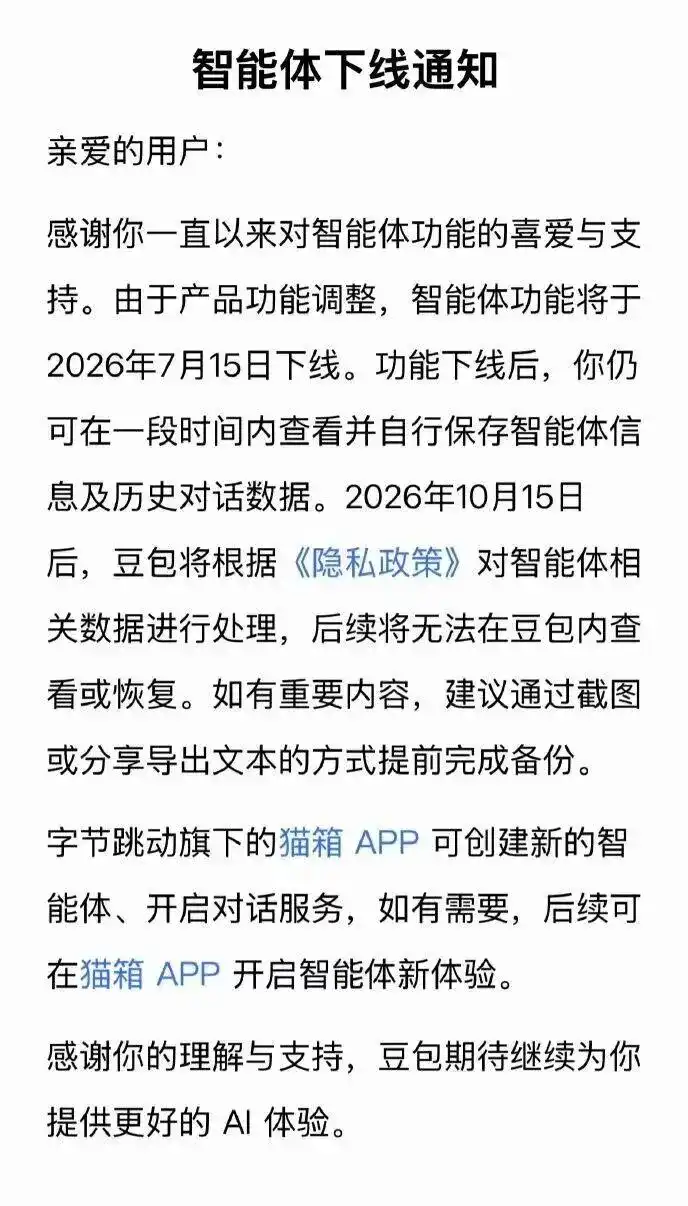
Doubao issued the "Notice on Discontinuation of Doubao Agent Functionality," confirming that the agent functionality will be discontinued on July 15, and will redirect users to ByteDance's Mao Xiang App to meet related needs.
On the same day, Tongyi Qwen pushed a discontinuation reminder to users, stating that personified interaction agents and user-created agent functionality will be discontinued on July 10, and that after the complete discontinuation of Qwen agent functionality and services on July 15, users will no longer be able to access related agent configurations and historical conversation records.
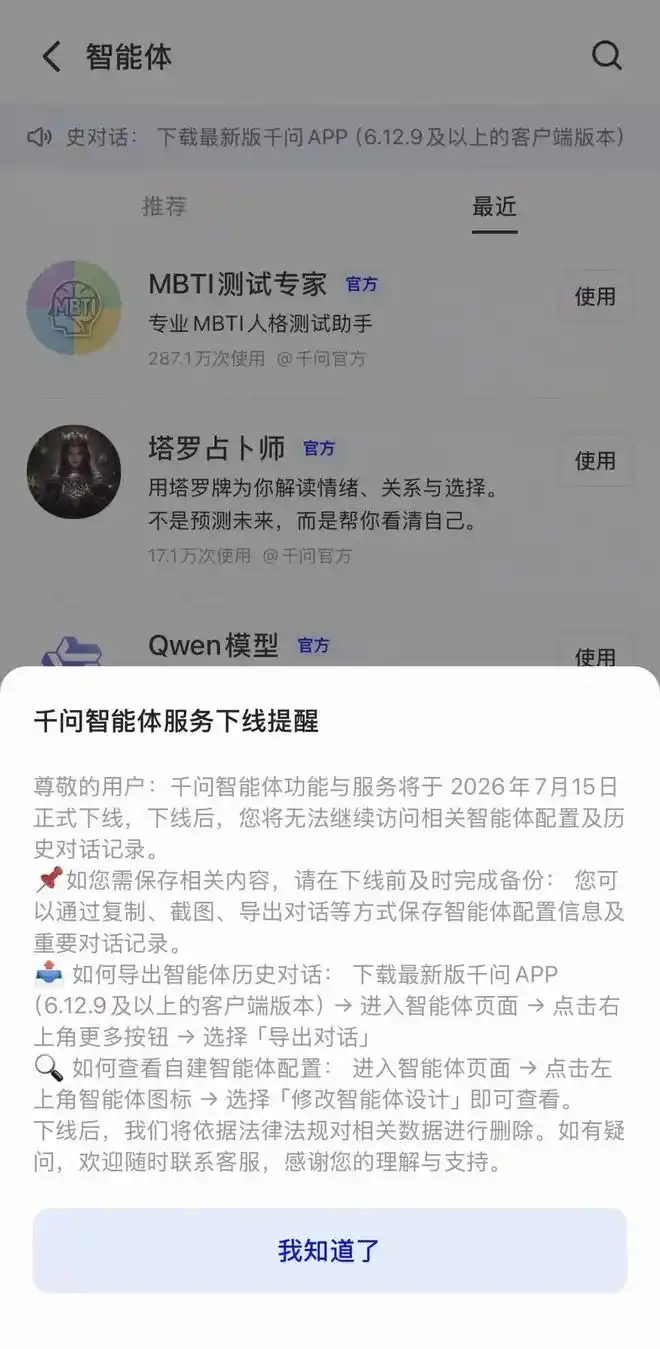
This adjustment affects the most core personalized usage scenarios for C-end users of AI platforms — including role-playing, exclusive assistants, and vertical tool-type agents.

For Doubao and Qwen, user-created agents were previously a key means to gather C-end users and accumulate UGC content. The comprehensive discontinuation of this functionality signifies a directional shift in the platforms' traffic strategies.

New Regulations Force Action, Discontinuation Date Not a Coincidence

The discontinuation date chosen by Doubao and Qwen, July 15, coincides with the official implementation date of the "Interim Measures for the Administration of AI Personified Interaction Services."

These measures strictly regulate "personified emotional interaction services," requiring platforms to implement mechanisms to prevent addiction, verify the identities of minors, conduct content reviews, and fulfill other primary responsibilities.

Regulatory rectification actions have already begun. On June 26, the Cyberspace Administration of Shanghai Municipal Committee announced the results of the first phase of the "Clear and Bright: Rectifying Irregularities in AI Applications" special campaign, having removed over 14,000 non-compliant agents. Among them, agents from Xuanyu (MiniMax) involving functions like "one-click undressing" and soccer betting/gambling were key targets of the crackdown.

Currently, the Cyberspace Administration of Shanghai Municipal Committee has completed regulatory briefings for nearly a hundred key platforms, urging enterprises to fulfill their compliance obligations.

Against this backdrop, Doubao and Qwen proactively aligning with the regulatory timeline, choosing to complete the functionality discontinuation on the day the new regulations take effect, is widely interpreted by the industry as a proactive move to mitigate compliance risks in advance and fulfill platform responsibilities.

User Transition Arrangements and Data Processing Timeline

Both platforms have provided a transition window for existing users to save their data.

For Doubao, after the functionality is discontinued, users will still be able to view and manually save their agent information and historical conversation data for a period of time; after October 15, Doubao will process the relevant data according to its privacy policy, at which point the data will no longer be viewable or recoverable.

Doubao recommends users back up their data in advance by taking screenshots or exporting text, and migrate agent creation and conversation functionality to the Mao Xiang App.

Tongyi Qwen similarly advises users to save important content before the discontinuation by copying, taking screenshots, or exporting conversations. After discontinuation, access to related agent configuration information and historical conversation records will no longer be possible.

As leading platforms successively scale back their C-end agent layouts, the competitive logic of the AI application market is undergoing a fundamental shift.

Compliance capabilities and sustainable business models will replace user scale and feature richness as the core dimensions of platform competition in the next phase.

High Consumption, Low Efficiency, Business Logic Also Unsustainable

In addition to regulatory pressure, difficulties in commercial monetization are also an intrinsic motive driving this adjustment.

Analysis suggests that personified chit-chat and niche role-playing agents typically generate scattered, high-frequency, lightweight conversation calls, resulting in high computing power consumption and low per-unit commercial value, representing a typical "high consumption, low efficiency" business model.

In the phase where AI applications are shifting from "land grabbing" to "value verification," while such UGC agents may bring short-term traffic and user engagement metrics, they are difficult to convert into direct commercial revenue. Their economic rationale for continued existence is being questioned.

Tongyi Qwen's pivot to the B-end has already shown signs. On June 3, Qwen officially announced the comprehensive opening of Agent and Skill access permissions to third-party enterprises and developers across all industries. Leading brands like Luckin Coffee, KFC, Mixue Ice Cream & Tea, and China Eastern Airlines have already initiated service testing.

This strategic shift indicates that platforms are concentrating resources from low-value C-end UGC ecosystems towards high-value B-end enterprise service scenarios.


Criptomoedas em alta

Perguntas relacionadas

QAccording to the article, on what date are Doubao and Tongyi Qianwen scheduled to take their 'Intelligent Agent' functions offline?

ABoth platforms have scheduled the full shutdown of their Intelligent Agent functions for July 15.

QWhat is the main regulatory reason mentioned for the shutdown of the Intelligent Agent functions?

AThe shutdown coincides with the formal implementation on July 15 of the 'Interim Measures for the Management of Artificial Intelligence Anthropomorphic Interaction Services', which strictly regulates services involving simulated human emotional interaction.

QWhat alternative platform does Doubao recommend for users who wish to continue using Intelligent Agent features?

ADoubao is directing users to migrate their Intelligent Agent creation and conversation functions to the ByteDance-owned app, Cat Box (猫箱 App).

QBeyond regulatory pressure, what internal business challenge contributed to the decision to shut down these C-end Intelligent Agent functions?

AThe article cites commercialization difficulties, describing these UGC agents (especially for casual chat and niche roles) as 'high-consumption, low-efficiency'—they require significant computing power but generate little direct revenue, making them economically unsustainable.

QHow is Tongyi Qianwen's strategic focus shifting according to the article?

ATongyi Qianwen is shifting its resources from low-value C-end UGC ecosystems towards high-value B-end enterprise service scenarios, having opened its Agent and Skill access to third-party businesses and developers.

Leituras Relacionadas

Reviewing 8 'Cash Cow' Projects in the Bear Market: The Leader Repurchased $283 Million Worth This Year

This article highlights eight cryptocurrency projects that have demonstrated strong cash-generating capabilities and implemented significant token buyback programs during the bear market of 2026. These projects, dubbed "cash cows," are repurchasing their own tokens, often reducing supply. According to data from Tokenomist, the projects with notable buyback activity from January 1st to June 30th are: Meteora (MET), Pump.fun (PUMP), GMX, Rollbit (RLB), Metaplex (MPLX), Hyperliquid (HYPE), Lighter (LIT), and Aave. Notably, MET's buybacks equaled 71% of its January token supply, while HYPE executed the largest buyback by value at $283 million. Key project summaries include: - **Hyperliquid (HYPE):** The leader by dollar value, its perpetual DEX protocol has repurchased and burned 44 million HYPE tokens (approx. 4.4% of supply) using a significant portion of trading fees, with total buybacks exceeding $1.1 billion since March 2025. - **Meteora (MET):** Its buyback of 336.2 million MET tokens had the greatest proportional impact on its circulating supply, equivalent to 71% of its supply at the start of the year. - **Pump.fun (PUMP):** The popular memecoin launchpad has cumulatively bought back over $400 million worth of PUMP since July 2025, using 50% of net revenue for buybacks and burns since April. - **Aave (AAVE):** Despite facing a major security incident earlier in the year, the lending protocol has continued its buyback program, repurchasing over 200,000 AAVE tokens. Its team is designing a new automated buyback mechanism. - **GMX, Lighter (LIT), Rollbit (RLB), and Metaplex (MPLX)** also have active buyback mechanisms funded by protocol fees or revenues. The article concludes that while token buybacks and burns do not guarantee price appreciation—as market conditions, news, and other factors play a role—these projects stand out for their ability to generate consistent cash flow in a challenging market environment.

marsbitHá 1m

Reviewing 8 'Cash Cow' Projects in the Bear Market: The Leader Repurchased $283 Million Worth This Year

marsbitHá 1m

Ethereum Sheds Its Load? What Ethereum Supporters Think About the Lean Ethereum Upgrade and the Future Market

Ethereum is back in focus with the announcement of the "Lean Ethereum" upgrade roadmap, described by Vitalik Buterin as Ethereum's third major update. This proposal aims to fundamentally redesign the consensus, data, and execution layers from first principles, striving to make Ethereum **simpler, more secure (quantum-resistant), more verifiable, and more scalable.** The announcement comes amidst a broader restructuring within the ecosystem, including a 20% staff reduction at the Ethereum Foundation and the emergence of new organizations like EthLabs. This has sparked a debate among Ethereum supporters ("E-bizens"). **Optimists** view Lean Ethereum as a critical refocusing on core protocol fundamentals: * **sassal.eth** calls it the ultimate bullish catalyst, envisioning a future where running a node is so lightweight it could be done on a smartwatch, greatly enhancing decentralization. * **Ryan Sean Adams** sees it as Ethereum moving from "narrative expansion" to "protocol hardening," addressing long-term foundational issues like security and scalability. * Analysts like **BITWU** and **蓝狐 (Blue Fox)** frame it as a third-phase evolution towards a "minimal, durable, and credible base layer" designed for the next decade. * **gigi发财猪** interprets the organizational changes as Ethereum "shedding old baggage and forming new teams" for a lighter, more agile approach. * **Xiyu** notes that the roadmap itself provides a much-needed new narrative for market sentiment recovery. **Cautious voices** acknowledge the vision but emphasize execution and market timing: * **Ignas** warns that while the roadmap addresses key community requests, it overlooks tokenomics, and competitors are gaining ground in areas like RWA. Timely delivery is crucial; delays could be bearish. * **Dankrad Feist**, a former Ethereum Foundation researcher, agrees on direction but criticizes the proposed 3-4 year timeline as too slow for the current market pace, especially with AI-aided development available. **In summary,** optimists believe Lean Ethereum reaffirms Ethereum's long-term value proposition as a decentralized world computer, while the cautious argue that its success hinges on faster delivery and tangible results to maintain market relevance. Despite ongoing criticism, the move signals Ethereum's effort to regroup and reclaim initiative at the protocol level.

marsbitHá 48m

Ethereum Sheds Its Load? What Ethereum Supporters Think About the Lean Ethereum Upgrade and the Future Market

marsbitHá 48m

AI Folding: Fable 5 and GPT-5.6 Are Becoming the Privilege of a Few

【AI Accessibility Gap Widens: Elite Tools Like Fable 5 and GPT-5.6 Are Becoming Privileged】 We are witnessing a growing "AI divide." A stark reality is emerging: a tiny fraction of elites, primarily in tech, are using powerful next-generation models like Fable 5 or the upcoming GPT-5.6, while the vast majority of the public only has access to "toys" - free, limited models equivalent to ChatGPT's basic versions (8B to 30B parameters). This creates a massive experiential chasm and cognitive dissonance. Industry outsiders see AI as overhyped and ineffective, unable to grasp its transformative potential, while insiders leverage these advanced models for a decisive competitive edge. The gap isn't just about model quality but product functionality. Free users get a simple chatbot. Paying elites get integrated workflow systems—capable of creating specialized agents, processing complex data, and handling real-world tasks like management, coding, and planning. Demos showcasing AI planning weddings or building apps feel disconnected from everyday needs like managing bills, groceries, or health. The cost barrier is immense, with reports of engineers spending $1000 daily on Fable 5 inference. Elite users employ sophisticated multi-model workflows, combining different AIs for ideation, architecture, execution, and review, completing complex projects in minutes instead of weeks. This divide extends to critical areas like healthcare, where free models are dangerously unreliable for medical queries. However, some argue that for 90% of common business tasks, mid-tier models like GPT-5.5 are sufficient; the perceived limitation often stems from poor integration and lack of context, not model intelligence. Ultimately, unequal access to cutting-edge AI is creating a new form of social stratification, where the most powerful tools are becoming the exclusive privilege of a few.

marsbitHá 1h

AI Folding: Fable 5 and GPT-5.6 Are Becoming the Privilege of a Few

marsbitHá 1h

Cathie Wood's June $77M Investment: Are Crypto Stocks a True 'Substitute' for Bitcoin?

In June, Cathie Wood's ARK Invest purchased $77 million worth of publicly traded crypto-related stocks, including Coinbase, Circle, and Bullish, during Bitcoin's worst monthly performance in four years. This aligns with the investment thesis that such stocks offer a compliant way to gain exposure to the crypto cycle without directly holding Bitcoin. However, data analysis reveals significant drawbacks. A group of nine U.S.-listed crypto companies showed 30-day annualized realized volatility between 68% and 90%, nearly double Bitcoin's 37.6%. Over 90 days, Circle's volatility reached 103.6% versus Bitcoin's 37.8%. Drawdowns were also more severe for stocks like Circle (-51.4%) and MicroStrategy (-48.6%) compared to Bitcoin's -36.4% from its January high. Correlation analysis shows most stocks share only a moderate link to Bitcoin. For example, Circle, Robinhood, and Bullish have a 90-day correlation coefficient of just 0.55–0.58 with BTC, meaning only about one-third of their price movement is explained by Bitcoin's action. The rest stems from company-specific risks: earnings, competition, fundraising, and equity dilution. MicroStrategy (MSTR) is the notable exception, acting as a leveraged Bitcoin proxy with a beta of 1.59 and 0.85 correlation. Coinbase offers relatively balanced exposure. Circle exemplifies "crypto-wrapped" corporate risk, with its recent crash tied to stablecoin competition, not Bitcoin. Robinhood's diversified business insulates it from crypto downturns but also limits upside. Bitcoin miners like RIOT and MARA have posted significant gains year-to-date, driven primarily by their pivot to AI compute services, not Bitcoin's price. The article highlights that investing in crypto stocks often means accepting amplified volatility or layering on business-specific risks absent from direct Bitcoin ownership. For instance, MicroStrategy's recent challenges—its market value falling below its Bitcoin holdings (mNAV <1) and facing potential Bitcoin sales for liquidity—demonstrate equity-specific hazards like dilution and financing pressures not faced by a direct Bitcoin holder. ARK's buying spree represents a bet on a basket of different business models with varying crypto exposure, not a simple, lower-risk substitute for holding Bitcoin.

marsbitHá 1h

Cathie Wood's June $77M Investment: Are Crypto Stocks a True 'Substitute' for Bitcoin?

marsbitHá 1h

Trading

Spot

Artigos em Destaque

Como comprar 4

Bem-vindo à HTX.com!Tornámos a compra de 4 (4) simples e conveniente.Segue o nosso guia passo a passo para iniciar a tua jornada no mundo das criptos.Passo 1: cria a tua conta HTXUtiliza o teu e-mail ou número de telefone para te inscreveres numa conta gratuita na HTX.Desfruta de um processo de inscrição sem complicações e desbloqueia todas as funcionalidades.Obter a minha contaPasso 2: vai para Comprar Cripto e escolhe o teu método de pagamentoCartão de crédito/débito: usa o teu visa ou mastercard para comprar 4 (4) instantaneamente.Saldo: usa os fundos da tua conta HTX para transacionar sem problemas.Terceiros: adicionamos métodos de pagamento populares, como Google Pay e Apple Pay, para aumentar a conveniência.P2P: transaciona diretamente com outros utilizadores na HTX.Mercado de balcão (OTC): oferecemos serviços personalizados e taxas de câmbio competitivas para os traders.Passo 3: armazena teu 4 (4)Depois de comprar o teu 4 (4), armazena-o na tua conta HTX.Alternativamente, podes enviá-lo para outro lugar através de transferência blockchain ou usá-lo para transacionar outras criptomoedas.Passo 4: transaciona 4 (4)Transaciona facilmente 4 (4) no mercado à vista da HTX.Acede simplesmente à tua conta, seleciona o teu par de trading, executa as tuas transações e monitoriza em tempo real.Oferecemos uma experiência de fácil utilização tanto para principiantes como para traders experientes.

633 Visualizações TotaisPublicado em {updateTime}Atualizado em 2026.06.02

Como comprar 4

Discussões

Bem-vindo à Comunidade HTX. Aqui, pode manter-se informado sobre os mais recentes desenvolvimentos da plataforma e obter acesso a análises profissionais de mercado. As opiniões dos utilizadores sobre o preço de 4 (4) são apresentadas abaixo.

活动图片