MiCA strikes again? Revolut to drop USDT as Circle gains momentum

ambcryptoPublicado em 2026-07-04Última atualização em 2026-07-04

Resumo

Europe's largest fintech platform Revolut will delist Tether's USDT stablecoin, halting deposits by the end of July and removing it entirely by August 31. This move is widely attributed to compliance with the EU's new MiCA crypto regulatory framework, which aims to block non-compliant stablecoins. Tether's CEO has criticized MiCA as "dangerous," arguing its reserve requirements could destabilize European banks, and has opted not to seek approval. In contrast, Circle's USDC, which is MiCA-compliant, is gaining significant momentum. Visa data shows USDC's transfer volume doubled that of USDT in June, reaching $1.21 trillion, with a notable shift towards Euro-based stablecoins also observed. The delisting by Revolut and other EU platforms may further accelerate this trend, though USDT maintains a dominant position in overall market supply.

Europe’s largest fintech platform, Revolut, will drop Tether’s USDT by 31st of August. However, USDT deposits will be disabled from the platform by the end of this month.

The tech giant informed users that those who fail to transfer their funds by the end of August will have their USDT automatically exchanged to fiat.

The move is likely informed by regulatory pressure, according to analyst Max Karpis. He noted,

Revolut is delisting USDT on 31 Aug 2026 (regulatory/risk reasons). Not long ago, they expanded support to include zero-fee transfers and 1:1 USDT/USDC swaps. Now a reversal. Compliance hits again.

EU’s crypto regulatory framework, MiCA, is now in effect. Hence, the move is likely to block non-compliant stablecoins and tokens.

Tether CEO deems MiCA as ‘dangerous’ for stablecoins

Interestingly, Tether CEO Paolo Ardoino has been open about not seeking MiCA approval. In fact, he argued that the regulation is “bad” and “dangerous” for stablecoins.

The problem I have with MiCA is that it’s very dangerous for stablecoins. What will happen next year is that a few banks in Europe will go belly up because of MiCA’s requirement that 60% of stablecoin reserves be kept in uninsured cash deposits in European banks.

He also noted that only small banks accept crypto firms, as major ones like UBS are unwilling to accept stablecoin business. For Ardoino, this would be risky as a +20% redemption on USDT could quickly trigger a banking crisis.

He believes that MiCA is designed to position the Digital Euro to control fund flows. Hence, he opted to keep USDT safe for emerging markets that rely heavily on it.

Whether the same risk applies to Circle’s USDC or Euro stablecoin EURC is not clear. However, Circle has MiCA approval and seems to have benefited last month as the MiCA transition period came to an end.

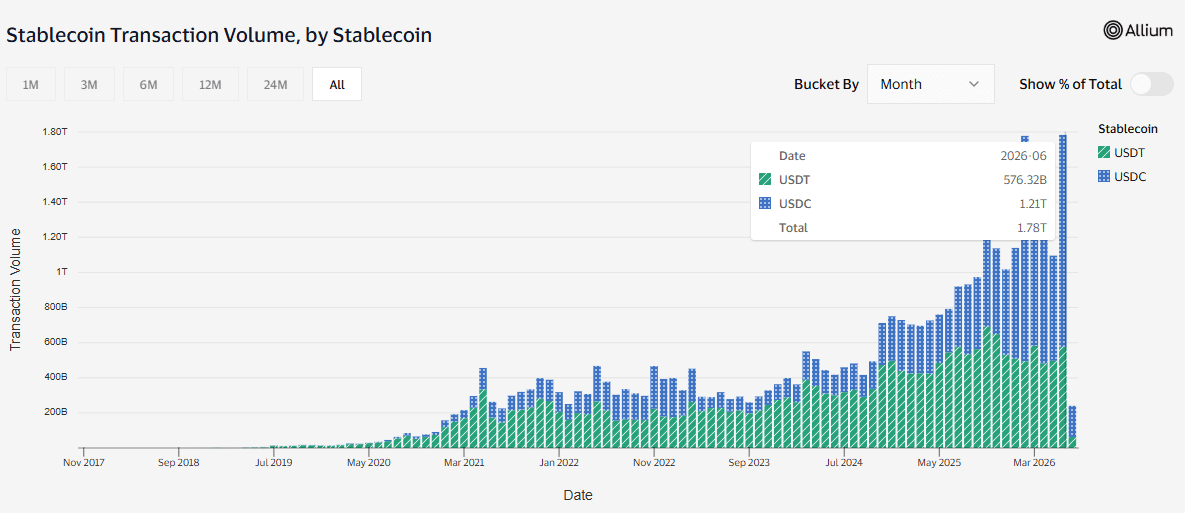
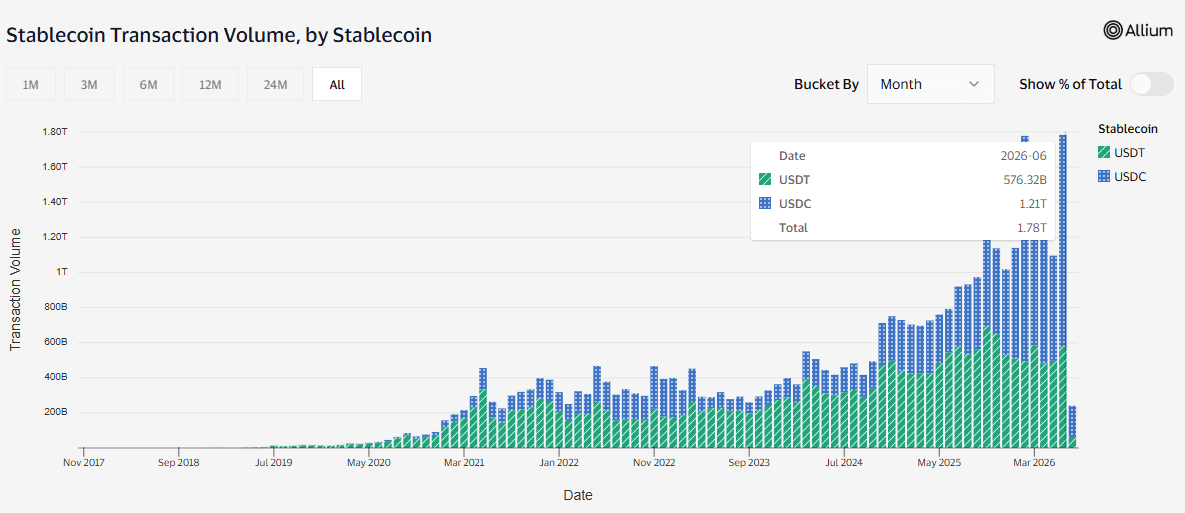
According to Visa data, USDC saw $1.21T in transfer volume in June, doubling Tether’s USDT. This was the second highest monthly transfer volume following February’s record $1.28T amid growing adoption across most blockchains.
Source: Visa

In fact, less than a week into July, USDC’s volume was 3x that of USDT, underscoring a likely shift tied to the MiCA framework. Users across the EU or those sending money to the continent may be opting for USDC instead of USDT.

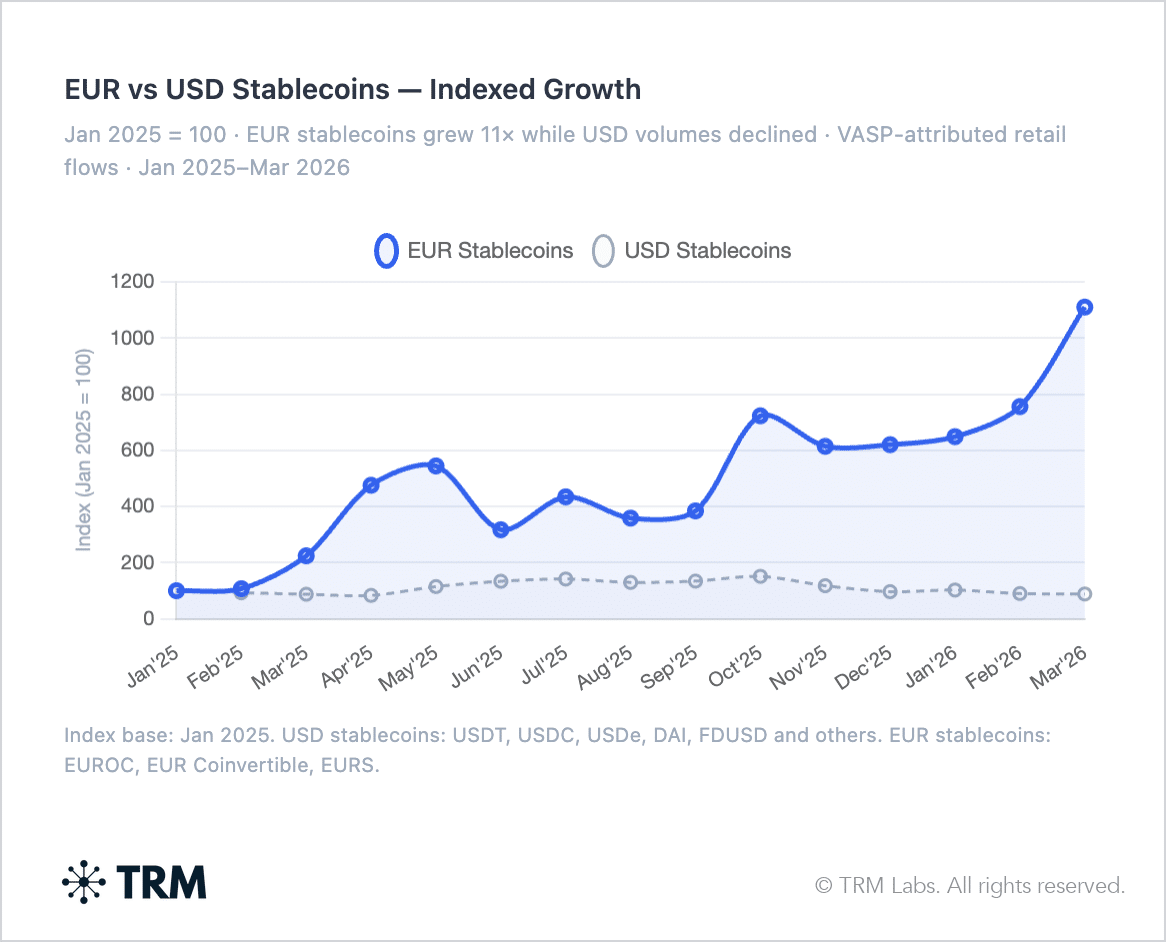
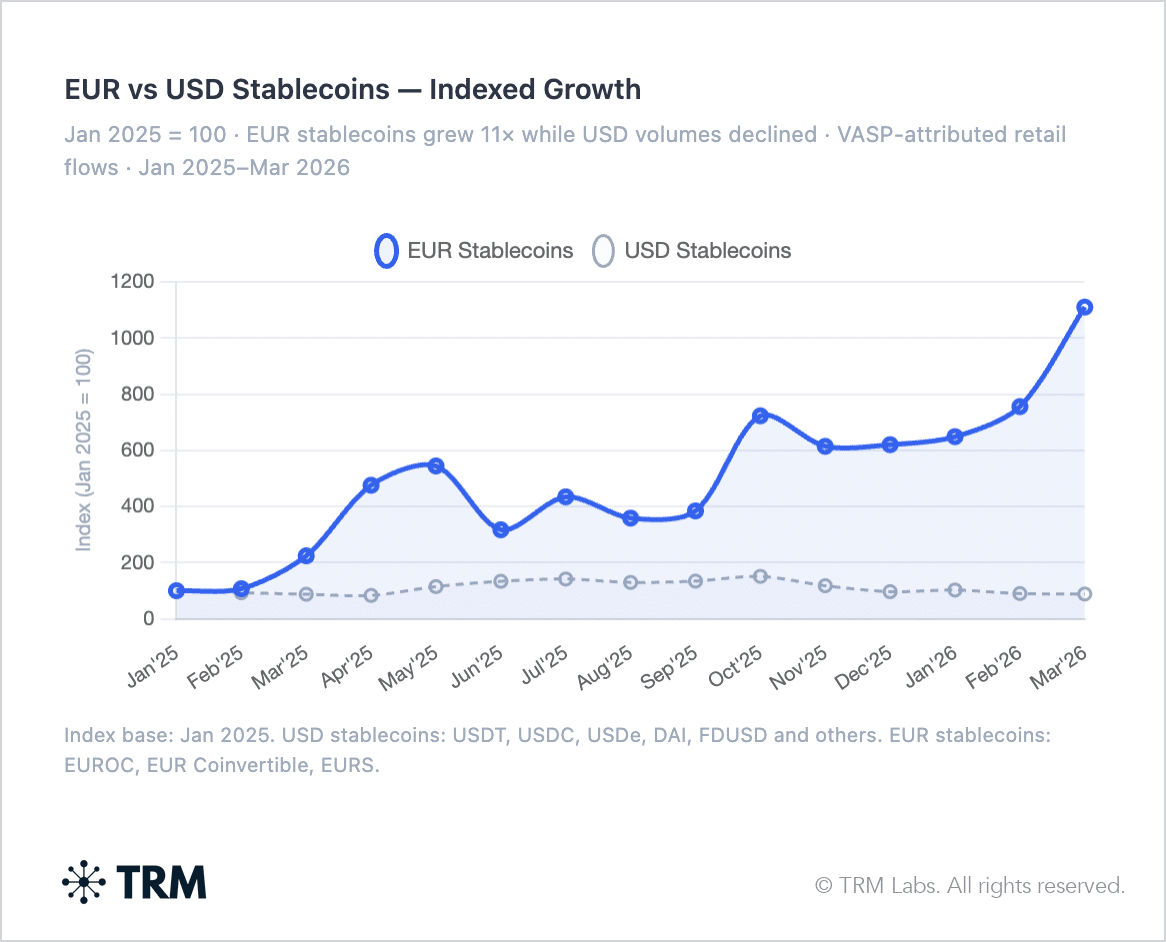
The shift was also evident across US dollar and Euro-based stablecoins. The latter grew 11x while USD-based stablecoin volumes shrank.
Source: TRM Labs

Tether’s USDT still dominates the stablecoin market in terms of supply though. It remains to be seen whether Circle will close the gap as Revolut and other EU platforms continue to delist USDT.


Final Summary

  • Revolut will delist USDT by August 31st and stop accepting deposits from the stablecoin by the end of July.
  • USDC transfer volume hit $1.21T, doubling Tether’s USDT, further underscoring MiCA’s impact on stablecoin adoption.


Perguntas relacionadas

QWhat is the key deadline and action that Revolut is taking regarding Tether's USDT stablecoin?

ARevolut will stop accepting USDT deposits by the end of July 2026 and will completely delist Tether's USDT from its platform by August 31, 2026. Users who fail to transfer their USDT funds by the end of August will have them automatically exchanged to fiat currency.

QAccording to the analyst Max Karpis, what is the primary reason behind Revolut's decision to delist USDT?

AAccording to analyst Max Karpis, Revolut's decision is primarily due to regulatory and risk reasons, specifically in response to compliance pressures, which he attributes to the EU's MiCA regulatory framework now being in effect.

QWhat are the main criticisms of the MiCA regulation expressed by Tether's CEO, Paolo Ardoino?

ATether CEO Paolo Ardoino criticizes MiCA as being 'bad' and 'dangerous' for stablecoins. He argues that its requirement for 60% of stablecoin reserves to be held as uninsured cash deposits in European banks could lead to bank failures, especially if there is a large-scale redemption event like a +20% redemption of USDT. He also believes it is designed to favor the Digital Euro and control fund flows.

QHow has Circle's USDC stablecoin reportedly been affected by the implementation of MiCA, according to the Visa data mentioned in the article?

AAccording to Visa data cited in the article, USDC's transfer volume reached $1.21 trillion in June 2026, doubling that of Tether's USDT. Furthermore, in early July, USDC's volume was three times that of USDT, indicating a significant shift in adoption likely tied to MiCA compliance.

QBeyond USDT and USDC, what broader trend in stablecoin usage was observed in the EU market as the MiCA transition period ended?

AThe article shows a broader shift towards Euro-based stablecoins. While USD-based stablecoin volumes shrank, Euro-based stablecoin volumes grew by 11 times, indicating a significant move towards euro-denominated stablecoins within the EU market following the MiCA framework's implementation.

Leituras Relacionadas

How Token Economy Reshapes the Business Rules of AI 'Measurement' | ToB Industry Observation

"Token Economy: How It Reshapes the Business Rules of AI's 'Metrics' | ToB Industry Observation" The article discusses how the token economy is fundamentally changing the business landscape for AI, moving from a phase of explosive technical supply to a focus on measurable value for enterprise demand. It highlights the astronomical growth in daily token usage in China, framing tokens as the new "measurement standard" or "electricity" of the intelligent era. A central challenge is determining a token's value, which varies drastically—up to 100,000x—across different applications, from drug discovery to casual chat. The concept of "high-quality tokens" that deliver real intelligence, versus "noise," is emphasized as crucial. Lenovo's Vice President shares three proposed "laws" of token economics: 1. **Law of Inertia:** The cost per token will continuously decline due to technological innovation, system optimization, and intelligent runtime scheduling. 2. **Law of Acceleration:** The value generated per token accelerates based on the depth of AI integration into business workflows, the level of engineering support, and organizational readiness. 3. **Law of the Singularity:** A tipping point where the value curve of AI application surpasses its cost curve, shifting from cost-saving to generating incremental, previously impossible value—enabling "innovation at scale." The article notes real-world struggles, such as companies exceeding AI budgets due to unpredictable token pricing and "token inflation" from agentic AI workflows. Solutions being explored include standardized metrics for token quality, transparent pricing, and new infrastructure like "Token Factories" for efficient, on-demand token production. The ultimate goal is for businesses to move past anxiety and reach the "singularity," where AI drives scalable innovation, akin to how electricity enabled countless modern appliances.

marsbitHá 3m

How Token Economy Reshapes the Business Rules of AI 'Measurement' | ToB Industry Observation

marsbitHá 3m

Bitcoin Rebounds to $64k as Fed Rate Hike Expectations Plummet?

Bitcoin rebounded strongly this week, climbing back above $60,000 and briefly touching $64,000. This recovery followed a significant drop after the U.S. presidential election, with the market now closely watching Federal Reserve policy signals. The key trigger was a weaker-than-expected June U.S. jobs report, showing only 57,000 new jobs versus an expected 115,000. While the unemployment rate fell, analysts noted concerning details like declining labor force participation. However, wage growth accelerated to 3.5% year-over-year, sustaining inflation concerns. Market focus has shifted to the upcoming July Consumer Price Index (CPI) data. Analysts expect a monthly decline in overall prices, partly due to falling gasoline costs. This has led traders to reduce bets on further Fed rate hikes this year, with markets now pricing in a high probability of rates holding steady at the July meeting. Fed Chair Kevin Warsh's recent comments about easing inflation risks have further supported this dovish shift. The anticipation of lower borrowing costs and a weaker dollar is seen as supportive for risk-sensitive assets like Bitcoin. Some investors are positioning for a potential Fed policy pivot to easing later this year, which could benefit "devaluation trades" including cryptocurrencies. Looking ahead, Bitcoin's price trajectory remains highly sensitive to U.S. economic data—particularly jobs and inflation reports—and evolving Fed policy expectations. Other critical factors include institutional ETF flows and geopolitical developments. Analysts suggest that if these factors improve, the recent sell-off could be seen as a buying opportunity; otherwise, high volatility may persist until a solid price floor is established.

marsbitHá 22m

Bitcoin Rebounds to $64k as Fed Rate Hike Expectations Plummet?

marsbitHá 22m

Trading

Spot
活动图片