ANSEM jumps 13% as holders nearly triple – Can memecoin keep rallying?

ambcryptoPublicado em 2026-07-03Última atualização em 2026-07-03

Resumo

The Solana memecoin ANSEM surged over 13% in 24 hours, rebounding after a brief correction following its market cap surpassing $100 million. The token's price remains supported by a rising trendline established since late June. However, analysts note momentum indicators like the MACD and True Strength Index are weakening on lower timeframes, signaling potential fading bullish strength. Key concerns center on tokenomics. The initial allocation concentrated 60% of the 1 billion token supply with the influencer Ansem, raising questions about long-term supply control despite a subsequent airdrop. Holder count nearly tripled to over 92,000 in three days, fueled by community anticipation of further distributions. The article highlights risks associated with new memecoins, citing an incident where a trader permanently lost $226,000 worth of ANSEM by mistakenly sending it to the contract address. While the token is currently above key support, the combination of concentrated holdings, speculative trading driven by influencer branding, and weakening momentum suggests traders should watch for a potential shift in market direction. A break below the trendline support could trigger a deeper correction.

The Black Bull [ANSEM] rose more than 13% after cooling off shortly after surpassing a $100 million market capitalization. The Solana memecoin has largely been driven by influencer branding, fueling volatility and speculative trading.

However, its token distribution has raised questions about long-term sustainability. Here’s why.

Why are traders watching ANSEM’s tokenomics?

ANSEM has a total supply of 1 billion tokens, with 60% initially allocated to influencer Ansem by the deployer. Ansem later distributed roughly $7 million worth of tokens through an airdrop.

Holder growth accelerated as the community anticipated additional distributions. That followed Ansem’s public request for Pump.fun to allocate $300 million worth of tokens to the community.

According to CoinMarketCap, the number of holders climbed from 32,320 to 92,470 over the past three days.

The concentrated token allocation, however, remained a concern for some market participants because large holders could significantly influence future supply.

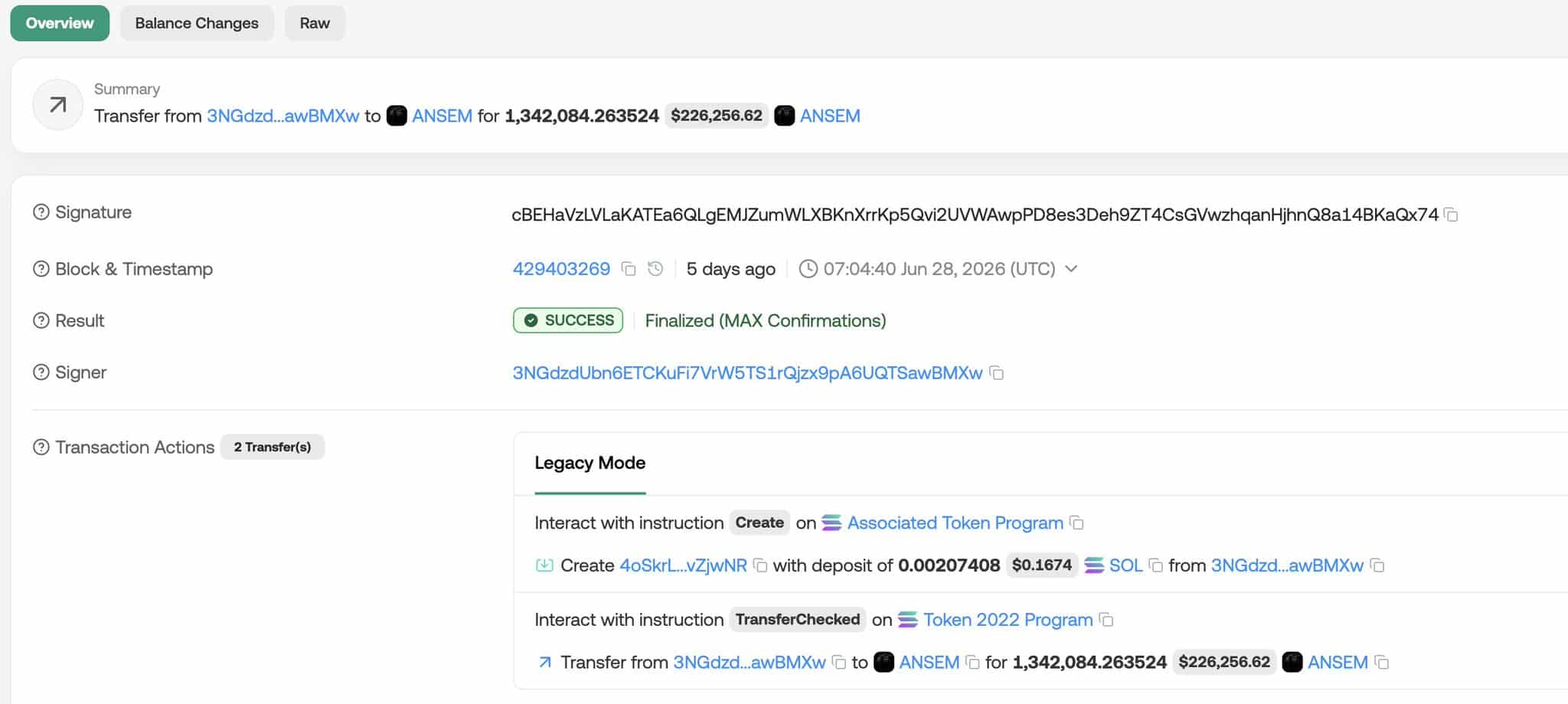
At the same time, Lookonchain reported that one trader mistakenly transferred 1.34 million ANSEM, worth about $226,000, to the token’s contract address, permanently losing the funds.
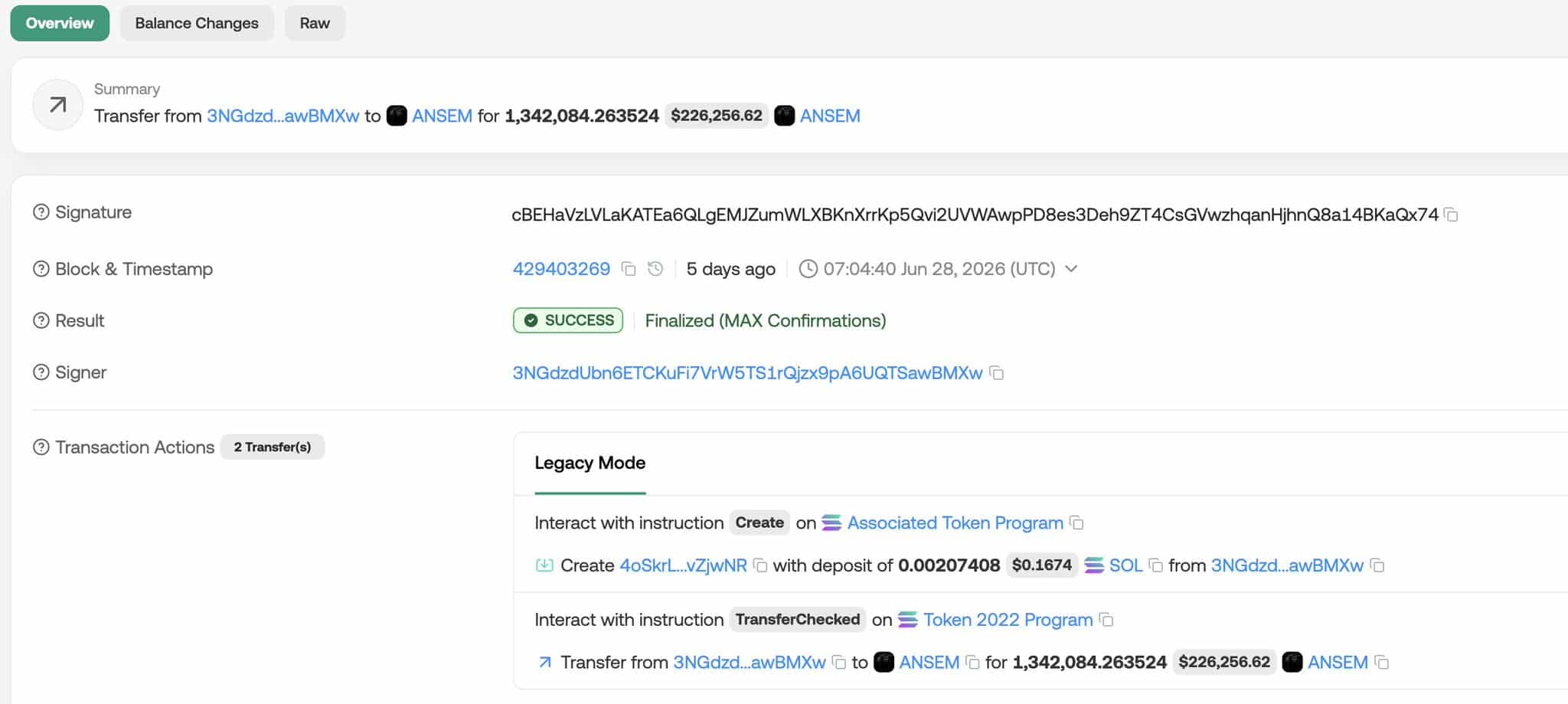
Source: Lookonchain

While the lost supply represented only a small fraction of the total supply, the incident highlighted the risks surrounding newly launched tokens.

Even so, ANSEM’s price action remained largely influenced by community sentiment and influencer attention.

Will ANSEM keep rallying high?

The price chart showed buyers defending a rising trendline support. Since the 28th of June, ANSEM has rebounded each time it tested that level.

Even so, the rally has experienced brief consolidation periods, including on the 2nd of July.

If buyers continue defending the trendline, ANSEM could revisit a market capitalization above $100 million. However, losing that support could trigger a deeper correction.
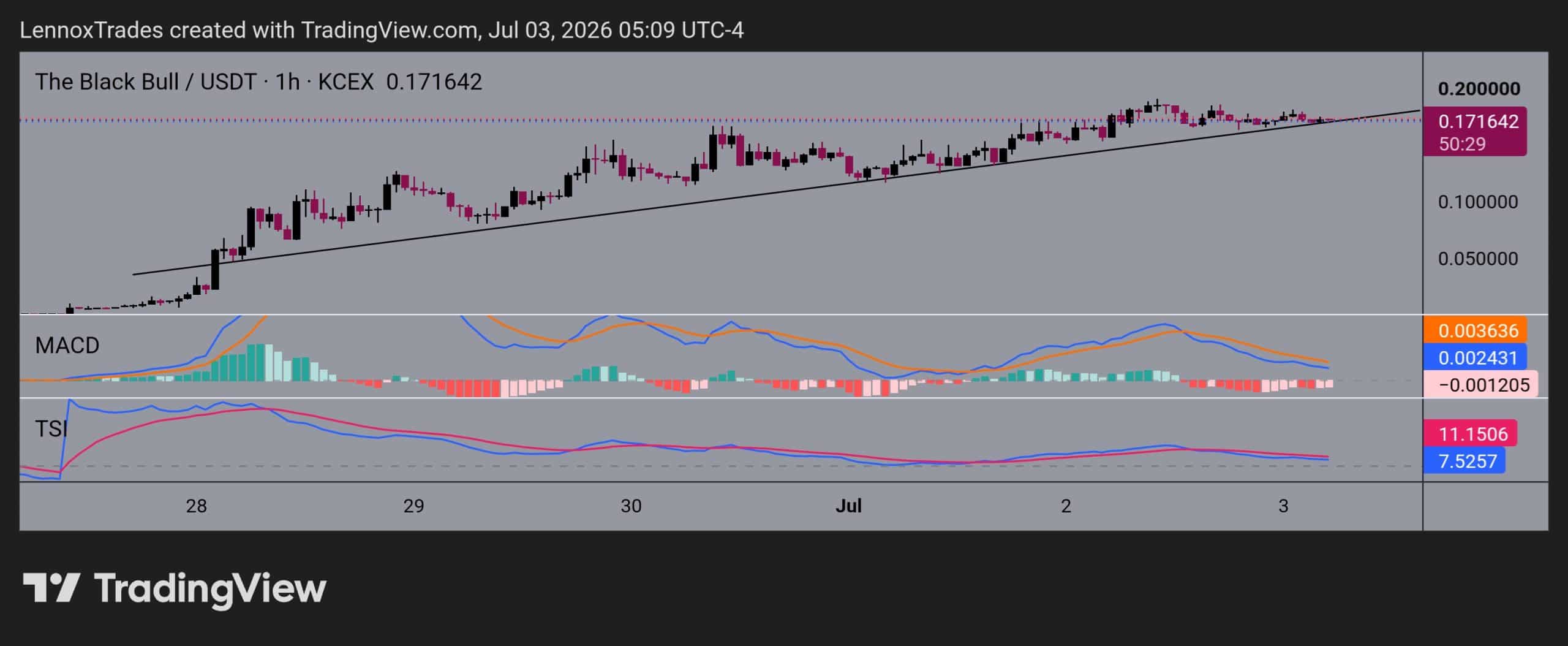
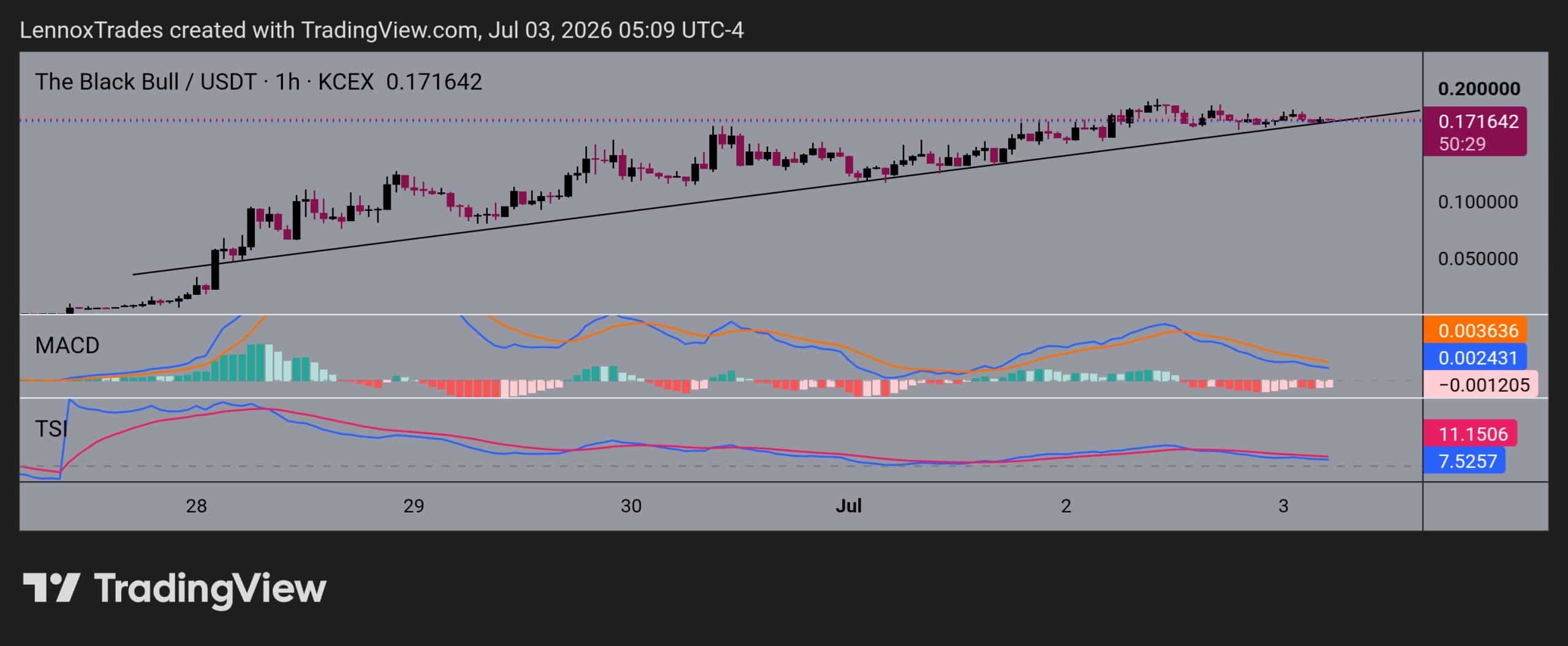
Source: ANSEM/USDT on TradingView

Momentum indicators suggested bullish strength had started to fade on lower timeframes.

The Moving Average Convergence Divergence (MACD) showed weakening bullish momentum, although bearish momentum remained limited. Meanwhile, the True Strength Index (TSI) continued to decline, indicating that trend momentum was losing strength.

Taken together, ANSEM remained above key support, but weakening momentum suggested traders should watch for a potential shift in market direction.


Final Summary

  • ANSEM surges 13% in 24 hours as price action rebounds following a correction that came after hitting a market cap of $100 million.
  • ANSEM price is respecting a trendline support but losing it would mean bears take full control.

Criptomoedas em alta

Perguntas relacionadas

QWhat are the two main factors driving the volatility and speculative trading of the ANSEM memecoin according to the article?

AAccording to the article, the two main factors driving the volatility and speculative trading of ANSEM are influencer branding and community sentiment/influencer attention.

QWhat is the primary concern raised regarding ANSEM's token distribution and long-term sustainability?

AThe primary concern is the concentrated token allocation, where 60% of the total supply was initially allocated to influencer Ansem. This concentration means large holders could significantly influence future supply, posing a risk to sustainability.

QWhat event caused a trader to permanently lose approximately $226,000 worth of ANSEM tokens?

AA trader mistakenly transferred 1.34 million ANSEM tokens to the token's contract address instead of to another wallet, which resulted in the permanent loss of those funds.

QBased on the technical analysis in the article, what key level must ANSEM's price hold to potentially revisit a market cap above $100 million?

AANSEM's price must continue to defend and hold the rising trendline support. Losing this support could trigger a deeper correction instead.

QWhat do the MACD and TSI momentum indicators suggest about ANSEM's trend strength on lower timeframes?

AThe MACD shows weakening bullish momentum, and the TSI is declining. Together, they indicate that the trend momentum is losing strength, suggesting a potential shift in market direction.

Leituras Relacionadas

Automotive Chips Initiate a New Round of Game

After two years of deep inventory correction, the global automotive semiconductor industry is signaling a turning point in the second half of 2026, entering a structural upcycle. Unlike the broad-based shortages of 2022, this recovery is characterized by significant divergence across different chip segments, driven by 800V high-voltage platforms, high-level autonomous driving, and ongoing localization of supply chains in China. The industry-wide destocking cycle has concluded, with inventory levels at automakers and Tier 1 suppliers returning to healthy ranges. Key indicators, including rising OEM orders, lengthening component lead times, improving vendor revenues, and the initiation of price hikes by major suppliers like Infineon and Texas Instruments, confirm the start of a replenishment cycle. Segments are diverging into three tiers based on demand and supply dynamics. The first and strongest tier includes Silicon Carbide (SiC), high-voltage IGBTs, and automotive power management chips, fueled by the rapid adoption of 800V platforms. The second tier, experiencing a moderate recovery, comprises high-end 32-bit MCUs and automotive NOR Flash/DRAM, benefiting from advanced compute domains and AI-driven capacity constraints on mature nodes. The third tier, consisting of low-voltage MOSFETs and basic body electronics, remains stable with ample supply. The core growth logic has shifted from pure vehicle sales volume to increasing semiconductor content per vehicle. This is propelled by the transition to domain/centralized E/E architectures, software-defined vehicles, and new applications like commercial vehicle electrification and V2X communications. While the domestic Chinese supply chain is seizing this window for localization, risks remain, including potential softness in end-demand, future SiC oversupply, and possible easing of 8-inch wafer capacity constraints. In the near term, key segments are expected to see simultaneous volume and price increases, with the industry's cyclicality gradually giving way to more prominent long-term growth characteristics.

marsbitHá 15m

Automotive Chips Initiate a New Round of Game

marsbitHá 15m

Domestic RF Filters, Finally Starting to Compete?

China's domestic filter industry, particularly in the challenging BAW (Bulk Acoustic Wave) segment, has reached a significant inflection point, moving from solving the "availability" problem to entering a phase of commercial competition and scale. The market is attractive, with the global mobile terminal RF filter market projected to reach $9.2 billion in 2025, and BAW filters showing strong growth. However, the sector is historically dominated by giants like Broadcom and Qorvo, protected by deep patent walls, as evidenced by lawsuits that have bankrupted competitors like Akoustis. Previously, high-frequency BAW filter production in China was nearly zero. Now, domestic players like Nous Micro, Wuhan Memsensing, Hansky, and others are forming a genuine industrial cluster, achieving mass production and shipping hundreds of millions of chips to clients. Different business models are emerging, including IDM and fab-lite approaches through partnerships with foundries like Sai Microelectronics and Runxin Sensing. A key signal of this new competitive phase is a patent lawsuit filed by Nous Micro against Wuhan Memsensing in June 2025, alleging infringement of a core BAW resonator patent. This conflict, rather than mere internal friction, underscores that the industry now has substantial products and market stakes to contest. The challenge is no longer just technical breakthrough but transforming technological leads into sustainable commercial success through superior patents, product performance, cost control, and customer acquisition. Chinese companies are finally positioned to compete for a share of this lucrative market long held by foreign leaders.

marsbitHá 40m

Domestic RF Filters, Finally Starting to Compete?

marsbitHá 40m

Zhang Lei: How He Became the Biggest Money-Maker This Year

Zhang Lei's company Pinzhun Laser (频准激光) became the biggest "meat sign" (highly profitable new share) of the year on its A-share market debut. Its stock price skyrocketed nearly 600% from its IPO price, generating potential single-lot profits of over 550,000 RMB for lucky subscribers. Founded by Zhang Lei, a 2014 Ph.D. graduate from the Shanghai Institute of Optics and Fine Mechanics, Pinzhun Laser specializes in ultra-stable, narrow-linewidth lasers critical for quantum computing. Its lasers are used by leading global research teams at Harvard, Caltech, and France's PASQAL. The company later successfully applied its core frequency conversion technology to the semiconductor sector, developing deep-ultraviolet lasers for advanced chip manufacturing and inspection. This move diversified its revenue, with semiconductor sales growing rapidly to account for over 25% of its business by 2025. The company boasts gross margins consistently above 69%. Remarkably, Pinzhun Laser required only two major external funding rounds before its IPO, a testament to its early profitability. Key strategic investors in its IPO included major downstream players like BOE,佰维存储 (BIWIN), and中微半导体 (AMEC), signaling strong industry validation. The article highlights the crucial early-stage support from Hangzhou-based capital, particularly funds associated with the Hangzhou Institute of Optics and Fine Mechanics. This "patient capital" model, part of Hangzhou's broader 300-billion-yuan industrial fund strategy, focuses on partnering with scientist-entrepreneurs through the risky valley of death from lab to market. The success of Pinzhun Laser and another Hangzhou-backed firm,宇树科技 (Unitree Robotics), showcases how this supportive ecosystem helps build leading hard-tech companies.

marsbitHá 46m

Zhang Lei: How He Became the Biggest Money-Maker This Year

marsbitHá 46m

3-Month Loss of $10 Billion, DAT Companies Begin to Return to Rationality

During the recent earnings season, major Digital Asset Treasury (DAT) companies reported staggering combined losses of approximately $10 billion for Q2 and over $30 billion for the first half, primarily due to markdowns on their bitcoin holdings. However, contrary to expectations, their stock prices have rebounded from June lows, indicating the market had already priced in these losses. The key shift is a collective return to rationality. Companies like Strategy, Sharplink, and Metaplanet are now prioritizing a new core metric: increasing the amount of crypto assets per share. This marks a departure from last year's aggressive growth-at-all-costs narrative. To achieve this, they are adopting disciplined capital allocation—issuing stock to buy crypto when trading at a premium, and halting dilution or initiating buybacks when at a discount. Some, like Strategy, have even broken "never sell" pledges to uphold this discipline. A major tool enabling this strategy is the STRC model—perpetual preferred shares offering high dividends (e.g., 12-13%) to raise fixed-income capital for purchasing bitcoin. Strive, Bitmine, and Metaplanet have launched their own variants. Sharplink pursues a different path, staking its vast Ethereum holdings to generate native yield. While the premium of DAT stocks over their underlying crypto asset value has declined and may not fully return, the model is evolving rather than ending. Stripped of hype, DAT firms are becoming actively managed, leveraged thematic funds. Their survival through massive losses and continued institutional investment (with major funds adding billions to positions during downturns) suggests the industry is maturing into a more calculated, long-term business focused on compounding crypto per share.

marsbitHá 50m

3-Month Loss of $10 Billion, DAT Companies Begin to Return to Rationality

marsbitHá 50m

Trading

Spot

Artigos em Destaque

Como comprar ANSEM

Bem-vindo à HTX.com!Tornámos a compra de The Black Bull (ANSEM) simples e conveniente.Segue o nosso guia passo a passo para iniciar a tua jornada no mundo das criptos.Passo 1: cria a tua conta HTXUtiliza o teu e-mail ou número de telefone para te inscreveres numa conta gratuita na HTX.Desfruta de um processo de inscrição sem complicações e desbloqueia todas as funcionalidades.Obter a minha contaPasso 2: vai para Comprar Cripto e escolhe o teu método de pagamentoCartão de crédito/débito: usa o teu visa ou mastercard para comprar The Black Bull (ANSEM) instantaneamente.Saldo: usa os fundos da tua conta HTX para transacionar sem problemas.Terceiros: adicionamos métodos de pagamento populares, como Google Pay e Apple Pay, para aumentar a conveniência.P2P: transaciona diretamente com outros utilizadores na HTX.Mercado de balcão (OTC): oferecemos serviços personalizados e taxas de câmbio competitivas para os traders.Passo 3: armazena teu The Black Bull (ANSEM)Depois de comprar o teu The Black Bull (ANSEM), armazena-o na tua conta HTX.Alternativamente, podes enviá-lo para outro lugar através de transferência blockchain ou usá-lo para transacionar outras criptomoedas.Passo 4: transaciona The Black Bull (ANSEM)Transaciona facilmente The Black Bull (ANSEM) no mercado à vista da HTX.Acede simplesmente à tua conta, seleciona o teu par de trading, executa as tuas transações e monitoriza em tempo real.Oferecemos uma experiência de fácil utilização tanto para principiantes como para traders experientes.

531 Visualizações TotaisPublicado em {updateTime}Atualizado em 2026.07.01

Como comprar ANSEM

Discussões

Bem-vindo à Comunidade HTX. Aqui, pode manter-se informado sobre os mais recentes desenvolvimentos da plataforma e obter acesso a análises profissionais de mercado. As opiniões dos utilizadores sobre o preço de ANSEM (ANSEM) são apresentadas abaixo.

活动图片