Aave baru saja menembus pendapatan swap $1 juta, tapi INILAH yang terlewatkan

ambcryptoPublicado em 2026-07-03Última atualização em 2026-07-03

Resumo

Aave (AAVE) tidak lagi hanya bergantung pada aktivitas deposito dan peminjaman, tetapi kini juga membangun aliran pendapatan baru melalui fitur swap. Pendapatan swap Aave DAO telah melampaui $1 juta sejak peluncuran "Aave Will Win", dengan sebagian besar kontribusi berasal dari jaringan Ethereum (ETH), disusul Arbitrum (ARB) dan beberapa chain lainnya. Ini menambah sumber pendapatan di luar fee berbasis AUM dari pasar lending. Aktivitas on-chain Aave juga meningkat, terutama setelah peluncuran V4 Global Dollar Hub. Meskipun harga AAVE sempat naik dari sekitar $72 ke $95 sebelum dikoreksi ke level $85, pertumbuhan pengguna tetap kuat. Alamat baru AAVE mencapai 1.806 pada 30 Juni, jauh di atas rata-rata harian sekitar 200 di musim semi, dan alamat aktif sempat menyentuh 3.144. Secara teknis, AAVE diperdagangkan di sekitar $87 dengan RSI di 58 (tidak overbought) dan CMF positif di 0.10, mengindikasikan masih ada ketertarikan beli. Dengan rencana pengembangan fitur seperti leverage tools dan dukungan V4 di Aave Pro, basis pendapatan ini berpotensi terus tumbuh.

Aave [AAVE] tidak lagi hanya berkembang melalui aktivitas deposit dan peminjaman; mereka juga membangun aliran pendapatan baru. Dengan peluncuran Global Dollar Hub Aave dan peningkatan aktivitas pengguna, proyek ini kembali mendapatkan momentum.

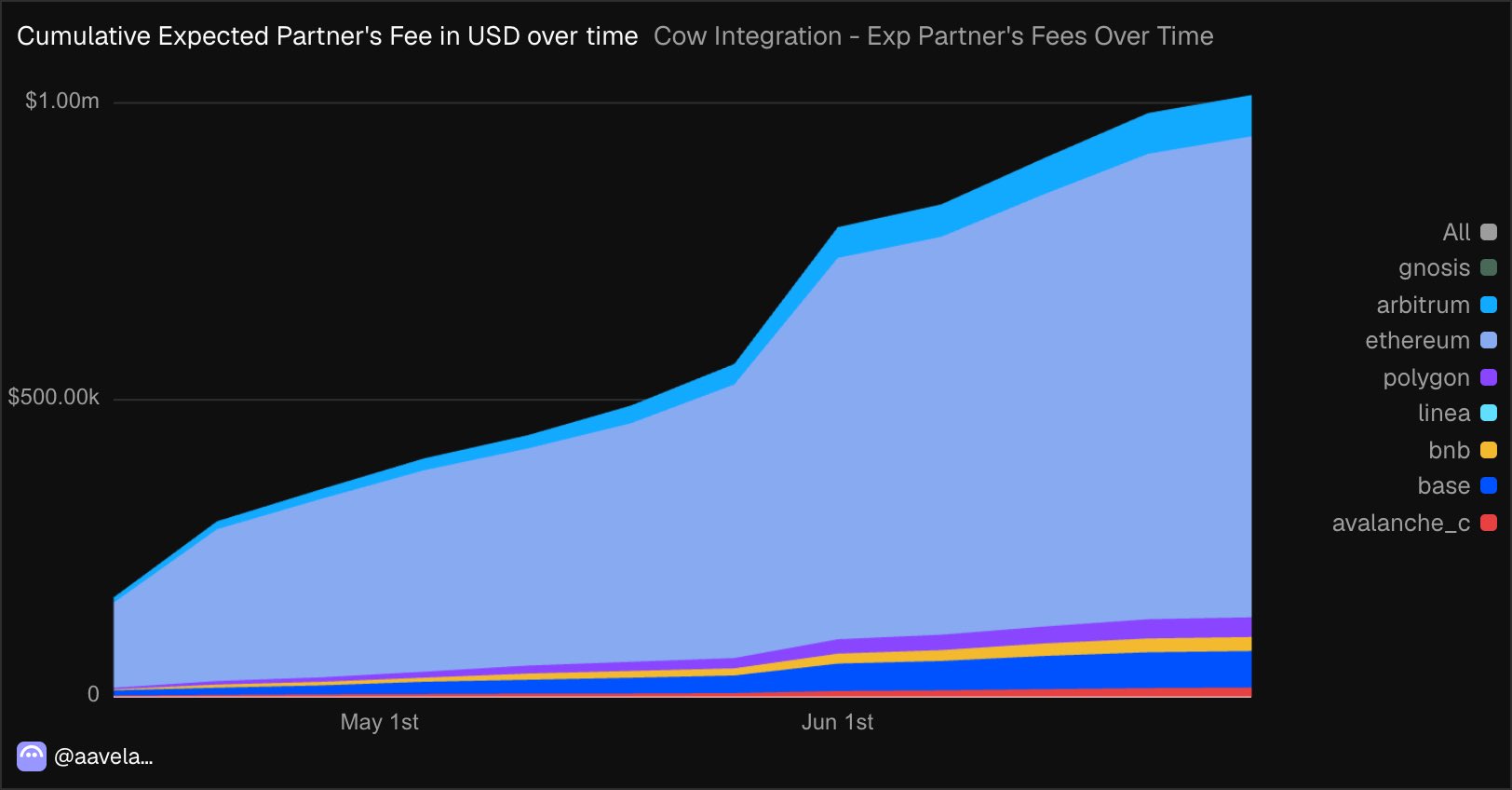
Pendapatan swap Aave DAO menembus $1 juta!

Pendapatan swap Aave DAO telah menembus $1 juta sejak peluncuran Aave Will Win. Biaya partner kumulatif yang diharapkan telah meningkat sejak April, dengan lonjakan sekitar awal Juni dan pertumbuhan berkelanjutan sepanjang bulan.
Sumber: X

Sebagian besar pendapatan ini berasal dari Ethereum [ETH], sementara Arbitrum [ARB] dan beberapa chain lainnya juga memberikan kontribusi yang lebih kecil. Menariknya, ini memberikan Aave aliran pendapatan lain di luar biaya berbasis AUM yang biasa dari pasar peminjaman.

Dengan lebih banyak fitur yang direncanakan – termasuk alat leverage, dukungan pembangun transaksi, dan dukungan V4 di Aave Pro – basis pendapatan ini dapat terus tumbuh.

Pertumbuhan dompet baru bertahan lebih lama daripada harga AAVE

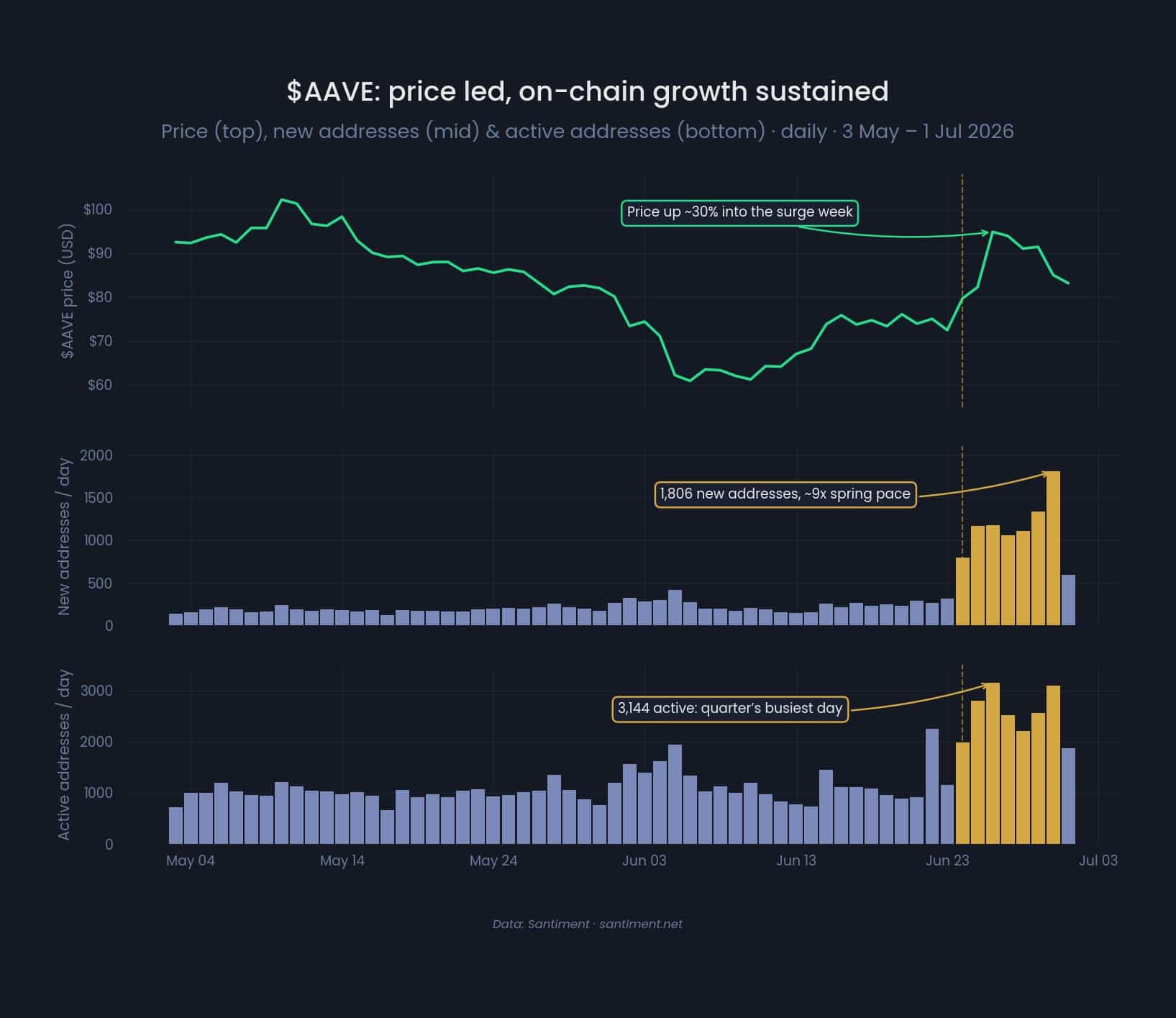
Di luar ini, aktivitas on-chain Aave juga melonjak. Sekitar peluncuran V4 Global Dollar Hub-nya, harga AAVE bergerak dari hampir $72 menjadi sekitar $95, sebelum turun kembali ke arah $85.
Sumber: Santiment

Namun, yang mencolok adalah bahwa pertumbuhan pengguna tidak memudar seiring harga. Alamat AAVE baru mencapai 1.806 pada tanggal 30 Juni, jauh di atas kecepatan musim semi biasa sekitar 200 per hari.

Pertumbuhan alamat baru juga jauh di atas garis dasar sepanjang minggu ini. Bahkan, alamat aktif berada di atas 2.200 dan mencapai 3.144 pada titik tertingginya.

AAVE bertahan di atas zona penurunan

Ini sedikit penyeimbang untuk cerita ini. Setelah pergerakan menuju area $95-$100, AAVE turun kembali di bawah $90 pada grafik.
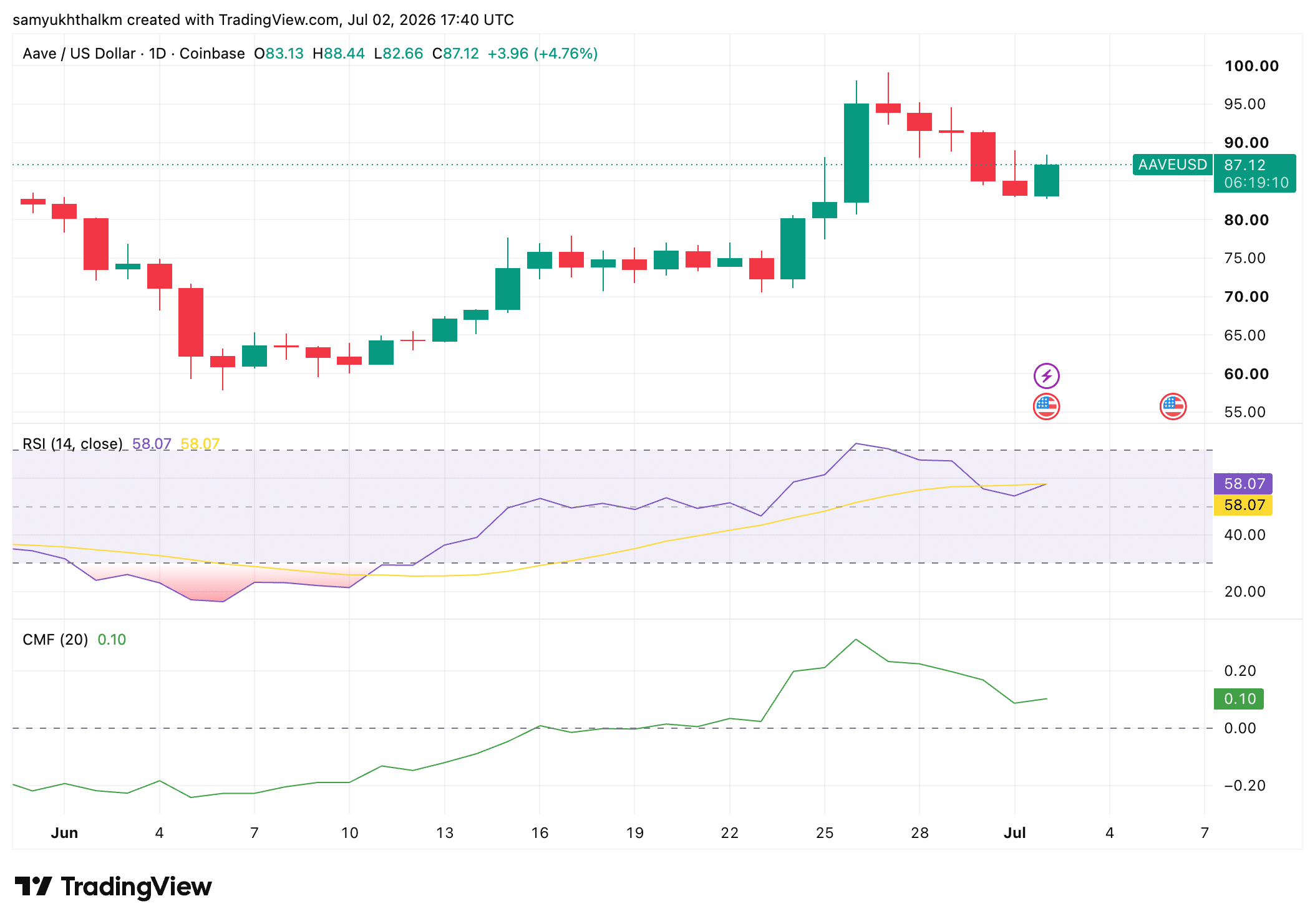
Sumber: TradingView

Namun, token ini juga belum sepenuhnya kehilangan kecepatannya. Token ini diperdagangkan sekitar $87 pada saat pers, dengan upaya pemulihan kecil.

RSI berada di 58, jadi reli tidak lagi terlalu panas. Tampaknya masih ada kekuatan yang tersisa. CMF juga positif di 0,10, menunjukkan minat beli.


Ringkasan Akhir

  • Aave DAO menembus $1 juta dalam pendapatan swap, menambah mode pendapatan baru.
  • Harga AAVE mengerem di grafik, tetapi alamat baru juga mencapai 1.806.

Perguntas relacionadas

QDari mana sebagian besar pendapatan swap Aave DAO berasal?

ASebagian besar pendapatan swap Aave DAO berasal dari jaringan Ethereum (ETH). Jaringan lain seperti Arbitrum (ARB) juga memberikan kontribusi yang lebih kecil.

QBerapa banyak alamat AAVE baru yang tercatat pada tanggal 30 Juni, dan bagaimana perbandingannya dengan periode sebelumnya?

APada tanggal 30 Juni, tercatat 1.806 alamat AAVE baru. Jumlah ini jauh lebih tinggi dibandingkan kecepatan normal di musim semi yang sekitar 200 alamat per hari.

QApa saja fitur yang direncanakan Aave yang dapat mendorong pertumbuhan pendapatan lebih lanjut?

AFitur yang direncanakan Aave termasuk alat leverage, dukungan pembangun transaksi (transaction builder support), dan dukungan V4 di Aave Pro. Fitur-fitur ini diharapkan dapat membantu basis pendapatan mereka terus tumbuh.

QBagaimana kinerja harga token AAVE setelah mencapai area $95-$100?

ASetelah bergerak ke area $95-$100, harga token AAVE jatuh kembali di bawah $90. Namun, pada waktu artikel dibuat, token diperdagangkan di sekitar $87 dengan upaya pemulihan kecil.

QApa yang ditunjukkan oleh indikator RSI dan CMF untuk token AAVE pada saat artikel dibuat?

AIndikator RSI berada di level 58, menunjukkan bahwa rally tidak lagi terlalu panas namun masih ada kekuatan tersisa. Sementara itu, CMF positif di level 0.10, mengindikasikan adanya minat beli.

Leituras Relacionadas

The Biggest Political Economy Question in the AI Era: As Robots Become More Capable, How Do Humans Share the Value?

In the AI era, the most pressing political economy question is: as machines become increasingly capable, how can humanity share in the value they create? An article originally critiquing China's tech focus has sparked a deeper debate on this global challenge. Historically, industrial progress improved efficiency but still relied on human labor for wealth creation and distribution. AI is fundamentally different—it is now replacing cognitive and knowledge work. As AI and robots take over more tasks, economic growth may continue while direct human participation in value creation shrinks, creating a core tension between productivity gains and widespread income generation. The issue is not unique to China. While leading tech companies amass enormous wealth, labor's share of income is declining globally. The core problem is a broken link: technological innovation and corporate profits are not translating into sufficient consumer income and demand. Three potential paths forward are outlined: a traditional capitalist model where profits primarily go to capital owners; a state-capitalist approach with public investment in AI; and more innovative models like digital sovereign wealth funds, universal shareholding, or AI-era basic income schemes to directly distribute AI-generated value. The future competitive advantage may lie not just in technological supremacy, but in which society can build a new, inclusive distribution system for the intelligent economy. The ultimate challenge is ensuring that as AI creates value, humans have a means to obtain income and share in the resulting widespread social benefits.

marsbitHá 7m

The Biggest Political Economy Question in the AI Era: As Robots Become More Capable, How Do Humans Share the Value?

marsbitHá 7m

Generating Profits for Seven Consecutive Quarters, Emerging Markets Carry Trade Outperforms Everything

For the seventh consecutive quarter, dollar-funded emerging market carry trades have delivered positive returns, marking the longest winning streak since 2008. According to Bloomberg's index, this strategy has gained approximately 22% since late 2024, outperforming U.S. Treasuries, emerging market sovereign, and corporate dollar debt. The core of the trade involves borrowing low-interest currencies like the U.S. dollar, euro, or yen to invest in high-yielding emerging market assets, such as Turkish lira bonds offering over 40% returns. Returns were amplified by favorable currency moves, with the dollar weakening against most emerging market currencies and other traditional funding currencies. For instance, the trade gained 48% on the Colombian peso in the past year. A key test came in August 2024 with a historic joint U.S.-Japan currency intervention, which caused only a modest 1% dip in the carry trade risk premium as investors shifted funding from the yen to the euro and Swiss franc. Looking ahead, the primary risk is the timing of Federal Reserve policy changes. While persistent inflation allows the Fed to hold rates, a rapid rise in long-term U.S. yields could threaten the trade. Another concern is crowding, as massive inflows increase vulnerability to a sudden reversal. High interest rates in regions like Latin America and Eastern Europe, supported by external factors like Middle East tensions and energy prices, continue to sustain the opportunity. Major investors remain engaged, favoring currencies like the Mexican peso, South African rand, and Turkish lira.

marsbitHá 22m

Generating Profits for Seven Consecutive Quarters, Emerging Markets Carry Trade Outperforms Everything

marsbitHá 22m

Unpacking the Truth Behind On-chain Assets: Leverage, Liquidity, and Risk

The article analyzes the concept of "real-world asset" (RWA) tokenization, arguing that while tokenizing assets on-chain is a useful step, it is far from transformative on its own. The author compares it to placing a barcode on a shipping container—it enables identification but does not build the necessary market infrastructure. The core argument is that true value emerges not from tokenization, but from integrating these tokens into DeFi systems where they can be valued, financed, hedged, traded, and liquidated under stress. Key challenges identified include: 1. **Multiple Time Clocks**: A fundamental tension exists between blockchain's 24/7 settlement and the slower, business-hour-dependent processes of traditional markets, custody, and redemption. This "duration mismatch" can create dangerous liquidity gaps during crises. 2. **Liquidity Misconceptions**: True liquidity is not measured by Total Value Locked (TVL) or trading pairs, but by the ability to exit a position within a required timeframe at an acceptable price. It requires analyzing multiple exit paths and stress-testing scenarios. 3. **Leverage and Risk**: Leverage unlocks economic utility (e.g., using tokenized assets as collateral) but also introduces fragility. Risk models must account for more than asset volatility, incorporating factors like legal enforceability, oracle freshness, and market structure. Paradoxically, a "safer" asset like tokenized Treasury bonds could require a higher collateral discount than ETH due to slower, less-proven liquidation mechanisms. 4. **A Risk Graph**: RWA risk should be modeled as a network of interconnected dependencies (e.g., issuers, custodians, oracles, stablecoin pools), not a single score. Failures can propagate through this graph, turning operational issues into systemic liquidity crises. The article states that tokenized government bonds are merely an entry point, while more complex frontiers like computing power and energy assets present greater challenges and opportunities. It also examines the interplay and risks between tokenized stocks and perpetual futures contracts. The conclusion is that the future lies not in "tokenizing everything," but in building robust market layers where tokenized rights become resilient financial primitives within a programmable capital system. The token is just the barcode; the market is the machine.

marsbitHá 47m

Unpacking the Truth Behind On-chain Assets: Leverage, Liquidity, and Risk

marsbitHá 47m

Trading

Spot
活动图片