‘Hard-backed currency’ – Coinbase CEO pushes crypto for $39T debt

ambcryptoPublicado em 2026-07-02Última atualização em 2026-07-02

Resumo

Coinbase CEO Brian Armstrong proposes using cryptocurrency as "hard-backed currency" to address the U.S. national debt, which stands at $39.4 trillion. He argues the U.S. Constitution needs amendments to cap government spending and mandate such a currency to prevent fiscal decline. While Bitcoin's fixed supply is seen as a digital alternative to gold, analysis suggests even significant Bitcoin reserves would only cover a fraction of the debt by 2049. The article concludes that capping spending may be a more practical step than relying solely on crypto to solve the debt issue.

Coinbase CEO Brian Armstrong has made a bold proposal to rein in inflation and unchecked government spending.

According to him, crypto can be used as ‘hard-backed currency.’ For growth, he floated AI and robotics as the best bet to spur the next growth. He noted,

The US Constitution was the most important political innovation ever, but it’s missing two important things: A cap on the growth of government spending and a requirement for hard-backed currency.

AD

He added,

Without them, every democracy drifts toward more debt and eventual loss of reserve currency status.

As of writing, the total U.S fiscal debt has hit $39.4 trillion. Armstrong cautioned that the fiscal debt increases by $1 trillion after every 100 days, largely driven by the current broken ‘political incentive structure.’

Can Bitcoin, stablecoins solve U.S. debt?

Others were quick to correct him, saying that the Constitution only allows gold and silver coins to be used to pay debts. Well, that’s why he is advocating for an amendment to include other “money” options.

For his part, BitGo CEO Mike Belshe supported his proposal and added,

The Bill of Rights protects you from the government taking your speech, your property, your liberty. It’s time to update it to protect you from the government debasing your money.

Well, this is not the first time crypto has been floated as a solution to U.S fiscal debt.

In particular, Bitcoin’s hard-coded supply limit of 21 million coins has been viewed as a potential replacement for gold or a better digital alternative to the precious metal.

In fact, the two assets have shown close correlation, sparking a ‘debasement trade’ during the West Asia crisis. They acted as macro hedges, and their demand pushed their values higher.

So far, gold and Bitcoin prices have fallen together amid slow but progress toward a solution to the West Asia crisis.

Bitcoin vs. America’s debt problem

But U.S inflation has devalued the dollar by nearly 97% since 1913. Since 2000, the US dollar’s purchasing power has dropped further to a record low. Over the same period, BTC value has surged from below $1 to over $50K.
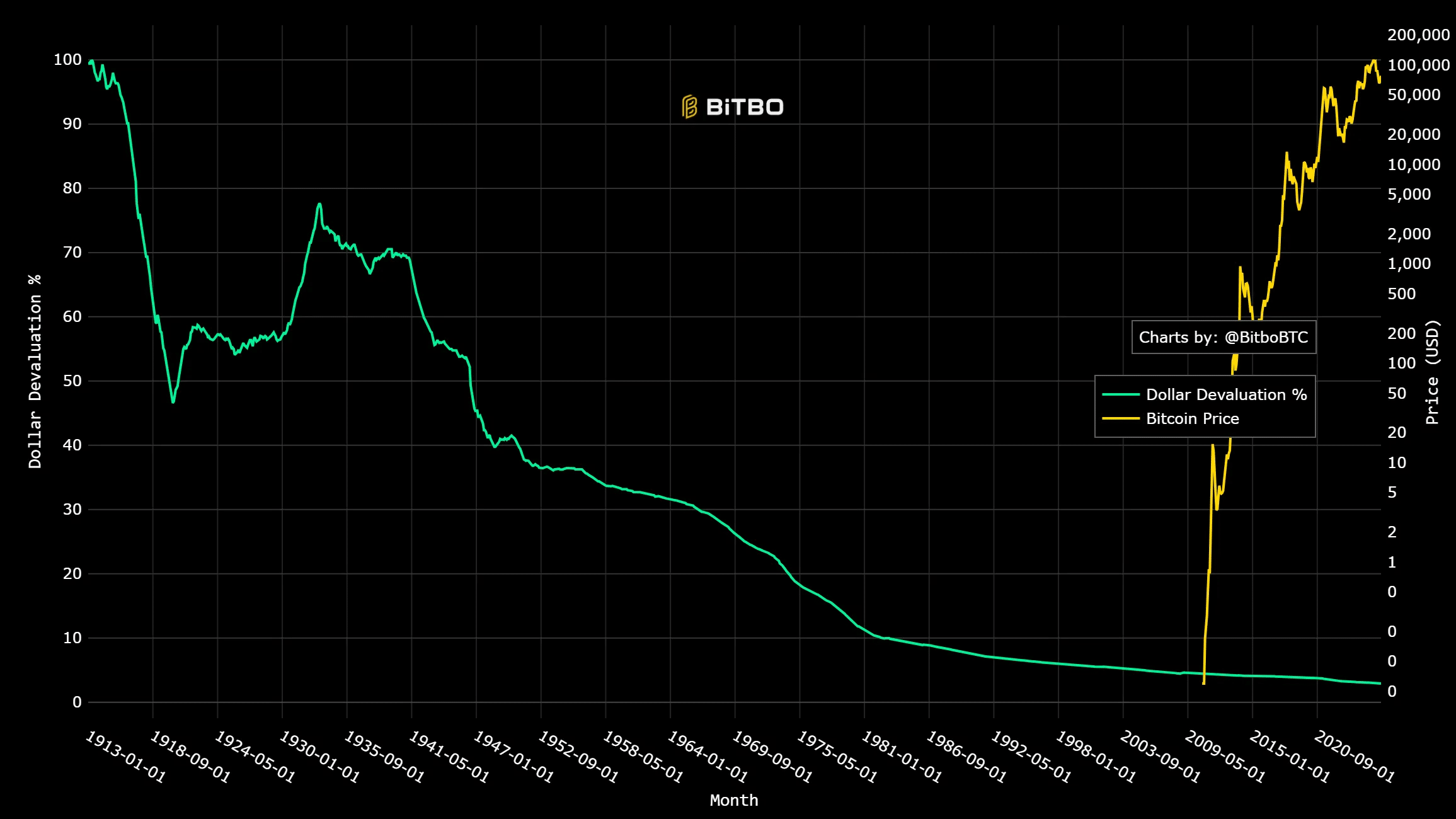
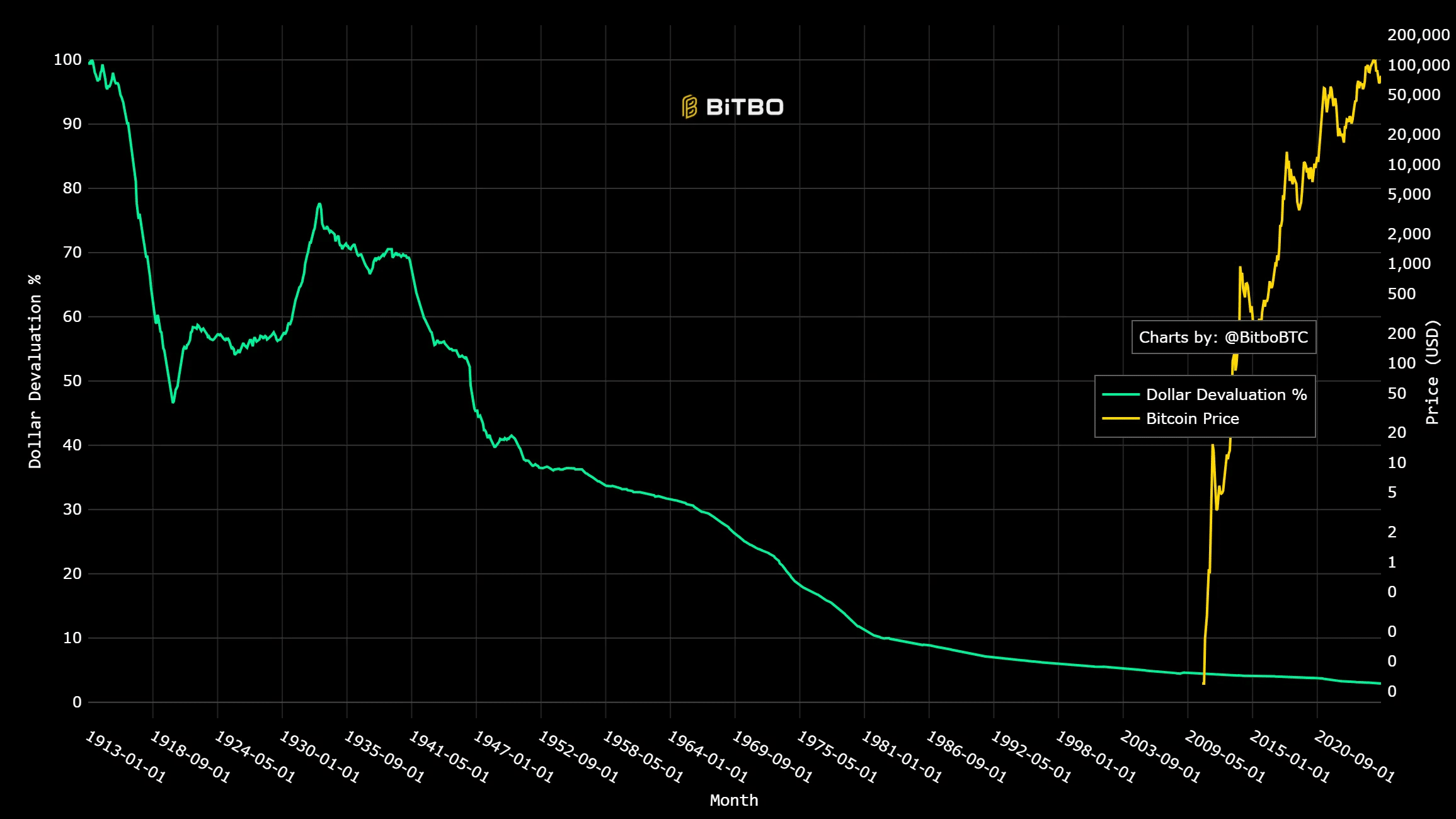
Source: Bitbo

In fact, the Trump Administration is betting on a Bitcoin strategic reserve and stablecoins to manage its debt. Unfortunately, VanEck projected that a BTC reserve can only help pay 18%-36% of the US debt by 2049.

The above projection holds only if the government holds 1 million BTC and the price surges from $250K to $43M per coin before 2050.
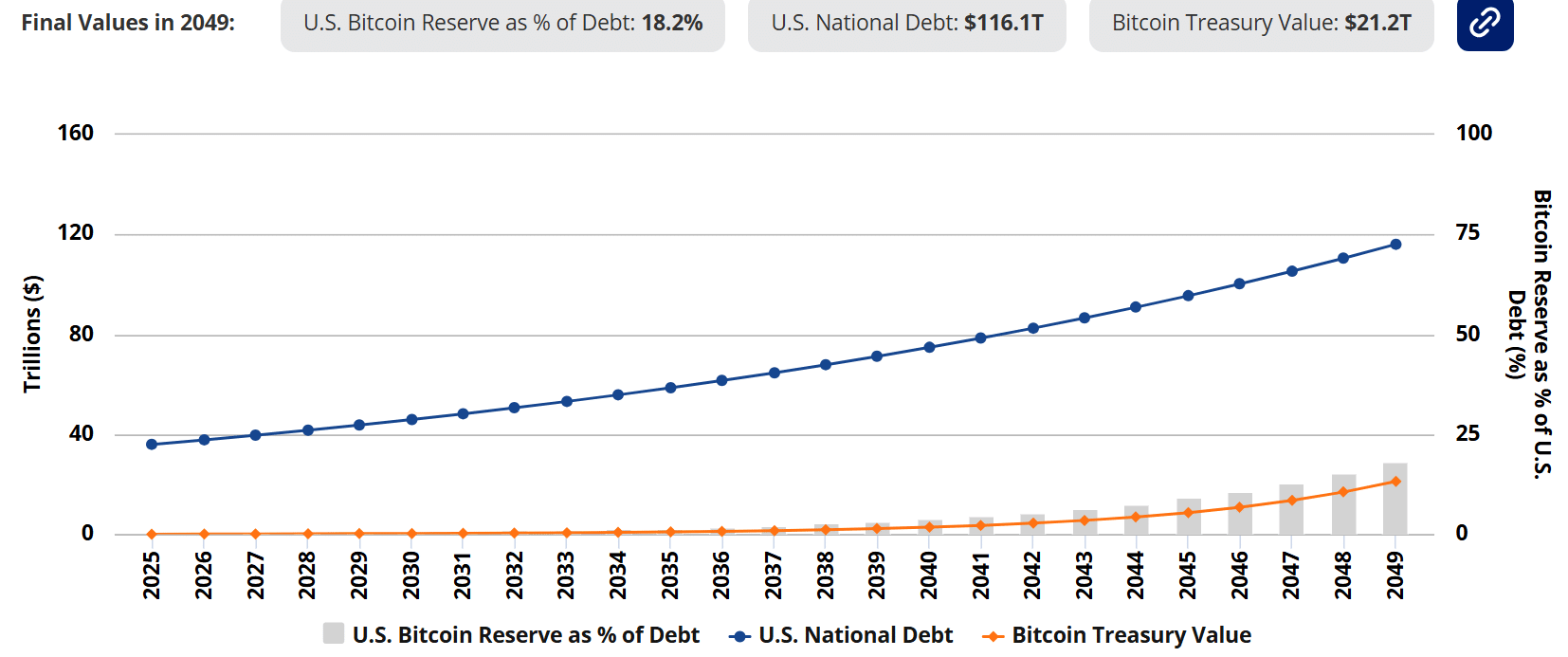
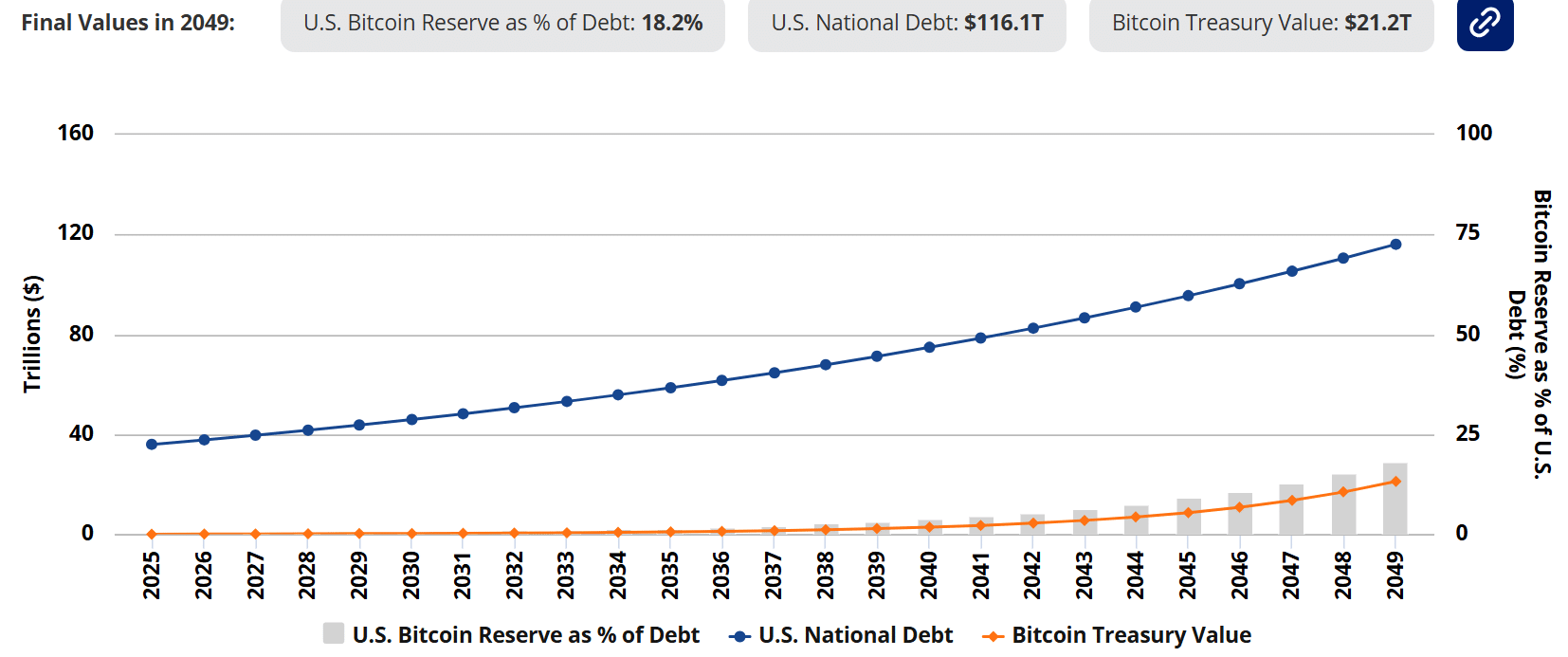
Source: VanEck

Overall, the crypto proposal may not fully solve the U.S debt problem. However, capping government spending could be a practical step toward addressing the fiscal debt issue.


Final Summary

  • Coinbase CEO proposed crypto as ‘hard-backed money’ to address the U.S $39T fiscal debt problem
  • But crypto could only pay a fraction of the U.S debt, assuming BTC price hits $43M per coin by 2049.


Perguntas relacionadas

QWhat is Coinbase CEO Brian Armstrong's proposal to address the U.S. fiscal debt, and what key constitutional changes does he suggest are needed?

ABrian Armstrong proposes using cryptocurrency as 'hard-backed currency' to address inflation and U.S. fiscal debt. He suggests amending the U.S. Constitution to include a cap on government spending growth and a requirement for a hard-backed currency, which he believes are missing but necessary to prevent excessive debt and loss of reserve currency status.

QWhat is the current size of the U.S. fiscal debt according to the article, and at what rate is it reportedly increasing?

AAccording to the article, the total U.S. fiscal debt has hit $39.4 trillion. Armstrong cautions that the debt increases by $1 trillion approximately every 100 days.

QWhy is Bitcoin specifically considered as a potential tool to manage debt, and what is one significant limitation of this idea presented in the article?

ABitcoin is considered due to its hard-coded supply limit of 21 million coins, making it a potential digital alternative to gold and a hedge against currency debasement. A significant limitation, according to a VanEck projection cited, is that even if the U.S. held 1 million BTC, and its price surged to an unrealistic $43 million per coin by 2049, it would only cover 18%-36% of the U.S. debt by that time.

QAccording to the article, what role did Mike Belshe, CEO of BitGo, see for the Bill of Rights in relation to the current monetary system?

AMike Belshe suggested that the Bill of Rights protects citizens from the government infringing on speech, property, and liberty, and it should be updated to also protect people from the government debasing their money.

QWhat practical step does the article suggest might be more effective than relying solely on cryptocurrency reserves to address the U.S. debt problem?

AThe article suggests that capping government spending could be a more practical step toward addressing the fiscal debt issue, as the crypto proposal alone may not fully solve the problem.

Leituras Relacionadas

How Token Economy Reshapes the Business Rules of AI 'Measurement' | ToB Industry Observation

"Token Economy: How It Reshapes the Business Rules of AI's 'Metrics' | ToB Industry Observation" The article discusses how the token economy is fundamentally changing the business landscape for AI, moving from a phase of explosive technical supply to a focus on measurable value for enterprise demand. It highlights the astronomical growth in daily token usage in China, framing tokens as the new "measurement standard" or "electricity" of the intelligent era. A central challenge is determining a token's value, which varies drastically—up to 100,000x—across different applications, from drug discovery to casual chat. The concept of "high-quality tokens" that deliver real intelligence, versus "noise," is emphasized as crucial. Lenovo's Vice President shares three proposed "laws" of token economics: 1. **Law of Inertia:** The cost per token will continuously decline due to technological innovation, system optimization, and intelligent runtime scheduling. 2. **Law of Acceleration:** The value generated per token accelerates based on the depth of AI integration into business workflows, the level of engineering support, and organizational readiness. 3. **Law of the Singularity:** A tipping point where the value curve of AI application surpasses its cost curve, shifting from cost-saving to generating incremental, previously impossible value—enabling "innovation at scale." The article notes real-world struggles, such as companies exceeding AI budgets due to unpredictable token pricing and "token inflation" from agentic AI workflows. Solutions being explored include standardized metrics for token quality, transparent pricing, and new infrastructure like "Token Factories" for efficient, on-demand token production. The ultimate goal is for businesses to move past anxiety and reach the "singularity," where AI drives scalable innovation, akin to how electricity enabled countless modern appliances.

marsbitHá 2m

How Token Economy Reshapes the Business Rules of AI 'Measurement' | ToB Industry Observation

marsbitHá 2m

Bitcoin Rebounds to $64k as Fed Rate Hike Expectations Plummet?

Bitcoin rebounded strongly this week, climbing back above $60,000 and briefly touching $64,000. This recovery followed a significant drop after the U.S. presidential election, with the market now closely watching Federal Reserve policy signals. The key trigger was a weaker-than-expected June U.S. jobs report, showing only 57,000 new jobs versus an expected 115,000. While the unemployment rate fell, analysts noted concerning details like declining labor force participation. However, wage growth accelerated to 3.5% year-over-year, sustaining inflation concerns. Market focus has shifted to the upcoming July Consumer Price Index (CPI) data. Analysts expect a monthly decline in overall prices, partly due to falling gasoline costs. This has led traders to reduce bets on further Fed rate hikes this year, with markets now pricing in a high probability of rates holding steady at the July meeting. Fed Chair Kevin Warsh's recent comments about easing inflation risks have further supported this dovish shift. The anticipation of lower borrowing costs and a weaker dollar is seen as supportive for risk-sensitive assets like Bitcoin. Some investors are positioning for a potential Fed policy pivot to easing later this year, which could benefit "devaluation trades" including cryptocurrencies. Looking ahead, Bitcoin's price trajectory remains highly sensitive to U.S. economic data—particularly jobs and inflation reports—and evolving Fed policy expectations. Other critical factors include institutional ETF flows and geopolitical developments. Analysts suggest that if these factors improve, the recent sell-off could be seen as a buying opportunity; otherwise, high volatility may persist until a solid price floor is established.

marsbitHá 22m

Bitcoin Rebounds to $64k as Fed Rate Hike Expectations Plummet?

marsbitHá 22m

Trading

Spot
活动图片