Tiger Research: Crypto Payment Cards Handling $1.5B Monthly Volume Stuck in the 1990s

marsbitPublicado em 2026-07-02Última atualização em 2026-07-02

Resumo

Titled "Crypto Payment Cards at a $1.5 Billion Monthly Volume, Stuck in the 1990s," this article analyzes the crypto payment card industry, arguing its development stage is analogous to debit cards before they became core banking accounts. Despite rapid growth to ~$15B monthly volume, usage is concentrated in emerging markets (e.g., Bangladesh, India) where access to USD is limited, not in developed economies. The industry lacks integration into daily financial life—most cards rely on user-topped-up stablecoins, not payroll deposits or recurring payments, resulting in low circulation velocity compared to fiat. The piece outlines four main business models: 1) Issuing Infrastructure (highly concentrated, with players like Rain offering T+0 stablecoin settlement), 2) Exchange-Issued Cards (for user retention, not core revenue), 3) Decentralized Wallet/DeFi Cards (complex, high-Gas, limited to crypto-natives), and 4) Stablecoin Digital Banks (the largest segment by volume, focusing on account functions for emerging markets). The conclusion warns that pure payment functionality is unsustainable. For long-term viability, companies must control the funds flow, secure niche markets, and build indispensable user account relationships—similar to how traditional banks captured primary accounts. Without this, crypto cards risk remaining niche prepaid tools.

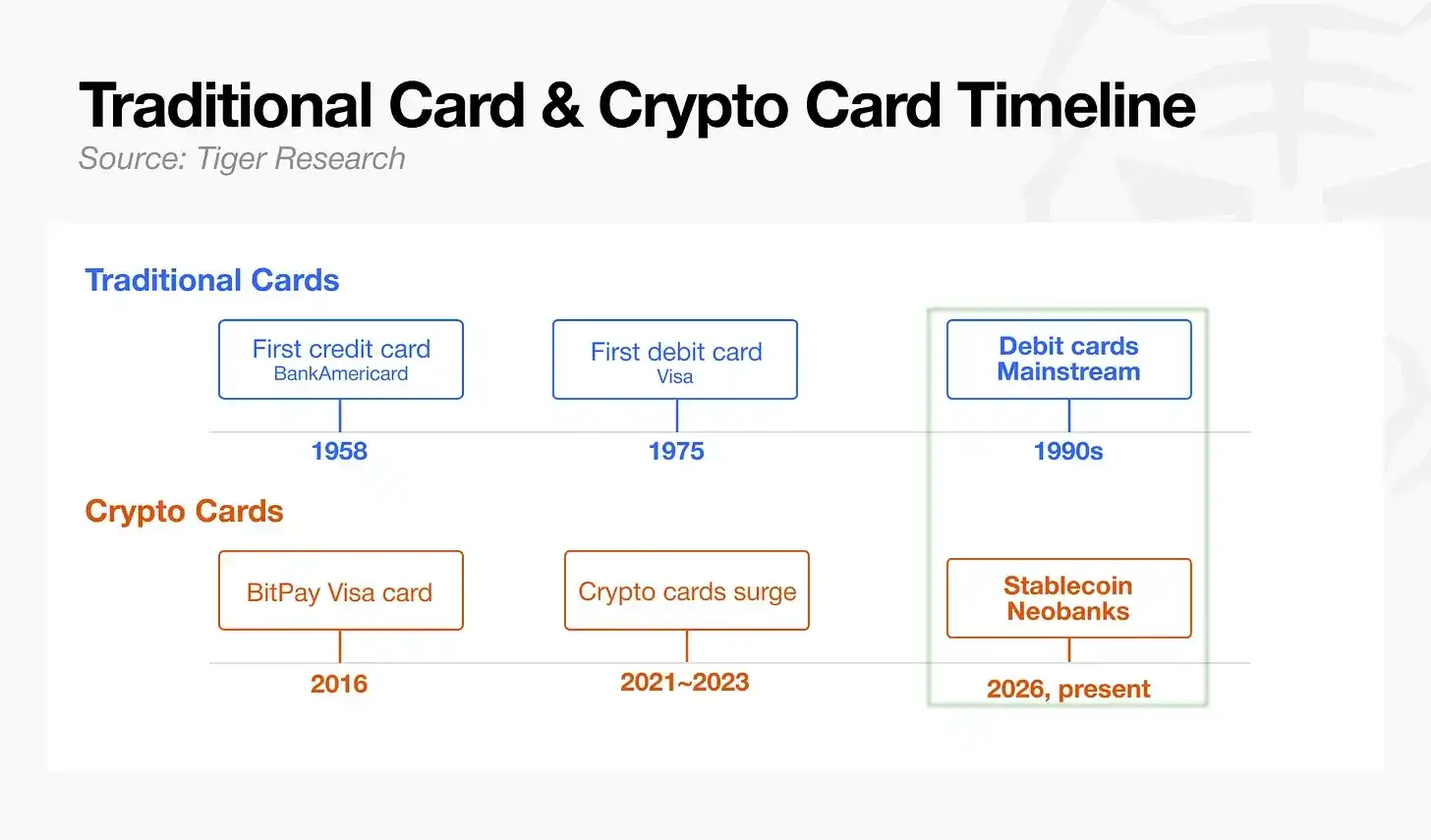
In September 1958, Bank of America bulk-mailed credit cards to 65,000 residents of Fresno, California. This was the first payment card launched without supporting underlying infrastructure. One year after launch, the business was dismal, with a delinquency rate of 22% and losses as high as $20 million. The industry spent 15 years building an electronic settlement system; debit cards took another 17 years to officially appear, and Visa spent a full 20 years establishing a globally accepted payment standard.
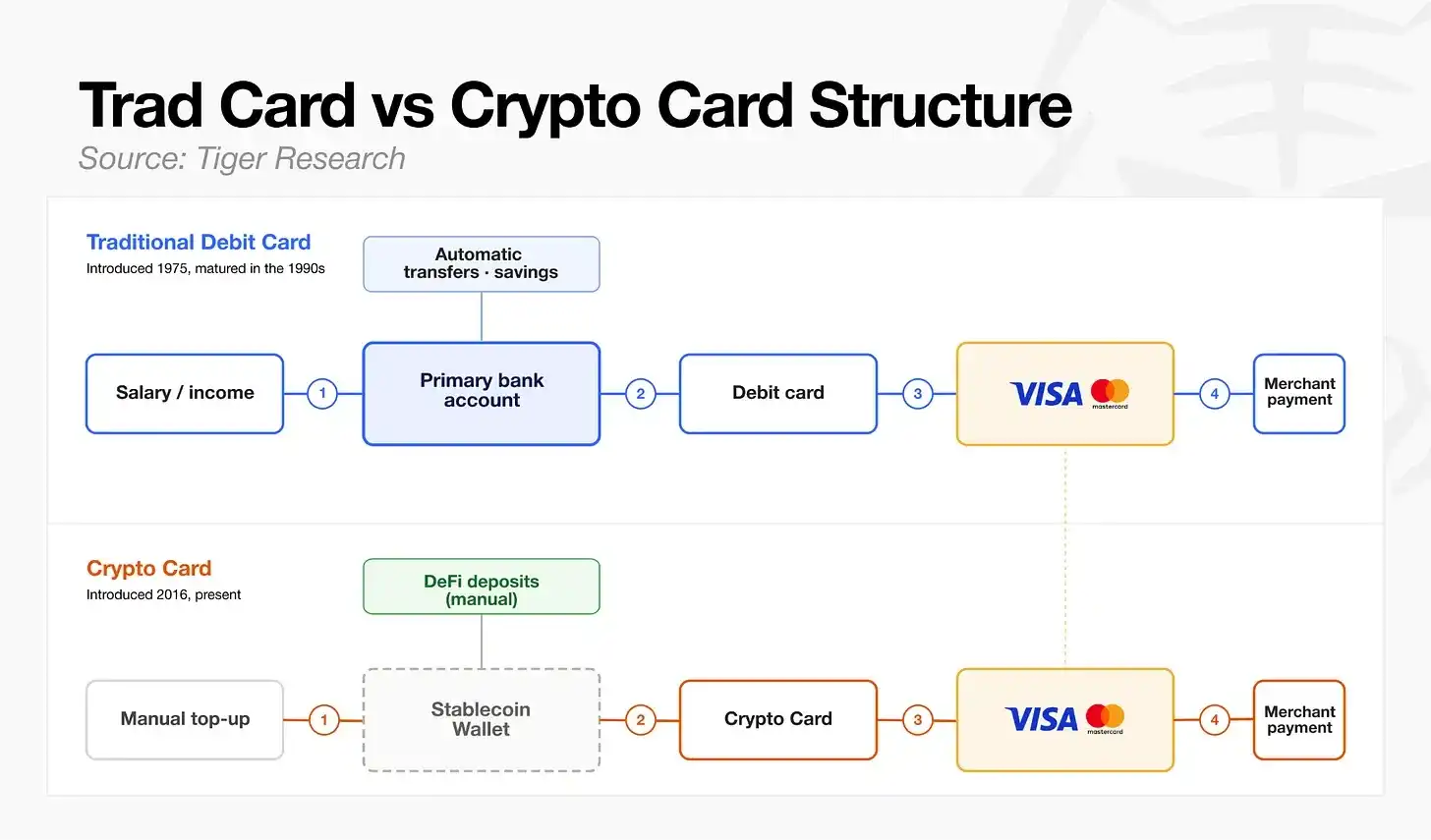
The biggest watershed between traditional payment and crypto payment lies in whether they foster users' routine financial account relationships. Debit cards were born in 1975, but only became a standard feature of individual core bank accounts after salary deposit services became widespread in the 1990s. In contrast, for today's crypto payment cards, the main funding source is basically users self-topping up stablecoins; the vast majority of crypto wallets cannot handle daily financial flows like salary deposits or scheduled bill payments. The industry's overall development stage is roughly equivalent to that of debit cards around the early 1990s.

The future leader in the crypto payment card race won't be determined by the number of cards issued, but by who first builds a core account that truly serves daily income and expenses, or finds a growth driver that fosters long-term user retention.

Monthly Transaction Volume of $1.5 Billion Does Not Equate to Industry Maturity

According to data from analytics firm Artemis, the monthly transaction volume of crypto payment cards grew from $100 million in early 2023 to $1.5 billion by the end of 2025, representing an annualized scale of approximately $18 billion. Affected by variations in on-chain data statistical methods, the actual annualized figure may fluctuate slightly, but the explosive growth in transaction volume is an indisputable fact.
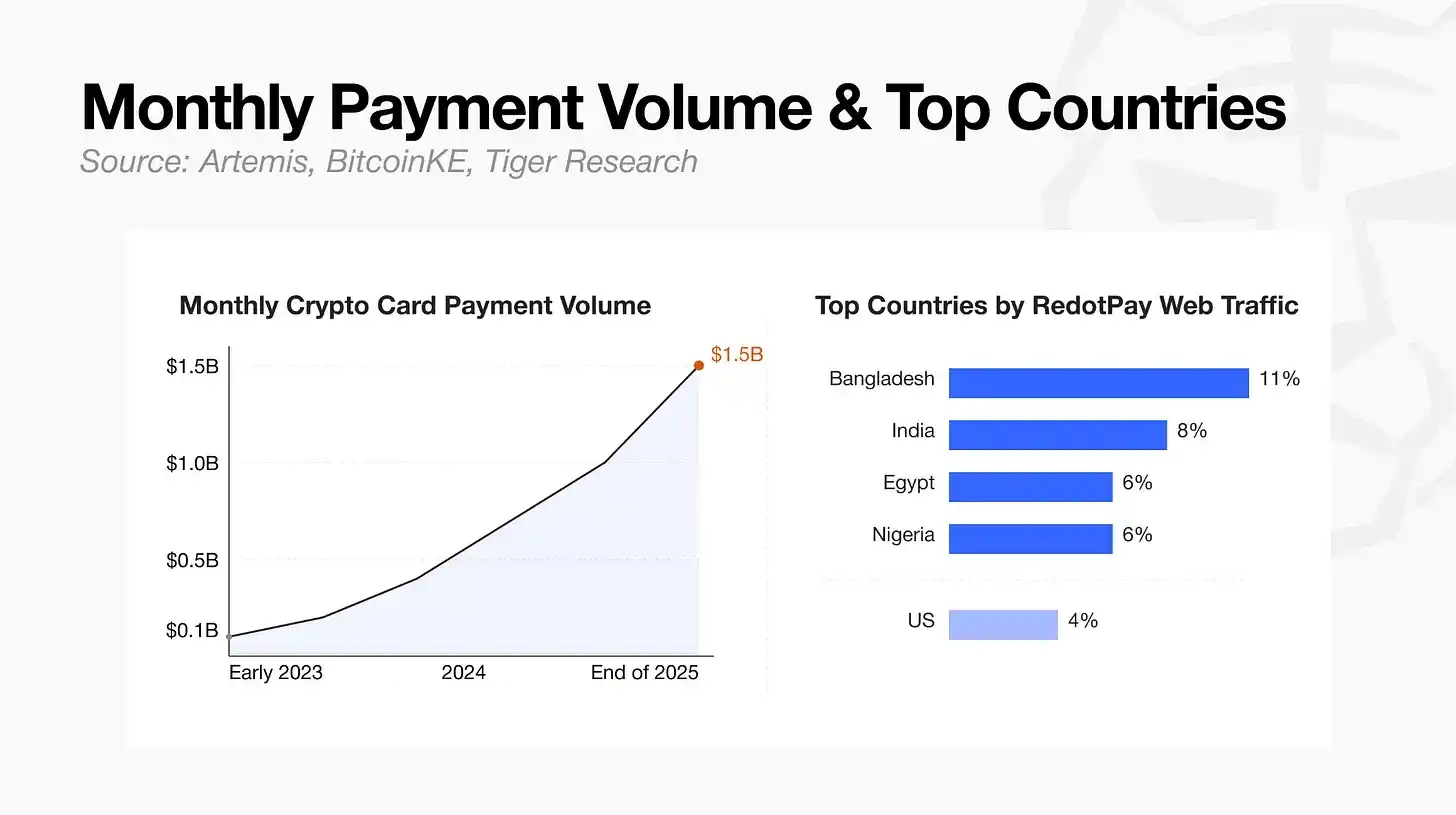
A closer analysis of these metrics reveals significant concentration among services and regions. Leading service provider RedotPay alone accounts for over half of the entire industry's transaction flow; platform users are highly concentrated in emerging markets: Bangladesh accounts for 11%, India 8%, Egypt 6%, Nigeria 6%, with the US representing only 4%.

This shows that the real demand for crypto payment cards does not come from developed mainstream markets, but from developing regions with insufficient financial services and restricted access to USD.
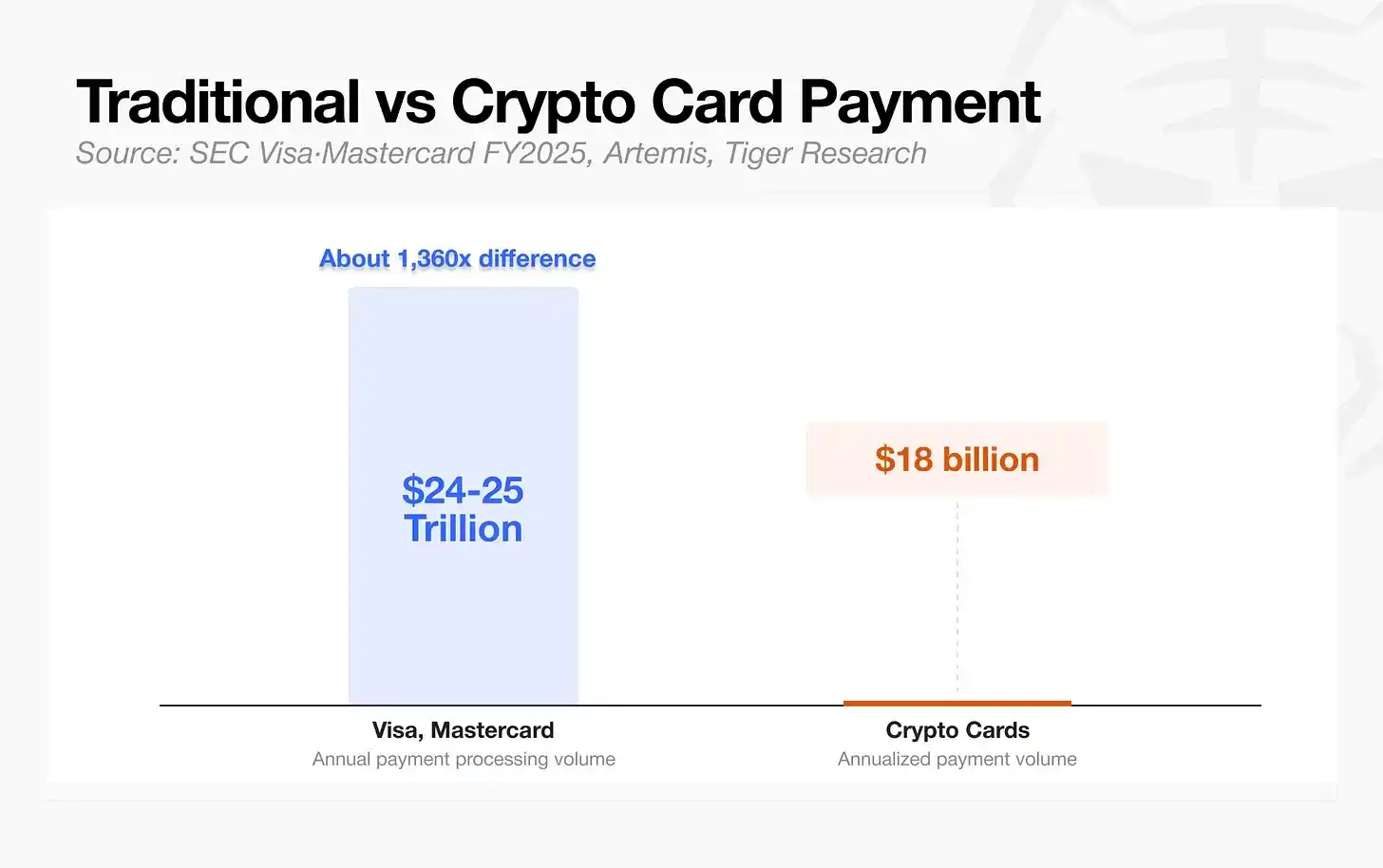
Compared to mature financial networks, the scale gap of cryptocurrency remains vast. Visa and Mastercard's annual total payment volume reaches $24-25 trillion, while crypto payment card annualized transactions are merely $18 billion. They are not on the same scale.
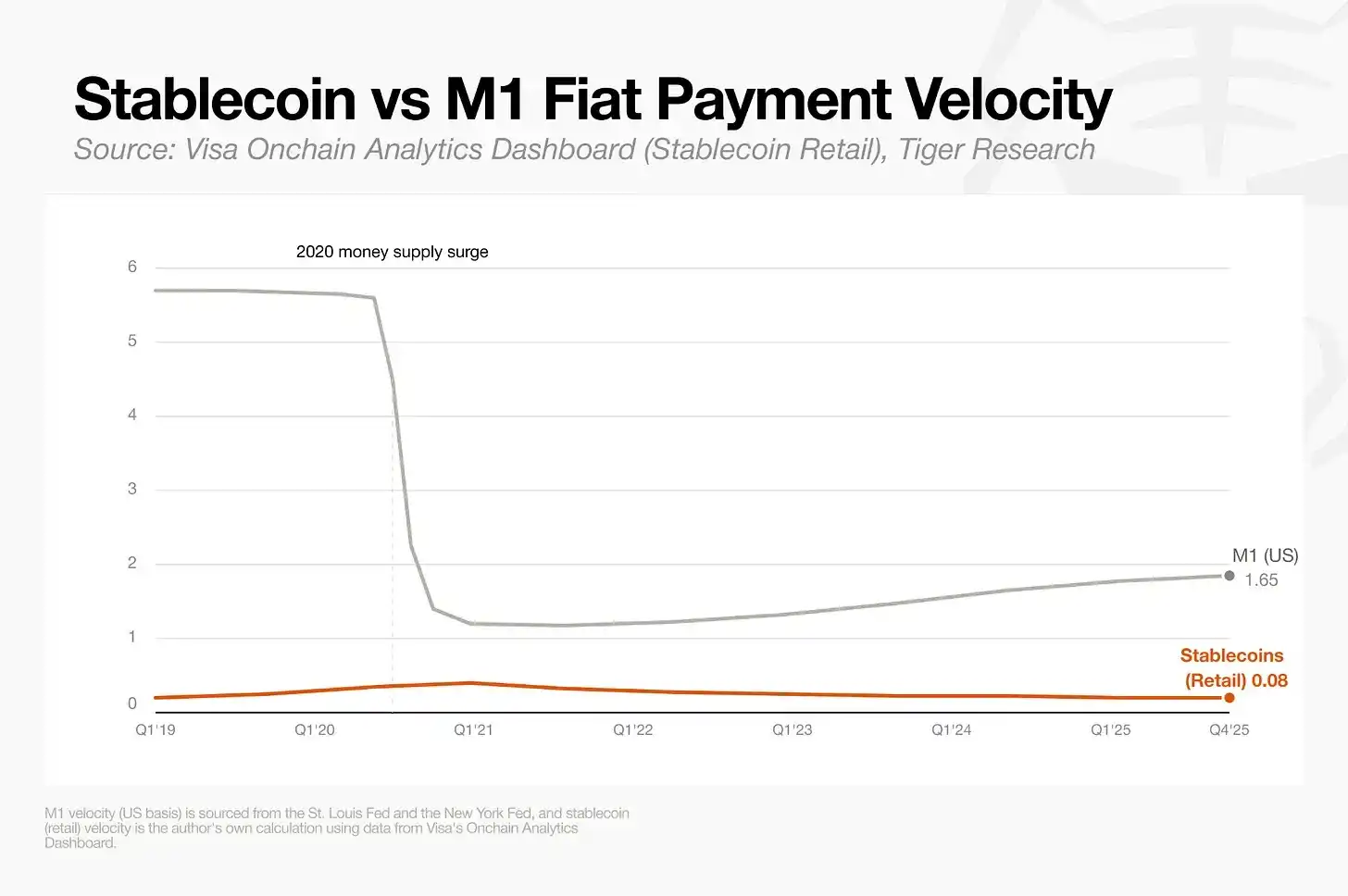
The velocity of circulation indicator, which measures the penetration of daily payments, is also relatively low. According to Visa statistics, the retail circulation velocity of on-chain stablecoins is only 0.08, merely one-twentieth of the velocity (1.65) of narrow fiat money M1. The pattern of stablecoin usage for most users is not the routine cycle of salary deposit, daily spending, and top-up recharge, but rather a one-time top-up followed by intermittent card spending.

Growth in transaction volume numbers does not equate to the market forming a mature, universally accepted clearing system. Currently, a large portion of crypto payment card transactions come from users in emerging markets who lack convenient access to USD-denominated bank accounts. For these users, crypto cards indeed possess practical financial value.

However, in developed markets, crypto payment cards have yet to find a stable product-market fit, nor have they established the deep account binding relationships brought about by features like salary deposits and automated bill payments.

Considering both funding channels and spending scenarios, current crypto payment cards are better suited for specific country-specific niche needs, acting as supplementary tools rather than universal financial infrastructure. Nonetheless, amidst the industry's rapid growth, leading players across four major business models are simultaneously refining various aspects of the industry chain.

Four Mainstream Business Models for Crypto Payment Cards
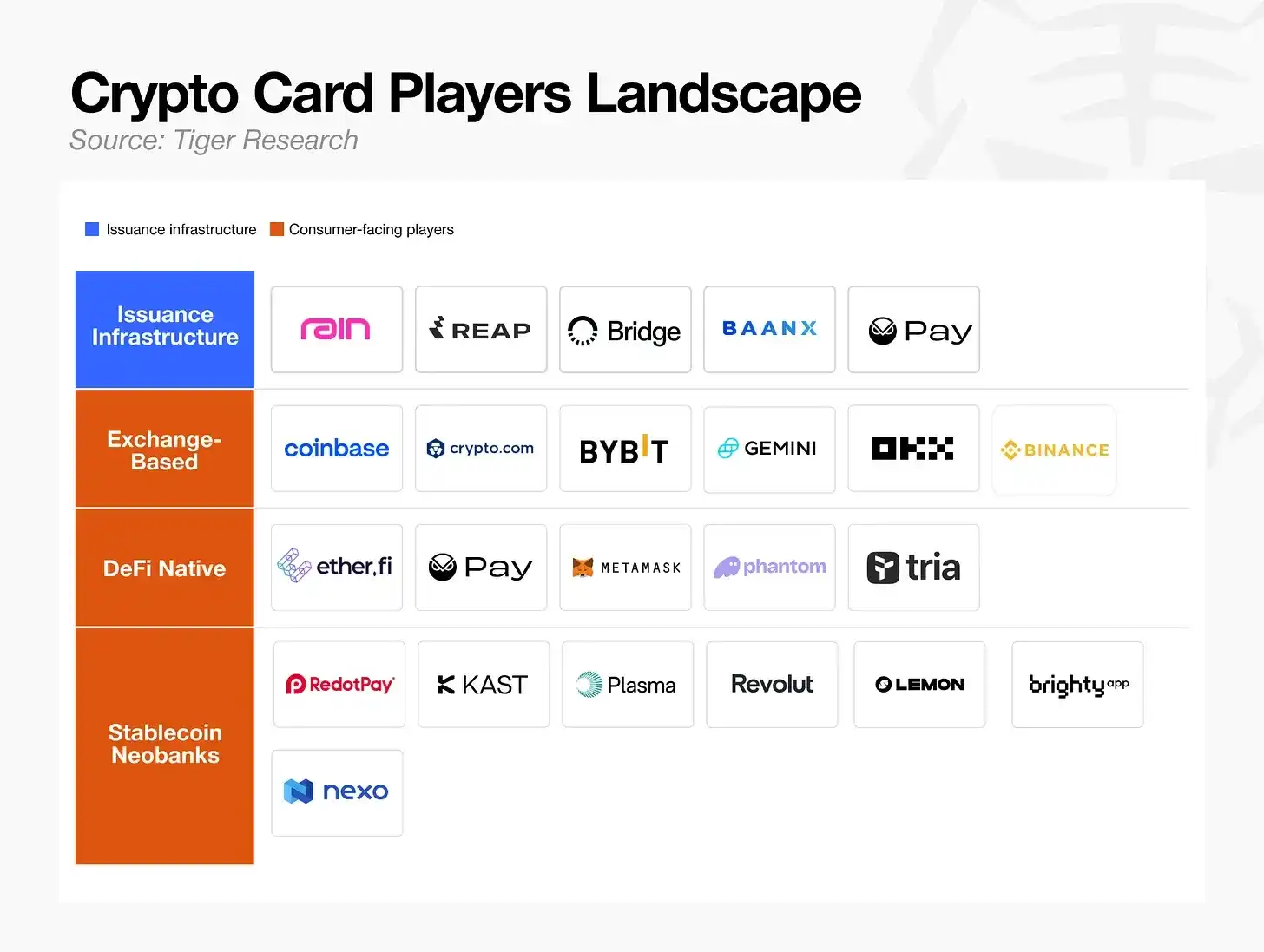
The crypto card industry can be broadly categorized into four business models, with various participants vying for first-mover advantage at different layers. These models vary widely, from companies focused on providing backend infrastructure to those merely adopting the card form factor but with entirely different underlying structures.

Card Issuing Infrastructure

The well-known payment networks Visa and Mastercard also apply to the crypto card ecosystem. Beneath them lies the card issuing infrastructure layer, which ultimately extends to the consumer card. As shown in the diagram above, there are two structures within the issuing infrastructure layer. The first is the traditional two-tier structure, where the program manager responsible for operations is separate from the issuing bank responsible for member management and settlement. The second is the full-stack issuer, such as Rain and Reap, which combines these two roles.
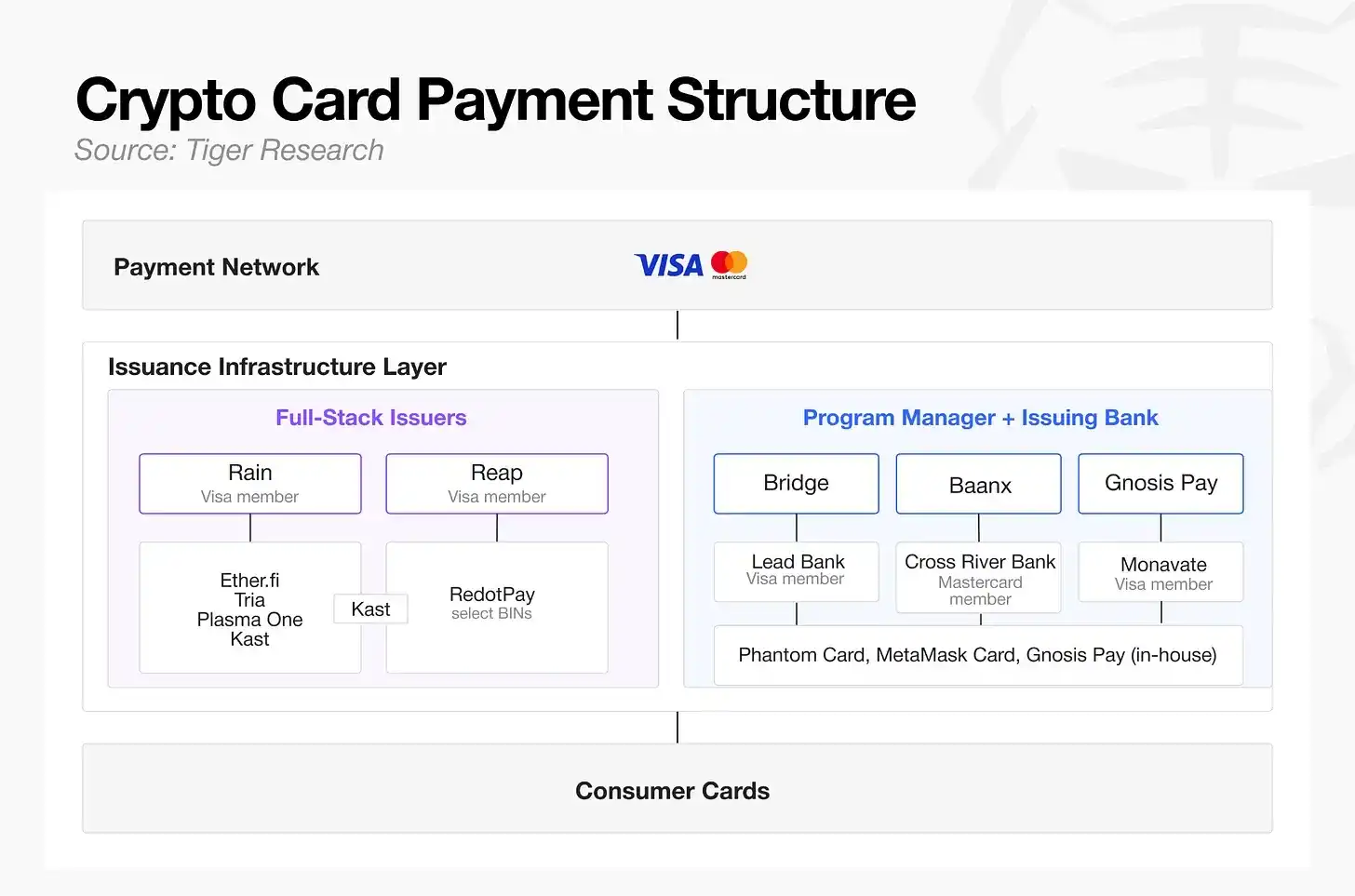
Multiple seemingly independent payment card brands actually reuse a handful of program service providers at their core. Phantom Card, MetaMask Card, and Gnosis Pay are typical examples.
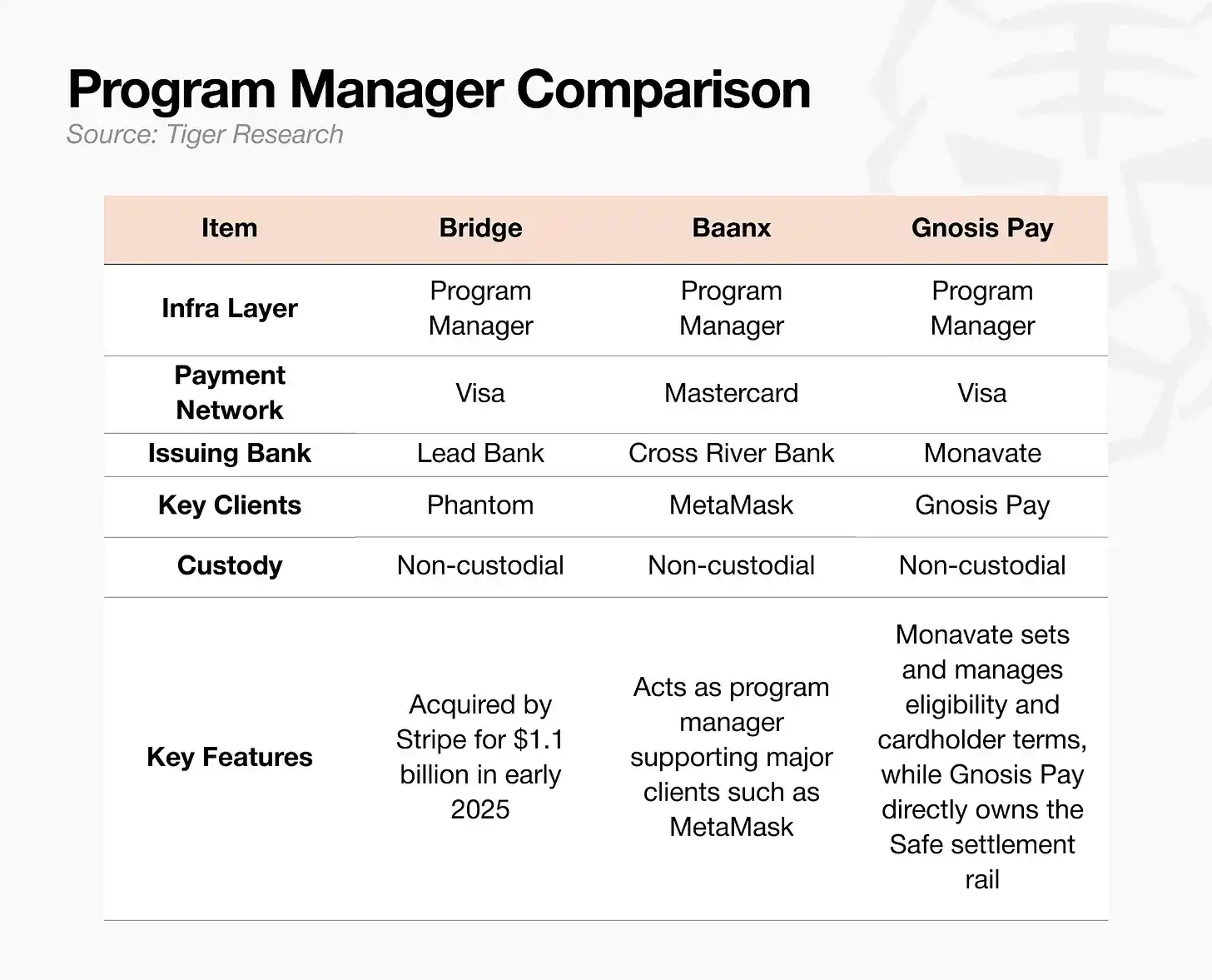
Seemingly independent payment card products like Kast, Ether.fi, Tria, and Plasma One similarly share a small number of underlying infrastructure service providers, with Rain handling the majority of consumer-grade card business.

The high concentration of issuing infrastructure has also attracted established traditional digital banks to enter the fray. In March 2026, Nium launched a stablecoin card issuing platform, supporting both Visa and Mastercard networks. Other traditional financial infrastructure vendors include Bridge (acquired by Stripe for $1.1 billion in early 2025) and BVNK (acquired by Mastercard for up to $1.8 billion in March 2026).

Competition in the issuing sector is intensifying, with full-stack issuers, veteran program managers, and new fintech players competing on the same stage. Pure card issuing business alone can no longer build high barriers.

Rain has differentiated itself by leveraging daily stablecoin settlements. Traditional card settlement cycles take several days; Rain achieves T+0 settlement for stablecoins through Visa, significantly improving capital turnover efficiency for partner platforms like Ether.fi. Recently, the platform launched an AI Agent control layer, enabling programs to automatically generate disposable virtual cards, moving functionality beyond basic issuing infrastructure.

Issuing service providers seeking to break through cannot merely offer basic payment rails; they must also rapidly implement differentiated value-added features that traditional infrastructure cannot provide.

Exchange-Attached Payment Cards

For exchanges, payment cards are not a core revenue source; their primary role is to retain existing users. By overlaying card functionality onto the platform's existing user base, assets, and transaction data, they aim to prevent user churn. The platform's real profits come from trading fees, lending services, and asset custody, not from card spending itself.
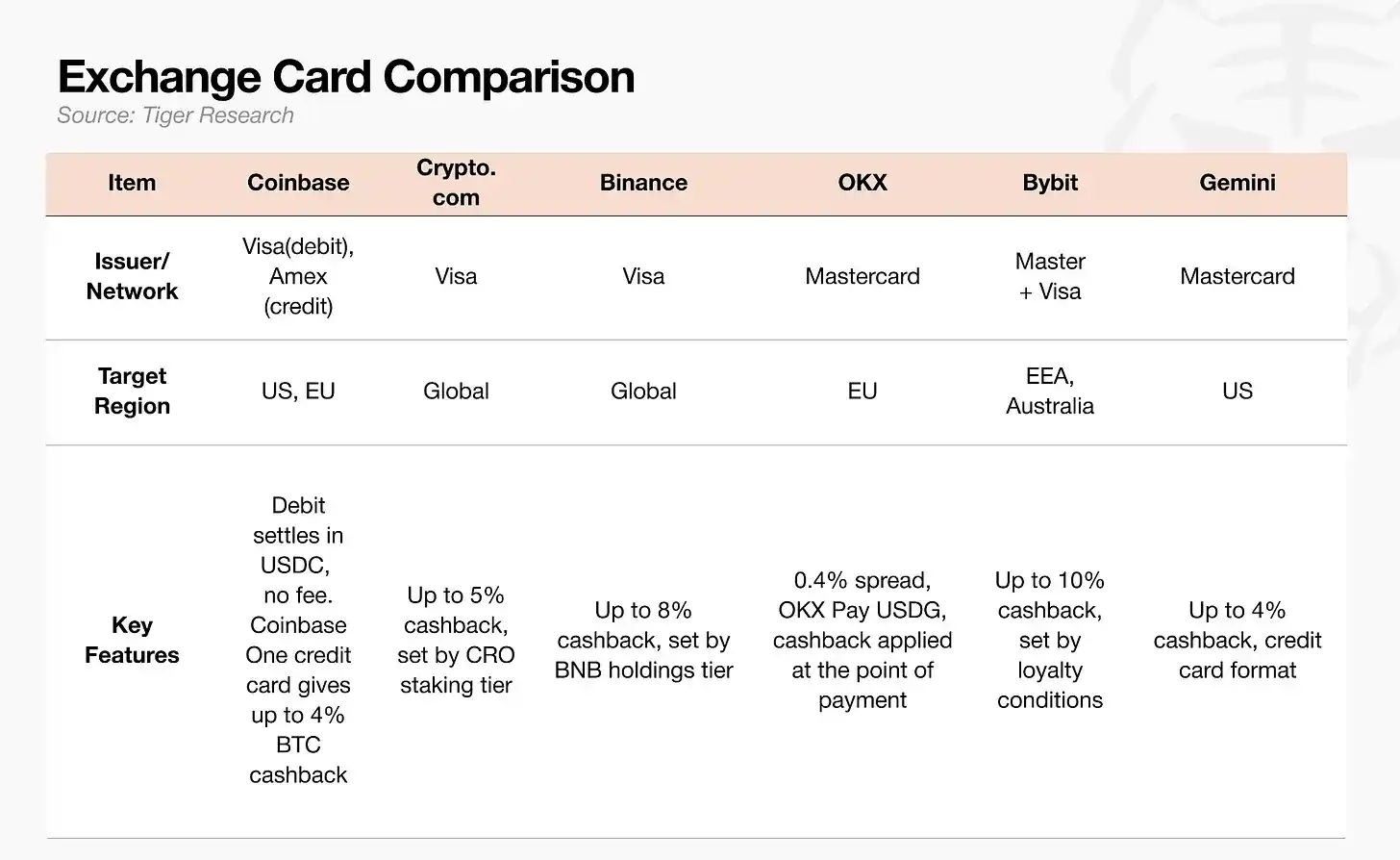
Exchanges view payment cards as a traffic entry point for building a financial super-app. However, the platform's native token cashback model carries risks: token price volatility directly leads to unstable actual cashback ratios.

Industry alternatives include stablecoin cashback and balance interest accrual, but the US "GENIUS Stablecoin Act" prohibits interest-bearing activities, creating a barrier to market expansion.

Decentralized Wallet DeFi Model

The core logic of this model is that the wallet itself is the user account, with assets self-custodied on-chain, eliminating the need to deposit them with a centralized exchange. Card spending is settled directly from on-chain assets. Simultaneously, it offers a line of credit, using the assets as collateral.

However, users need to set up vaults, manage collateral, and monitor liquidation risks themselves, resulting in high operational barriers. This consequently limits the scale of the user base for this model.
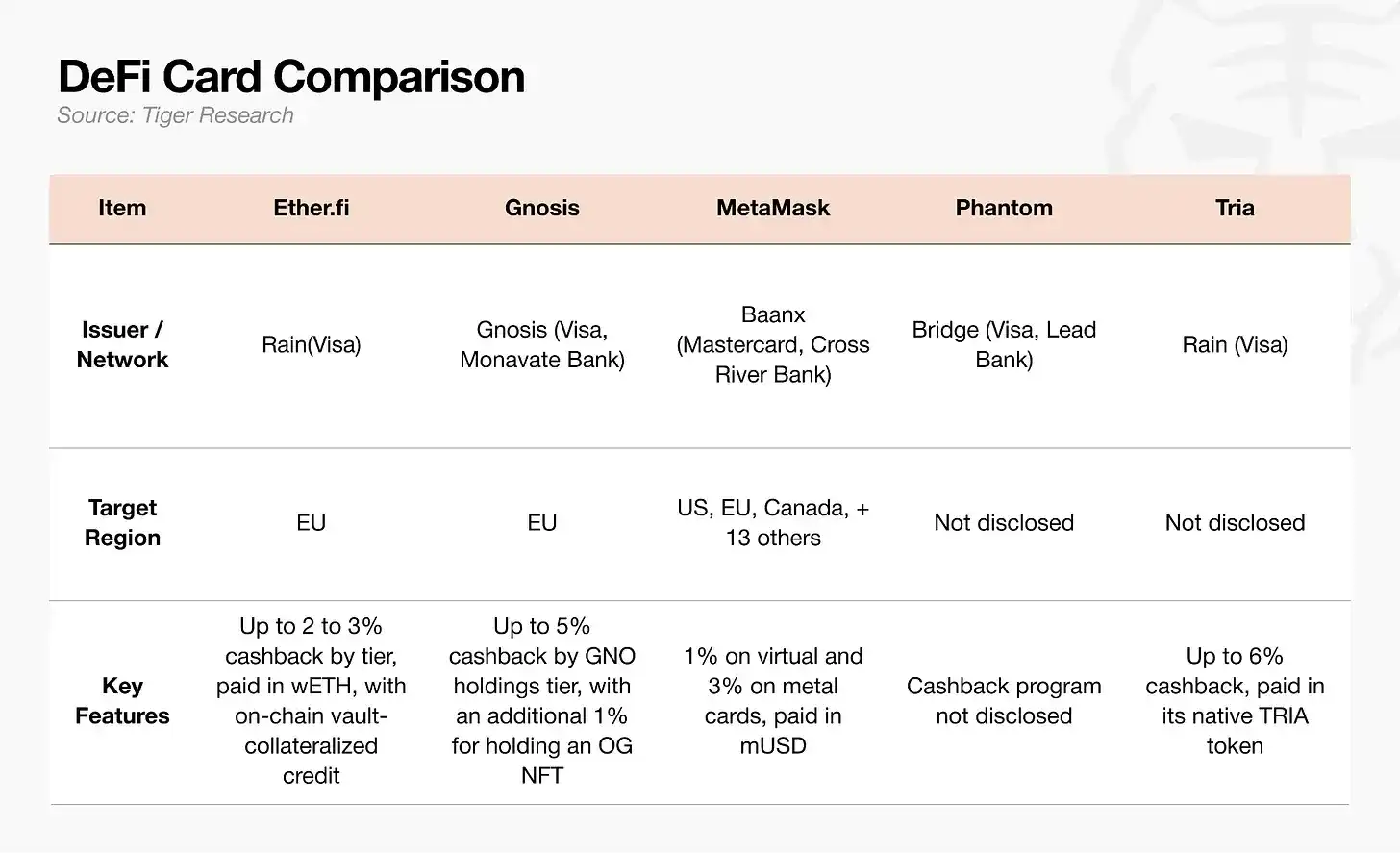
During payment, the system instantly converts on-chain assets to fiat for settlement, generating on-chain Gas fees for each transaction; when public chain throughput is insufficient or the network is congested, fees may exceed the spending amount, and transaction authorization delays are frequent.

For this reason, MetaMask Card opted for its self-developed Layer-2 network Linea, reducing per-transaction Gas fees to around $0.01, alleviating the pain points of high fees and delays for small payments. Tria employs a Gas-less top-up solution, with the platform covering fees generated during top-up, sparing users the operational cost of selecting blockchains and calculating fees.

However, until the user experience, balancing asset self-custody with spending convenience, is polished to the level of traditional debit cards, this model's users will remain confined to native crypto users.

Stablecoin Digital Bank

This is the segment with the highest share of current market transaction volume. Its focus is on account functionality rather than the card itself. Stablecoin balances integrate foreign exchange, cross-border remittance, and wealth management features, with the payment card merely serving as the top-level spending vehicle. In emerging markets with high local currency volatility, costly cross-border remittances, and difficult USD access, this model possesses strong competitiveness.
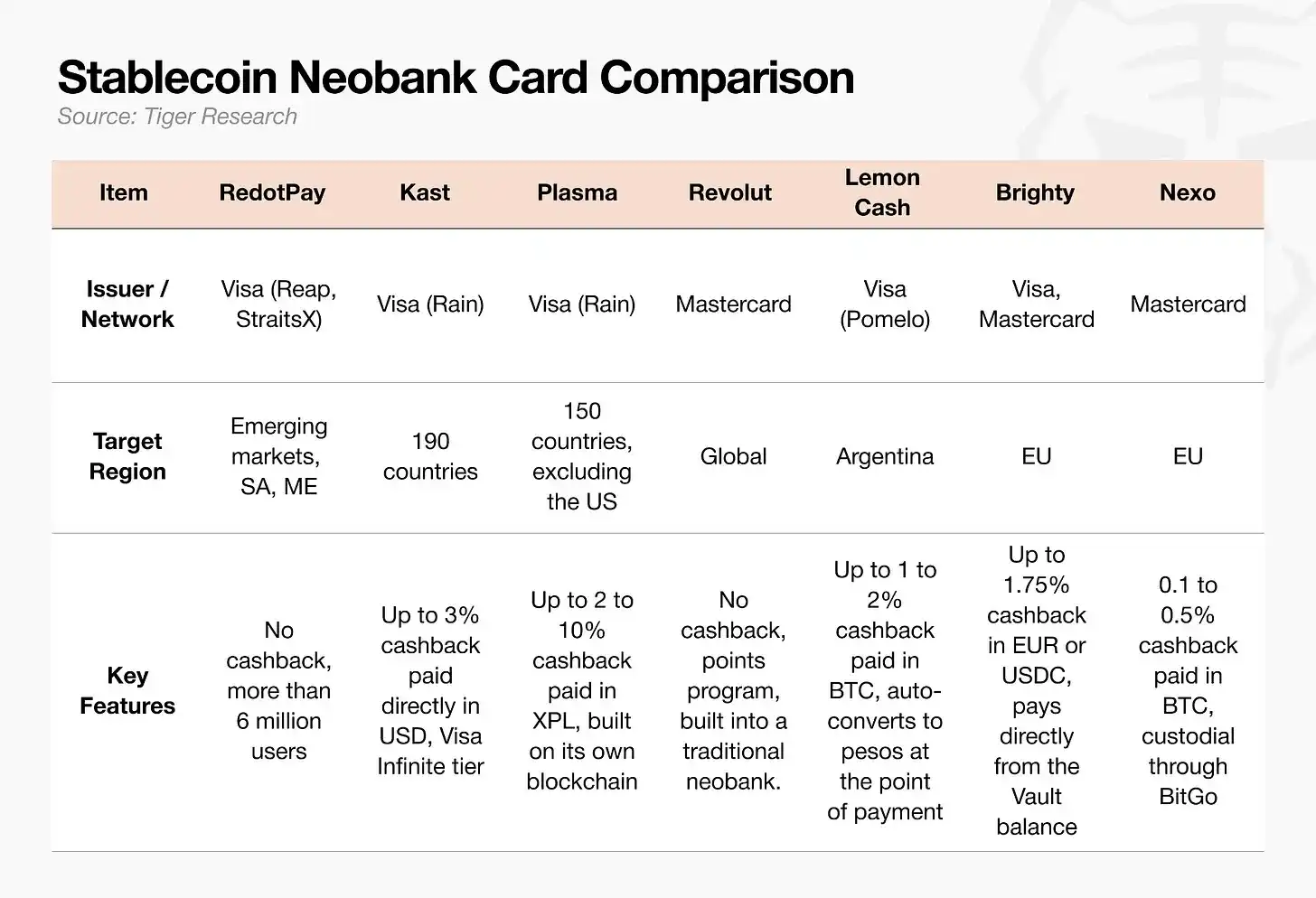
To sustain growth, this segment must move beyond the single form of a "prepaid card" model, where users autonomously purchase stablecoins and transfer them to their balance.

Cashback strategies across platforms have diverged based on market positioning. Industry leader RedotPay and established fintech player Revolut offer no cashback campaigns, while later entrants like Kast and Plasma One aggressively promote USD or platform token cashback to attract users.

However, relying solely on incentive subsidies cannot drive crypto payment cards to truly integrate into users' daily consumption habits.

Pure Payment Functionality Cannot Support Long-Term Development

The history of traditional bank cards and digital banks demonstrates that pure payment businesses have extremely low profitability ceilings. These enterprises only became profitable after incorporating concepts like the primary account and structural elements such as deposit-loan spreads into their business models. The crypto payment card industry has now reached the same critical development point. However, global regulatory frameworks like the US GENIUS Act and the EU's MiCA restrict the development of interest-bearing stablecoin and asset management services, making the path to breakthrough arduous.

Under these macro regulatory constraints, for industry players to survive long-term, they must grasp three core strategic imperatives:

  • Directly control the fund flow pathway.
  • Secure unique application scenarios in emerging markets.
  • Build proprietary user account systems that cannot be replaced by underlying infrastructure providers.

After industry standards solidify, companies unable to achieve the above will gradually fall behind.

Looking back at the history of debit cards, those who ultimately dominated the market were not the ones issuing the most cards, but those who first gained control of users' primary bank accounts. The crypto payment card industry now faces precisely the same proposition.

Crypto card operators need to directly control the fund flow upstream of the Visa payment process, seize first-mover advantage in niche markets, and, akin to the rise of bank accounts in traditional finance, take control of consumer infrastructure. This means establishing a global standard with no precedent to follow.

Without achieving the above, crypto payment cards will never become essential tools integrated into daily life, remaining merely prepaid cards used intermittently by niche groups for small cashback rewards.


Criptomoedas em alta

Perguntas relacionadas

QAccording to the article, what is the key difference between traditional payment cards and current crypto payment cards?

AThe key difference lies in whether they establish a user's normalized financial account relationship. Traditional debit cards became core banking tools after the popularization of payroll deposits in the 1990s. In contrast, most crypto payment cards today rely primarily on user self-topped-up stablecoins, lacking integration with payroll, recurring payments, and other daily financial flows, placing the industry at a development stage equivalent to debit cards around 1990.

QBased on the data from Artemis, what does the concentration of crypto payment card traffic reveal about its real-world demand?

AThe data reveals that the real demand for crypto payment cards is not from developed mainstream markets but primarily from developing regions with insufficient financial services and limited access to US dollars. Over half of the industry's transaction volume comes from a single provider, RedotPay. User traffic is highly concentrated in emerging markets like Bangladesh (11%), India (8%), Egypt (6%), and Nigeria (6%), with the US accounting for only 4%.

QWhat are the four mainstream business models for crypto payment cards outlined in the article?

AThe four mainstream business models are: 1) Issuing Infrastructure (e.g., Rain, Nium), 2) Exchange-based Payment Cards (e.g., products from major crypto exchanges), 3) Decentralized Wallet/DeFi Cards (e.g., MetaMask Card, Tria), and 4) Stablecoin Digital Banks (e.g., RedotPay, Revolut's crypto offerings).

QWhat major challenge does the article identify for DeFi-based crypto payment cards regarding user experience?

AThe major challenge is the high user experience barrier. For DeFi cards, each transaction requires on-chain gas fees for currency conversion, which can sometimes exceed the transaction amount itself during network congestion, leading to authorization delays. While solutions like using Layer-2 networks or absorbing gas fees exist, the overall interaction experience has not yet reached the seamless level of traditional debit cards, limiting adoption to native crypto users.

QWhat three core strategic imperatives does the article suggest for crypto payment card players to achieve long-term survival and growth?

AThe three core strategic imperatives are: 1) Directly control the capital flow within the payment chain. 2) Secure and defend unique application scenarios in emerging markets. 3) Build a proprietary user account system that cannot be easily replaced by underlying infrastructure providers.

Leituras Relacionadas

Crypto Welcomes the 'July Rebound'? On-Chain Bottom Signals Align, Reversal Still Requires Breakthrough Above $70k

The cryptocurrency market is showing signs of a potential "July rebound," with Bitcoin leading a recovery above $63,000 and total market cap rising. This bounce is attributed to improved macro expectations (weaker US jobs data easing Fed hike fears), a short squeeze in derivatives, and signs of whale accumulation. Key on-chain metrics signal a potential bottom, including the Sharpe Ratio hitting extreme lows, the AHR999 index nearing historic buy zones, and miner pressure reaching significant levels. However, analysts caution this is likely a corrective rebound rather than a confirmed trend reversal. Persistent challenges include weak spot demand, negative Coinbase Premium indicating institutional caution, and ongoing selling pressure in the altcoin market. Market sentiment remains in "extreme fear" territory, and the AVIV ratio suggests the average active Bitcoin investor is still at a loss. For a true bullish reversal, Bitcoin needs to convincingly break above the key $70,000 level (aligned with the Short-Term Holder Realized Price). The path to a new parabolic bull market is seen as dependent on attracting substantially more capital, as capital efficiency has declined. While prices may be approaching a cyclical bottom zone (with estimates between $37k-$60k), the market requires more sustained positive signals for a definitive uptrend.

marsbitHá 12m

Crypto Welcomes the 'July Rebound'? On-Chain Bottom Signals Align, Reversal Still Requires Breakthrough Above $70k

marsbitHá 12m

1600 Lines of Code Create an Underwater Manhattan, Fable 5 Leaves Karpathy Stunned

Title: Fable 5 Stuns Karpathy with 3D Worlds Built from 1600 Lines of Code An AI model, Fable 5, has demonstrated a remarkable leap in generating complex, interactive 3D worlds with minimal code. Showcased by Peter Gostev of Arena.ai, the model created 63 diverse 3D environments across themes like immersive cityscapes, explorable famous paintings, natural wonders, and cosmic phenomena. Many were generated in a single attempt. A standout creation is a detailed, submerged Manhattan built with only 1600 lines of Three.js code. Other highlights include traversable versions of Van Gogh's "Starry Night," a bear catching a salmon with realistic physics, and a split Red Sea. The model's ability to cohesively manage vast numbers of elements within a scene represents a significant technical advancement. Andrej Karpathy, who recently joined Anthropic's pre-training team, expressed amazement, particularly at how the model intuitively understood and rendered complex real-world interactions like a fish struggling when caught. He coined the term "fablemaxxing" to describe this qualitative leap. While Fable 5 excels at world-building, Gostev notes current limitations in creating engaging, long-form gameplay. The model also sometimes requires prompting to fully utilize its capabilities. Having topped the Agent Arena benchmark for real-world task completion, Fable 5 signals that the boundaries of AI-generated content are rapidly expanding, with its full potential yet to be discovered.

marsbitHá 28m

1600 Lines of Code Create an Underwater Manhattan, Fable 5 Leaves Karpathy Stunned

marsbitHá 28m

From ANSEM to CZ, The Celebrity Coin Relay Race Between Solana and BSC

The past week was a whirlwind of on-chain activity, sparked by the meteoric rise of $ANSEM, a Solana-based meme coin that surged 600x and hit a $100 million market cap in a single day. This rally began when crypto influencer Ansem announced his return to buying Solana meme coins and publicly advocated for an airdrop from the platform pump.fun. Ansem’s subsequent "soft claim" of the token—promising to airdrop creator revenue to followers—ignited a frenzy, drawing comparisons to past community-led token distributions. However, his dual role as a co-founder of the trading terminal Bullpen, which later hosted the $ANSEM airdrop, suggests a strategic promotional element. The narrative quickly shifted to "celebrity coins," where tokens named after influencers are sent to their public addresses in hopes of endorsement. While a similar coin, $TJR, briefly gained traction, it faltered after the influencer TJR urged focus back on $ANSEM. Attention then turned to projects Ansem endorsed and coins found in his wallet, like $manlet, but momentum on Solana began to stall. The action then migrated to BSC with the viral resurgence of a 2021 tweet from former Binance CEO CZ, referencing a "final form" bull. This sparked the explosive launch of $CZ, which briefly approached a $90 million market cap despite expectations that CZ wouldn't actively engage like Ansem. Another BSC token, $TCC, gained attention due to CZ's interactions with its promoter. The BSC ecosystem saw faster-paced, albeit volatile, "celebrity coin" plays, with tokens like $dingaling experiencing rapid pumps and dumps without official endorsements. Currently, BSC shows more momentum for new token launches than Solana, with the market awaiting a new narrative to succeed the fleeting "celebrity coin" trend.

marsbitHá 38m

From ANSEM to CZ, The Celebrity Coin Relay Race Between Solana and BSC

marsbitHá 38m

Trading

Spot

Artigos em Destaque

O que é $BANK

Bank AI: Um Passo Revolucionário no Futuro da Banca Introdução Em uma era marcada por avanços rápidos na tecnologia, o Bank AI está na interseção da inteligência artificial (IA) e dos serviços bancários. Este projeto inovador visa redefinir o panorama financeiro, melhorando a eficiência operacional, as medidas de segurança e as experiências dos clientes através do poder da IA. Ao embarcarmos nesta exploração do Bank AI, iremos aprofundar no que o projeto implica, suas dinâmicas operacionais, seu contexto histórico e marcos significativos. O que é o Bank AI? No seu cerne, o Bank AI representa uma iniciativa transformadora com o objetivo de integrar a inteligência artificial em várias operações bancárias. Este projeto aproveita as capacidades da IA para automatizar processos, melhorar os protocolos de gestão de risco e melhorar a interação com os clientes através de serviços personalizados. Os principais objetivos do Bank AI incluem: Automatização das Funções Bancárias: Ao aproveitar as tecnologias de IA, o Bank AI visa automatizar tarefas rotineiras, reduzindo o peso sobre os recursos humanos e aumentando a eficiência. Gestão de Risco Melhorada: O projeto utiliza algoritmos de IA para prever e identificar riscos, fortalecendo assim as medidas de segurança contra fraudes e outras ameaças. Personalização dos Serviços Bancários: O Bank AI foca em oferecer produtos e serviços financeiros ajustados, analisando dados e comportamentos dos clientes. Melhoria da Experiência do Cliente: A implementação de soluções impulsionadas por IA, como chatbots e assistentes virtuais, visa proporcionar aos usuários interações mais humanizadas, revolucionando a forma como os clientes se envolvem com os bancos. Com esses objetivos, o Bank AI posiciona-se como um ator crucial para tornar a banca mais eficiente, segura e centrada no usuário. Quem é o Criador do Bank AI? Os detalhes sobre o criador do Bank AI permanecem desconhecidos. Assim, nenhuma pessoa ou organização específica foi identificada nas informações disponíveis. O anonimato que cerca a origem do projeto levanta questões, mas não diminui a sua ambiciosa visão e objetivos. Quem são os Investidores do Bank AI? Semelhante ao criador do projeto, informações específicas sobre os investidores ou organizações que apoiam o Bank AI não foram divulgadas. Sem essas informações, é difícil delinear o apoio financeiro e institucional que pode estar impulsionando o projeto para frente. No entanto, a importância de ter uma sólida base de investimento é fundamental para sustentar o desenvolvimento em um campo tão inovador. Como Funciona o Bank AI? O Bank AI opera em várias frentes inovadoras, focando em fatores únicos que o diferenciam das estruturas bancárias tradicionais. Abaixo estão as principais características operacionais: Automatização: Ao aplicar algoritmos de aprendizado de máquina, o Bank AI automatiza vários processos manuais dentro dos bancos. Isso resulta na redução dos custos operacionais e permite que os trabalhadores humanos redirecionem os seus esforços para atividades mais estratégicas. Gestão de Risco Avançada: A integração da IA nas práticas de gestão de risco equipa os bancos com ferramentas para prever com precisão potenciais ameaças, como fraudes, garantindo que as informações e ativos dos clientes permaneçam seguros. Recomendações Financeiras Personalizadas: Através do aprendizado contínuo a partir das interações com os clientes, os sistemas de IA desenvolvem uma compreensão sutil das necessidades dos usuários, permitindo oferecer conselhos adaptados sobre decisões financeiras. Interações Melhoradas com os Clientes: Utilizando chatbots e assistentes virtuais alimentados por IA, o Bank AI permite uma experiência de cliente mais envolvente, permitindo que os usuários tenham suas dúvidas resolvidas rapidamente, reduzindo assim os tempos de espera e melhorando os níveis de satisfação. Juntas, estas características operacionais posicionam o Bank AI como um pioneiro no setor bancário, estabelecendo novos padrões para a prestação de serviços e a excelência operacional. Cronologia do Bank AI Compreender a trajetória do Bank AI requer uma análise do seu contexto histórico. Abaixo está uma cronologia que destaca marcos e desenvolvimentos importantes: Início de 2010: A conceituação da integração da IA nos serviços bancários começou a ganhar atenção à medida que instituições bancárias reconheciam os potenciais benefícios. 2018: Ocorreu um aumento significativo na implementação de tecnologias de IA, quando os bancos começaram a usar ferramentas de IA como chatbots para atendimento ao cliente básico e sistemas de gestão de risco para melhorar o tratamento de segurança. 2023: A sofisticação da IA continuou a avançar, com a introdução de IA generativa para tarefas mais complexas, como processamento de documentos e análise de investimentos em tempo real. Este ano marcou um salto significativo nas capacidades proporcionadas aos bancos pela tecnologia de IA. 2024-Estado Atual: Neste ano, o Bank AI está em uma trajetória ascendente, com pesquisas e desenvolvimentos em andamento prontos para aprimorar ainda mais as capacidades nas operações bancárias. A exploração contínua das aplicações de IA sugere desenvolvimentos emocionantes por vir. Pontos Chave Sobre o Bank AI Integração da IA na Banca: O Bank AI foca na adoção da inteligência artificial para simplificar os processos bancários e melhorar as experiências dos usuários. Automatização e Foco em Gestão de Risco: O projeto enfatiza fortemente essas áreas, visando transferir o peso das tarefas rotineiras enquanto melhora as estruturas de segurança através de análises preditivas. Soluções Bancárias Personalizadas: Ao aproveitar os dados dos clientes, o Bank AI possibilita serviços bancários ajustados que atendem às necessidades individuais dos usuários. Compromisso com o Desenvolvimento: O Bank AI permanece comprometido com contínuas pesquisas e esforços de desenvolvimento, garantindo a sua adaptabilidade e relevância contínua à medida que a tecnologia continua a evoluir. Conclusão Em resumo, o Bank AI exemplifica um passo crucial em frente na indústria bancária, aproveitando a inteligência artificial para remodelar paradigmas operacionais, melhorar a segurança e promover a satisfação do cliente. Apesar das lacunas de informação em torno do criador e dos investidores, os objetivos claros e os mecanismos funcionais do Bank AI fornecem uma base sólida para sua evolução contínua. À medida que a tecnologia de IA continua a avançar e se fundir com o setor bancário, o Bank AI está bem posicionado para impactar significativamente o futuro dos serviços financeiros, aprimorando a maneira como entendemos e interagimos com a banca.

65 Visualizações TotaisPublicado em {updateTime}Atualizado em 2024.12.03

O que é $BANK

Como comprar BANK

Bem-vindo à HTX.com!Tornámos a compra de Lorenzo Protocol (BANK) simples e conveniente.Segue o nosso guia passo a passo para iniciar a tua jornada no mundo das criptos.Passo 1: cria a tua conta HTXUtiliza o teu e-mail ou número de telefone para te inscreveres numa conta gratuita na HTX.Desfruta de um processo de inscrição sem complicações e desbloqueia todas as funcionalidades.Obter a minha contaPasso 2: vai para Comprar Cripto e escolhe o teu método de pagamentoCartão de crédito/débito: usa o teu visa ou mastercard para comprar Lorenzo Protocol (BANK) instantaneamente.Saldo: usa os fundos da tua conta HTX para transacionar sem problemas.Terceiros: adicionamos métodos de pagamento populares, como Google Pay e Apple Pay, para aumentar a conveniência.P2P: transaciona diretamente com outros utilizadores na HTX.Mercado de balcão (OTC): oferecemos serviços personalizados e taxas de câmbio competitivas para os traders.Passo 3: armazena teu Lorenzo Protocol (BANK)Depois de comprar o teu Lorenzo Protocol (BANK), armazena-o na tua conta HTX.Alternativamente, podes enviá-lo para outro lugar através de transferência blockchain ou usá-lo para transacionar outras criptomoedas.Passo 4: transaciona Lorenzo Protocol (BANK)Transaciona facilmente Lorenzo Protocol (BANK) no mercado à vista da HTX.Acede simplesmente à tua conta, seleciona o teu par de trading, executa as tuas transações e monitoriza em tempo real.Oferecemos uma experiência de fácil utilização tanto para principiantes como para traders experientes.

411 Visualizações TotaisPublicado em {updateTime}Atualizado em 2026.06.02

Como comprar BANK

Discussões

Bem-vindo à Comunidade HTX. Aqui, pode manter-se informado sobre os mais recentes desenvolvimentos da plataforma e obter acesso a análises profissionais de mercado. As opiniões dos utilizadores sobre o preço de BANK (BANK) são apresentadas abaixo.

活动图片