Anyone Can Easily Create Prediction Markets, But Can Limitless' User-Generated Markets Last?

Foresight NewsPublicado em 2026-07-02Última atualização em 2026-07-02

Resumo

The article discusses the historical challenges of user-generated prediction markets in crypto, where previous attempts like Augur, Omen, Zeitgeist, and Manifold Markets failed due to fragmented liquidity, poor discoverability, and unreliable, slow settlement processes. These issues often led to platforms filled with inactive markets and low user engagement, prompting some, like Polymarket, to shift to a curated model. Limitless recently launched its User-Generated Market (UGM) feature, allowing anyone to create crypto price prediction markets. It addresses past failures through several key design choices: markets are limited to objective, oracle-based price questions (e.g., "Will Asset X be above $Y at time Z?") for instant, automatic settlement via Pyth and Chainlink, eliminating voting disputes. To combat spam and fragmentation, market creation requires burning 100-1000 LMTS tokens (a non-refundable cost), while creators earn 50% of the trading fees generated by their market, aligning incentives. The platform also benefits from an existing active user base and uses an order book model, removing the need for creators to provide initial liquidity. By tackling settlement reliability, liquidity fragmentation, and creator incentives, Limitless presents a new model for sustainable, permissionless prediction markets.


Author: Stacy Muur

Compiled by: AIdidiaoJP, Foresight News


In the crypto space, allowing users to freely create prediction markets has long been an unresolved, major challenge. Over the years, almost all attempts have ended in failure.


@trylimitless (Limitless) has taken a unique path to address this challenge. Recently, they launched the UGM (User-Generated Market) feature, allowing any user to create their own crypto price prediction markets. This is a bold attempt to tackle a long-standing pain point in the prediction market space.


Let's explore previous attempts, the reasons for their failures, and how Limitless is making this model work.


A History of Permissionless Prediction Markets


The earliest permissionless prediction market was @AugurProject. Launched on Ethereum in 2018, its core concept was "anyone can create a market on any topic, priced by the crowd for truth."
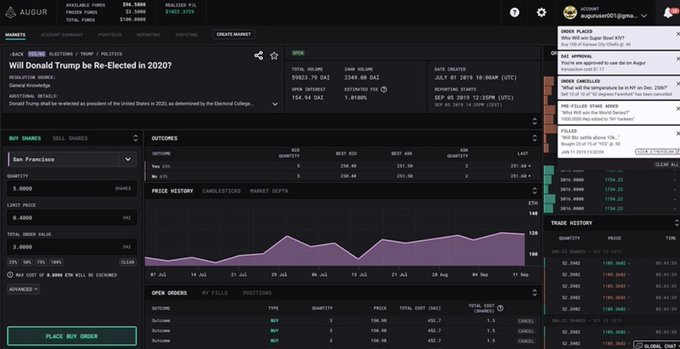


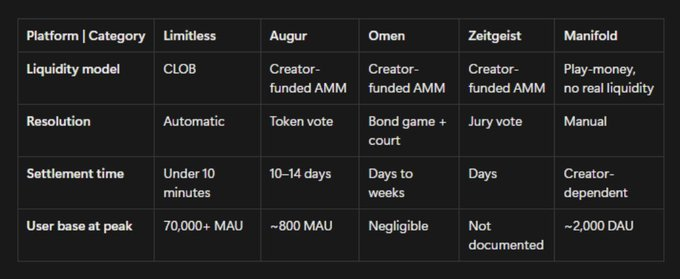
Perfect in theory, but desolate in practice. The project's token reached a peak market cap of over $170 million, yet its daily active users were only about 47, with fewer than 115 users per week.


The reasons for failure were brutal and mutually reinforcing:


  • Liquidity was scattered across thousands of empty markets (because anyone could create a market).
  • Market settlement took 10 to 14 days.
  • User funds were locked until settlement.
  • Users had to run their own Ethereum node before placing bets.


Augur was not an isolated case. @OmenEth on the Gnosis chain adopted a similar model and gradually faded. @ZeitgeistPM on Polkadot even added creator fees but still struggled to generate substantial trading volume. @ManifoldMarkets once built a real community using virtual currency, with daily active users peaking at several thousand, but later declined to below 900 after the hype subsided.


Different teams, different chains, yet all ending the same way.


A Recurring Pattern


This recurring pattern is hard to attribute to mere execution issues. Making creation free and easy doesn't create demand; it just floods the platform with more supply, all competing for the same small pool of attention.


This leads to fragmentation of prediction markets on two levels:


Thin Liquidity


Most markets created by users quickly become ghost towns. On early AMM (Automated Market Maker) platforms, creating a market also required providing initial liquidity with one's own capital, increasing the cost.


Poor Discoverability


When anyone can create a market, you quickly get a dozen slightly different versions of "Will the Fed cut rates in July?" markets, further fragmenting liquidity.


Imagine a user opening the app and seeing a list of half-dead markets, each with almost no liquidity. Who would want to stay?


It was this very problem that forced the industry's biggest player to pivot. In 2022, Polymarket shifted to a curated model, concentrating liquidity into a few deep markets, which proved effective. But it also abandoned its initial promise of open creation—the "harder version" of allowing anyone to easily launch a market remained unsolved.


The Settlement Challenge


Liquidity and discoverability are tricky enough, but if settlement isn't hardcoded, user trust collapses.


After a market ends, the platform needs to decide how to settle it. Objective events like "Will Bitcoin close above $100,000?" are easy to handle. But those requiring subjective interpretation, like whether a politician's statement constitutes endorsement of a specific policy, easily spark controversy.


Most platforms rely on token holder voting to resolve disputes. The intention is decentralized settlement, but in practice, voting power is often concentrated among the largest holders. And since they can also place bets like regular users, they have the potential to manipulate outcomes.


This erodes trust in the fairness of settlement, creating another path back to the liquidity problem.


How Limitless Responds


Any new attempt must overcome the three hurdles of thin liquidity, poor discoverability, and unreliable settlement. @trylimitless has made different choices in these areas.


Focusing on the newly launched UGM feature: any user can create a market in just a few steps:


  • Select an asset.
  • Set a price target (percentage change or specific dollar value).
  • Set a duration (from 15 minutes to 1 day).
  • Launch (requires holding LMTS tokens).


The longer the market duration, the higher the creation cost.


Anyone can trade these markets. Upon expiry, an oracle automatically pulls the asset price and settles the result instantly. These markets rely on real-time price feeds from @PythNetwork and @Chainlink, requiring no voting, no dispute panels, no committees.


Markets are limited to objective types, e.g., "Will SOL be above price X at a given time?". The smart contract can automatically settle the moment the market closes. It's not possible to create markets requiring human interpretation (like election results or disputed news events). Limitless deliberately restricts the scope to price markets because this is the only type that can be reliably settled within seconds every time, whereas other platforms often take hours or even days.


The cold-start problem tripped up most previous platforms. Limitless already has advantages here:


  • Cumulative trading volume exceeding $3 billion.
  • Trading volume in May and June exceeding $1.2 billion.
  • Peak monthly active traders over 70,000.


There is already a fairly active trader base, completely different from Augur in 2018.


Another crucial difference: Limitless uses an order book model rather than the early AMM model. On platforms like Augur, creating a market required funding initial liquidity yourself. Limitless eliminates this step entirely; traders place their own buy and sell orders, and markets only need to attract them.


The most ingenious part is the creator economic mechanism. Creating a market costs 100 to 1000 LMTS tokens, which are non-refundable. In return, the creator receives 50% of all trading fees generated by that market.


On one side is a real cost, on the other a real reward. The cost effectively prevents market spam, as each market requires a real financial commitment. The reward means truly active markets can generate tangible fee income for creators.


The cost mechanism also adds utility to the LMTS token. Creating each market burns LMTS tokens from the open market, directly linking token utility to UGM activity. The more people create markets, the greater the demand for LMTS.


Summary and Outlook


The existing evidence clearly points in one direction: all previous attempts at permissionless prediction markets either got bogged down in settlement disputes, drowned in dead liquidity, or simply abandoned the open model for curation.


Limitless is the first solution designed to address all three failure modes simultaneously.


Settlement (the trickiest problem) is completely avoided by sticking to oracle-based price markets.


The cold-start problem is mitigated by an existing active user base.


The cost-and-reward structure for market creation balances incentives for both sides.


Most importantly, with these markets settling faster, we will quickly see if the design works at scale.


If it does, permissionless prediction markets finally have their first viable blueprint.


Disclosure: The author holds some $LMTS tokens and is a Limitless user.

Perguntas relacionadas

QWhat are the three main reasons why previous attempts at permissionless prediction markets, like Augur, have generally failed?

AThey failed due to three main reasons: 1) Thin liquidity fragmented across thousands of empty markets. 2) Poor discoverability caused by market duplication and a cluttered interface. 3) Unreliable and slow dispute resolution processes, often taking days and being prone to manipulation.

QHow does Limitless's new UGM feature specifically address the problem of market creation spam and low-quality markets?

ALimitless addresses this by implementing a cost-to-create mechanism. Creating a market requires spending 100 to 1000 LMTS tokens, which are burned. This real cost discourages the creation of frivolous or spam markets. In return, creators are incentivized with 50% of all trading fees generated by their market, aligning rewards with market success.

QWhat is the key difference in how Limitless handles market settlement compared to earlier platforms, and why is this significant?

ALimitless exclusively uses oracle-based price markets (e.g., "Will Asset X be above price Y at time Z?") that settle automatically and instantly via price feeds from providers like Pyth Network and Chainlink. This is significant because it completely avoids the slow, contentious, and potentially manipulative dispute resolution processes (like token-holder voting) that plagued earlier platforms, ensuring fast, trustless, and objective settlements.

QWhat advantage does Limitless have over earlier projects like Augur regarding the 'cold start' problem of attracting initial users and liquidity?

ALimitless already has an established, active user base and trading volume before launching UGM. The article cites over $30B in cumulative volume, over $12B in May and June volume, and a peak of over 70,000 monthly active traders. This existing ecosystem provides immediate attention and potential liquidity for newly created user markets, unlike earlier projects that launched into empty platforms.

QAccording to the article, how does the economic design of UGM potentially benefit the LMTS token?

AThe UGM design directly benefits the LMTS token by creating a built-in burn mechanism. Every new market creation burns LMTS tokens, permanently removing them from circulation. As more users create markets, the demand for LMTS tokens to pay the creation fee increases, which can positively impact the token's utility and value.

Leituras Relacionadas

After 'Bessent Put', How Far Is the U.S. from Restarting QE?

Following an unscheduled announcement from the U.S. Treasury Department on August 19th, investor discussions have intensified regarding the potential for future policy interventions in long-term bond markets. The Treasury increased the maximum size of its regular buyback operations for 10-to-30 year bonds from $2 billion to $4 billion, citing a desire to improve liquidity. This move came shortly after a surge in long-term yields, with the 30-year Treasury yield briefly touching 5.34%. Market analysts, rather than focusing on the modest operational size, have interpreted the timing—outside the normal quarterly communication window—as a significant signal. The move has been dubbed the "Bessent Put," implying the market's growing expectation that Treasury officials, led by Deputy Secretary Josh Bessent, may act to prevent a disorderly rise in long-term borrowing costs. This perception represents a potential shift in the market's view of the government's "policy reaction function." The underlying pressures on long-term bonds are multifaceted, including large fiscal deficits, increased Treasury supply, a rise in corporate debt issuance for AI infrastructure (creating a "crowding out" effect), and uncertainty around foreign holdings, particularly from Japan. Geopolitical risks in the Middle East further complicate the policy landscape, potentially creating conflicting pressures between fighting inflation and managing financing costs. However, the article clarifies that this Treasury buyback program is distinct from Quantitative Easing (QE). It is a debt management operation, not a Federal Reserve balance sheet expansion. While the announcement opens the door for market speculation about more forceful tools like Yield Curve Control (YCC) or a return to QE, analysts note that conditions would need to deteriorate significantly for such measures to be implemented. For now, the "Bessent Put" reflects a change in market expectations about possible policy boundaries, not an imminent launch of new monetary stimulus.

marsbitHá 1m

After 'Bessent Put', How Far Is the U.S. from Restarting QE?

marsbitHá 1m

Is Stablecoin Really Necessary for Cross-border Payments?

"Is Stablecoin Truly Necessary for Cross-Border Payments? While stablecoins are often praised as superior for cross-border transfers—especially if the recipient desires crypto—their advantage is less clear in traditional cross-currency scenarios (e.g., USD to Mexican Peso). The existing correspondent banking system is slow and costly (≈15% fees) due to multiple intermediaries. Modern fintech solutions like Wise have dramatically improved this by using a netting model: they hold local currency pools and settle payments domestically, avoiding actual cross-border fund movement. This offers near-instant transfers with low, transparent fees (averaging ~0.52%). The 'stablecoin sandwich' model (convert fiat to stablecoin, transfer on-chain, convert to local fiat) offers similar user experience but doesn't inherently provide major cost or speed advantages over fintech. Its on-chain transfer is cheap, but fiat conversion spreads remain. Stablecoin's real innovation is 'unbundling' the cross-border payment stack. Instead of requiring a proprietary global network like Wise, businesses only need reliable on- and off-ramps in specific corridors. This lowers market entry barriers, fosters competition among local providers, and can drive down costs, particularly for niche or underserved corridors (e.g., US to Africa). While vertical integration may reoccur, the open, permissionless nature of the underlying blockchain layer makes monopolistic pricing difficult. The long-term benefit is the potential redistribution of value—previously captured as intermediary rents—to consumers through lower costs."

marsbitHá 5m

Is Stablecoin Really Necessary for Cross-border Payments?

marsbitHá 5m

Ethereum Finally 'Bounces Back'! ETH Returns to the Golden Line, What's Different About This Rally?

Ethereum has surged above $2,300, a level not seen in over three months, marking a significant recovery and technical breakthrough by reclaiming key resistance levels, including the weekly EMA50 for the first time in the current bear market. The rally has been fueled by a combination of factors: improved market risk appetite, positive regulatory sentiment, and a major short squeeze where over 88% of recent ETH liquidations were short positions. The ETH/BTC ratio has also broken its long-term downtrend, indicating renewed strength for Ethereum relative to Bitcoin. Fundamentally, Ethereum spot ETFs have shown strong inflows, outperforming their Bitcoin counterparts in recent months. Wall Street institutions like Morgan Stanley and JPMorgan have notably increased their ETH exposure, while several banks have added or expanded positions in ETH ETFs. On-chain fundamentals remain robust, with the proportion of staked ETH reaching a new all-time high of nearly 33.7%. Data indicates long-term holding sentiment, as small wallet holdings increased while large outflows were often directed towards staking or contracts, not selling. However, potential headwinds include declining staking yields and community debate over proposals to adjust staking rewards at high participation levels. The upcoming Glamsterdam upgrade, featuring improvements to validator exit efficiency, could enhance liquidity and further attract institutional stakers. While the rebound is supported by sentiment, capital flows, and fundamentals, its sustainability hinges on continued positive developments.

marsbitHá 5m

Ethereum Finally 'Bounces Back'! ETH Returns to the Golden Line, What's Different About This Rally?

marsbitHá 5m

Trading

Spot
活动图片