Will JUP’s price hit $0.28 on the back of these THREE catalysts?

ambcryptoPublicado em 2026-07-02Última atualização em 2026-07-02

Resumo

Jupiter (JUP) surged over 15% in 24 hours, outperforming the broader crypto market. Three key catalysts drove the rally: 1) The integration of its native stablecoin, JupUSD, into the Jupiter Liquidity Provider (JLP), enabling a major USDC-to-JupUSD transition. 2) Growing discussions about Jupiter developing its own Omnichain Ledger, reflecting its evolution into a comprehensive on-chain finance system. 3) Active buying and supply reduction by the Jupiter Strategic Reserve (Litterbox Trust), which has accumulated millions of JUP tokens, contributing to a decreased total supply. Technically, JUP's price reclaimed a key trendline support level. If it holds above $0.24, a move toward $0.28 is possible, contingent on sustained buying pressure and a confirmed trend shift.

Jupiter [JUP] is in the news today after it hiked by more than 15% in the last 24 hours, outperforming both Bitcoin [BTC] and the broader crypto market. Its daily trading volume surged by 72%, hitting $48 million too.

That’s not all though as the Solana [SOL] DEX Aggregator seemed to be up by this margin due to a couple of factors too. Hence, it’s worth looking at the finer details here.

3 catalysts behind Jupiter’s double-digit rally

To start with, Jupiter added its own stablecoin, JupUSD, to Jupiter Liquidity Provider (JLP) as a custody asset. This step makes it possible for the planned $500 million USDC-to-JupUSD transition inside Jupiter’s perps pool.

JupUSD is now the sixth asset after Solana [SOL], Bitcoin [BTC], Ethereum [ETH], USDC and USDT. As such, the stablecoin addition means more liquidity into the exchange.

This has further reignited talks of Jupiter building its own Omnichain Ledger. This move echoes Jupiter’s growth since 2021 from a swap aggregator into a full on-chain finance system. In fact, Jupiter drives more than 80% of total retail liquidity on movement on Solana.

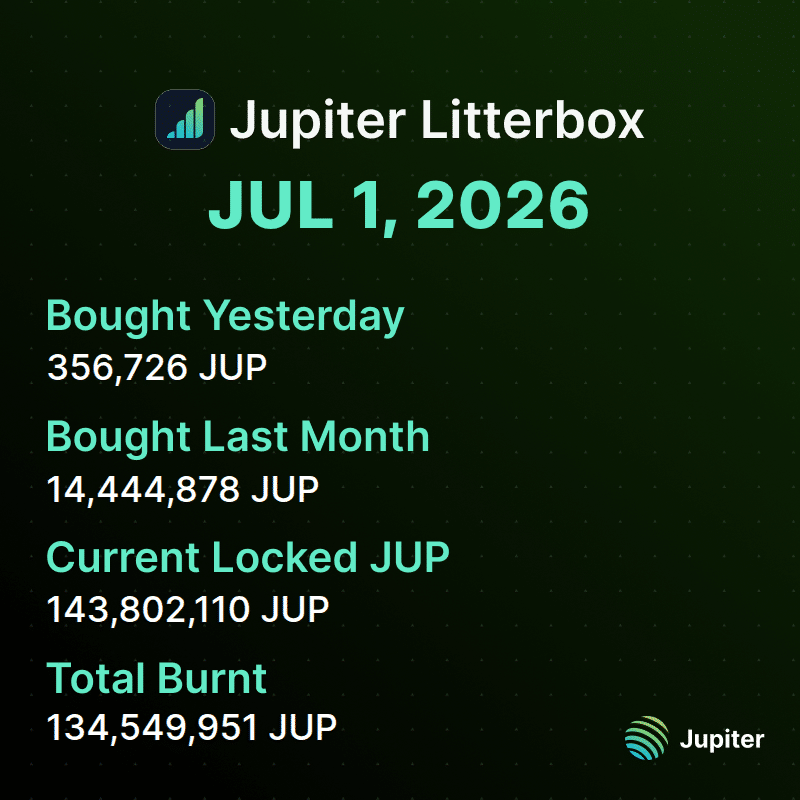
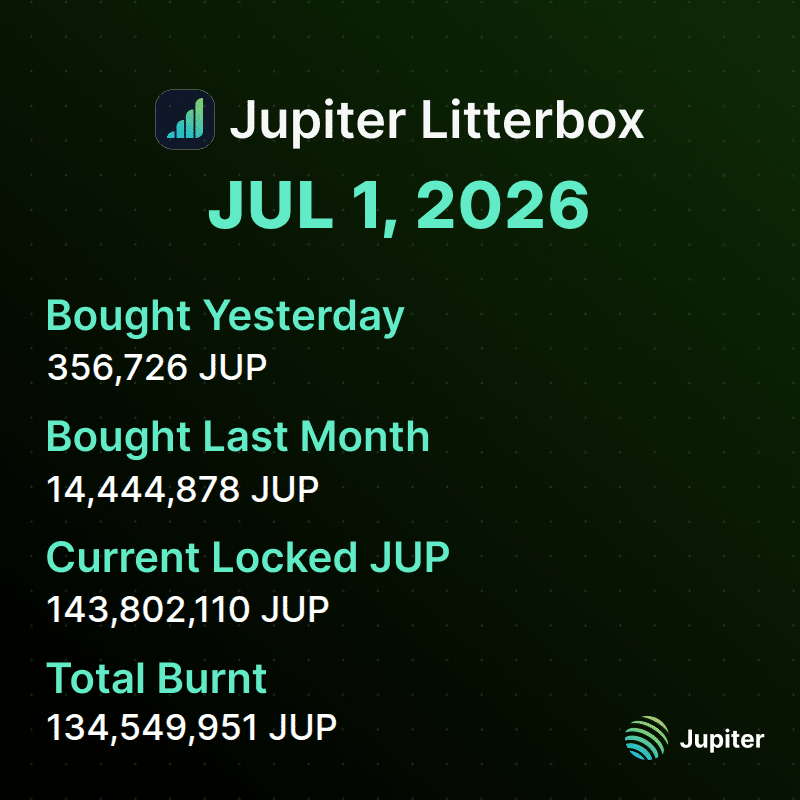
That is not all there is though. Jupiter Strategic Reserve, Litterbox Trust, is creating buying pressure in the market as well as shrinking supply.

Over the last 24 hours alone, the strategic reserve added 356,726 JUP. This, on top of 14.44 million JUP bought last month, taking the total locked JUP tokens to 143.8 million.
Source: X

On the supply tokenomics side, a total of about 134.55 JUP have been burned from the reserve’s effort.

This is a big step towards reducing total supply of the token after 3 billion tokens were burned in January 2025. The altcoin’s total supply is now below 7 billion, down from 10 billion.

Has JUP reclaimed the lost trendline support level?

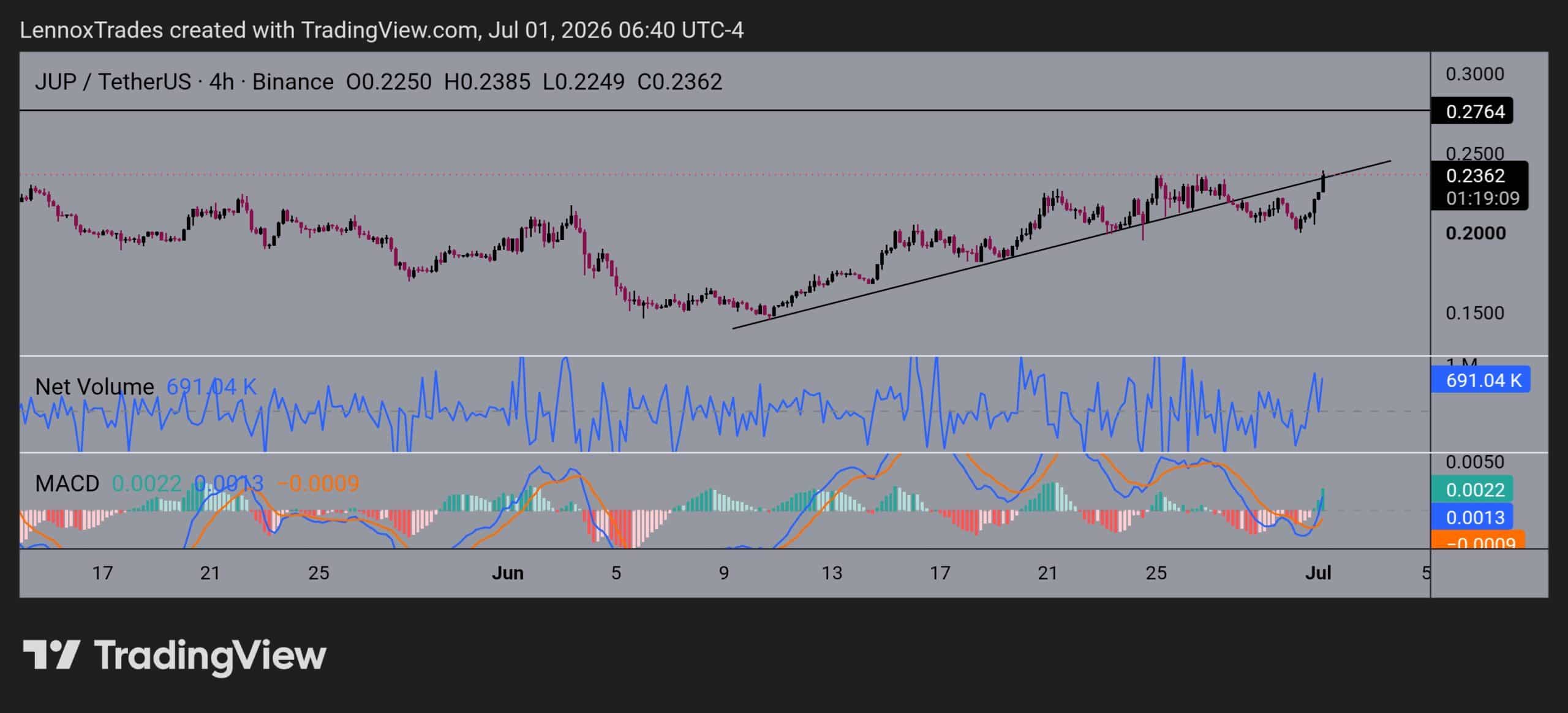
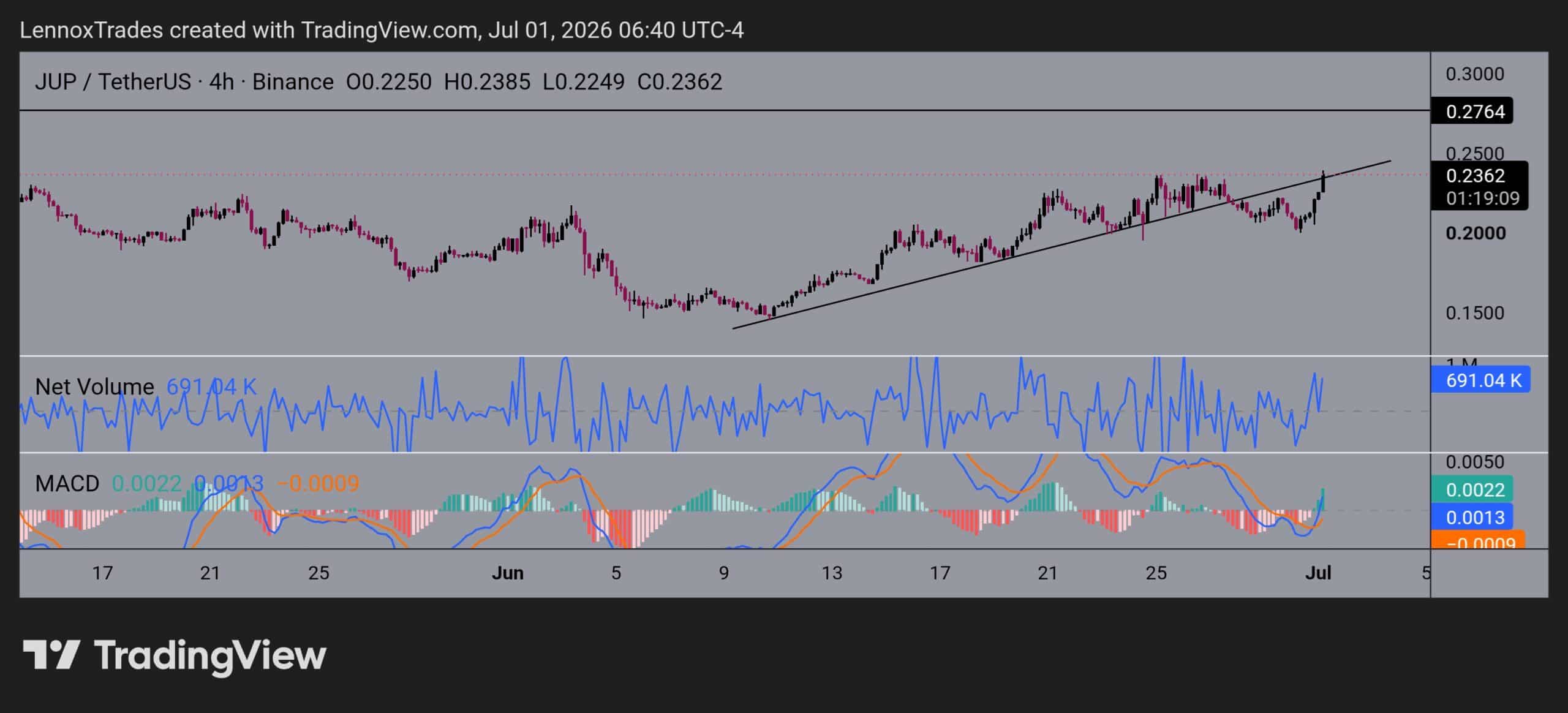
JUP showed similar strength on the 4-hour chart, as it attempted to reclaim the lost trendline support level. The altcoin has traded above the trendline for the better part of June, but it was lost in the last five days of the month.

At press time, JUP’s price was above this level. However, it was yet to create a base above it to ascertain a true shift. If the price stays above the minor resistance at $0.24, it may mean that the altcoin could push to $0.28.

This scenario can probably be supported by the market’s buying pressure too. In fact, Net Volume revealed that more than 800K JUP were bought on the day as bulls reclaimed market momentum.
Source: JUP/USDT on TradingView

All in all, turning the resistance into support would mean a trend shift in the short term. Otherwise, failure would extend the bear structure that had started to form.


Final Summary

  • Jupiter rallied by more than 15% after JupUSD’s integration into JLP, talks of its own Omnichain Ledger, and its strategic reserve accumulation.
  • JUP’s price action reclaimed its lost trendline support, but was yet to form a base level at press time.


Criptomoedas em alta

Perguntas relacionadas

QWhat are the three main catalysts behind Jupiter's (JUP) recent double-digit price rally?

AThe three main catalysts are: 1) The addition of its own stablecoin, JupUSD, to Jupiter Liquidity Provider (JLP) as a custody asset, facilitating a planned $500 million USDC-to-JupUSD transition. 2) Reignited talks of Jupiter building its own Omnichain Ledger. 3) The Jupiter Strategic Reserve (Litterbox Trust) creating buying pressure and shrinking supply by accumulating JUP tokens, with 356,726 JUP added in the last 24 hours and a total of 143.8 million JUP now locked.

QWhat is the potential next price target for JUP mentioned in the article, and what condition must be met?

AThe article states that JUP's price may push to $0.28. For this to happen, the price must stay above the minor resistance level at $0.24 to confirm a true shift and turn that resistance into support.

QWhat significant change has occurred to JUP's total token supply according to the article?

AJUP's total token supply is now below 7 billion, down from the original 10 billion. This reduction follows the burning of 3 billion tokens in January 2025 and ongoing burns from the strategic reserve's efforts, with about 134.55 JUP burned recently.

QWhat does Net Volume data indicate about market activity for JUP?

AThe Net Volume data reveals that more than 800,000 JUP were bought on the day, indicating strong buying pressure and that bulls have reclaimed market momentum.

QWhat role does Jupiter play in the Solana ecosystem based on the information provided?

AJupiter drives more than 80% of the total retail liquidity movement on Solana. It has grown from a swap aggregator in 2021 into a full on-chain finance system.

Leituras Relacionadas

Grayscale: Zcash, Financial Privacy in the Age of AI

Grayscale Research suggests a third wave of public focus on financial privacy is approaching, driven by stablecoin/blockchain adoption and new AI-powered surveillance tools. In this context, Zcash emerges as a decentralized digital currency, similar to Bitcoin but with built-in, robust privacy mechanisms via its "shielded" transactions that conceal sender, receiver, and amount using zero-knowledge proofs. While privacy is often seen as a niche feature, it is argued to be a core requirement for functional money, needed by individuals and businesses alike. Zcash's optional privacy is distinct from mixers or default-private chains like Monero. After years of development (Sapling, Orchard/NU5, Ironwood upgrades) to improve usability, key metrics show growing adoption: shielded transactions comprise ~90% of network activity, and ~25% of circulating ZEC is in shielded pools—a historical high. Despite this, ZEC's market valuation remains low (~0.6% of the "digital currency" sector), implying the market prices privacy as a marginal concern. The investment thesis hinges on a potential re-rating if the value of financial privacy is recognized more broadly. Risks include regulatory challenges around shielded transactions, legacy trusted setup pools, quantum computing threats, and execution risks for upcoming upgrades like Tachyon for scaling. In summary, Zcash represents a significant, technologically mature option in the privacy currency space, with current valuation offering potential upside if privacy demand grows.

marsbitHá 13m

Grayscale: Zcash, Financial Privacy in the Age of AI

marsbitHá 13m

The Bear Market Has Ended, A New Bull Cycle Has Begun

**Title: Bear Market Over, New Bull Cycle Begins** Bitcoin surged over 20% in just three days, from a low of $64,100 on August 19th to a high of $79,500 by August 21st, marking a dramatic shift in market sentiment. This rapid rise triggered massive liquidations exceeding $4 billion, with short positions accounting for $3.7 billion—the largest short squeeze since 2021. The rally was fueled by several key factors. Macroeconomic conditions improved as the US Treasury doubled its long-term bond buyback size, easing pressure. Significant regulatory developments included a White House meeting where former President Trump urged Senate action on the CLARITY Act and hinted at potential US Bitcoin reserves, followed by the CFTC Chairman stating the agency would establish crypto market rules if the bill stalls. On-chain data revealed a fierce battle: large whales faced substantial liquidations on short positions, while others took profits or doubled down on longs. Major altcoins like ETH and XRP also saw impressive gains. Analysts are divided but increasingly bullish. Many, including CryptoQuant's founder, declare the bear market over and a new bull cycle begun. Price targets range from $100k by year-end to ambitious long-term projections of $200k. However, some caution against immediate chasing, noting overbought conditions and viewing the move as a potential "trap" ahead of the crucial September 15th Senate vote on the CLARITY Act. The market's next test is sustaining the momentum with real buying pressure, holding above key resistance near $78k-$80k, and watching ETF inflows and the upcoming regulatory vote.

marsbitHá 17m

The Bear Market Has Ended, A New Bull Cycle Has Begun

marsbitHá 17m

Xiaomi Defended Its Smartphone Gross Margin, Yet to Find a Profit Successor

Xiaomi's Q2 2026 financial report reveals a company navigating a complex transition. While smartphone gross margin held steady at 8.5% through strategic product mix and a record-high average selling price (ASP), this came at the cost of a 26.5% year-over-year decline in global shipments, pressuring its core user acquisition engine. This illustrates Xiaomi's central challenge: managing the "timing gap" between its established and emerging growth engines. Its smartphone business is pivoting from scale to premiumization, but it's unclear if high-end models can fully offset the volume loss from more price-sensitive segments, especially in markets like India and Africa. Meanwhile, the electric vehicle segment has become a significant revenue contributor, delivering 104,200 units and generating ¥23.9 billion. However, its profit contribution remains unclear as it, along with AI investments, is still in a scaling and investment phase. The AI and humanoid robot initiatives, though strategically prioritized and tested in Xiaomi's own factories, are in early-stage validation with no near-term commercialization timeline. Financially, the company remains stable, supported by a robust cash position and its high-margin internet services business, which hit a new high in monthly active users. Management emphasized continued heavy investment in AI, chips, and robotics to fuel the next growth cycle. The key question is whether these new engines—cars, AI, robotics—can achieve commercial scale and profitability before the smartphone engine's growth slows further.

marsbitHá 17m

Xiaomi Defended Its Smartphone Gross Margin, Yet to Find a Profit Successor

marsbitHá 17m

Is RWA Still Meaningful Without DeFi?

The article "Would RWA Still Matter Without DeFi?" argues that tokenizing real-world assets (RWA) alone, like putting a barcode on a container, is not transformative. True value emerges when these tokenized assets are integrated into decentralized finance (DeFi) ecosystems, enabling valuation, financing, hedging, trading, and loss management in a programmable, automated manner. Tokenization provides digital representation, but DeFi provides utility through leverage, liquidity, and composability. The core challenge lies in aligning the different "time clocks" of blockchain (fast, 24/7), traditional markets (limited hours), and asset redemption (slow processes), which creates liquidation risks and gaps. Effective RWA integration requires more than a token; it needs a full stack: legally enforceable rights, reliable data oracles, clear transfer rules, executable secondary liquidity, appropriate collateral parameters, and credible loss resolution paths. Liquidity is defined not by total value locked (TVL) but by the ability to exit a position under stress within a required timeframe. Risk management for RWAs must be modeled as a dependency graph, monitoring interconnected nodes like issuers, custodians, oracles, and liquidity pools for early warning signs beyond just price data. While tokenized government bonds serve as an initial "ping test," the future lies in more complex assets like computing power and energy, which require bespoke risk models. Tokenized stocks paired with perpetual futures present a major test, combining global equity ownership with crypto-native leverage, necessitating robust architectural safeguards like isolation and dynamic collateral rules. The conclusion is that without DeFi, RWA tokenization offers limited value—improving distribution and transparency. The significant opportunity arises when tokenized assets become functional components within open, programmable capital markets, where they can be used as collateral and facilitate complex financial strategies. The token is merely the barcode; the market operating system is the real machine.

marsbitHá 39m

Is RWA Still Meaningful Without DeFi?

marsbitHá 39m

Trading

Spot

Artigos em Destaque

Como comprar JUP

Bem-vindo à HTX.com!Tornámos a compra de Jupiter (JUP) simples e conveniente.Segue o nosso guia passo a passo para iniciar a tua jornada no mundo das criptos.Passo 1: cria a tua conta HTXUtiliza o teu e-mail ou número de telefone para te inscreveres numa conta gratuita na HTX.Desfruta de um processo de inscrição sem complicações e desbloqueia todas as funcionalidades.Obter a minha contaPasso 2: vai para Comprar Cripto e escolhe o teu método de pagamentoCartão de crédito/débito: usa o teu visa ou mastercard para comprar Jupiter (JUP) instantaneamente.Saldo: usa os fundos da tua conta HTX para transacionar sem problemas.Terceiros: adicionamos métodos de pagamento populares, como Google Pay e Apple Pay, para aumentar a conveniência.P2P: transaciona diretamente com outros utilizadores na HTX.Mercado de balcão (OTC): oferecemos serviços personalizados e taxas de câmbio competitivas para os traders.Passo 3: armazena teu Jupiter (JUP)Depois de comprar o teu Jupiter (JUP), armazena-o na tua conta HTX.Alternativamente, podes enviá-lo para outro lugar através de transferência blockchain ou usá-lo para transacionar outras criptomoedas.Passo 4: transaciona Jupiter (JUP)Transaciona facilmente Jupiter (JUP) no mercado à vista da HTX.Acede simplesmente à tua conta, seleciona o teu par de trading, executa as tuas transações e monitoriza em tempo real.Oferecemos uma experiência de fácil utilização tanto para principiantes como para traders experientes.

345 Visualizações TotaisPublicado em {updateTime}Atualizado em 2026.06.02

Como comprar JUP

Discussões

Bem-vindo à Comunidade HTX. Aqui, pode manter-se informado sobre os mais recentes desenvolvimentos da plataforma e obter acesso a análises profissionais de mercado. As opiniões dos utilizadores sobre o preço de JUP (JUP) são apresentadas abaixo.

活动图片