US CFTC Launches Broad Investigation into Polymarket, Is the Prediction Market Party Coming to an End?

marsbitPublicado em 2026-06-30Última atualização em 2026-06-30

Resumo

The U.S. Commodity Futures Trading Commission (CFTC) is conducting a broad investigation into the prediction market platform Polymarket, focusing on its business practices including social media promotions. This follows a bipartisan letter from U.S. senators urging the CFTC to probe alleged fraudulent marketing tactics used to promote gambling-like products. The action coincides with a period of explosive growth for the prediction market sector, driven by events like the World Cup, with platforms like Kalshi and Robinhood reporting record trading volumes and revenue. The investigation signals a potential end to the sector's unregulated expansion and may lead to clearer federal oversight, particularly regarding investor protection and distinguishing prediction markets from traditional sports betting. The CFTC's move has also intensified a jurisdictional conflict with multiple U.S. states (including Kentucky and New York), which have sued platforms like Polymarket and Kalshi, accusing them of operating illegal sports betting and threatening state gambling tax revenues. Furthermore, the CME Group has sued the CFTC, challenging its approval of certain prediction market products. The report also highlights the political and capital interests intertwined with the industry. Donald Trump Jr. holds advisory and investment roles in both Kalshi and Polymarket, and the Trump administration has previously emphasized federal regulatory authority over these markets. The CFTC's investigati...

Original | Odaily Planet Daily (@OdailyChina)

Author | Wenser(@wenser2010 )

Polymarket's deceptive marketing has finally caught the attention of regulatory authorities.

Recently, the U.S. Commodity Futures Trading Commission (CFTC) has initiated a broad investigation into the prediction market platform Polymarket, covering its business activities including social media campaigns. Previously, U.S. Republican Senator John Curtis and Democratic Senator Adam Schiff co-signed a letter to CFTC Chairman Mike Selig, urging an investigation into Polymarket's practices of paying KOLs for deceptive marketing and using fraudulent marketing tactics to promote gambling-like products to American audiences.

At a time when the World Cup is driving a surge in prediction market trading volumes, this move may pour cold water on the development of this sector. More importantly, the CFTC's investigation into Polymarket has brought to light conflicts of interest between U.S. federal and state authorities, as well as between officials and capital. (Recommended reading: "WSJ: Fake Websites, Fake Trades, Real Promotion, Polymarket's Traffic Scam").

End of the Wild West Era for Prediction Market Marketing, Regulatory Policies May Enter Deep Waters

If the earlier incidents involving Polymarket—such as university students posting fake profit videos and paid KOLs exaggerating prediction profits—were seen as the wild attempts of the early expansion phase of prediction markets, then the formal CFTC investigation is clear proof that this wild growth period is over.

Prediction Market Platform Data Sees Explosive Growth, Attracting Strong Attention from Traditional Internet Giants

As we entered June 2026, with the official start of the World Cup, prediction markets have received unprecedented attention, leading to a continuous rise in trading volumes.

Data from a16z crypto shows that prediction market trading volume has hit record highs for three consecutive weeks. The total market trading volume reached a historic first of $144 billion last week, a significant increase from approximately $50–60 billion at the beginning of the year. The previous record high of around $100 billion was set just the week before. From the platform side, the data has also seen substantial growth:

  • Latest data shows Kalshi's weekly notional trading volume surpassed $100 billion for the first time.
  • Polymarket officially stated that its annualized revenue has significantly exceeded $1 billion, a development occurring just six weeks after the removal of the waitlist for its U.S. trading platform; data shows that the U.S. platform's daily trading volume grew from about $50 million in mid-May to over $200 million on June 20 (based on Dune Analytics data).
  • Robinhood's prediction market platform business is growing rapidly, with annualized revenue reaching $500 million. In Q2 as of June 25, Robinhood's active contract trading volume was approximately 12.3 billion contracts. Based on a standard rate of 1 cent per contract, the prediction market revenue for this quarter is estimated to be at least $123 million. Its recently launched Rothera prediction market platform achieved over 900 million contract trades in its first week, contributing nearly 60% growth in active contract trading volume for Robinhood.
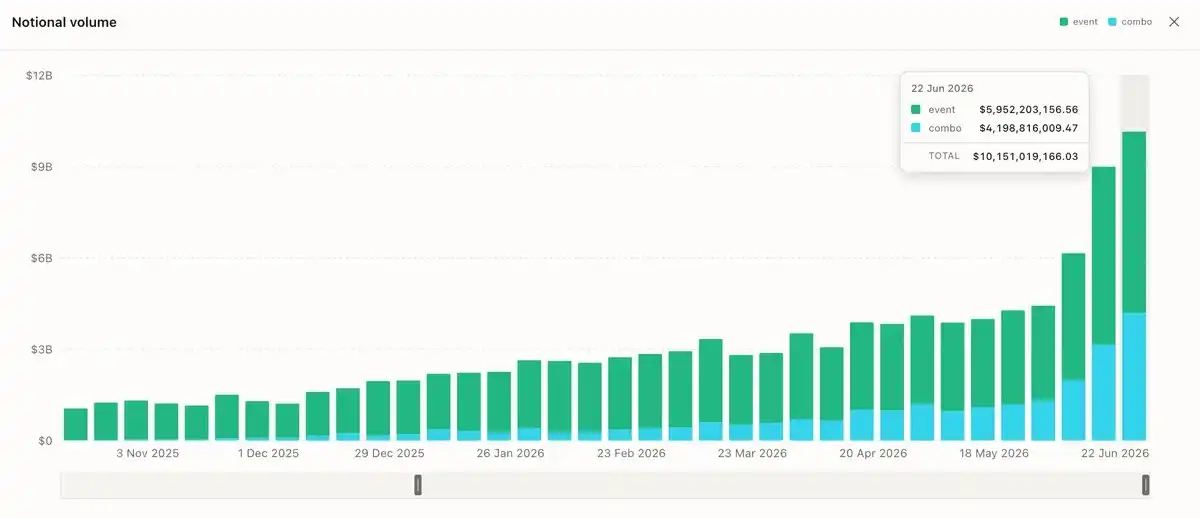
Such impressive data has also attracted the attention of stock market giant Meta. According to media reports, Meta CEO Mark Zuckerberg has urged the company to explore partnerships with prediction markets Polymarket and Kalshi. Meanwhile, Meta is developing a similar prediction market application called Arena.

All signs indicate that prediction markets have leapt from a niche sector a few years ago to a hot industry experiencing exponential expansion. In the face of this trend, regulatory authorities are unlikely to stand idly by. The recent deceptive marketing incidents at Polymarket serve as a timely and fitting 'soft knife,' providing an opportunity for regulatory intervention. The author believes that subsequent regulations may gradually clarify the boundaries for prediction market platforms regarding marketing, event contract content, and trading fees, aiming to strengthen investor protection and clearly distinguish them from traditional gambling businesses.

Simultaneously, as the investigation deepens, the power struggle between federal regulatory agencies represented by the U.S. CFTC and state-level regulators is also coming to light.

When U.S. CFTC and Nine U.S. States Lock Horns: The Battle for Prediction Market Regulatory Power

Last Tuesday, the U.S. CFTC formally filed a lawsuit against Kentucky, attempting to reaffirm the agency's jurisdiction over prediction market platforms.

In the complaint filed with the U.S. District Court for the Eastern District of Kentucky, the CFTC stated that Kentucky's attempt to shut down federally regulated designated contract markets interferes with the federal regulatory system Congress established for the national swaps market. It claims "exclusive jurisdiction" over related event contracts and prediction market products.

Previously, Kentucky sued platforms like Kalshi and Polymarket, accusing them of operating unlicensed illegal sports betting and gambling businesses within the state. As of June, over 12 U.S. states, including Kentucky and New York, have taken legal action against Polymarket and Kalshi, alleging they operate illegal sports betting. Kentucky has become the ninth state sued by the CFTC in the prediction market regulatory dispute.

This action highlights the escalating conflict between federal derivatives regulation and state-level gambling regulation.

There are two main reasons behind this dispute:

  • First, the practical interests of state and local gambling industries, such as tax revenue. Traditional sports betting previously brought significant tax revenue to various states (e.g., high-tax-rate online gambling). If prediction markets completely replace the gambling industry, potential tax losses for states could amount to hundreds of millions of dollars annually (one estimate is around $600 million).
  • Second, the definition of the regulatory boundary between the gambling industry and prediction markets as an emerging industry. The CFTC seeks to maintain the classification of "event contracts" as commodity derivatives, futures, or swaps, enforcing a policy of federal law preemption.

The final outcome and specific definitions may depend on the interpretation and rulings by state courts, and potentially the U.S. Supreme Court, regarding the Commodity Exchange Act (CEA).

Furthermore, the battle between exchanges and the U.S. CFTC has also ignited. The CFTC's previous approval of Kalshi's application for perpetual futures trading triggered CME's lawsuit—

Reportedly, CME has sued the U.S. Commodity Futures Trading Commission and its Chairman Michael Selig in the U.S. District Court for the District of Columbia. Regarding the CFTC's May 29th approval for prediction market platform Kalshi to launch perpetual futures contracts linked to the Bitcoin spot price, among other actions, the CFTC's treatment of "futures" with expiration dates as "swaps" violates U.S. Congressional directives and the Commodity Exchange Act. CME requests the court to overturn the related perpetual futures actions. CME also claimed that Selig acted unilaterally without the presence of the full five-member panel of commissioners.

A CFTC spokesperson responded that CME is waging a "legal war" against the agency and the government's crypto policy, stating that "the act of filing the lawsuit is extremely imprudent." (Essentially saying "your lawsuit is filed too hastily" right on its forehead.)

Of course, it's no wonder CME is so agitated. The CFTC's move to allow Kalshi to trade crypto perpetual futures contracts essentially lets prediction market platforms like Kalshi, along with crypto exchanges like Coinbase and Kraken, encroach upon CME's "trading territory." As for the driving force behind this, it might have some connection to the Trump family.

The Trump Family's Prediction Market 'Double-Down Strategy': Don Jr. Bets on Kalshi and Polymarket

Recently, it was revealed that Kalshi is negotiating a new round of funding at a valuation of approximately $40 billion, with the deal potentially closing as early as Q3. Following a $10 billion financing round in May (investors included Sequoia Capital, Andreessen Horowitz, Coatue, and Morgan Stanley), Kalshi's valuation rose from its previous $12 billion to $22 billion. Now, that number is about to double.

Kalshi CEO Tarek Mansour stated that the company is considering an IPO no earlier than late 2027 or 2028. Kalshi officially stated that as of April 2026, its annualized trading volume reached $178 billion, a 32-fold increase year-over-year.

Such remarkable market data and the high enthusiasm from capital markets are hard to separate from one of the Trump family's prominent figures, Donald Trump Jr.

It is understood that Don Jr. is essentially "hedging his bets" in the prediction market sector:

On one hand, he served as a paid strategic advisor for Kalshi in early 2025, receiving approximately $300,000 worth of company equity at a time when Kalshi's valuation was less than $2 billion. That investment alone has yielded over a 10x return;

On the other hand, he also serves as an advisor to Polymarket and has made a strategic investment in the latter through his venture capital firm, 1789 Capital, where he is a partner.

Coupled with Trump's previous emphasis on federal government regulatory authority over prediction markets, and his mention that "Kalshi and Polymarket will thrive under his leadership,"

To some extent, the conflict of interest between capital and official regulatory agencies has been eased; and the Trump family serves as the "best lubricant" in this contradictory situation.

Thus, a network of interests connecting the U.S. CFTC and other federal regulatory agencies, U.S. state governments, and Trump family investment entities gradually takes shape.

As for the U.S. CFTC's investigation into Polymarket, it may just be an inevitable step in regulating the prediction market industry.

The era of wild growth, the 'Spring of Prediction Markets,' is coming to an end, while the 'Prosperous Summer' for the prediction market industry is slowly approaching.


Criptomoedas em alta

Perguntas relacionadas

QWhat is the US CFTC investigating regarding Polymarket?

AThe US Commodity Futures Trading Commission (CFTC) is conducting a broad investigation into the prediction market platform Polymarket, covering aspects of its business including social media activities. The investigation is prompted by concerns over paid KOLs engaging in deceptive marketing, using fraudulent methods to promote gambling-like products to a US audience.

QWhat is the core conflict highlighted between the US CFTC and certain US states in the article?

AThe core conflict is a jurisdictional battle between federal regulatory authority (the CFTC) and state-level power. The CFTC asserts exclusive federal jurisdiction over event contracts and prediction market products under the Commodity Exchange Act. However, states like Kentucky and New York are suing platforms like Polymarket and Kalshi, accusing them of operating illegal sports betting and gambling businesses within their borders, which are traditionally regulated by the states. This conflict involves both regulatory boundaries and potential state tax revenue losses from the traditional gambling industry.

QWhat role does Donald Trump Jr. play in the prediction market sector according to the article?

AAccording to the article, Donald Trump Jr. is involved with both major prediction market platforms. He serves as a paid strategic advisor for Kalshi, receiving company equity, and also acts as an advisor for Polymarket through his venture capital firm, 1789 Capital, which made a strategic investment in the platform. His involvement is presented as part of a network connecting capital, political influence, and regulatory bodies.

QWhat significant legal action did the CME Group take against the CFTC, and why?

AThe CME Group filed a lawsuit against the US CFTC and its Chairman, Michael Selig, in the US District Court for the District of Columbia. The lawsuit challenges the CFTC's approval for Kalshi to launch perpetual futures contracts tied to Bitcoin's spot price. CME argues the CFTC violated the Commodity Exchange Act by treating futures with expiration dates as 'swaps' and that Chairman Selig acted unilaterally without a full commission. The move is seen as CME protecting its trading turf from encroachment by prediction market and crypto exchanges.

QHow does the article characterize the current stage and future of the prediction market industry?

AThe article characterizes the current massive growth, driven by events like the World Cup, as the end of a 'wild spring' or野蛮生长期 (barbaric growth period) for prediction markets, marked by early expansion tactics like deceptive marketing. The CFTC's investigation is seen as the start of increased regulatory scrutiny. However, the conclusion suggests this is a necessary step, and a 'prosperous summer' for a more regulated and mature prediction market industry is slowly approaching.

Leituras Relacionadas

Pax Silica vs. WAICO: The US Wants to Prohibit Europe from Using Chinese Artificial Intelligence

The United States is preparing to demand that European and other partners abandon Chinese artificial intelligence initiatives, threatening exclusion from the American-led "Pax Silica" coalition, according to a leaked U.S. State Department document. This ultimatum forces signatories of the "AI Opportunity Statement" to choose between the Western technological ecosystem and alternative frameworks, with China not explicitly named but clearly targeted. Pax Silica is a U.S. strategy for AI and semiconductor hegemony, launched in late 2025. Its European presence expanded significantly in mid-2026. Concurrently, China, Russia, and 27 other nations established the World AI Cooperation Organization (WAICO) in July 2026 as an independent intergovernmental platform promoting AI governance based on UN principles. This situation creates a difficult choice, especially for European nations balancing strategic autonomy with dependence on U.S. tech and security. It also pressures Global South countries with pragmatic ties to both Washington and Beijing. The formation of competing blocks risks fragmenting the global tech landscape, forcing companies to split supply chains, increasing costs, and potentially leading to incompatible standards and protocols. The era of open globalization in AI may be ending, replaced by geopolitical confrontation where technological sovereignty trumps economic efficiency. The decisions made will shape the global digital economy for decades.

cryptonews.ruHá 25m

Pax Silica vs. WAICO: The US Wants to Prohibit Europe from Using Chinese Artificial Intelligence

cryptonews.ruHá 25m

Robert Kiyosaki Shares His Mentor's Predictions About the Emergence of Bitcoin and AI

American entrepreneur and author of "Rich Dad Poor Dad," Robert Kiyosaki, discussed the influence of futurist R. Buckminster Fuller on his worldview, linking Fuller's past technological predictions to the emergence of Bitcoin and the development of artificial intelligence. In an X post, Kiyosaki also reflected on personal purpose, sharing his journey from the music business—where he worked with bands like The Police and Iron Maiden—to creating the "Cashflow" board game and writing his famous book. He described feeling an inner emptiness despite his success, a turning point that came after meeting Fuller, whom he studied with for three summers. Kiyosaki described Fuller as a "friendly genius" who foresaw world-changing developments like Bitcoin and AI. However, the core of his post focused on Fuller's philosophical impact, particularly a quote about belonging to the universe and finding purpose by dedicating one's life to the maximum benefit of others. The entrepreneur remains a vocal advocate for cryptocurrencies. He regularly advises buying Bitcoin during market panics, viewing it and assets like Ethereum, gold, and silver as hedges against traditional financial system failures. Kiyosaki has predicted a major market crash by 2026, seeing it as an opportunity for prepared investors, with long-term price targets including $750,000 for Bitcoin and $95,000 for Ethereum.

cryptonews.ruHá 2h

Robert Kiyosaki Shares His Mentor's Predictions About the Emergence of Bitcoin and AI

cryptonews.ruHá 2h

Etherealize CEO Calls Wall Street's Private Blockchains a 'Race to the Bottom'

Etherealize co-founder and CEO Vivek Raman criticized Wall Street's growing interest in private, permissioned blockchains, calling them a "race to the bottom." In an interview with CoinDesk, Raman argued that consortium networks fragment liquidity and return the industry to the siloed systems that blockchain technology was meant to overcome. He stated that closed networks do not interoperate, undermining two key advantages of the technology: system compatibility and liquidity concentration. Etherealize promotes Ethereum as an open, foundational layer for institutional players. Raman insists that privacy and access restrictions should be built on top of public infrastructure—at the application or L2 level—rather than creating separate, closed networks. He compared Ethereum to HTTP as a base layer, with additional permissioned and private layers akin to HTTPS. Examples of this new wave of "closed" solutions mentioned include Canton Network from Digital Asset, Circle's Arc project, and Stripe's Tempo. Raman termed this trend "consortium chains 2.0," recalling earlier initiatives like the R3 interbank consortium and the Hyperledger corporate ecosystem from 2016 that failed to gain significant traction. He reiterated his firm belief that a global, open, permissionless infrastructure is necessary as a foundational base layer. Raman previously noted in June that traditional financial institutions had begun implementing Ethereum-based solutions into real business processes.

cryptonews.ruHá 2h

Etherealize CEO Calls Wall Street's Private Blockchains a 'Race to the Bottom'

cryptonews.ruHá 2h

Trading

Spot

Artigos em Destaque

Como comprar POL

Bem-vindo à HTX.com!Tornámos a compra de Polygon Ecosystem Token (POL) simples e conveniente.Segue o nosso guia passo a passo para iniciar a tua jornada no mundo das criptos.Passo 1: cria a tua conta HTXUtiliza o teu e-mail ou número de telefone para te inscreveres numa conta gratuita na HTX.Desfruta de um processo de inscrição sem complicações e desbloqueia todas as funcionalidades.Obter a minha contaPasso 2: vai para Comprar Cripto e escolhe o teu método de pagamentoCartão de crédito/débito: usa o teu visa ou mastercard para comprar Polygon Ecosystem Token (POL) instantaneamente.Saldo: usa os fundos da tua conta HTX para transacionar sem problemas.Terceiros: adicionamos métodos de pagamento populares, como Google Pay e Apple Pay, para aumentar a conveniência.P2P: transaciona diretamente com outros utilizadores na HTX.Mercado de balcão (OTC): oferecemos serviços personalizados e taxas de câmbio competitivas para os traders.Passo 3: armazena teu Polygon Ecosystem Token (POL)Depois de comprar o teu Polygon Ecosystem Token (POL), armazena-o na tua conta HTX.Alternativamente, podes enviá-lo para outro lugar através de transferência blockchain ou usá-lo para transacionar outras criptomoedas.Passo 4: transaciona Polygon Ecosystem Token (POL)Transaciona facilmente Polygon Ecosystem Token (POL) no mercado à vista da HTX.Acede simplesmente à tua conta, seleciona o teu par de trading, executa as tuas transações e monitoriza em tempo real.Oferecemos uma experiência de fácil utilização tanto para principiantes como para traders experientes.

417 Visualizações TotaisPublicado em {updateTime}Atualizado em 2026.06.02

Como comprar POL

Discussões

Bem-vindo à Comunidade HTX. Aqui, pode manter-se informado sobre os mais recentes desenvolvimentos da plataforma e obter acesso a análises profissionais de mercado. As opiniões dos utilizadores sobre o preço de POL (POL) são apresentadas abaixo.

活动图片