Crypto market’s weekly winners and losers – VELVET, BEAT, WLD, XLM

ambcryptoPublished on 2026-06-29Last updated on 2026-06-29

Abstract

This week, crypto markets faced pressure as Bitcoin and Ethereum extended their weakness, prompting capital rotation into select low-cap altcoins. Key weekly gainers included **Velvet (VELVET)**, which surged 235% nearing its all-time high; **DeXe (DEXE)**, up 60% and reclaiming a key level from late 2021; and **Audiera (BEAT)**, rising 45% following a prior sharp crash. Other notable movers were Cortex (CX) and Synapse (SYN). On the losing side, **MemeCore (M)** crashed 70% amid reports of insider manipulation, **Worldcoin (WLD)** fell 26% in a post-rally cooldown, and **Stellar (XLM)** dropped 18.5%, extending a bearish streak. The action highlighted a week of sharp volatility and rotational moves within a cautious broader market.

Crypto markets stayed under pressure this week.

Bitcoin [BTC] and Ethereum [ETH] extended their weak performance, with risk appetite remaining subdued amid persistent macro uncertainty.

While major cryptocurrencies struggled to gain traction, capital rotated into a handful of low-cap altcoins, fueling triple-digit rallies in select tokens even as broader market sentiment remained cautious and profit-taking accelerated across many large-cap assets.

Weekly winners

Velvet [VELVET] – Emerging ecosystem topped the board with triple-digit gains

Velvet [VELVET] emerged as the biggest weekly gainer, rallying 235%. With the token now closing in on its $1.80 all-time high, a short-term cooldown wouldn’t be surprising after such a sharp move.

Backing this up, the RSI has pushed deep into overbought territory, suggesting profit-taking could kick in. That said, price history suggests the rally may not be over just yet. After a 157% rally in early June, VELVET continued pushing higher over the following three weeks, showing that buyers remained firmly in control despite overbought conditions.

This week’s move also comes after a lengthy consolidation phase. Following its previous run to $1.80, VELVET spent weeks ranging around the $0.50 level before finally breaking out. That kind of base-building usually adds more strength to a breakout than a straight vertical move.
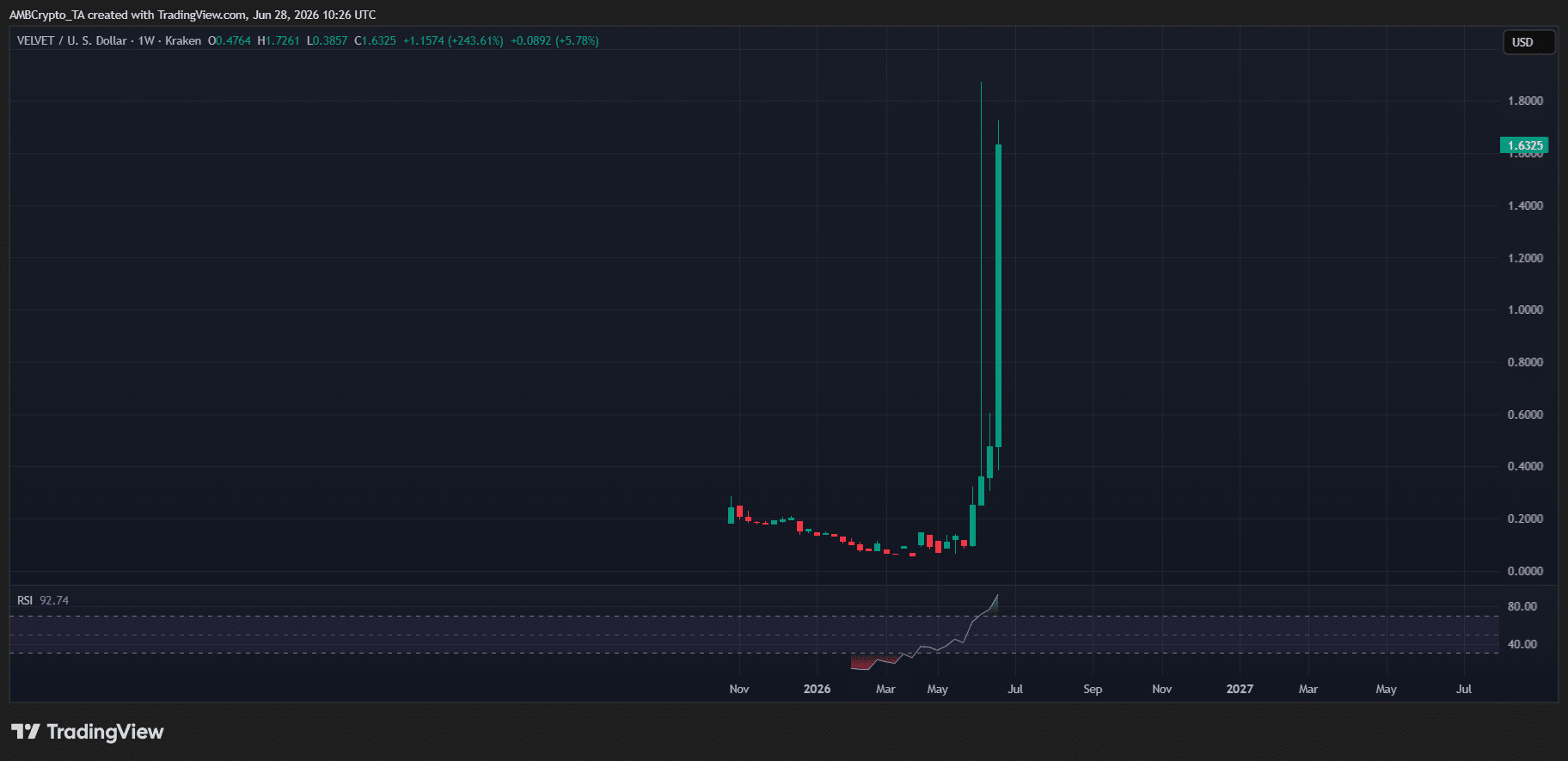
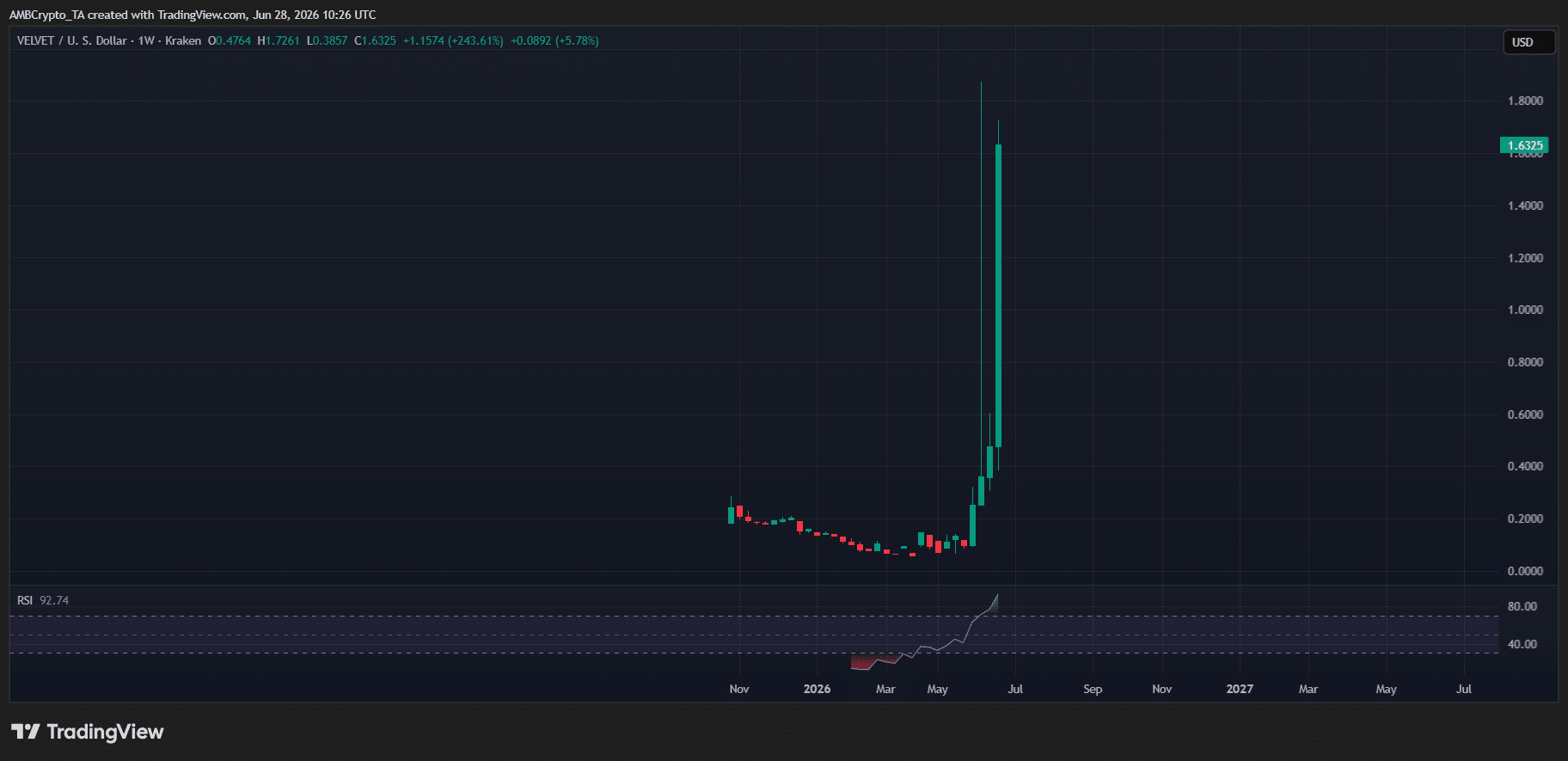
Source: TradingView (VELVET/USDT)

In short, both the daily and weekly charts still favor the bulls. While a brief pullback or consolidation would be healthy, the broader trend remains intact. If buying pressure holds up, a break above the $1.80 all-time high looks increasingly likely, putting the $2 level firmly in focus.

DeXe [DEXE] – Decentralized protocol reinforced steady bullish continuation

DeXe [DEXE] came in as the second-biggest weekly gainer, climbing 60%. More importantly, the token has reclaimed the $22 level for the first time since Q4 2021, meaning a large portion of long-term holders who had been underwater are finally back in profit.

Normally, that would increase the chances of profit-taking. However, DEXE’s recent price action suggests the bulls are still in control. After pulling back for three straight days, the token bounced nearly 4% in under 48 hours, showing buyers are quickly absorbing selling pressure.

That dip-buying behavior keeps the broader uptrend intact. If the current momentum continues, a break above $25 could trigger another leg higher as fresh buyers pile in and existing holders become less willing to sell. In that scenario, the $30 level becomes the next logical upside target.

Audiera [BEAT] – Entertainment token surged sharply on a classic short squeeze

Audiera [BEAT] rounded out this week’s top three gainers with a 45% rally. What’s more interesting is that this comes just one week after the token crashed nearly 70%. That kind of reversal is usually a sign that buyers have stepped back in aggressively after an oversold move.

The sharp sell-off also appears to have flushed out excess leverage and shaken out weak hands. On top of that, the RSI has cooled back toward the neutral zone, giving BEAT more room to move higher.

The next level to watch is $2.50, which now stands as the key resistance. A break above it could quickly open the door for a move back toward $3. But it won’t be easy, BEAT’s 3% intraday pullback shows sellers are still defending that area. If they do, BEAT could spend some more time consolidating before making another breakout attempt.

Other notable winners

Outside the majors, altcoin movers also stood out this week.

Cortex [CX] led the action with a +2710% move, followed by Biconomy [BICO] surging +246%, while Synapse [SYN] climbed +186%, rounding out the list of biggest movers.

Weekly losers

MemeCore [M] – Meme token saw a massive crash this week

MemeCore [M] ended the week as the biggest loser, crashing 70% after reports of insider manipulation triggered a wave of panic selling. The move almost perfectly mirrors Audiera’s 70% collapse from last week, setting up an interesting reversal setup to watch.

Technically, the damage has been significant. M lost the $1 support and has now retraced back to the $0.60-$0.65 area, effectively erasing its post-October rally. The sharp decline has also pushed the RSI deep into oversold territory, showing sellers may be getting exhausted after such an aggressive flush.

The positive is that the crash has also cleared out most of the excess leverage. As AMBCrypto reported, nearly $8 million in long positions were liquidated, alongside a wave of short liquidations. That kind of reset usually gives price a better chance to build a base instead of continuing a leveraged sell-off.
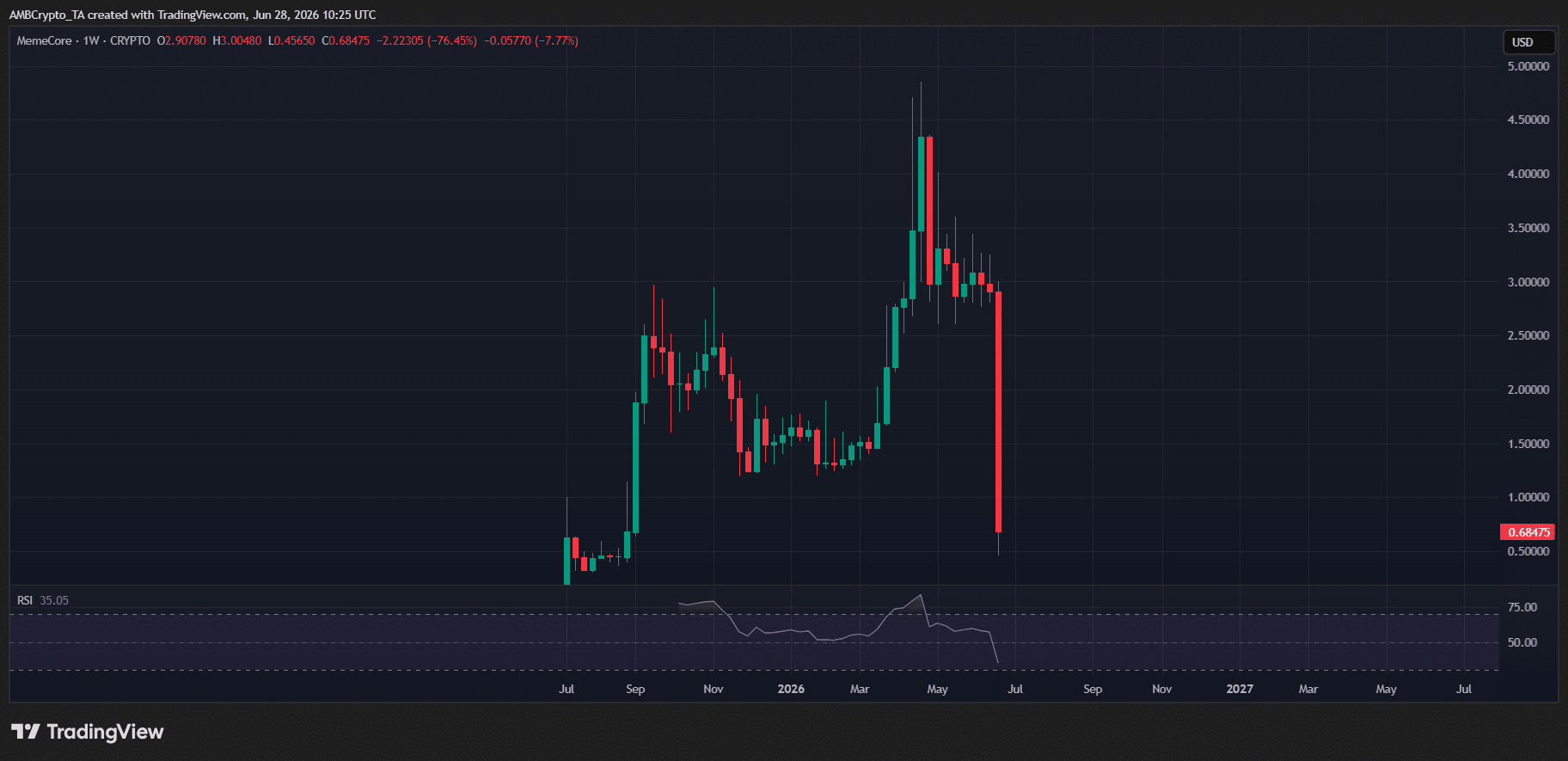
Source: TradingView (M/USDT)

The next question is whether M can pull off a BEAT-style rebound.

So far, the chart is showing early signs of stabilization. MemeCore has spent the last 48 hours trading around the $0.65 level, suggesting buyers are starting to absorb the selling pressure. It’s still too early to call a bottom, but if this consolidation continues, a relief bounce becomes much more likely.

For now, volume is the chart to watch. A pickup in buying volume while price holds above $0.65 would be the first real sign that the bulls are trying to take back control.

Worldcoin [WLD] – Crypto project retraced back to a key support level this week

Worldcoin [WLD] finished as the second-biggest weekly loser, falling 26%. Unlike MemeCore’s panic-driven sell-off, though, WLD’s decline looks more like a healthy cooldown after a strong multi-week run.

From a technical lens, WLD had rallied for five straight weeks. That move put plenty of STHs into profit, so profit-taking was always on the cards. The only concern is momentum. Even after the five-week rally, the RSI never pushed into overbought territory, suggesting the uptrend wasn’t backed by strong buying pressure.

That’s now showing up on the chart. On the daily timeframe, WLD has posted six straight days of pullbacks, dragging price back toward the $0.40 support area. If selling pressure continues and support gives way, a deeper correction could be next before the bulls return.

Steller [XLM] – Payments-focused blockchain failed to show strong bullish conviction

Stellar [XLM] finished as the third-biggest weekly loser, dropping 18.5%. Like Worldcoin, XLM’s daily chart has been under steady selling pressure, with the token extending its losing streak to 11 consecutive days, keeping the short-term trend firmly bearish.

On the weekly chart, though, the picture is a bit more interesting.

Last week’s 9% rally came after two straight weeks of selling that knocked nearly 30% off the price, with buyers stepping in around the $0.25 level. This week, however, that support failed to hold. Unless XLM can quickly reclaim $0.25 and start building a base, the risk of a deeper correction remains elevated.

If the current structure stays intact, XLM could retrace a large chunk of its two-month rally, with $0.15 emerging as the next major support to watch. Until buyers show up and confirm a bottom, the chart continues to favor the bears.

Other notable losers

In the broader market, downside volatility hit hard.

Humanity [H] – 71% drop, followed by Biconomy [BICO] falling 68.5%, and Yei Finance [CLO] slipping 42.2%, as momentum sharply cooled.

Conclusion

This week was a rollercoaster. Big pumps, sharp dips, and nonstop action. As always, stay sharp, do your own research, and trade smart.


Final Summary

  • Velvet [VELVET], DeXe [DEXE], Audiera [BEAT] led the week in gains.
  • MemeCore [M], Worldcoin [WLD], Steller [XLM] saw significant declines.

Trending Cryptos

Related Questions

QWhat were the top three weekly gainers in the cryptocurrency market according to the article?

AThe top three weekly gainers were Velvet [VELVET] with a 235% rally, DeXe [DEXE] with a 60% climb, and Audiera [BEAT] with a 45% surge.

QWhy did MemeCore [M] experience a massive price crash this week?

AMemeCore [M] crashed 70% after reports of insider manipulation triggered a wave of panic selling and liquidations, erasing its post-October rally.

QWhat technical indicator is mentioned as a reason Velvet [VELVET] might see a short-term cooldown despite its strong rally?

AThe article states that Velvet's RSI has pushed deep into overbought territory, suggesting profit-taking could kick in, potentially leading to a short-term cooldown.

QAccording to the analysis, what is a key difference between Worldcoin's [WLD] decline and MemeCore's [M] crash?

AWorldcoin's 26% decline is described as a healthy cooldown after a strong multi-week run, whereas MemeCore's crash was a panic-driven sell-off triggered by reports of insider manipulation.

QWhat are the next major upside targets mentioned for DeXe [DEXE] and Velvet [VELVET]?

AFor DeXe [DEXE], a break above $25 could target the $30 level. For Velvet [VELVET], a break above its $1.80 all-time high would put the $2 level firmly in focus.

Related Reads

Nobel Laureate Hassabis Delivers Another Masterpiece: AlphaGenome 2 Deciphers 98% of Human DNA 'Dark Matter'

DeepMind has unveiled AlphaGenome 2, a next-generation DNA foundation model led by Nobel laureate Demis Hassabis. While AlphaFold decoded only the 2% of the human genome that encodes proteins, AlphaGenome 2 targets the remaining 98% of non-coding "dark matter," which harbors gene-regulatory switches and over 90% of disease-causing mutations. Released alongside a 78-page technical report, the model delivers four major breakthroughs. First, it achieves single-cell resolution, trained on over 107 million single cells across 68 human tissues, doubling the rate at which it identifies pathogenic mutations—raising detection from 16% to 30% and directional accuracy from 23% to 43% on the TenK10K immune-cell benchmark. Second, it reproduces years of Nature-published research purely through computation: with zero wet-lab experiments, it correctly identified a distant regulatory mutation that over-activates ETS2 across 290,000 bases to cause inflammatory bowel disease, and precisely located the regulatory site and GATAA core sequence targeted by approved sickle-cell CRISPR therapy. Third, a new cell encoder lets the model interpret previously unseen diseases from just dozens of patient cells without retraining—identifying 41% of pathogenic mutations in unseen Parkinson's brain samples versus 17% for a specialized model, and uncovering a hidden severe-COVID mutation active only in immune-activated T cells. Finally, DeepMind released free databases covering 640 real human cell types and impact scores for nearly 7 million genetic variants across 510 cell states, with APIs and Colab tutorials open for non-commercial research. The model will soon be packaged as Skills and integrated into Google Antigravity for direct use by Gemini 4, promising to dramatically shorten the cycle of disease investigation and drug discovery.

marsbit51m ago

Nobel Laureate Hassabis Delivers Another Masterpiece: AlphaGenome 2 Deciphers 98% of Human DNA 'Dark Matter'

marsbit51m ago

Midterm Elections Settled, What Lies Ahead for the CLARITY Act?

The CLARITY Act (Digital Asset Market Clarity Act), which had already struggled before the election, now faces dim prospects after Democrats swept both chambers in the midterms. On September 15, a Senate cloture motion on the House-passed bill failed 49-50, eleven votes short of the 60-vote threshold. All 49 yes votes came from Republicans; the opposition included all Democrats present, two independents, and four Republicans (Collins, Hawley, Moran, Tillis). Even if absentee Democrat Coons had voted yes and the four Republicans had flipped, the tally would have reached only 54—still short. The bill's core compromise would make the CFTC the primary regulator for digital commodities and trading platforms while preserving clear SEC authority; jurisdictional division and added ethics provisions are the main disputes. Democrats will control both chambers when the new Congress opens January 3, 2027, leaving little incentive to cooperate during the lame-duck session. Only two theoretical paths remain before the 119th Congress ends: renegotiate the text and hold another cloture vote via Tillis's reconsideration motion, or attach crypto market structure provisions to must-pass December legislation such as government funding (expiring December 11) or the NDAA. Both are unlikely, given the tight legislative calendar and Democratic leverage. Stablecoin oversight continues separately under the GENIUS Act and OCC rulemaking. If the bill dies, it must be reintroduced in the 120th Congress, where Democrats—likely led by Elizabeth Warren and Maxine Waters—are expected to draft a very different framework expanding SEC authority and narrowing the CFTC's role. Key things to watch before January 3: any new cloture vote or revised text, any attempt to attach provisions to funding or defense bills, outstanding vote counts in Alaska, Mississippi, and House districts, and the incoming committee chair selections. Absent such developments, the CLARITY Act is effectively finished as a 2026 legislative project.

marsbit51m ago

Midterm Elections Settled, What Lies Ahead for the CLARITY Act?

marsbit51m ago

4.8 Billion Dollars: Tether's Hand Has Reached Into 13 U.S. Public Companies

Tether, the world's largest stablecoin issuer, holds roughly $4.8 billion in public-market exposure across 13 U.S.-listed companies, according to a Protos review of regulatory filings. Its holdings span a controversial video platform, gold royalty companies, a satellite firm, bitcoin miners, and a bitcoin treasury project. Key positions include a 50.3% stake (including warrants) in Rumble (RUM), though voting power is capped below 9.9%; Rumble has also acquired Tether's Northern Data and counts Tether as its most important advertising client, committed to $50 million annually for two years. Tether and Bitfinex are controlling shareholders of Twenty One Capital (XXI), with rights to nominate four of seven directors, including Tether CEO Paolo Ardoino; the company trades at about 60% of its bitcoin value. In gold, Tether holds about 27% of Elemental Royalty (ELE), 12.6% of Gold.com (GOLD), 12.6% of Versamet Royalties (VMET), 14.6% of Metalla (MTA), 14.4% of Gold Royalty (GROY), 12% of Aurelion (AURE), and about 8% of Antalpha (ANTA). It also holds 19.7% of Bitdeer (BTDR) and a stake in Adecoagro (AGRO), plus shares in Satellogic (SATL), 9.9% of SDEV (down about 99%), and a stake in VCI Global (VCIG) via Oobit. Powerlaw Corp (PWRL) claims roughly $20 million in Tether equity. The exposure is concentrated in a few large holdings—Twenty One, Rumble, and Adecoagro—showing Tether's growing role as a multi-sector financial institution that also places executives in key positions.

marsbit1h ago

4.8 Billion Dollars: Tether's Hand Has Reached Into 13 U.S. Public Companies

marsbit1h ago

Trading

Spot

Hot Articles

How to Buy BEAT

Welcome to HTX.com! We've made purchasing Audiera (BEAT) simple and convenient. Follow our step-by-step guide to embark on your crypto journey.Step 1: Create Your HTX AccountUse your email or phone number to sign up for a free account on HTX. Experience a hassle-free registration journey and unlock all features.Get My AccountStep 2: Go to Buy Crypto and Choose Your Payment MethodCredit/Debit Card: Use your Visa or Mastercard to buy Audiera (BEAT) instantly.Balance: Use funds from your HTX account balance to trade seamlessly.Third Parties: We've added popular payment methods such as Google Pay and Apple Pay to enhance convenience.P2P: Trade directly with other users on HTX.Over-the-Counter (OTC): We offer tailor-made services and competitive exchange rates for traders.Step 3: Store Your Audiera (BEAT)After purchasing your Audiera (BEAT), store it in your HTX account. Alternatively, you can send it elsewhere via blockchain transfer or use it to trade other cryptocurrencies.Step 4: Trade Audiera (BEAT)Easily trade Audiera (BEAT) on HTX's spot market. Simply access your account, select your trading pair, execute your trades, and monitor in real-time. We offer a user-friendly experience for both beginners and seasoned traders.

5.1k Total ViewsPublished 2026.01.22Updated 2026.06.02

How to Buy BEAT

Discussions

Welcome to the HTX Community. Here, you can stay informed about the latest platform developments and gain access to professional market insights. Users' opinions on the price of BEAT (BEAT) are presented below.

活动图片