铜,2026年的黄金

marsbitPublicado em 2026-06-16Última atualização em 2026-06-16

Resumo

过去两年,AI 的故事主要围绕芯片展开,但 AI 基础设施远不止于此,它需要电网、电缆、冷却系统等大量金属。市场对铜的关注度急剧上升,其叙事已从单纯的工业周期指标,转变为一个具有结构性需求支撑的战略性资产。 这一变化的核心在于,铜已成为电气化时代的基石。AI 数据中心、电网扩建、新能源车、储能及再工业化等趋势都在拉动铜的需求。数据显示,AI 数据中心的铜需求将从 2024 年的约 50 万吨,大幅增长至 2050 年的约 300 万吨。更重要的是,这些新兴需求与建筑、空调等传统需求共同构成了强劲的总需求。 供给端则面临长期瓶颈。新铜矿从发现到投产平均需要约 17 年,全球铜矿品位持续下降,新发现矿床稀少,建设周期长且成本攀升。国际能源署估算,到 2035 年,铜市场可能出现 30% 的供给缺口。此外,冶炼端加工费跌至历史低位,凸显了上游矿石供应的紧张。 因此,铜的稀缺性开始被市场重新定价,吸引了宏观资金的关注。知名投资人如 Stanley Druckenmiller 将铜作为宏观对冲工具,而 Pierre Andurand 等交易员则预测铜价可能飙升至每吨 40,000 美元。这种“黄金化”趋势也体现在铜矿股上,它们作为铜价的杠杆,提供了高弹性,但也伴随着资源国政策、成本通胀等复杂风险。 尽管铜仍会受经济周期影响而波动,但其长期供给瓶颈和结构性需求增长已为其构筑了新的价值底线。铜的“黄金化”叙事,可能才刚刚拉开序幕。

原文作者:加六

铜,会不会变成这个时代的另一种黄金?

过去两年,市场把 AI 基础设施理解成一个芯片故事。NVIDIA 的 GPU、TSMC 的产能、HBM 的良率、CoWoS 的封装瓶颈,几乎所有讨论都围绕硅片展开。但 AI 数据中心不是把 GPU 买回来插上就能跑。它还需要电网接入、变压器、母线槽、电缆、液冷系统、光纤互连和大量金属。

在上一篇《AI 时代,光纤与铜的「大饥荒」时刻》里,我们已经简单聊过一件事:AI 的需求正在从芯片下沉到光纤和铜。

这篇再继续深入聊聊铜在这一年的叙事变化。为什么市场觉得铜越来越像黄金?为什么宏观资金开始买铜?为什么矿业公司和商品交易员都在说「铜不够」?为什么它不再只是过去那个用来判断经济周期的工业金属?

Dr. Copper 不只是制造业周期的缩影了

英文金融市场里有个老说法叫 Dr. Copper,中文财经媒体有时会译成「铜博士」。这个名字的意思是,铜价像一个经济医生,可以提前诊断全球经济冷暖。

因为铜的价格和制造业分不开。中国地产开工多,制造业补库存,家电、汽车、电缆、管材需求起来,铜价就涨。周期下去,铜也跟着跌。铜价本质上是中国地产、全球制造业和贸易周期的缩影。

但如今铜的需求有了新的影响变量:AI 数据中心、电网扩建、新能源车、储能、军工、再工业化,都在增加铜的结构性需求。

只要用到电的地方,就离不开铜。

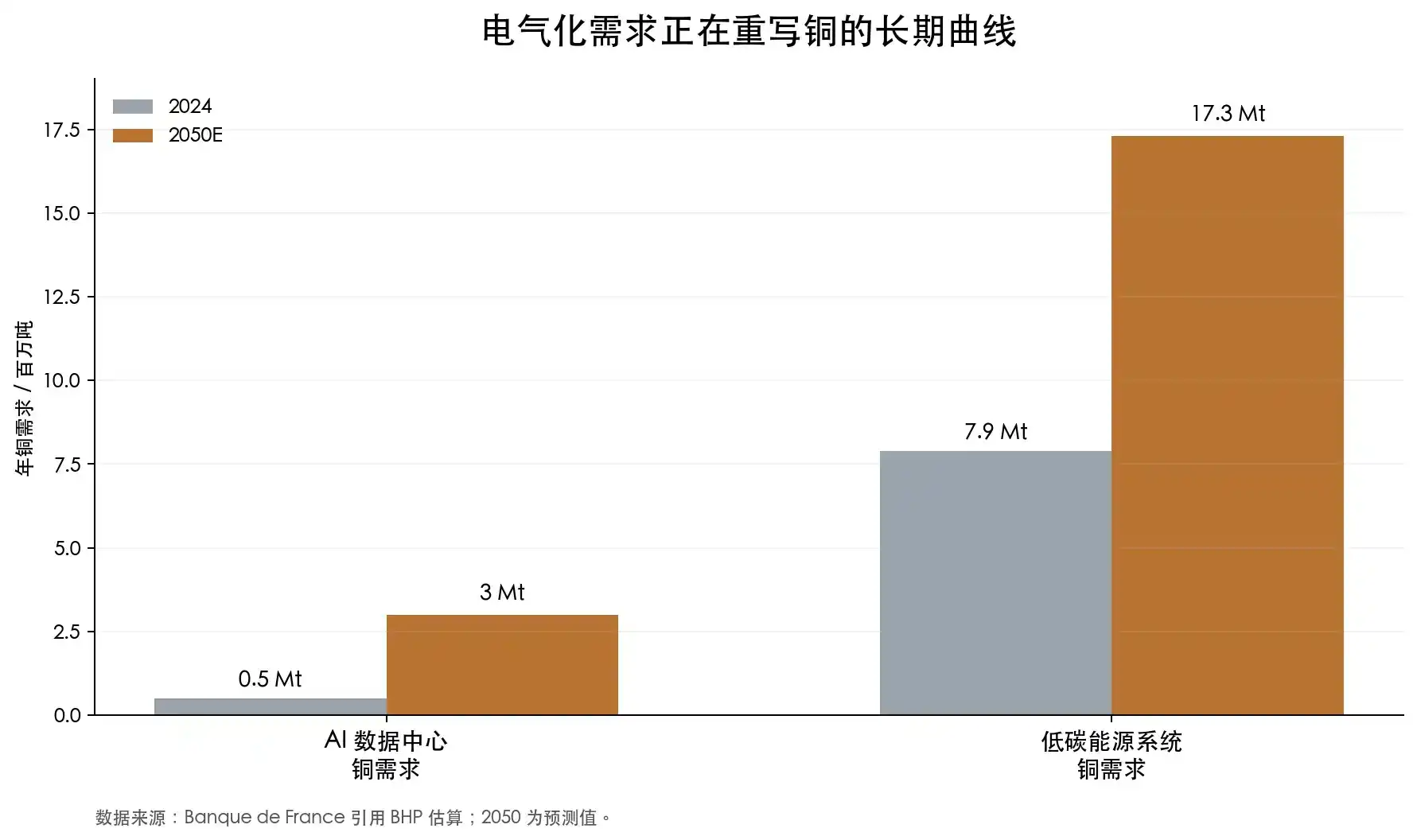
法国央行 Banque de France 在一篇关于 AI 数据中心和铜市场的分析中引用 BHP 估算:AI 数据中心铜需求可能从 2024 年约 50 万吨,增长到 2050 年约 300 万吨。同期,低碳能源系统的铜需求可能从 790 万吨升至 1730 万吨。文章还引用了一个具体案例:微软芝加哥数据中心建设消耗了 2177 吨铜。

单看这个数字,它在全球铜市场里不算特别大。但重点不在于某一个数据中心用了多少铜,而在于 AI 数据中心背后不是单点需求,而是一整套电力基础设施需求。GPU 越密,机柜功率越高,数据中心就越像一座高耗能工厂。工厂要用电,用电就要电网、变压器、电缆、母线、开关设备和冷却系统。
当然,也不能把铜的所有故事都简单归到 AI 上。

全球大宗商品贸易巨头 Trafigura 的 CEO Richard Holtum 在 2025 年 LME Week 上提醒过,数据中心和国防确实很热,但未来十年铜需求的大头仍然来自传统基础设施、建筑、城市化和消费品。他还提到,当年空调用铜仍然超过数据中心用铜。

这个观点也给了我们新的视角:铜的需求增加不只是靠 AI 单点支撑,它的需求量在于几乎所有用电场景都在同时扩张。

铜最大的牛市逻辑,是它挖不出来那么快

很多人对铜的第一印象是「工业金属」,总觉得只要价格涨了,矿山多挖一点,供应自然就上来。但真实情况不是这样。

大型铜矿从发现、勘探、资源确认、可研、融资、许可、建设到投产,通常要十几年。IEA 的报告显示,新铜项目从发现到生产平均需要约 17 年。这意味着,如果市场在 2026 年突然发现铜不够用,真正大规模的新供给未必能在 2028 年、2029 年出现,很多供给要等到 2030 年代。

加拿大矿业公司 Ivanhoe Mines 的创始人和执行联席主席 Robert Friedland 就反复强调这个问题。他是全球矿业圈最有名的铜多头之一,在刚果金拥有世界级铜矿项目 Kamoa-Kakula。他的表达一向很激进:世界还没有意识到自己到底需要多少铜。过去十多年,全球没有为电气化时代准备足够多的新铜矿。

这不是他一个人的判断。IEA 的数据也支持这个方向。

全球铜矿平均品位自 1991 年以来已经下降约 40%。品位下降意味着,过去挖一吨矿石能得到更多铜,现在要挖更多矿石、耗更多电、用更多水、处理更多废石,才能得到同样一吨铜。IEA 还提到,在过去 35 年发现的铜矿床中,只有 5% 出现在最近十年。新发现少,老矿品位下降,项目建设周期拉长,资本开支还在上升。IEA 估算,基于当前项目管线,到 2035 年铜市场可能面临 30% 的供给缺口。

所以铜不是普通商品周期里那种「涨价以后供给马上出来」的资产。铜矿项目越来越像大型基础设施工程:要找矿,要拿许可,要处理社区关系,要解决水资源,要面对环保审查,还要承受资源国税收政策变化。

智利、秘鲁、刚果金、赞比亚、印尼、蒙古,这些地方都有重要铜资源,也都有不同形式的政治、税收、社区或运营风险。铜越战略,资源国越有动力提高分成;铜价越高,矿企越容易面对加税和重新谈判。

冶炼端也在暴露紧张。

铜精矿进入冶炼厂后,会被加工成精炼铜。冶炼厂向矿山收取的加工费和精炼费,行业里叫 TC/RC,也就是 treatment charge 和 refining charge。正常情况下,精矿供应充足,冶炼厂议价能力强,TC/RC 较高;精矿紧张,冶炼厂抢原料,TC/RC 就会下跌。

2026 年比较反常的一点是,铜价创新高,冶炼加工费却跌到历史低位。IEA 称,2026 年年度 TC/RC 基准降到每吨 0 美元,现货 TC/RC 自 2024 年以来已经为负。

这比单纯看交易所库存更关键。因为铜的瓶颈不只在精炼铜成品,也在矿山和精矿。上游原料紧,冶炼厂再多也没用。中国过去二十年大幅扩张铜冶炼能力,IEA 称中国占 2005 年以来全球铜冶炼产量增长的 90% 以上,到 2025 年约占全球铜冶炼产量一半。中游能力很强,上游矿山偏紧,供应链的脆弱性就被放大了。

黄金的稀缺来自储量、开采成本和货币属性。铜当然不是黄金,但当它的新增供给越来越慢、资源越来越集中、战略属性越来越强,它也开始拥有某种类似黄金的稀缺感。

宏观资金为什么开始喜欢铜

铜以前主要属于商品交易员和矿业分析师。现在,它也越来越吸引宏观资金。

比如 Stanley Druckenmiller,他是美国最知名的宏观投资人之一,曾和索罗斯一起管理量子基金,后来创立 Duquesne Family Office。他的特点是做大周期、重仓高置信度交易,所以市场很关注他怎么看 AI、美元、债券和大宗商品。

最近他在 Morgan Stanley 的访谈里提到,自己的组合过去几年主要由 AI 驱动,但现在已经转向更宏观和地缘政治的定位。他提到持有铜,看跌美元,也持有黄金作为地缘政治对冲。

他的逻辑是:美元如果走弱,以美元计价的大宗商品会受益。财政赤字扩大、政府继续投钱、地缘风险上升,黄金有买盘;同一环境下,电网、军工、AI 数据中心、能源系统和制造业回流也会带来实物资产需求,铜就站在这些方向的交叉点上。

Druckenmiller 代表的是宏观资金的视角,商品交易圈里还有更激进的表达。

Pierre Andurand 是其中最典型的一个。他是欧洲知名大宗商品对冲基金经理,早年做能源交易,曾联合创立 BlueGold Capital,后来创办 Andurand Capital。他在接受 Financial Times 采访时给出过非常激进的判断:铜价未来几年可能冲到每吨 40000 美元。

Jeff Currie 的观点也值得一提。Jeff Currie 曾长期担任 Goldman Sachs 大宗商品研究负责人,后来加入 Carlyle,是华尔街商品研究里最有影响力的人之一。他早就提出过「copper is the new oil」的说法,意思是能源转型时代,铜可能扮演类似旧能源时代石油的基础资源角色。2024 年他又把铜称作自己最高确信度的交易之一。
数据上也能看到资金正在进来。

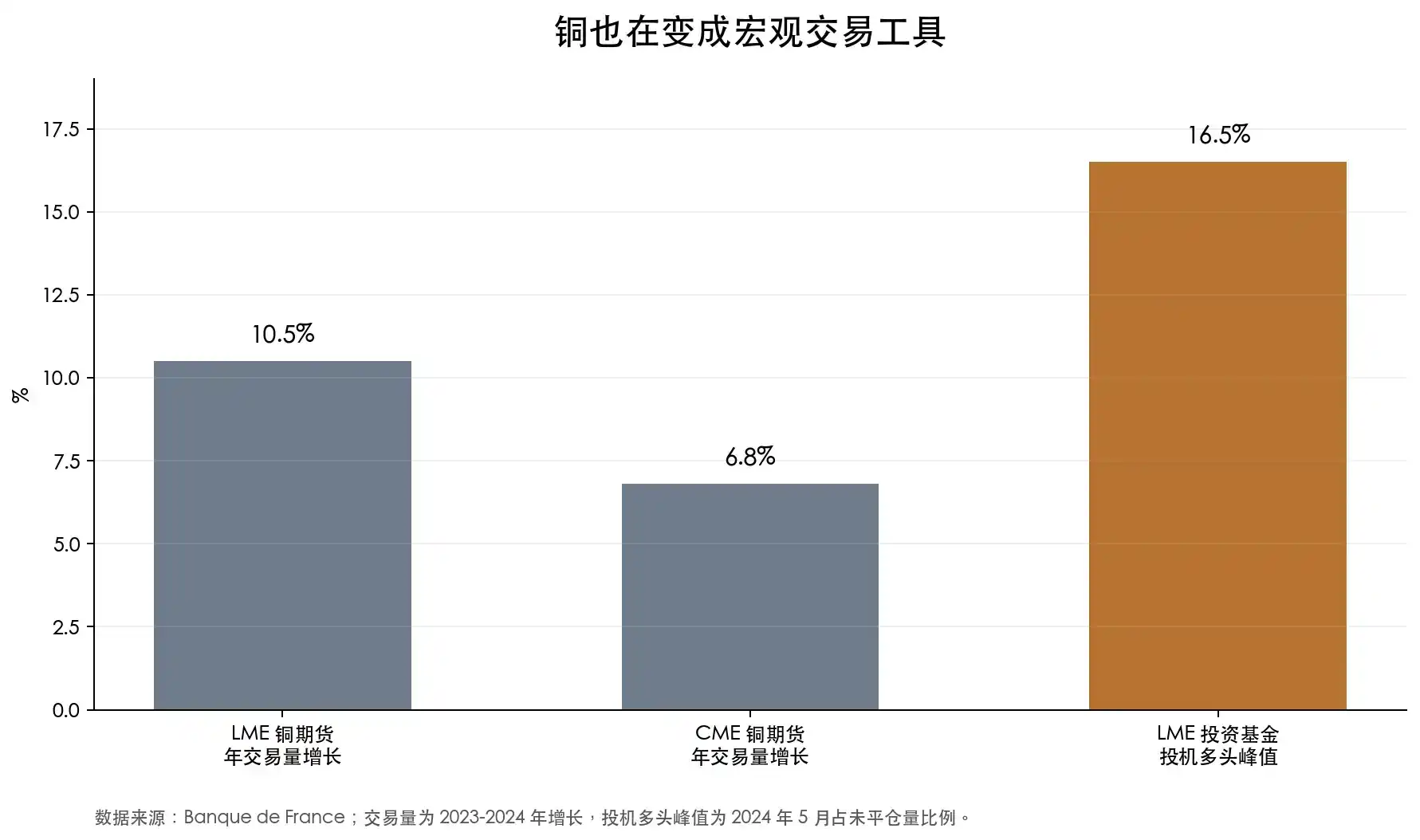
Banque de France 提到,2023 到 2024 年,LME 铜期货年交易量增长 10.5%,CME 铜期货年交易量增长 6.8%;LME 铜期货中,投资基金投机多头在 2024 年 5 月达到未平仓量的 16.5%。这不是简单的实物补库,而是金融资金在把铜当成宏观交易工具。

铜矿股:铜的杠杆

黄金牛市里,黄金股通常会放大金价波动。铜牛市里,铜矿股也有类似的放大器属性。

铜价上涨,对终端用户是成本压力,但对已经拥有产能的矿企来说,可能是利润率扩张。比如铜价从每吨 9000 美元涨到 12000 美元,如果矿企的现金成本没有同步上升,那么新增的 3000 美元很大一部分会直接进入利润表。也正因为如此,铜矿股天然带有经营杠杆。铜价涨一段,矿企利润可能涨更多;铜价回落,利润也会更快收缩。

这两年市场已经把这种杠杆交易出来了。

以 A 股为例,2024 年 6 月到 2026 年 6 月,洛阳钼业是最典型的高弹性样本。它的核心看点是刚果金的铜钴资产,尤其是 Tenke Fungurume 和 KFM。按前复权收盘价粗算,洛阳钼业这两年区间涨幅约 129%,最高时涨幅接近 260%。这不是普通周期股的表现,而是市场在重新定价海外铜矿资源。

江西铜业、铜陵有色、云南铜业这类公司,则更能体现铜价和冶炼属性叠加后的波动。江西铜业区间涨幅约 82%,最高时涨幅超过 200%;铜陵有色区间涨幅约 77%,最高时涨幅约 159%;云南铜业区间涨幅只有约 29%,但最高时涨幅也超过 130%。

这类股票都体现出了铜矿股的另一面:行情来的时候,弹性很大;行情退潮时,回撤也很凶。

从高点回撤看,波动更直观。云南铜业从区间高点回撤约 45%,江西铜业回撤约 41%,洛阳钼业、北方铜业、紫金矿业也都有 30% 以上的回撤。铜矿股不是铜价本身,它是铜价、成本、库存、TC/RC、项目进度、资源国风险和权益市场情绪共同作用的结果。

美股里,最典型的铜矿股代表是 Freeport-McMoRan,代码 FCX。它是美国最核心的铜生产商之一,资产包括美国 Morenci、秘鲁 Cerro Verde 和印尼 Grasberg。对全球资金来说,FCX 几乎是买铜价敞口最常用的美股工具之一。MarketWatch 数据显示,FCX 在 2026 年 6 月 2 日触及 52 周高点 72.09 美元,但 6 月 5 日单日下跌 9.07%,几天内就从高点回撤超过 12%。

Southern Copper,代码 SCCO,是另一个高质量铜矿股代表。它的资产主要在秘鲁和墨西哥,铜敞口高,盈利能力强。IBD 今年早些时候提到,SCCO 年内一度上涨 55%,并创出历史新高。相比 FCX,SCCO 更像纯度较高、盈利质量较好的铜矿资产,但它同样逃不开铜价和资源国风险。

如果投资者不想押单一公司,也可以看铜矿 ETF。比如 Global X Copper Miners ETF,一只跟踪全球铜矿公司的 ETF。

不过,铜矿股比铜复杂得多。

一个矿企的价值不只取决于铜价,还取决于矿山品位、现金成本、储量寿命、资本开支、所在国家、税收政策、劳工关系、环保许可、运输条件和管理层执行力。铜价能抬高整个板块估值,最后公司之间会出现很大分化。

资源国风险尤其重要。很多优质铜矿分布在智利、秘鲁、刚果金、赞比亚、蒙古、印尼。资源禀赋好,不代表股东回报稳定。铜越值钱,政府越会重新计算分成;项目越大,社区、环保、用水和基础设施问题越难处理。

成本通胀也会吃掉利润。铜价上涨时,能源、设备、人工、钢材和融资成本常常一起上涨。一个看起来很美的开发项目,可能因为资本开支超预算、投产延期、许可受阻,最后没有给股东留下多少收益。

早期铜矿公司风险更高。它们讲的是未来储量和未来产量,但从资源量到可采储量,从可研到融资,从许可证到建设,每一步都可能失败。铜的长期逻辑成立,不等于每只铜矿股都能兑现。

所以,铜矿股更适合被理解成铜价逻辑的杠杆表达,而不是铜价本身的简单替代品。它们可以提供更高弹性,也会带来更大回撤。真正值得研究的是低成本、长寿命、扩产路径清楚、资产负债表稳健、政治风险可控的公司。

这也是铜「黄金化」的一部分:铜的稀缺逻辑不只停留在现货和期货市场,它正在被股票市场、ETF 和投机资金重新包装。铜价上涨是一层交易,铜矿股上涨是另一层交易。前者反映商品本身,后者反映市场愿意为这场长期短缺付出多少想象力。

铜的「黄金化」,才刚刚开始

这个世界需要更多电,而更多电意味着更多铜。

当然,铜不会真的变成黄金。它没有黄金那样纯粹的货币属性,也不会摆脱经济周期。全球经济放缓、制造业走弱、风险资产降温,都会压制铜价。铜依然会波动,甚至可能剧烈波动。

但变化在于,铜的下方逻辑和过去不一样了。

过去铜价大跌,常常发生在需求转弱叠加供给过剩的时候。今天的供给端没有那么宽松。矿山老化、品位下降、许可周期拉长、冶炼端抢原料、资源国重新分配利益,这些因素让铜越来越难被简单当成一个普通的周期品。

它可能还是工业金属,但它不再只是工业周期的缩影。

铜的「黄金化」,才刚刚开始。

Perguntas relacionadas

Q文章中提到,铜的稀缺性逻辑和过去有什么本质区别?

A过去铜价下跌主要是因为需求转弱和供给过剩。如今,供给端变得不再宽松,矿山老化、品位下降、新项目从勘探到投产周期长达十几年、冶炼厂争夺原料、资源国政策变动等因素,使铜的供给弹性降低,不再能被简单地视为一个普通的周期性工业品,其下方支撑逻辑变得更强,更接近某种战略性、结构性稀缺。

Q根据文章,AI数据中心对铜的需求主要体现在哪些方面?

AAI数据中心对铜的需求不仅是采购GPU等芯片本身,更体现在其配套的庞大电力基础设施上,包括电网接入、变压器、母线槽、电缆、开关设备以及液冷系统等。GPU集群功率密度极高,使得数据中心像一座高耗能工厂,从而产生了对铜的结构性需求。

Q文中引用Pierre Andurand和Jeff Currie的观点,分别表达了什么核心判断?

APierre Andurand(大宗商品对冲基金经理)给出了一个非常激进的判断,他认为铜价未来几年可能上涨至每吨40,000美元。Jeff Currie(前高盛大宗商品研究负责人)则提出了“铜是新的石油”的说法,认为在能源转型时代,铜扮演着类似旧能源时代石油的基础性战略资源角色,并曾将铜列为最高确信度的交易之一。

Q文章中如何解释“TC/RC费用跌至历史低位甚至为负”这一现象?

ATC/RC(加工费和精炼费)是冶炼厂向矿山收取的费用。该费用跌至历史低位甚至为负,表明上游铜精矿供应非常紧张,冶炼厂为了争夺有限的原料而被迫降低甚至放弃加工利润。这比交易所库存下降更能揭示供应链的瓶颈所在:中游冶炼产能(尤其在中国)充足,但上游矿山供给严重不足。

Q投资铜矿股相比直接投资铜(如期货)有哪些额外的风险和复杂性?

A投资铜矿股远为复杂,其价值不仅取决于铜价,还受到矿山品位、现金成本、储量寿命、资本开支、资源国政治与税收风险、环保许可、社区关系、劳工问题、管理层执行力以及成本通胀(能源、人工、设备等)等多重因素的影响。铜矿股是铜价逻辑的杠杆表达,可能带来更高的收益弹性,但伴随更大的股价回撤风险和公司个体经营风险。

Leituras Relacionadas

Can SK Hynix's Stock Double Again in This Rally?

The article discusses the highly optimistic price target of approximately $3,500 for SK Hynix stock, set by Aletheia Capital. This target is significantly above the consensus range of $2,000-$2,520 from major brokerages. The core debate is whether SK Hynix deserves a fundamental re-rating beyond its traditional cyclical discount, based on the long-term impact of AI-driven demand. The $3,500 target hinges on three key assumptions holding simultaneously until at least 2027: 1) Continued shortage and high pricing for HBM (High Bandwidth Memory), a critical component for AI chips; 2) Sustained high prices for standard DRAM, as HBM production consumes capacity and constrains general supply; and 3) Strong AI server demand generating substantial, above-expectation free cash flow. SK Hynix's leading ~58% market share in HBM and its early certification with key clients like Nvidia provide a competitive advantage, allowing it to capture significant supply chain premiums. The HBM shortage is seen not just as a niche growth driver but as a catalyst that amplifies profitability across the entire memory business by tightening overall DRAM supply. However, the article cautions that this target represents an optimistic "tail scenario." Key risks include potential supply increases from competitors (Samsung, Micron) by 2027, a possible slowdown in HBM price growth, and high capital expenditures that could erode the projected free cash flow. The divergence in analyst targets reflects the market's uncertainty over whether the current AI-driven boom will temporarily elevate earnings or permanently raise the memory industry's profit baseline.

marsbitHá 2m

Can SK Hynix's Stock Double Again in This Rally?

marsbitHá 2m

Has the Cryptocurrency Market Hit Bottom? Here's What Institutions Think

"Has the crypto market bottomed out? Major institutions are divided on the outlook, according to a recent analysis by Matt Hougan, Chief Investment Officer of Bitwise. Three prominent research firms published in-depth reports on the topic with differing conclusions. Galaxy Digital argues Bitcoin has not yet found its bottom, pointing to only 4 out of 13 historical bottoming indicators being met. Their analysis suggests a potential bottom range of $30,000 to $54,000. NYDIG adopts a more cautious stance, noting that while metrics are close to historical bear market lows, a classic panic-selling capitulation event is missing. They acknowledge the possibility of a bottom but consider it unlikely, citing structural changes from institutional adoption. In contrast, Standard Chartered Bank asserts the bottom is already in at around $59,000. Their revised bullish view, predicting a year-end target of $100,000, hinges on anticipated reductions in ETF selling pressure linked to events like a potential SpaceX IPO. Despite the surface-level disagreement on the exact price floor, the reports share significant common ground crucial for long-term investors. All three institutions agree that a market bottom will likely form within the current year, that current prices are closer to the bottom than to previous cycle highs, and that Bitcoin is poised for another major bull cycle in the future. The core takeaway is that while the precise bottom level remains debated, the long-term value proposition for Bitcoin remains strong and may even be strengthening. Key supportive trends include rising global debt, persistent inflation, declining trust in traditional institutions, accelerating digitization, and improving market infrastructure. Therefore, for investors with a long-term horizon, the focus should shift from pinpointing the exact bottom to recognizing that the cycle's peak is likely still ahead, making current levels an attractive entry point for substantial potential upside."

Foresight NewsHá 23m

Has the Cryptocurrency Market Hit Bottom? Here's What Institutions Think

Foresight NewsHá 23m

2029 Finale Prediction: When Cryptocurrency Completely "Vanishes", Who Can Remain in This Financial Upheaval?

By 2029, the crypto industry will have transformed into a largely invisible but foundational layer for traditional finance. This timeline outlines the key shifts from now until then. By mid-2026, the most sought-after assets on-chain will not be traditional tokens, but synthetic perpetual contracts for private, high-growth companies (like SpaceX, OpenAI). These become primary price discovery tools, highlighting the market's craving for real-world asset value. Most altcoins enter a sustained bear market as their fundamental lack of asset-backed value is exposed. In late 2026, the "AI + Crypto" narrative largely fades as AI giants prove they don't need crypto infrastructure, except for prediction markets betting on model performance. Simultaneously, a quiet but significant wave of tokenization for institutional assets (money market funds, private credit) begins. The industry splits into a noisy speculative economy and a silent institutional one. Throughout 2027, major public blockchain foundations pivot decisively to serve institutional clients, building compliance toolkits and sales teams. However, key sectors hit growth ceilings: private perpetual contracts are legally restricted from public promotion, stable币 growth is capped by looming political uncertainty, and tokenization projects remain cautious. In 2028, following a U.S. election assumed to maintain a regulatory (not prohibitive) stance, a pivotal change occurs. After a major liquidation crisis exposes the flaws of synthetic contracts lacking a real-asset anchor, new regulations allow the *public solicitation* of private security sales (secondary market shares) to accredited investors. This creates a legitimate, direct on-ramp for retail capital into previously illiquid private equity. By 2029, the resulting bull market is driven by trading in real, innovative company shares (biotech, robotics, AI labs), not speculative tokens. "Crypto" as a distinct asset class recedes; it becomes the mundane, unseen plumbing for this new global private markets infrastructure. Tokens that survive are those capturing real cash flows from this infrastructure. Speculation persists but is marginalized. The core questions posed at the start are answered: token value is tied to legally enforceable claims on real assets, frontier tech adoption happens via private market channels, and crypto's absorption into traditional finance is marked by its becoming boring and invisible. The key validation for this entire thesis is whether, by late 2028, a legal pathway exists for ordinary accredited investors to access private assets directly.

marsbitHá 1h

2029 Finale Prediction: When Cryptocurrency Completely "Vanishes", Who Can Remain in This Financial Upheaval?

marsbitHá 1h

Trading

Spot
Futuros

Artigos em Destaque

Como comprar ERA

Bem-vindo à HTX.com!Tornámos a compra de Caldera (ERA) simples e conveniente.Segue o nosso guia passo a passo para iniciar a tua jornada no mundo das criptos.Passo 1: cria a tua conta HTXUtiliza o teu e-mail ou número de telefone para te inscreveres numa conta gratuita na HTX.Desfruta de um processo de inscrição sem complicações e desbloqueia todas as funcionalidades.Obter a minha contaPasso 2: vai para Comprar Cripto e escolhe o teu método de pagamentoCartão de crédito/débito: usa o teu visa ou mastercard para comprar Caldera (ERA) instantaneamente.Saldo: usa os fundos da tua conta HTX para transacionar sem problemas.Terceiros: adicionamos métodos de pagamento populares, como Google Pay e Apple Pay, para aumentar a conveniência.P2P: transaciona diretamente com outros utilizadores na HTX.Mercado de balcão (OTC): oferecemos serviços personalizados e taxas de câmbio competitivas para os traders.Passo 3: armazena teu Caldera (ERA)Depois de comprar o teu Caldera (ERA), armazena-o na tua conta HTX.Alternativamente, podes enviá-lo para outro lugar através de transferência blockchain ou usá-lo para transacionar outras criptomoedas.Passo 4: transaciona Caldera (ERA)Transaciona facilmente Caldera (ERA) no mercado à vista da HTX.Acede simplesmente à tua conta, seleciona o teu par de trading, executa as tuas transações e monitoriza em tempo real.Oferecemos uma experiência de fácil utilização tanto para principiantes como para traders experientes.

486 Visualizações TotaisPublicado em {updateTime}Atualizado em 2026.06.02

Como comprar ERA

Discussões

Bem-vindo à Comunidade HTX. Aqui, pode manter-se informado sobre os mais recentes desenvolvimentos da plataforma e obter acesso a análises profissionais de mercado. As opiniões dos utilizadores sobre o preço de ERA (ERA) são apresentadas abaixo.

活动图片