Super-Rich Hoarded Record Cash in February, Stock Market Hit New Highs Four Months Later: Who's Getting Fooled?

marsbitPublicado em 2026-06-15Última atualização em 2026-06-15

Resumo

In February, the total assets in US money market funds reached a record high of approximately $8.25 trillion, a trend highlighted by high-net-worth individuals increasing their cash holdings. Notably, Warren Buffett's Berkshire Hathaway amassed a $381.7 billion cash pile ahead of his 2025 retirement, while other prominent figures like Peter Thiel sold tech stocks, fueling narratives of wealthy investors seeking safety. However, by June, the trend reversed. Money market fund assets fell to around $7.87 trillion, indicating a flow of capital back into equities. Concurrently, the S&P 500 and Nasdaq reached all-time highs, with the S&P 500 surpassing 7600 points. This market surge occurred despite the earlier defensive moves, highlighting a potential opportunity cost for those who retreated to cash. Analysis shows that since early 2022, the S&P 500's total return significantly outpaced that of prime money market funds. The capital shifted from equities appears to have been partly reallocated into alternative investments like real estate, art, and private credit, especially among ultra-high-net-worth individuals. Meanwhile, major investment banks like Goldman Sachs and Morgan Stanley have raised their year-end targets for the S&P 500, citing AI-driven earnings growth, while also cautioning about risks including market concentration and economic fragility beneath the surface rally.

Author: Claude, Deep Tide TechFlow

Deep Tide Introduction: In February of this year, US money market funds surged to a historical peak of about $8.25 trillion. Buffett left behind $381.7 billion in cash before retirement, and rumors swirled that the super-rich were fleeing the stock market.

But now in June, the plot has reversed: the S&P 500 repeatedly hits new highs, breaching the 7600-point level for the first time on June 2nd, while money market fund assets have fallen back to $7.87 trillion as of June 10th. Money is flowing from cash back into stocks. The safe-haven bet placed by the wealthiest group is now being proven wrong by the market.

The Story in February: Cash in the Hands of the Rich Piled Up to a Record High

Let's rewind to the beginning of the year.

According to a Goldman Sachs survey from October 2025, high-net-worth individuals with over $1 million in investable assets held, on average, about 20% of their net worth in cash and cash equivalents—a proportion considered high for traditional allocation.

The most symbolic figure was Buffett.

As reported by Bloomberg, before his retirement on December 31, 2025, the former CEO of Berkshire Hathaway had built the company's cash reserves to approximately $381.7 billion as of the end of the third quarter of 2025. This cash pile even ended up making money—despite market turmoil, Buffett's personal net worth still grew by about $21 billion last year.

He wasn't the only one reducing holdings. According to Reuters' disclosures of holdings documents, PayPal co-founder Peter Thiel, through his hedge fund Thiel Macro, sold about $100 million worth of Nvidia stock in Q3 2025. Nvidia rose nearly 35% in 2025; Thiel exiting at a high point added fuel to concerns about an "AI bubble."

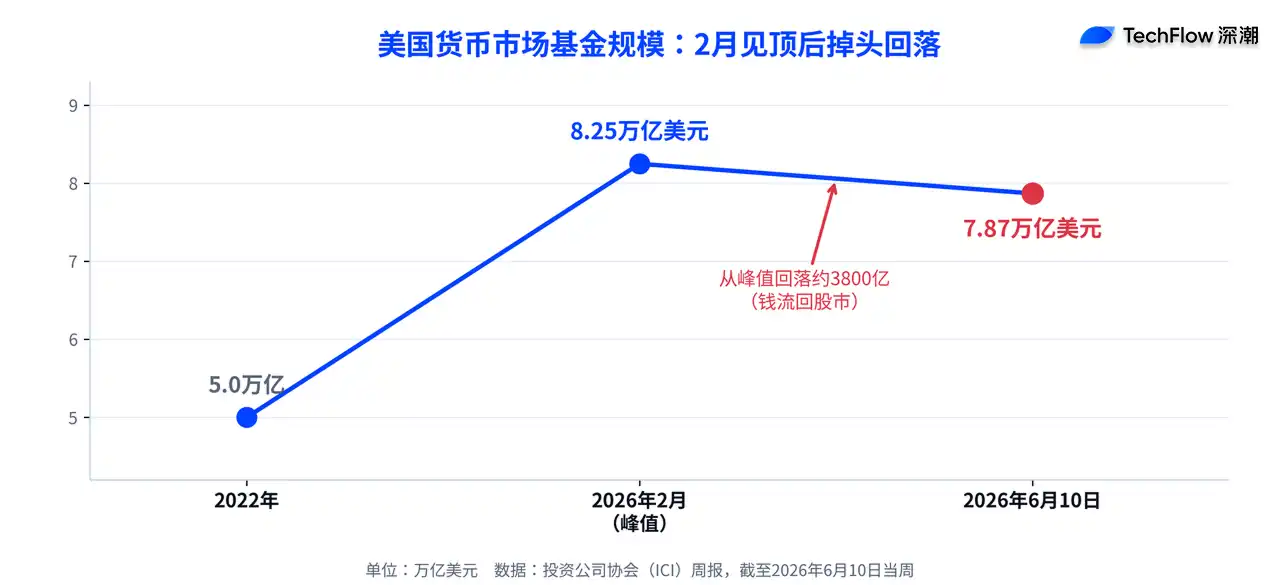
The market direction was the same. According to data from the Investment Company Institute (ICI), US money market fund assets surged to a historical peak of about $8.25 trillion at the end of February this year, a 65% increase from about $5 trillion in 2022. The narrative back then was clear: smart money was hiding in cash.
The June Reversal: Money is Flowing from Cash Back into Stocks

The problem is, it's June now, and the story has flipped.

According to official ICI data, as of the week ending June 10th, money market fund assets dropped to $7.87 trillion, with a single-week outflow of $21.48 billion; the previous week, June 4th, it was $7.89 trillion. From the February peak of $8.25 trillion, assets have shrunk by about $380 billion. Money is flowing *out* of cash, not in.

Where is it going? Stocks. According to CNBC, the S&P 500 closed at 7609.78 points on June 2nd, breaking above the 7600-point level for the first time in history, marking its ninth consecutive day of gains; the Nasdaq also hit new highs. Nvidia surged over 6% in a single day after releasing its new generation of PC chips, boosting Dell and HP. In short, the money that hid in cash back in February is now watching the market hit new highs without them.

There was an early signal behind this. According to investingLive reports, Bank of America (BofA) warned as early as late May that as the market surged to new highs and bullish sentiment peaked, cash levels were actually declining. The $8.25 trillion record was old news from February; by June, the market landscape was a different story.

The Cost of Hoarding Cash: Lagging Stocks by More Than Double

Why is the wealthy's safe-haven move being proven wrong? Look at the return gap.

According to calculations by The Motley Fool, if one had held from the point before the 2022 bear market when cash was flowing into money market funds all the way to the present, the total return for the S&P 500 would be about 42%, while the Vanguard Federal Money Market Fund returned only 18% over the same period—a gap of more than double. Hiding in cash seems safe, but the cost is missing a big chunk of the rally.

This is also why many analysts remain skeptical of the "pile into cash at the first sign of trouble" approach:

Historically, events like geopolitical conflicts are often short-term and can instead be buying opportunities at low points, not reasons to sell out.

Those Who Moved Money Out of Stocks Went into Real Estate and Art

The money freed up by those who did reduce stock holdings hasn't been idle. The Goldman Sachs survey shows that among those with $1 million to $5 million in investable assets, nearly 40% hold alternative investments; among those with over $10 million, this proportion reaches 80%. The greater the assets, the more they move beyond traditional stocks.

Art is one destination. According to UBS's 2025 Art Market Report, high-net-worth collectors allocated an average of about 20% of their wealth to art in 2025. Real estate, private credit, and hedge funds are also absorbing funds flowing out of the stock market. The logic is that in an environment of sticky inflation, high interest rates, and uncertain tariff prospects, these asset classes resemble safer harbors. But even safe harbors have a cost, as the earlier set of return numbers demonstrates.

Major Banks Are Still Doubling Down: Goldman Sachs, Morgan Stanley Raise Price Targets

If the wealthy's moves in February leaned defensive, Wall Street banks' stance in June is the opposite.

According to Bloomberg, Goldman Sachs' strategy team (led by Ben Snider) raised its year-end target for the S&P 500 from 7600 points to 8000 points in late May, citing AI-driven earnings growth. Goldman increased its 2026 S&P 500 earnings-per-share forecast to $340, representing a 24% year-on-year growth, and believes AI infrastructure beneficiaries will contribute about half of this year's index earnings growth. However, Goldman also cautioned: "AI sentiment and interest rates present risks in both directions."

Morgan Stanley is even more bullish. Chief Investment Officer for Wealth Management Lisa Shalett, in an outlook on May 20th, set a one-year target of 8300 points for the S&P 500, implying about 11% to 12% upside. But she also listed five risks: gains excessively concentrated in a few large-cap AI stocks, deteriorating US consumer finances, corporate profits reliant on price hikes rather than productivity, pressure on long-term interest rates, and better performance outside the US (Japan and some emerging markets). Shalett's core judgment is that the market's surface is stronger than the underlying economy.


Criptomoedas em alta

Perguntas relacionadas

QAccording to the article, what significant record did U.S. money market funds reach in February, and what was the narrative at that time?

AIn February, U.S. money market funds surged to a historical peak of approximately $8.25 trillion. The prevailing narrative at that time was that smart money was seeking shelter in cash, with super-wealthy individuals appearing to withdraw from the stock market.

QHow has the situation changed by June, specifically regarding the flow of funds and stock market performance?

ABy June, the situation reversed. Money market fund assets had decreased to $7.87 trillion by June 10, indicating an outflow of cash. Conversely, the stock market reached new highs, with the S&P 500 closing above 7600 points for the first time on June 2, marking a nine-day winning streak.

QWhat was the performance gap between holding cash (in a money market fund) and holding stocks (the S&P 500) from the start of the 2022 bear market to the present, as cited in the article?

AFrom the start of the 2022 bear market to the present, the S&P 500 delivered a total return of approximately 42%, while the Vanguard Federal Money Market Fund returned only about 18%. Holding cash thus resulted in missing more than double the returns of the stock market over that period.

QWhere are wealthy individuals, who reduced their stock holdings, reallocating their capital according to the Goldman Sachs survey mentioned in the article?

AAccording to the Goldman Sachs survey, wealthy individuals who reduced stock holdings are reallocating capital into alternative investments. This includes areas such as real estate, art, private credit, and hedge funds. Nearly 40% of those with $1-5 million in investable assets and 80% of those with over $10 million hold such alternative investments.

QWhat are the updated year-end price targets for the S&P 500 from Goldman Sachs and Morgan Stanley, and what are their primary reasons for these bullish forecasts?

AGoldman Sachs, led by strategist Ben Snider, raised its year-end target for the S&P 500 to 8000 points from 7600, citing AI-driven earnings growth. Morgan Stanley's Chief Investment Officer Lisa Shalett set a one-year target of 8300 points, forecasting about 11-12% upside, based on continued market strength, though she also listed several underlying economic risks.

Leituras Relacionadas

Polymarket's Sixth Anniversary: Bathroom, Exile, and Homecoming

Polymarket, a prediction market platform, recently celebrated its sixth anniversary. Born during New York's COVID-19 lockdown, founder Shayne Coplan built the initial product from his bathroom. The platform allows users to trade on the outcomes of real-world events, aiming to aggregate information faster than traditional media or polls. Its early years involved navigating regulatory challenges, most notably a 2022 CFTC order and penalty for offering unregistered event contracts, which led to a ban on U.S. users. Despite this "exile," the platform persisted, gaining significant traction during major news events like the 2024 U.S. presidential election, where its markets often preceded mainstream narratives. A pivotal shift occurred in 2025. Following the conclusion of a DOJ/CFTC investigation, Polymarket strategically acquired a CFTC-regulated exchange (QCX) to re-enter the U.S. market legally. It secured a massive strategic investment from Intercontinental Exchange (ICE), NYSE's parent company, and formed high-profile partnerships with sports leagues like the NHL, UFC, and MLB, as well as media outlets including Google and the Wall Street Journal. Now valued in the tens of billions, Polymarket stands at the intersection of crypto, finance, media, and sports. Its journey reflects a constant tension between innovative information aggregation and regulatory scrutiny, evolving from a fringe crypto experiment into a mainstream, albeit still contested, financial and data infrastructure.

marsbitHá 31m

Polymarket's Sixth Anniversary: Bathroom, Exile, and Homecoming

marsbitHá 31m

The 'Side Hustle Survival' of DAT Companies: After the Accumulation Flywheel Stops, They Begin Self-Rescue

"Metaplanet's 'Side Hustle Survival': After the 'Crypto Hoarding Flywheel' Stops, They Begin Self-Rescue" The article discusses the strategic pivot of Digital Asset Treasury (DAT) companies as the once-lucrative model of hoarding cryptocurrencies, pioneered by MicroStrategy, faces challenges. With the crypto bear market and the rise of ETFs offering direct, low-premium exposure, many DAT firms are abandoning the passive treasury model. Prominent examples include ETHZilla, which sold ETH to repay debt and shifted to RWA tokenization, and others like Prenetics Global exiting completely. Facing stalled growth, remaining companies are pursuing two main survival paths. The first path is transforming into institutional crypto asset management platforms and yield funds. SharpLink Gaming exemplifies this by staking 100% of its ETH and partnering with Galaxy Digital to launch a yield fund. GameSquare is taking a more aggressive approach, using AI-driven algorithms across DeFi protocols to seek higher returns. The second path involves becoming blockchain infrastructure operators, particularly in the Solana ecosystem. Companies like DeFi Development and SOL Strategies are moving beyond holding SOL to operating validator networks and launching liquid staking tokens, building fee-based revenue models from ecosystem participation. The article notes these transitions reflect a broader industry maturation, shifting from financial engineering to building operational moats through technology, network effects, and deep ecosystem integration. However, risks remain, including DeFi protocol vulnerabilities and dependence on specific blockchain networks' health. Ultimately, this collective shift signals that in crypto, sustainable value comes not from capital games but from active participation, cash flow generation, and providing real utility—a necessary, if painful, step towards industry maturity.

marsbitHá 32m

The 'Side Hustle Survival' of DAT Companies: After the Accumulation Flywheel Stops, They Begin Self-Rescue

marsbitHá 32m

Annual Revenue of 13 Billion, Paying 17.2 Billion to Microsoft: The Truth Behind AI's Money-Burning in OpenAI's Leaked Ledger

Leaked OpenAI financial documents from June 2026 revealed that in 2025, the company achieved $13.07 billion in revenue, a 253% growth from 2024. However, this was accompanied by an operational loss of $20.92 billion and a net loss of roughly $8 billion. Despite ChatGPT surpassing 900 million weekly active users, the "burn rate" remained high: for every $1 earned, $1.60 was spent. The cost structure shows $34 billion in total costs. R&D was the largest expense at $19.18 billion, which included $10.59 billion paid to Microsoft. Compute costs for model inference were $7.5 billion, with sales and marketing at $5.73 billion. Notably, total payments to Microsoft reached $17.2 billion, accounting for over 50% of OpenAI's total costs and exceeding its annual revenue, highlighting a significant structural burden. This high-cost, high-loss model is an industry-wide trend. xAI reported a 2025 operational loss of $6.4 billion against $3.2 billion in revenue, spending $3 for every $1 earned. Anthropic, with a reported $90 billion annualized revenue by late 2025, also faced pressure with a 40% gross margin, lower than expected due to high inference costs. Combined, these top three firms' operational losses surpassed $30 billion in 2025. OpenAI's vast user base presents a monetization challenge. With only about 50 million of its 900 million weekly users paying (a ~5.6% conversion rate), the compute cost of serving free users is substantial. This contrasts with strategies like Anthropic's, which focuses on premium pricing for enterprise clients. The industry's path to profitability hinges on dramatically reducing marginal costs, particularly for inference, through innovations in specialized chips or model efficiency. Until then, massive capital inflows—like OpenAI's $122 billion funding round in March 2026—remain essential to fund the relentless pursuit of scale and advanced capabilities.

marsbitHá 43m

Annual Revenue of 13 Billion, Paying 17.2 Billion to Microsoft: The Truth Behind AI's Money-Burning in OpenAI's Leaked Ledger

marsbitHá 43m

Trading

Spot
Futuros

Artigos em Destaque

Como comprar SUPER

Bem-vindo à HTX.com!Tornámos a compra de SuperFarm (SUPER) simples e conveniente.Segue o nosso guia passo a passo para iniciar a tua jornada no mundo das criptos.Passo 1: cria a tua conta HTXUtiliza o teu e-mail ou número de telefone para te inscreveres numa conta gratuita na HTX.Desfruta de um processo de inscrição sem complicações e desbloqueia todas as funcionalidades.Obter a minha contaPasso 2: vai para Comprar Cripto e escolhe o teu método de pagamentoCartão de crédito/débito: usa o teu visa ou mastercard para comprar SuperFarm (SUPER) instantaneamente.Saldo: usa os fundos da tua conta HTX para transacionar sem problemas.Terceiros: adicionamos métodos de pagamento populares, como Google Pay e Apple Pay, para aumentar a conveniência.P2P: transaciona diretamente com outros utilizadores na HTX.Mercado de balcão (OTC): oferecemos serviços personalizados e taxas de câmbio competitivas para os traders.Passo 3: armazena teu SuperFarm (SUPER)Depois de comprar o teu SuperFarm (SUPER), armazena-o na tua conta HTX.Alternativamente, podes enviá-lo para outro lugar através de transferência blockchain ou usá-lo para transacionar outras criptomoedas.Passo 4: transaciona SuperFarm (SUPER)Transaciona facilmente SuperFarm (SUPER) no mercado à vista da HTX.Acede simplesmente à tua conta, seleciona o teu par de trading, executa as tuas transações e monitoriza em tempo real.Oferecemos uma experiência de fácil utilização tanto para principiantes como para traders experientes.

222 Visualizações TotaisPublicado em {updateTime}Atualizado em 2026.06.02

Como comprar SUPER

Discussões

Bem-vindo à Comunidade HTX. Aqui, pode manter-se informado sobre os mais recentes desenvolvimentos da plataforma e obter acesso a análises profissionais de mercado. As opiniões dos utilizadores sobre o preço de SUPER (SUPER) são apresentadas abaixo.

活动图片












