The First to Bring an AI OS to 1.4 Billion People Might Actually Be WeChat?

marsbitPublicado em 2026-06-10Última atualização em 2026-06-10

Resumo

WeChat has introduced a significant AI update, allowing mini-program developers to integrate their services with WeChat AI. Developers can choose an "automatic mode," where WeChat AI autonomously analyzes and operates mini-programs without additional coding, or a "development mode" for creating customized skills. This move effectively transforms WeChat's vast ecosystem—including millions of mini-programs, WeChat Pay, and official accounts—into an execution layer for AI. The technical documentation reveals that WeChat's approach aligns with industry standards like MCP (Model Context Protocol) and incorporates practical lessons from AI-agent development. Key design principles include a clear "attention weight" system for API calls and a "fact + action" response structure to ensure reliable operations. Unlike Apple's Siri, which struggles with third-party app integration, WeChat's centralized control over mini-program code provides a "God's-eye view," enabling seamless AI orchestration across services. This development revives the concept of "WeChat OS," where the app could function as a natural-language-operated platform for daily tasks—from booking flights to ordering food—all within a chat interface. While challenges remain in areas like payment security and user trust, WeChat's existing service network and massive user base position it uniquely to advance AI agents from conversation to actionable assistance, potentially making complex tasks feel effortless for its 1.432 bi...

WeChat's AI has finally moved.

On the very same day as Apple's WWDC, WeChat did something potentially more significant than Apple, releasing an unassuming announcement: "Guidance for Developers to Access the WeChat AI Ecosystem."
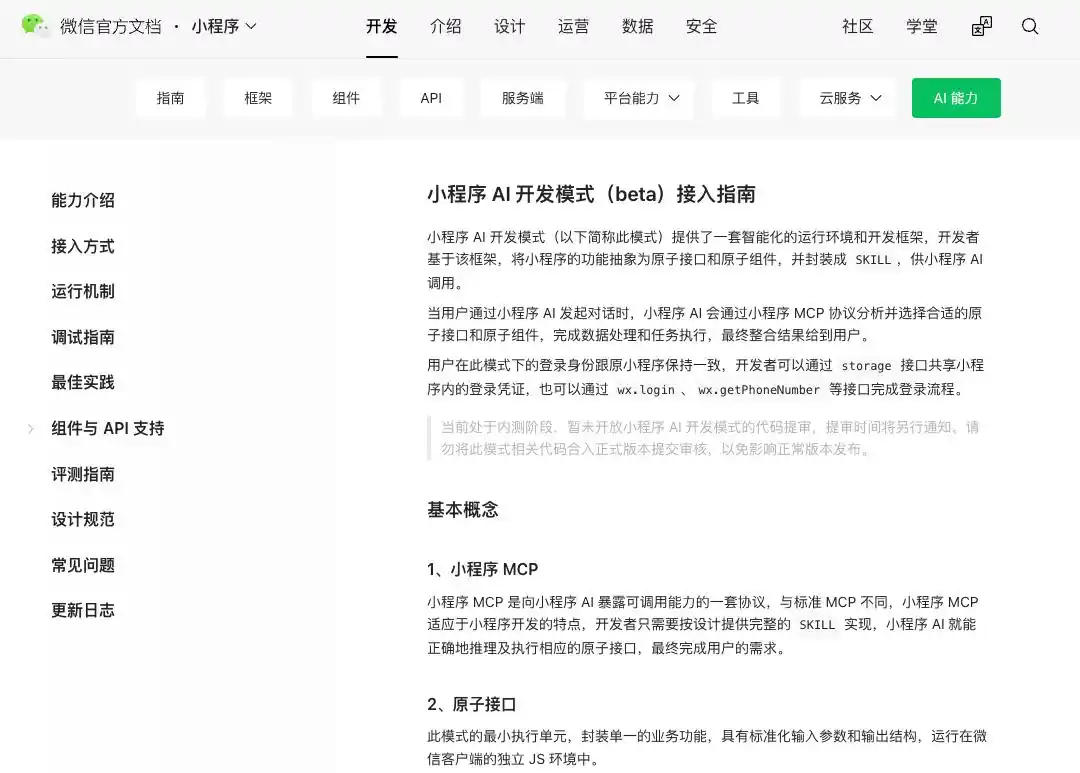
Starting today, Mini Program developers can grant authorization, allowing WeChat AI to read, operate, and invoke the functionalities of Mini Programs.

WeChat offers two access modes. The first is "Automatic Mode," with a nearly zero barrier to entry. Developers simply toggle a switch, and the platform itself reads the source code, analyzes pages, figures out what the Mini Program can do, and then the AI can directly operate it, all without writing a single line of code.

The other mode is called "Developer Mode," where developers create customized Skills, which are called by the AI after passing review. Both modes can be enabled simultaneously. Meituan has already announced its integration.

This should not be understood merely as the launch of another new feature. Instead, it signals that WeChat is turning its entire ecosystem—millions of Mini Programs, WeChat Pay, service notifications, Official Accounts—into the execution layer for AI.

Examining the Skill Documentation: How WeChat AI Invokes Mini Programs

The WeChat open documentation publicly shares the technical specifications for Mini Programs to integrate AI Skills. A close look reveals many design details hidden within.

Official skill documentation guide 👇🏻:

https://developers.weixin.qq.com/miniprogram/dev/ai/best-practices.html
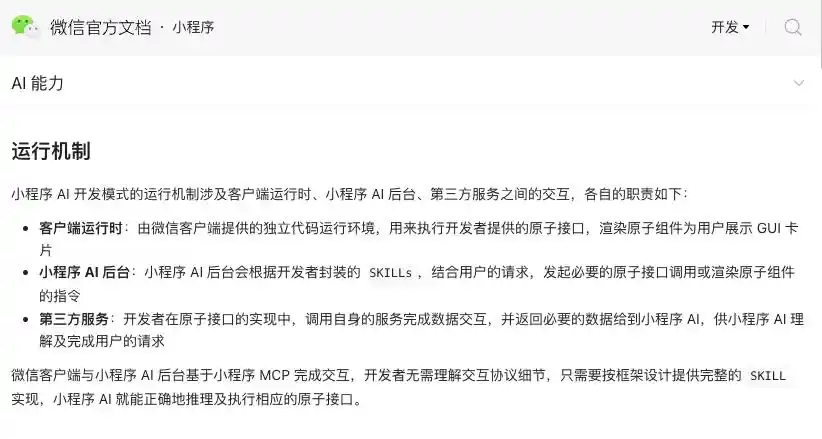
From an architectural perspective, those familiar with AI development will immediately recognize it: it's essentially MCP (Model Context Protocol). The `mcp.json` declares the function and parameters of each atomic interface, and `SKILL.md` describes how the entire business process runs. This is almost identical to the MCP+Skills architecture found in Claude, Cursor, or VS Code. WeChat didn't reinvent the wheel; it directly adopted the industry-standard that is currently converging.

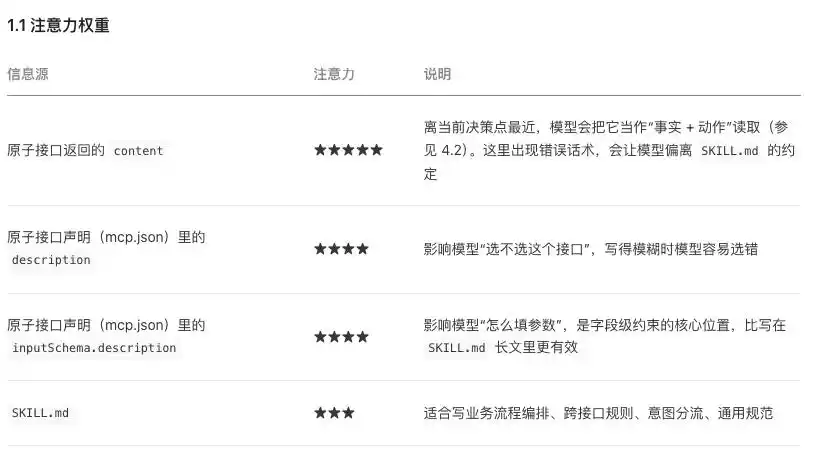
In the guidance, WeChat provides a clear "attention weight" system. When the AI decides which interface to call and what parameters to generate, it gives the highest priority to the content returned by the interface (five stars), followed by the interface description (four stars) and parameter descriptions (four stars) in `mcp.json`. `SKILL.md` ranks last (three stars). This means where developers write something matters more than what they write—the weight the AI gives to the same rule is completely different if it's written in the interface return versus in `SKILL.md`.
At the interface return level, there is a core specification: a two-stage "Fact + Action" format. First, tell the AI "what happened," then tell it "what to do next." If only the action is written without the fact, the AI might interpret "display card" as "prepare to call the next interface" and skip user confirmation. This is a rule learned after stepping into many pitfalls.
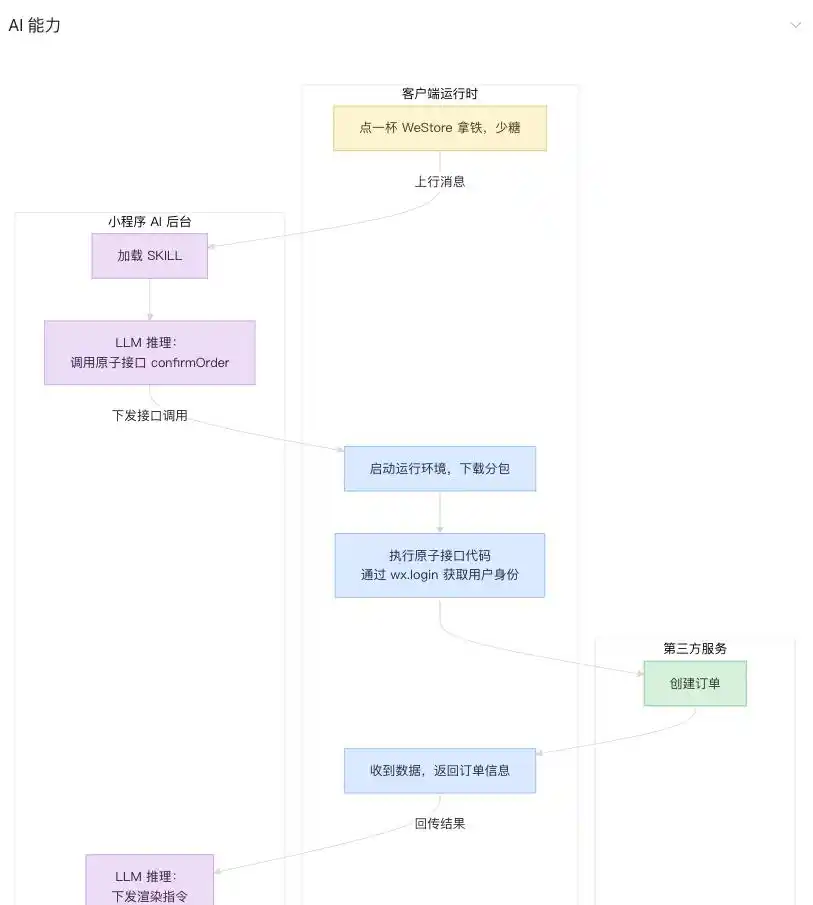
Fourth, parameter passing prioritizes using IDs over natural language. Taking the "Coffee Ordering" scenario in the diagram as an example, after the user states a need, the AI understands the vague intent and handles selection, modification, specification changes, and payment processing, all without leaving the chat dialog.

This design reveals a signal: WeChat has already run enough practical cases, knows where the pitfalls lie in AI calling external services, and has solidified these experiences into developer norms.

In fact, comparing WeChat Mini Programs, which are also known for their "ecosystem," to Apple's apps, WeChat possesses a kind of "God's-eye view" over its own ecosystem. This is the prerequisite for all this implementation.

Why It Might Be More Important Than Apple's AI

This year at WWDC, Apple released the new Siri AI. Despite having Google Gemini integrated at the underlying level and supporting natural language creation for Shortcuts, it didn't spark much discussion.
A closer look reveals the gap: Apple is making AI coordinate some native functions within the iOS system. Once it involves third-party applications—those apps installed on your phone—it becomes strained.

Take Ele.me, for example. Its code runs on Ele.me's own servers, which Apple cannot read. For Siri to call Ele.me, Ele.me's engineers must proactively connect to the App Intents API, negotiating and integrating one by one, a time-consuming and labor-intensive process.
What WeChat is doing is enabling AI to directly operate millions of third-party services, because Mini Programs are different. The code for every Mini Program, from developer submission, through WeChat's review, to finally running on the user's phone, remains entirely within WeChat's technical system throughout the entire process. During the review phase, WeChat can scan the code, automatically analyzing "what pages this Mini Program has, what it can do, what its inputs and outputs are."

This is why "Automatic Mode" is possible—developers don't need to write a single line of code. They just flip a switch, and WeChat itself can translate your Mini Program into a tool the AI can invoke. WeChat's foundational architecture naturally supports this. It possesses a "God's-eye view," enabling scheduling based on centralization.

Apple does not have this architectural advantage, and neither does Google.

Also noteworthy is the recent rumor that WeChat is collaborating with Huawei, Honor, Xiaomi, OPPO, and vivo to launch A2A (Agent-to-Agent) assistant capabilities, allowing users to directly initiate WeChat audio/video calls or send messages via their phone's voice assistant.
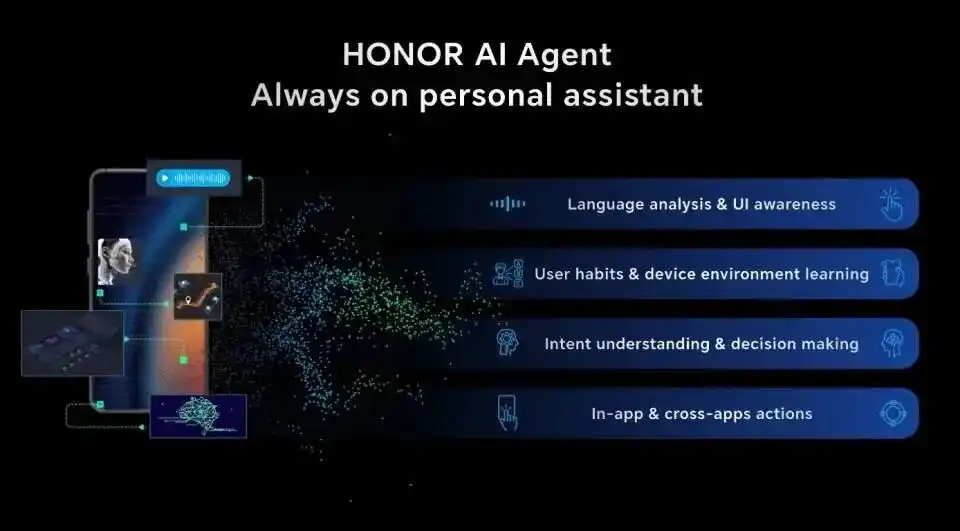
Internally, WeChat AI can invoke millions of Mini Programs. Externally, smartphone manufacturers' AI assistants can invoke WeChat. WeChat is becoming the super connector of the AI era, a service hub that all AIs can access.

The Old Prophecy of "WeChat OS"

When Mini Programs were launched, many joked that WeChat wanted to become "WeChat OS." Back then, it was more of a figure of speech—Mini Programs replaced some app functionalities but were essentially a "light application platform."

More coincidentally, the centralized review mechanism designed at the time was for quality and security control. Nine years later, this design, initially criticized as "excessive control," has unexpectedly become an infrastructure advantage in the AI era. The distributed App ecosystem (Apple/Android) seemed more "free" at the time, but now it has become an obstacle to AI integration.
An old prophecy, due to the emergence of new-era technology—AI—has taken on a transformative change.

Previously, when writing about OpenClaw and Feishu, I mentioned a judgment: IM (Instant Messaging) is the most natural entry point for AI Agents because dialogue itself is the most natural interaction between humans and AI, and the service ecosystem (bots, payments, mini-programs) inherent to IM allows AI not only to "chat" but also to "do." Feishu is already moving in this direction, launching enhanced Bot APIs and AI Agent nodes.
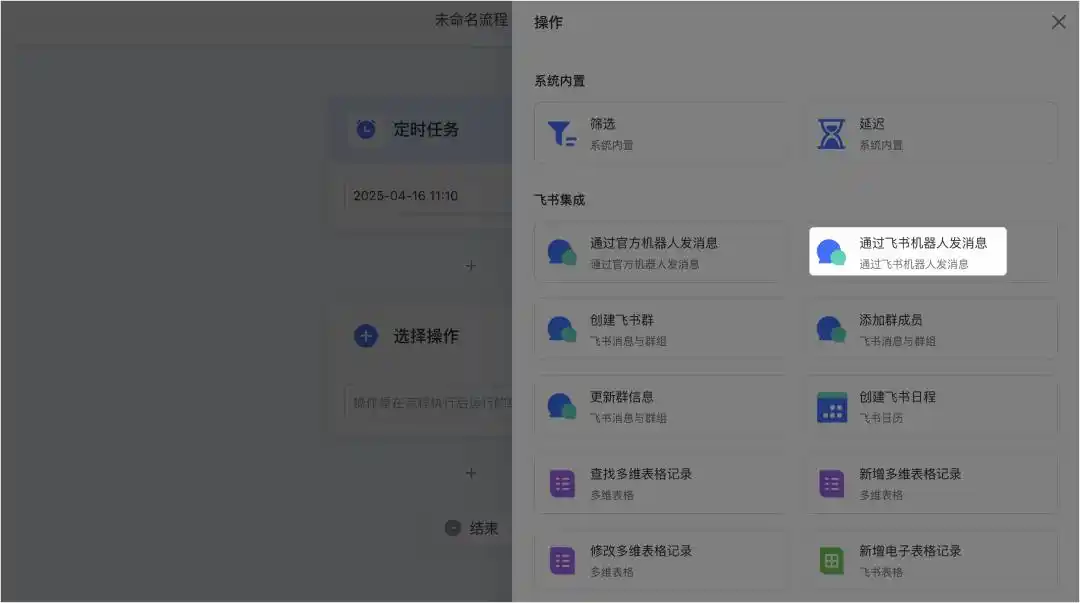
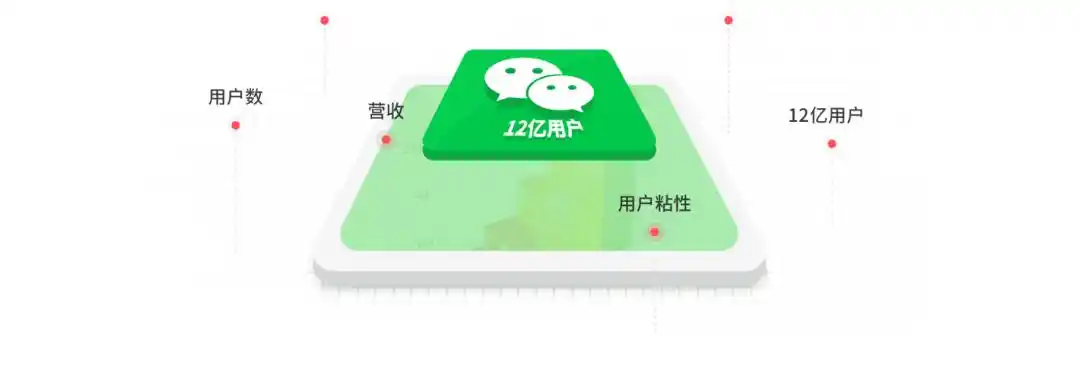
However, Feishu is an enterprise collaboration tool, covering work scenarios. WeChat has a distinctly different breadth—1.432 billion monthly active users, hundreds of Mini Programs across niche sectors, covering almost all service needs of a person's daily life, from ordering takeout to hospital registration to buying flight tickets to paying utility bills.
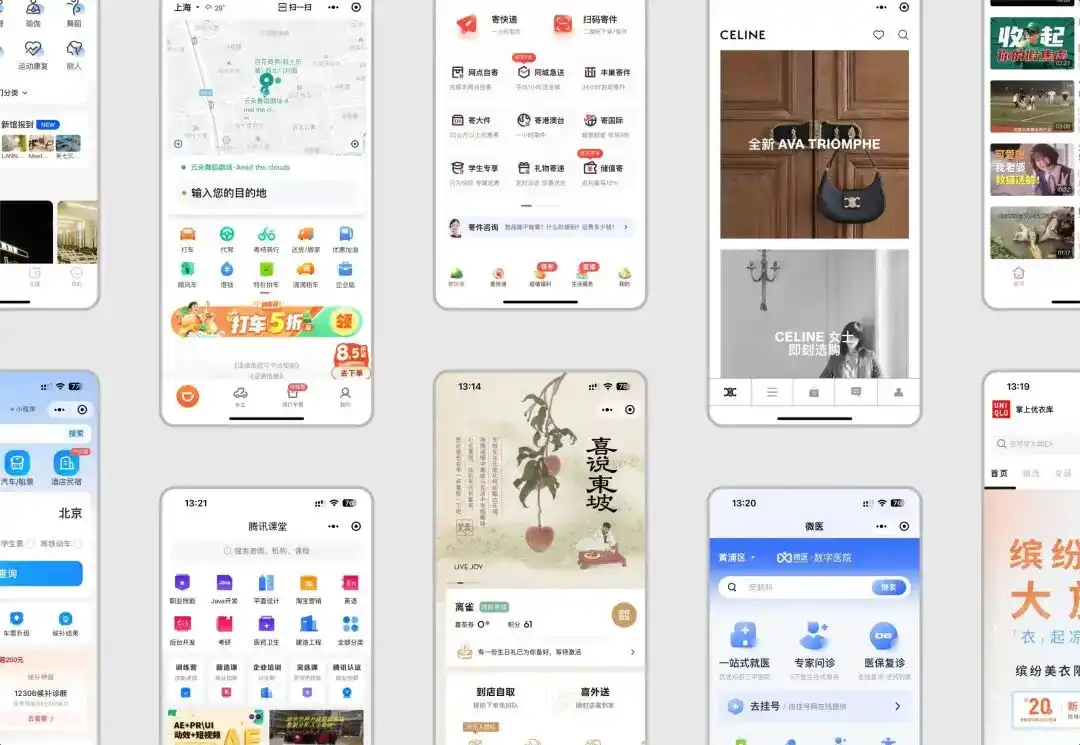
If WeChat AI can indeed smoothly invoke these Mini Programs to complete tasks, then, as the prophecy said, it becomes an operating system operated with natural language.

A user says, "Help me book a high-speed rail ticket from Beijing to Shanghai for tomorrow at 3 pm." The AI deconstructs the intent, invokes the 12306 Mini Program to check tickets, select seats, completes the order via WeChat Pay, all without leaving WeChat. This path can theoretically be executed today.

Of course, there is distance between theory and reality. AI invocation involving payment scenarios requires a near-zero error tolerance—ordering the wrong coffee is a minor issue, but buying the wrong flight ticket is a major one. The accuracy requirements for the underlying model are far higher than for conversational scenarios. This is also a common bottleneck facing AI Agent implementation globally: the gap between "able to chat" and "able to get things done" is not measured by technical metrics but by trust.
But WeChat has at least done one thing right: it didn't build a service network from scratch. Over the years, what ChatGPT has been doing is first having a smart brain, then connecting one by one to Shopify, DoorDash, Stripe, each connection built from the ground up. To this day, transaction-related queries still account for less than 3%.

The real change that is about to happen might be imperceptible to most users. One day, you type into WeChat, "Help me book a ticket to Shanghai for 9 pm tonight," and then it's done. You might not even know which Mini Program was called in the background or what payment process was followed.

This "imperceptible completion" is the true mark of a mature AI Agent. WeChat is closer to this step than anyone else.

This article is from the WeChat Official Account "APPSO", author: APPSO discovering tomorrow's products

Perguntas relacionadas

QWhat is the core change that WeChat announced regarding its AI and Mini Programs?

AWeChat announced that Mini Program developers can now grant permission for its AI to read, operate, and call upon their Mini Programs. This allows AI to directly execute tasks within these programs.

QWhat is the key architectural advantage WeChat has over Apple's iOS in integrating AI with third-party services?

AWeChat has a 'God's-eye view' due to its centralized ecosystem. Every Mini Program's code runs within WeChat's technical framework, from submission to review and execution. This allows WeChat to automatically analyze and translate a program's functions for AI use without requiring developers to write new code for the AI integration.

QWhat industry-standard architecture did WeChat adopt for its AI Skill system, and what does it allow?

AWeChat adopted the MCP (Model Context Protocol) architecture for its AI Skill system. This industry-standard approach allows its AI to understand the functions and parameters of Mini Program interfaces and the overall business workflow, enabling seamless AI-agent interaction.

QAccording to the article, what is the 'final sign of true maturity' for an AI Agent like WeChat's?

AThe final sign of true maturity is 'unconscious completion.' This is when a user makes a request in natural language (e.g., 'Book me a ticket to Shanghai for 9 PM tonight'), and the AI completes the task using the necessary services and payment processes in the background without the user needing to know which specific Mini Program or flow was used.

QWhy does the article suggest WeChat's move might be more significant than Apple's new Siri AI announced at WWDC?

AIt's more significant because Apple's Siri AI is largely limited to coordinating native iOS functions. To integrate with third-party apps, each developer must manually adapt their app using Apple's App Intents framework. In contrast, WeChat's architecture gives it direct, centralized access to millions of third-party Mini Programs, allowing for broader and more immediate AI-powered service automation for its vast user base.

Leituras Relacionadas

7 Key Questions Regarding 'DeepSeek Completes Over 50 Billion Yuan in Financing'

DeepSeek, the prominent Chinese AI company, has reportedly completed its first external funding round, raising over 50 billion RMB (approximately $6.9 billion USD), according to foreign media reports. This financing values the company at over $50 billion USD, a significant increase from a $10 billion valuation when the round began in April 2026. Founder Liang Wenfeng personally contributed 20 billion RMB, with other investors including Tencent, CATL (Contemporary Amperex Technology), JD.com, NetEase, and IDG Capital. Notably, the National Artificial Intelligence Industry Investment Fund also participated with a direct investment of 1 billion RMB. The funding round is distinctive for its structure. Most investors' capital is channeled into a limited partnership controlled by CEO Liang Wenfeng, rather than directly into DeepSeek. These investors face a five-year lock-up period, have no voting rights, but receive priority financial information and future investment rights. This arrangement is seen as a measure to ensure Liang's absolute control over the company's direction, aligning with its stated principles of prioritizing groundbreaking AGI (Artificial General Intelligence) research over short-term profitability. The report highlights strategic reasons for key investors. Tencent's involvement is viewed as a strategic alignment, building on existing collaborations. CATL's investment is linked to the critical energy and power infrastructure needed for AI data centers, a key growth area for the battery giant. The participation of a state-backed fund underscores the national strategic importance of AI development. Post-funding, DeepSeek is expected to accelerate infrastructure development, including building its own data centers, hire more talent, and release new model versions with enhanced capabilities like image and audio support. While this marks a major step, the company's long-term journey towards AGI remains a challenging path that will require balancing its foundational ideals with the expectations of its new investors.

marsbitHá 24m

7 Key Questions Regarding 'DeepSeek Completes Over 50 Billion Yuan in Financing'

marsbitHá 24m

The World Cup is Here: The Battle for Entry into Prediction Markets Has Begun

The 2026 FIFA World Cup has begun, and alongside the on-field competition, a new off-field battleground is emerging: prediction markets. These blockchain-based platforms, which convert crowd wisdom into tradable probabilities, are gaining significant traction. However, their complexity—involving wallets, gas fees, and smart contracts—has historically limited participation to crypto-native users. Centralized exchanges (CEXs), like Gate, are tackling this adoption barrier. By integrating with leading prediction market protocol Polymarket, Gate simplifies the user experience. Users can participate directly with their exchange account and USDT, bypassing complex Web3 steps. Gate offers a streamlined "Prediction Mode" for casual users and a professional "Trading Mode" with advanced tools. Key features include two-way trading (allowing users to buy or sell positions before event resolution), support for diverse markets (sports, crypto, macroeconomics), and a suite of information tools like a "Smart Money" leaderboard, wallet tracking, and AI-powered insights. For the World Cup, Gate launched a dedicated hub aggregating schedules, standings, and relevant markets. This allows fans to seamlessly follow games and trade on outcomes, transforming passive viewing into active participation where they can monetize their predictions and trade on shifting consensus throughout a match. The article argues that prediction markets have proven their value in event forecasting. The next challenge is mass adoption. The competition is shifting from building effective protocols to creating accessible user entry points. By lowering technical barriers and building a complete ecosystem for information and trading, platforms like Gate aim to transition prediction markets from a niche crypto tool to a mainstream platform for expressing and trading on collective intelligence.

Odaily星球日报Há 34m

The World Cup is Here: The Battle for Entry into Prediction Markets Has Begun

Odaily星球日报Há 34m

Spain Held to a Draw by Cape Verde, Jucom Prediction Market Witnesses Historic Upset

In a major upset at the 2026 FIFA World Cup, tournament favorites Spain were held to a surprising 0-0 draw by debutants Cape Verde in their Group H opener on June 16, Beijing time. Despite dominating possession (74%) and recording 27 shots with an expected goals figure of 2.16, Spain failed to break down a resilient Cape Verde defense, with their 40-year-old goalkeeper Vozinha making 7 saves to earn Man of the Match. Pre-match predictions on the Jucom prediction market had heavily favored Spain, assigning them a 92% win probability. The actual result, a goalless draw, triggered significant volatility across related prediction markets. This outcome forces a market-wide reassessment of several key probabilities, including Spain's likelihood of winning the group and the tournament itself, while Cape Verde's previously near-zero chance of advancing is now being re-evaluated. The event highlights both the efficiency and the inherent limitations of prediction markets. While prices aggregate known information, football's low-scoring, high-variance nature means unquantifiable in-game factors can lead to unlikely results. The core value of such markets lies not in perfect foresight but in their ability to dynamically reflect how new information is incorporated into collective expectations. Platforms like Jucom, which track outcomes from single matches to the final champion, provide a real-time lens into how global consensus evolves with each game.

链捕手Há 38m

Spain Held to a Draw by Cape Verde, Jucom Prediction Market Witnesses Historic Upset

链捕手Há 38m

Trading

Spot
Futuros

Artigos em Destaque

Como comprar PEOPLE

Bem-vindo à HTX.com!Tornámos a compra de ConstitutionDAO (PEOPLE) simples e conveniente.Segue o nosso guia passo a passo para iniciar a tua jornada no mundo das criptos.Passo 1: cria a tua conta HTXUtiliza o teu e-mail ou número de telefone para te inscreveres numa conta gratuita na HTX.Desfruta de um processo de inscrição sem complicações e desbloqueia todas as funcionalidades.Obter a minha contaPasso 2: vai para Comprar Cripto e escolhe o teu método de pagamentoCartão de crédito/débito: usa o teu visa ou mastercard para comprar ConstitutionDAO (PEOPLE) instantaneamente.Saldo: usa os fundos da tua conta HTX para transacionar sem problemas.Terceiros: adicionamos métodos de pagamento populares, como Google Pay e Apple Pay, para aumentar a conveniência.P2P: transaciona diretamente com outros utilizadores na HTX.Mercado de balcão (OTC): oferecemos serviços personalizados e taxas de câmbio competitivas para os traders.Passo 3: armazena teu ConstitutionDAO (PEOPLE)Depois de comprar o teu ConstitutionDAO (PEOPLE), armazena-o na tua conta HTX.Alternativamente, podes enviá-lo para outro lugar através de transferência blockchain ou usá-lo para transacionar outras criptomoedas.Passo 4: transaciona ConstitutionDAO (PEOPLE)Transaciona facilmente ConstitutionDAO (PEOPLE) no mercado à vista da HTX.Acede simplesmente à tua conta, seleciona o teu par de trading, executa as tuas transações e monitoriza em tempo real.Oferecemos uma experiência de fácil utilização tanto para principiantes como para traders experientes.

495 Visualizações TotaisPublicado em {updateTime}Atualizado em 2026.06.02

Como comprar PEOPLE

Discussões

Bem-vindo à Comunidade HTX. Aqui, pode manter-se informado sobre os mais recentes desenvolvimentos da plataforma e obter acesso a análises profissionais de mercado. As opiniões dos utilizadores sobre o preço de PEOPLE (PEOPLE) são apresentadas abaixo.

活动图片