HYPE Spot ETF Continuously Accumulates 1% in 14 Days: Is the $75 New High Just the Starting Point?

Odaily星球日报Publicado em 2026-06-03Última atualização em 2026-06-03

Resumo

Hyperliquid (HYPE) has surged to a new all-time high of $75 amid strong institutional and ETF-driven buying pressure. The article highlights several key bullish factors. First, the HYPE spot ETFs from 21Shares and Bitwise have seen 14 consecutive days of net inflows, totaling over $136 million and absorbing nearly 1% of HYPE's market cap—a faster initial pace than BTC or ETH ETFs. This ETF demand provides a solid price floor. Second, the protocol's own Assistance Fund (AF) mechanism, which uses 99% of fees to buy back and burn HYPE, has already removed over $1.1 billion worth of tokens, creating a dual support system alongside ETF inflows. This combined buying power is expected to counter potential selling pressure from upcoming team token unlocks. Institutionally, venture firm a16z is now considered one of the largest external holders of HYPE, with multiple addresses accumulating millions of tokens. Galaxy Digital is also actively buying. Analysts and firms like Bitwise and Grayscale are framing HYPE not as a mere meme coin but as a "second-generation" crypto with real value capture and infrastructure potential. Furthermore, Hyperliquid Strategies (PURR), a publicly traded company holding a large HYPE treasury, is set to join the Russell 3000 Index, potentially unlocking further passive investment flows. The ongoing feud between prominent backers like Arthur Hayes (pro-HYPE) and Kyle Samani (pro-SOL) underscores the intense market debate, with Hayes famously betting HYPE wil...

Original |Odaily Planet Daily(@OdailyChina)

Author|Golem(@web3_golem)
"HYPE should at least surpass SOL before the end of this bull market", BitMEX Co-Founder and the most devoted "H Guard" Arthur Hayes was the first to publicly voice this expectation in late May, having previously stated multiple times that HYPE would rise to $150.

The reason Arthur Hayes "stepped on one to praise another" stemmed from Multicoin Capital former Co-Founder and "S Guard" Kyle Samani first attacking Hyperliquid in the community, after which the "verbal sparring" between the two escalated, ultimately ending with a $100,000 bet. The wager was that HYPE would outperform all top-ten tokens by market cap for the remainder of the year(For details on their feud, read:Solana and Hyperliquid's Most Devoted Guards Got into a Spat).

In recent days, HYPE has continued to rally, reaching a new all-time high of $75. Investors looking to get in are experiencing "fear of heights," with some even beginning to try shorting. This article by Odaily Planet Daily will analyze the changes in HYPE's fundamentals from the perspective of market buying and selling pressure for readers' reference.

The Strongest Altcoin ETF in History Debuts

There are currently two HYPE spot ETFs on the market. On May 12th, 21Shares launched the first Hyperliquid ETF (THYP) on Nasdaq; on May 15th, Bitwise also launched a Hyperliquid ETF (BHYP) on the NYSE.

HYPE Spot ETF Records 14 Consecutive Days of Net Inflows

As of June 2nd, the HYPE spot ETF has achieved net inflows for 14 consecutive days since its launch, with cumulative net inflows exceeding $136 million, absorbing approximately 0.9% of HYPE's total market capitalization. Among them, Bitwise's BHYP had net inflows of $82.96 million, becoming the world's largest HYPE ETF.

The performance of the HYPE spot ETF post-launch clearly indicates the enthusiasm of traditional capital for Hyperliquid. Among the 12 US crypto spot ETFs, ranked by cumulative total net inflows, the HYPE spot ETF has become the 5th largest crypto spot ETF, trailing only BTC, ETH, XRP, and SOL spot ETFs, far surpassing other crypto spot ETFs that launched earlier.

Comparing the performance of BTC and ETH spot ETFs since May further highlights the market's divergence trend; capital for crypto asset ETFs is being reallocated.

BTC spot ETFs have seen net outflows for 12 consecutive days since May 15th, with May outflows exceeding $2.43 billion, breaking the record of 8 consecutive days of net outflows set in early 2025. ETH spot ETFs have seen net outflows for 16 consecutive days since May 11th, with May outflows exceeding $540 million. Meanwhile, the BNB ETF (VBNB) launched by VanEck on Nasdaq on May 28th has even recorded no net inflows for 4 consecutive days.

In this cycle, institutional and traditional capital's demand for exposure to BTC and ETH ETFs has noticeably cooled, while HYPE's attractiveness to them has gradually increased, with the FOMO level even surpassing the initial data from the launch of BTC and ETH spot ETFs.

Within two weeks of launch, the HYPE spot ETF has absorbed nearly 1% of HYPE's market cap. Calculated by market cap proportion, this exceeds the launch performance of BTC and ETH spot ETFs over the same period. According to SoSoValue data, BTC spot ETFs had net inflows of $1.46 billion in the first two weeks, absorbing only about 0.2% of BTC's market cap at the time; ETH spot ETFs even saw net outflows of about $400 million in the first two weeks; while SOL spot ETFs had net inflows of about $380 million in the first two weeks, absorbing only about 0.47% of SOL's market cap at the time.

The continuous inflows into the HYPE spot ETF have formed a solid foundation of support for HYPE's price.

Dual Support for HYPE Buying Pressure, Offsetting Unlock Selling Pressure

Besides ETFs, Hyperliquid's protocol revenue is also a crucial support for HYPE's buying pressure.

As early as the beginning of 2025, Hyperliquid introduced the Assistance Fund (AF) mechanism, stipulating that 97% of protocol transaction fees (perps + spot, etc.) automatically go into the AF system address for continuous HYPE buybacks. The fee ratio was later adjusted to 99%. This mechanism allows HYPE to effectively capture Hyperliquid's protocol value and also serves as a key support for HYPE's price.

Hyperliquid's daily protocol revenue ranges between $1-3 million. Since the AF mechanism's implementation, it has cumulatively bought back over $1.1 billion worth of HYPE. Although the cumulative net inflows of the HYPE spot ETF are not as high as the AF's buybacks, their growth rate is fast. In just half a month, net inflows have caught up to one-tenth of the AF's buyback volume, with the single-day peak net inflow reaching $31.62 million on May 29th.

Now, with the addition of HYPE spot ETFs, HYPE will form dual support, thereby offsetting the selling pressure brought by team token unlocks.

Since January 2026, the official rule for team token unlocks has adopted a monthly one-time unlock method, fixed on the 6th of each month. On June 6th, tokens worth $38.7 million will be unlocked at once, but this may not create significant selling pressure in the market.

Another important characteristic of ETF buying is that the investors behind them may not understand tokenomics or even have directly operated DeFi protocols; they simply want exposure to HYPE. Therefore, ETF investors are also less sensitive to token unlocks. As long as the project's fundamentals don't change drastically, token unlocks will not suppress buying power.

Simultaneously, more HYPE spot ETFs will be launched in the future. On June 2nd, Grayscale submitted a revised S-1 filing for a Hyperliquid Staking ETF, providing approximately 2 million HYPE as seed capital investment. The Hyperliquid ETF code is Grayscale Hyperliquid Staking ETF (HYPG), and it is set to officially begin trading on June 4th.

HYPE will welcome deeper liquidity, stronger institutional participation, and continuously generated incremental buying pressure.

Are Institutions More FOMO Than Retail?

Institutions' FOMO towards HYPE is no less than that of retail investors. They publicly express bullish views on HYPE while using real money to fuel HYPE's rise.

a16z May Have Become the Largest External HYPE Holding Institution

Starting in August 2025, a16z began its large-scale accumulation mode for HYPE. According to monitoring by crypto analyst Ai Yi @ai_9684xtpa, a16z may have become the sixth-largest holding entity on the HYPE chain and the largest external holding entity. The top 5 addresses on the HYPE chain belong to Hyperliquid's own ecosystem projects (the fifth being the Kinetiq staking protocol), while the sixth address is under a16z's control. This address holds 3.095 million HYPE, worth over $223 million.
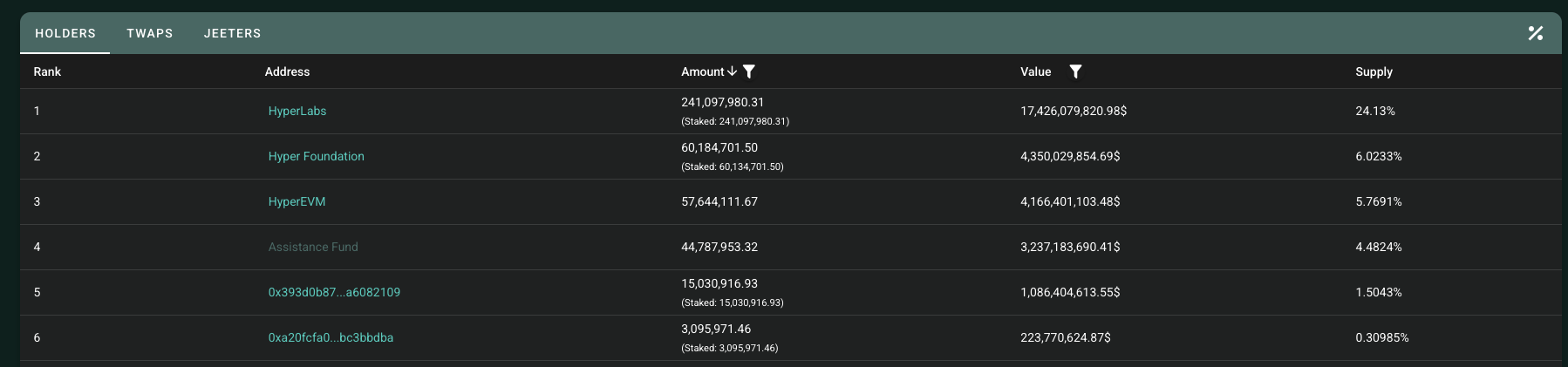
However, this is not a16z's only HYPE holding address. On-chain data shows a16z has also been continuously buying and accumulating HYPE through multiple associated addresses.

On May 28th, crypto analyst Ai Yi @ai_9684xtpa monitored that the 0x4c6... address associated with a16z withdrew a cumulative 253,947.43 HYPE from multiple exchanges and market maker addresses, with an average withdrawal price of approximately $59.2. On May 30th, Lookonchain monitored that another a16z-associated address, 0xb5E..., bought another 226,121 HYPE. Since April 14th, this address has cumulatively bought 3.9 million HYPE with an average purchase price of approximately $49.4.

Besides a16z, Galaxy Digital is also accumulating HYPE. On June 3rd, according to Lookonchain monitoring, Galaxy Digital withdrew 179,000 HYPE from Coinbase, worth approximately $12.62 million. On May 21st, another associated wallet also bought 158,100 HYPE, worth approximately $8.8 million.

Institutions have long stopped viewing HYPE as an ordinary meme/shitcoin. Bitwise Chief Investment Officer Matt Hougan stated that HYPE is not just another altcoin, but a "second generation" cryptocurrency because it possesses real value capture, buybacks, and institutional demand.

Simultaneously, institutions have elevated Hyperliquid's positioning from a Perp DEX to a blockchain financial infrastructure platform. Grayscale's mid-year report stated that Hyperliquid might even challenge traditional derivatives trading and exchange systems in the future and grow into a "financial services giant."

HYPE DAT Company Selected for Russell 3000 Index

While the DAT concept in US stocks cooled down and the sector leader Strategy also began selling coins, DAT companies betting on HYPE continued to float in profits as HYPE's price rose. (Related reading:DAT Failed? Public Company Betting on HYPE Sees $1.25 Billion Floating Profit)

The most notable among them is Hyperliquid Strategies (NASDAQ:PURR). According to official website data, it currently holds 22.3 million HYPE, with a holding value of $1.617 billion. Hyperliquid Strategies' financial report released in early May also disclosed that as of Q1 2026, they invested $10.5 million to repurchase approximately 3 million shares of stock, with an average cost of $3.42 per share.

On May 22nd, FTSE Russell announced the preliminary list for the June 2026 Russell 3000 Index reconstitution. PURR appeared on the addition list for the Russell 3000 Index and is expected to take effect on June 26th.
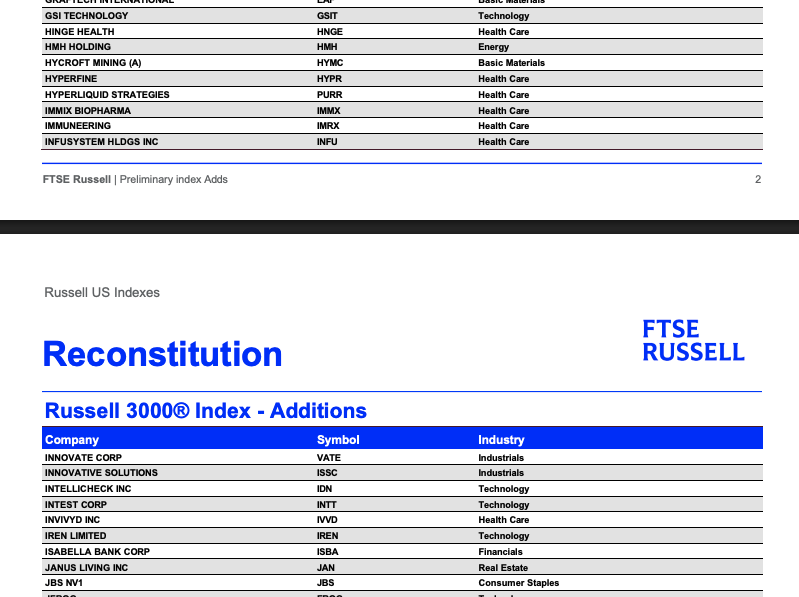
PURR appears on the addition list for the Russell 3000 Index

The Russell 3000 Index is also one of the broadest US stock market indices, covering approximately the 3000 largest publicly listed companies in the US, essentially encompassing the entire US stock market. It undergoes a major adjustment every June. Currently, a large number of index funds, pension funds, and ETFs track this index. FTSE Russell discloses that approximately $10.6 trillion in assets use Russell US indices as a benchmark.

If PURR is indeed included in the Russell 3000 Index, it will not only receive passive allocation from funds but also gain significantly higher visibility. To help investors obtain more HYPE exposure, they might also emulate Strategy's "financing to buy coins" model in the future, thereby becoming another solid source of buying pressure for HYPE.


Perguntas relacionadas

QAccording to the article, what is the unique performance of HYPE spot ETFs in terms of continuous net inflows, and how does this compare to the initial performance of BTC and ETH spot ETFs?

AAccording to the article, HYPE spot ETFs have achieved continuous net inflows for 14 consecutive days since their launch, accumulating over $136 million. This absorbed approximately 0.9% of HYPE's total market capitalization at the time. In contrast, BTC spot ETFs absorbed only about 0.2% of BTC's market cap in their first two weeks, and ETH spot ETFs even experienced net outflows of around $400 million in their first two weeks.

QWhat two major sources form the dual support for HYPE's buying pressure, as mentioned in the article, to offset the selling pressure from token unlocks?

AThe two major sources forming the dual support for HYPE's buying pressure are: 1) HYPE spot ETF inflows from traditional finance, and 2) The protocol's Assistance Fund (AF) mechanism, which automatically uses 99% of Hyperliquid's protocol transaction fees to buy back and burn HYPE tokens.

QWhich venture capital firm is identified in the article as potentially the largest external institutional holder of HYPE, and what evidence is provided for their accumulation?

AThe article identifies a16z (Andreessen Horowitz) as potentially the largest external institutional holder of HYPE. Evidence includes a specific a16z-linked address holding 3.095 million HYPE (worth over $223 million), making it the sixth-largest on-chain holder, and mentions of other associated addresses continuously buying HYPE from exchanges and market makers in large quantities.

QWhat significant US stock market index is the HYPE-focused DAT company 'Hyperliquid Strategies (PURR)' expected to be added to, and what is the potential implication of this inclusion?

AHyperliquid Strategies (PURR) is expected to be added to the Russell 3000 Index, with the inclusion expected to take effect on June 26, 2026. The implication is that it could lead to passive buying from index-tracking funds and ETFs (which benchmark against this index), increase the company's visibility, and potentially provide another source of buying pressure for HYPE if the company seeks more exposure to the token.

QWhat bet did Arthur Hayes and Kyle Samani make regarding HYPE's performance, and what was the catalyst for their disagreement?

AArthur Hayes and Kyle Samani made a $100,000 bet on whether HYPE would outperform all tokens in the top 10 by market capitalization for the remainder of the year. The catalyst for their disagreement was Kyle Samani (a strong Solana supporter) initially criticizing the Hyperliquid project in the community, which led to a public argument between the two, with Hayes being a prominent supporter of HYPE.

Leituras Relacionadas

Behind SpaceX's $2 Trillion Market Cap: Why Does Musk Always Have the Next Move Planned?

On June 12th, SpaceX debuted on the Nasdaq, reaching a valuation that briefly touched $2 trillion. This marked the culmination of a 24-year journey from its founding in 2002, driven by Elon Musk's frustration at the high cost of buying rockets. The company's path was defined by early failures, with its first three Falcon 1 launches ending in explosions before a successful 2008 flight opened the era of commercial spaceflight. Key to its model was a fixed-price NASA contract, incentivizing cost reduction. SpaceX mastered rocket reusability, first achieving a Falcon 9 landing in 2015, which drastically cut launch costs. This enabled its profitable Starlink satellite internet constellation, envisioned years before reusability was proven, to create an internal market for frequent launches. Similarly, the next-generation Starship rocket was in development long before its first flight, with its business case evolving from Mars colonization to supporting the emerging concept of in-orbit data centers for AI—a story now central to its valuation. The company's recent IPO, a reversal of its long-standing "no IPO" stance, is funding this ambitious "space-based compute" vision. While major tech players like Google, Blue Origin, and others are investing heavily, significant technical and cost hurdles remain. Ultimately, SpaceX's history is one of creating its own demand: first with Starlink and now with space-based AI compute, betting that its next rocket will enable its next giant market.

marsbitHá 2m

Behind SpaceX's $2 Trillion Market Cap: Why Does Musk Always Have the Next Move Planned?

marsbitHá 2m

When Crypto Meets the World Cup: CoinW and Modrić's Art of "Navigating Cycles"

When Encryption Meets the World Cup: CoinW and Modrić's "Transcending Cycles" Philosophy In the context of the 2026 FIFA World Cup and its massive global audience, the crypto exchange CoinW announced football legend Luka Modrić as its global brand ambassador. This move is framed not merely as a marketing tactic, but as a strategic experiment in user profile migration. It targets mature, financially stable football fans—particularly in Europe, Southeast Asia, and Latin America—who traditionally have low crypto awareness but value trusted, time-tested authority figures like Modrić. The article draws parallels between Modrić's enduring, disciplined career—marked by consistency and success at the highest level over two decades—and CoinW's own development path. Founded in 2017 during a volatile industry period, CoinW focused on building robust infrastructure and risk management. It weathered the 2022 industry crisis without major security incidents, subsequently earning recognition like "Europe's Most Trusted Exchange" and growing to over 20 million registered users. This "long-termism" is translated into user-centric products. CoinW Academy lowers the initial knowledge barrier. Its integrated ecosystem (CoinW, GemW, DeriW, PropW) and the recent launch of a TradFi section—offering perpetual contracts on traditional assets like stocks, gold, and oil—aim to create a unified platform for diverse assets. For the World Cup, CoinW launched the "We Are The Game" campaign, collaborating with Alchemy Pay to offer zero-fee deposits and local payment options, aiming to transform spectators into participants and lower entry barriers. Ultimately, CoinW's sports partnerships and product strategy are presented as a concerted effort to build trust and accessibility for the "silent majority" still outside crypto—shifting the industry narrative toward inclusivity and long-term value.

Foresight NewsHá 8m

When Crypto Meets the World Cup: CoinW and Modrić's Art of "Navigating Cycles"

Foresight NewsHá 8m

A Panoramic View of the Solana Privacy Ecosystem: The Complete Privacy Stack from Computation to AI

**Solana Privacy Ecosystem: A Comprehensive Overview from Computation to AI** Solana's privacy ecosystem, while nascent, is rapidly evolving to address key challenges across multiple layers. Key figures like Helius CEO Mert acknowledge that Solana has lagged in privacy but highlight its unique potential for scalable, composable privacy protocols, potentially leveraging technologies like ZK compression without persistent rollups. The foundational layer is **Private Compute**, addressed by providers like Arcium and Magic Block. Arcium utilizes Multi-Party Computation (MPC) networks to process encrypted data off-chain with final settlement on Solana, supporting use cases like confidential payments (via its C-SPL token standard) and encrypted data analysis. Magic Block employs Trusted Execution Environments (TEEs) to create private, ephemeral rollups, offering confidentiality, scalability, and composability. Both enable private order books, dark pools, and DeFi rails. Building on this infrastructure are applications for **Private Transfers and Balances**. Umbra, built on Arcium, offers encrypted token accounts with amount, balance, and sender-receiver linkage privacy, plus compliance features. Privacy Cash uses Tornado-style shielded pools for SOL, while Hush provides private staking and trading with integrated swaps via Jupiter. To eliminate **On-Chain Trails** from everyday activities like trading, protocols like encifherio and VanishTrade are emerging. encifherio privately routes swaps through Jupiter by encrypting transaction details within TEEs. VanishTrade routes trades through shielded liquidity pools. Darklake offers a ZK-native "blind slippage" AMM and private perpetuals to hide trading intent and prevent front-running. More advanced applications include **Private Prediction Markets**. Platforms like Melee Markets use Arcium's MPC to encrypt order books, allowing participants to place hidden bets without revealing their market position until settlement. Finally, the ecosystem is expanding into **Private AI**. Loyal leverages both Magic Block and Arcium to create a decentralized protocol where user-AI interactions, queries, and preferences are encrypted on-chain, giving users ownership and control over their data while enabling private transactions and yield generation. In summary, Solana's privacy stack is developing from core compute and transfer privacy towards sophisticated applications in DeFi, prediction markets, and AI, aiming for a future where Fully Homomorphic Encryption (FHE) and Zero-Knowledge (ZK) proofs combine for a complete privacy solution.

marsbitHá 10m

A Panoramic View of the Solana Privacy Ecosystem: The Complete Privacy Stack from Computation to AI

marsbitHá 10m

Spain's Stunning Upset: A Sharp Review of World Cup Betting Methods from 'Solid' to 'Meh'

"Spain Stunned: A Critical Review of World Cup Betting Methods from 'Awesome' to 'Trash'" The 2026 World Cup has already delivered its first major upset, as tournament favorite Spain was held to a goalless draw by Cape Verde. This shock result highlights the unpredictable nature of sports and the risks involved in betting on favorites. The article critically compares four major channels for World Cup predictions across five key dimensions: market clarity, transaction transparency, variety of bets, user access/compliance, and promotional incentives. Traditional online sportsbooks and China's official sports lottery offer familiar but opaque systems using complex odds. While they provide a vast array of betting options, their market mechanics and liquidity are not transparent to users. In contrast, new crypto prediction markets like Polymarket, Kalshi, Opinion, and Predict.fun present a clearer model. They translate probability directly into a tradable price (e.g., a 16¢ price equals a perceived 16% chance to win), making market sentiment easily visible. These platforms offer full transparency into order books and trading activity. User access varies significantly. China's sports lottery is fully compliant but primarily offline. Crypto markets require digital wallets and carry regulatory uncertainties. Kalshi is US-regulated but geographically restricted. Traditional offshore books pose the highest compliance and fund security risks. For engagement, Predict.fun leads with a $2 million incentive campaign and gamified features on BNB Chain. Traditional books also ramp up promotions during the World Cup, while other platforms focus more on core market functionality. In summary, the landscape is diversifying. Traditional platforms offer betting as entertainment, while emerging prediction markets frame the World Cup as a transparent, real-time information market. The core appeal remains the same: the human desire to price the future and validate one's predictions.

marsbitHá 15m

Spain's Stunning Upset: A Sharp Review of World Cup Betting Methods from 'Solid' to 'Meh'

marsbitHá 15m

Trading

Spot
Futuros

Artigos em Destaque

Como comprar HYPE

Bem-vindo à HTX.com!Tornámos a compra de Hyperliquid (HYPE) simples e conveniente.Segue o nosso guia passo a passo para iniciar a tua jornada no mundo das criptos.Passo 1: cria a tua conta HTXUtiliza o teu e-mail ou número de telefone para te inscreveres numa conta gratuita na HTX.Desfruta de um processo de inscrição sem complicações e desbloqueia todas as funcionalidades.Obter a minha contaPasso 2: vai para Comprar Cripto e escolhe o teu método de pagamentoCartão de crédito/débito: usa o teu visa ou mastercard para comprar Hyperliquid (HYPE) instantaneamente.Saldo: usa os fundos da tua conta HTX para transacionar sem problemas.Terceiros: adicionamos métodos de pagamento populares, como Google Pay e Apple Pay, para aumentar a conveniência.P2P: transaciona diretamente com outros utilizadores na HTX.Mercado de balcão (OTC): oferecemos serviços personalizados e taxas de câmbio competitivas para os traders.Passo 3: armazena teu Hyperliquid (HYPE)Depois de comprar o teu Hyperliquid (HYPE), armazena-o na tua conta HTX.Alternativamente, podes enviá-lo para outro lugar através de transferência blockchain ou usá-lo para transacionar outras criptomoedas.Passo 4: transaciona Hyperliquid (HYPE)Transaciona facilmente Hyperliquid (HYPE) no mercado à vista da HTX.Acede simplesmente à tua conta, seleciona o teu par de trading, executa as tuas transações e monitoriza em tempo real.Oferecemos uma experiência de fácil utilização tanto para principiantes como para traders experientes.

302 Visualizações TotaisPublicado em {updateTime}Atualizado em 2026.06.02

Como comprar HYPE

Discussões

Bem-vindo à Comunidade HTX. Aqui, pode manter-se informado sobre os mais recentes desenvolvimentos da plataforma e obter acesso a análises profissionais de mercado. As opiniões dos utilizadores sobre o preço de HYPE (HYPE) são apresentadas abaixo.

活动图片